
Type & Discipline
Disenfranchised grief is a construct, not a treatment modality. 1 It names grief that is not openly acknowledged, socially validated, or publicly mourned, because the relationship, the loss, or the griever falls outside what a community recognizes as a legitimate occasion for mourning. 2 The idea originated in thanatology and social work and has since been absorbed into bereavement counseling, hospice and palliative care, and general clinical practice. 4 Because it is a sociological lens rather than a protocol, clinicians do not “treat disenfranchised grief”; they recognize when a client’s mourning is being socially suppressed and adjust the work accordingly. LLM The construct’s clinical value lies in naming an invisible barrier: a person may be grieving fully but receiving none of the rituals, condolences, or permission that ordinarily scaffold mourning. LLM
Creators & Lineage
The concept was introduced by Kenneth J. Doka, who published the foundational volume Disenfranchised Grief: Recognizing Hidden Sorrow in 1989. 4 Doka, a grief scholar and longtime Senior Vice President of Grief Programs at the Hospice Foundation of America, named and theorized a phenomenon that clinicians had observed but not systematized. 5 He expanded the framework in the 2002 edited collection Disenfranchised Grief: New Directions, Challenges, and Strategies for Practice, which gathered contributors to examine the psychological, biological, and sociological dimensions of socially unsupported loss across populations including adolescents, caregivers, people with developmental disabilities, suicide survivors, and the human-animal bond. 2
The construct draws conceptually on the sociology of mourning and the notion that every society maintains norms governing who may grieve, for whom, and how. 3 Doka built on the recognition that grief is not merely an individual emotional process but a socially regulated one, scaffolded by ritual, acknowledgment, and the conferral of a “griever” role. 3 Disenfranchised grief sits within the broader family of grief and bereavement theory, alongside models of complicated and prolonged grief, and it has become a standard reference point in the Encyclopedia of Death and the Human Experience. 3 More than three decades after the original book, the framework remains actively applied and extended in contemporary bereavement scholarship and practice. 5
Core Principles
The central principle is that societies operate with implicit grieving rules — norms that specify which losses warrant mourning, which relationships count, and how grief may legitimately be expressed. 3 When a loss falls outside these rules, the bereaved person is denied the social role of griever: there is no acknowledgment, no public mourning, and no support. 3 Doka described disenfranchisement as arising whenever a society “does not recognize a person’s right, role, or capacity to grieve.” 3
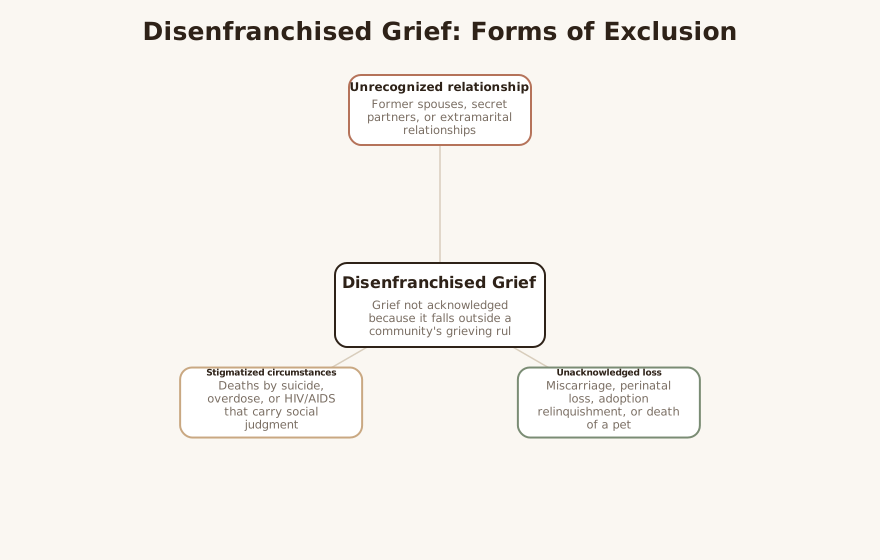
A second principle is that the grief itself is real and often intense; what is missing is the social sanction. 2 The bereaved person experiences genuine loss but must do so privately, frequently in silence and isolation. 4 Doka organized the phenomenon into recognizable categories. 4 The relationship may be unrecognized, as with former spouses, secret partners, or extramarital relationships. 4 The loss may be unacknowledged, as with miscarriage, perinatal loss, relinquishing a child to adoption, or the death of a pet. 4 The circumstances of the death may be stigmatized, as with suicide, drug overdose, or deaths from HIV/AIDS, which carry social judgment that attaches to survivors. 4 In other cases society implies the bereaved should feel relief or gratitude rather than grief, as when the deceased was very elderly or had suffered a long illness. 4
A third principle is that disenfranchisement compounds harm. LLM Because the griever receives none of the ordinary supports, they are at elevated risk for prolonged sorrow, diminished self-esteem, and difficulty integrating future losses, and the grief can spill into physical illness, substance use, and isolation. 4 In effect, the social silence around the loss becomes a second injury layered on the first. LLM
Interventions & Techniques
Because disenfranchised grief is a construct, the relevant “interventions” are clinical postures and bereavement techniques applied with attention to the missing social sanction. LLM The first and most consequential act is recognition: naming the loss as a genuine bereavement and explicitly conferring on the client the right to grieve that society has withheld. 3 Validation of the authenticity of the client’s feelings is itself therapeutic, because the wound is partly one of having one’s grief denied. 4
A second technique is the construction of mourning where ritual is absent. LLM When a loss carries no funeral, no obituary, and no condolence, the clinician can help the client create personal rituals, commemorations, or symbolic acts that perform the function ordinary mourning rites would otherwise provide. LLM Psychoeducation about grieving rules can help clients understand that the absence of support reflects social norms, not the illegitimacy of their loss. 3
A third technique is connecting clients with others who share comparable, similarly unrecognized losses, which restores a community of acknowledgment. 4 Bereavement support groups organized around a specific disenfranchised loss — perinatal loss, suicide loss, the death of an estranged family member — can supply the witnessing that the wider community withholds. 4 Clinicians can also coach clients to assert their grief, speaking up when others minimize or dismiss it. 4
LLM-generated illustrative example (not a guideline): A client whose former spouse has died may feel acute grief yet receive no condolences, because friends assume the divorce ended the bond; the clinician names the loss as legitimate, helps the client mark it with a private commemoration, and rehearses how to respond when others imply he “shouldn’t” be grieving. LLM
Evidence Base
The maturity of disenfranchised grief as a clinical concept is best described as established rather than experimentally validated. LLM It has been a standard, widely cited framework in thanatology and bereavement practice for more than thirty-five years, it anchors entries in major reference works, and it is routinely taught to grief counselors and hospice staff. 5 Its conceptual durability and continued extension to new populations attest to its usefulness as an organizing lens. 5
Honesty requires distinguishing conceptual establishment from outcome evidence. LLM Disenfranchised grief is a descriptive and explanatory framework, not an intervention with randomized trials behind it; there is no manualized “treatment for disenfranchised grief” whose efficacy has been tested against a control condition. LLM What the literature offers is a robust typology and clinical wisdom about recognition, validation, and ritual, rather than effect sizes. 2 The construct’s boundaries are also somewhat fluid: whether a given loss is disenfranchised depends on the surrounding culture and era, so the same loss may be openly mourned in one community and silenced in another. 3 Clinicians should therefore use it as a sensitizing lens — a way of seeing what is being socially suppressed — rather than as a diagnosis or a protocol with established efficacy data. LLM
Populations & Indications
Disenfranchised grief is relevant across many populations, and contemporary practice has extended Doka’s framework deliberately. 5 The Hospice Foundation of America’s continuing work highlights its application to the LGBTQ+ community, where members may face death-grief alongside non-death traumas and life-transition losses that go unrecognized, and to adult siblings, whose bereavement is frequently minimized relative to that of spouses, parents, or children. 5 Other commonly affected groups include people grieving a miscarriage or perinatal loss, those who relinquished a child for adoption, former and secret partners, survivors of a death by suicide or overdose, caregivers, and people grieving the loss of a companion animal. 4
A distinct and clinically important indication is the grief that accompanies losses that are not deaths at all. LLM Doka’s framework explicitly encompasses non-death losses, and clinicians frequently encounter disenfranchised grief in caregivers of people with dementia who mourn a living person who is psychologically gone, in the context of infertility, and in major life transitions where the loss is real but unnamed. 2 The indication to apply the lens is less a diagnosis than a clinical signal: a client is grieving but reports that no one around them treats the loss as worthy of mourning. LLM
Problems-for-Work
The construct is applied alongside treatment for the underlying clinical problems that unsupported grief tends to produce. LLM Relevant problems-for-work include complicated or prolonged grief, depression, anxiety, social isolation, shame, low self-esteem, identity disruption, and substance use that develops as a way to manage unwitnessed pain. 4
For a client with social isolation following a stigmatized loss such as a partner’s overdose death, the clinician names the disenfranchisement, validates the grief, and connects the client to a loss-specific support group so that mourning can occur in the presence of witnesses. 4 For a caregiver experiencing anticipatory grief and identity disruption as a spouse with dementia declines, the clinician legitimizes the mourning of a living person and helps the client hold both ongoing caregiving and active grief. 2 For a client carrying shame after a miscarriage that others dismissed as “not a real loss,” the work centers on countering the internalized grieving rule and constructing a private ritual of acknowledgment. 4
Contraindications, Cautions & Cultural Humility
The construct itself is not contraindicated, but several cautions apply to its use. LLM The clinician should avoid the opposite error of over-pathologizing: not every quiet or private grief is “disenfranchised” in a way that requires intervention, and labeling a client’s experience prematurely can impose a narrative the client does not hold. LLM Because disenfranchised grief overlaps with prolonged and complicated grief, the clinician must assess whether a client’s distress reflects the absence of social support, a more entrenched grief disorder, or co-occurring depression, and treat accordingly rather than assuming recognition alone will suffice. LLM
Cultural humility is central, because grieving rules are themselves cultural artifacts. 3 What counts as a legitimate loss, who is entitled to mourn, and how grief may be expressed vary profoundly across communities, religions, and eras, so a loss that is disenfranchised in one cultural setting may be openly honored in another. 3 The clinician’s task is to understand the specific norms operating in the client’s own world rather than importing an external template of what “should” be mourned. LLM Particular care is warranted with populations whose losses are systematically disenfranchised by stigma — including LGBTQ+ clients and those bereaved by suicide, overdose, or HIV/AIDS — where the disenfranchisement is reinforced by social marginalization the clinician should not unwittingly reproduce. 5
Treatment-Plan Suggestions & SMART Objectives
| Goal | SMART objective (example) | Mechanism |
|---|---|---|
| Establish recognition of the loss | Within 2 sessions, client will name the loss aloud and identify it as a legitimate bereavement | Clinician confers the griever role society withheld |
| Reduce shame about grieving | Over 6 weeks, client will verbalize on 3 occasions that the grief is valid despite others’ dismissal | Validation of authentic feelings; countering internalized grieving rules |
| Create mourning where ritual is absent | Within 4 sessions, client will design and complete 1 personal commemoration of the loss | Constructed ritual replacing absent public mourning |
| Restore a community of acknowledgment | Within 8 weeks, client will attend 3 sessions of a loss-specific support group | Witnessing by others with comparable disenfranchised losses |
| Build assertion of grief | Over 6 sessions, client will rehearse and use 2 responses when others minimize the loss | Coached self-advocacy when grief is disenfranchised |
| Address co-occurring depressive symptoms | Within 10 sessions, client’s depression screen score will decrease by a clinically meaningful margin | Concurrent treatment of secondary depression |
| Reduce maladaptive coping | Over 8 weeks, client will substitute 2 grief-processing strategies for substance use on tracked occasions | Replacing avoidance with supported mourning |
Common Misconceptions
The most common misconception is that disenfranchised grief means the grief is somehow lesser or less intense; in fact the grief is fully real and often heightened precisely because it lacks social support. 2 A second misconception is that the framework applies only to deaths, when it explicitly covers non-death losses such as the living loss of a person with dementia, infertility, and major life transitions. 2 A third is that disenfranchisement is a property of the individual griever, when it is a social phenomenon arising from community grieving rules and stigma. 3 A fourth is that simply acknowledging the loss resolves it; recognition is necessary and powerful but does not by itself treat co-occurring depression, prolonged grief, or substance use. LLM A fifth is that disenfranchised grief is a diagnosis, when it is a sensitizing construct used to understand why a client’s mourning is unsupported rather than a discrete disorder. LLM
Training & Certification
There is no licensure or required credential to apply the disenfranchised grief framework, because it is a construct rather than a regulated modality. LLM Clinicians typically encounter it within broader bereavement and thanatology training, and Doka’s books — the 1989 Recognizing Hidden Sorrow and the 2002 New Directions, Challenges, and Strategies for Practice — serve as the foundational references for practitioners seeking to apply it. 2 The Hospice Foundation of America offers continuing education on the history and contemporary applications of the concept, including its extension to specific populations, for grief professionals and clinicians. 5 Accessible talks by Doka himself provide an entry point for clinicians new to the framework. 6 In practice, competence comes from integrating the lens into general grief work rather than from a standalone certificate. LLM
Key Terms
Disenfranchised grief: grief that is not openly acknowledged, socially validated, or publicly mourned. 2
Grieving rules: the social norms that govern which losses warrant mourning, who may grieve, and how grief may be expressed. 3
Griever role: the socially conferred status that ordinarily entitles a bereaved person to acknowledgment, ritual, and support. 3
Unrecognized relationship: a bond society does not count as warranting grief, such as a former spouse, secret partner, or extramarital relationship. 4
Unacknowledged loss: a loss society treats as not a “real” bereavement, such as miscarriage, adoption relinquishment, or the death of a pet. 4
Stigmatized death: a death whose circumstances — suicide, overdose, HIV/AIDS — attract social judgment that disenfranchises survivors. 4
Non-death loss: a real loss that is not a death, such as the living loss in dementia, infertility, or a major life transition, which the framework explicitly includes. 2
Resources & Further Reading
▶ Watch — a video introduction to this concept:
- Disenfranchised grief — APA Dictionary of Psychology
- Disenfranchised Grief: New Directions, Challenges, and Strategies for Practice — Kenneth J. Doka (Google Books)
- Disenfranchised Grief — Encyclopedia of Death and the Human Experience (Sage)
- Disenfranchised grief — EBSCO Research Starters
- Disenfranchised Grief: History and Contemporary Applications — Hospice Foundation of America
- Disenfranchised Grief: Dr. Ken Doka (YouTube)
Reflective / Supervision Questions
- When a client’s grief seems disproportionate or “stuck,” am I considering that the problem may be the absence of social acknowledgment rather than something pathological in the client? LLM
- Whose grieving rules are operating in the room — the client’s, the client’s community’s, or my own — and how might my assumptions about which losses “count” disenfranchise the person in front of me? LLM
- For losses I find easy to dismiss (a pet, a former spouse, a very early pregnancy), how do I notice and set aside my own minimizing reflex? LLM
- Am I distinguishing disenfranchised grief from prolonged grief and depression, and treating co-occurring conditions rather than assuming recognition alone is sufficient? LLM
- How do I help a client construct mourning when their community offers no ritual, and whose meaning system is guiding what that ritual looks like? LLM