
Type & Discipline
Ritualization is a theory, not a treatment modality. It originates in religious studies and cultural anthropology rather than in clinical psychology 4. Its author, Catherine Bell, was a scholar of Chinese religions and ritual studies who worked across anthropology, sociology, and the history of religions 3 4. The concept belongs to the family of practice theory — an approach that analyzes culture through what people actually do rather than through abstract belief systems 3.
For the practicing therapist, this matters in two ways. First, it means ritualization carries no clinical evidence base of its own, no manual, and no outcome trials; it is a conceptual lens, not an intervention package LLM. Second, it offers something many narrowly psychological frameworks lack: a rigorous account of how repeated, embodied, set-apart action constructs meaning, identity, and a sense of order — phenomena that surface constantly in clinical work but are rarely theorized well LLM. Used carefully, it sharpens how a clinician notices and works with the rituals clients already bring into the room LLM.
Creators & Lineage
Catherine Bell (1953–2008) earned her MA and PhD from the University of Chicago Divinity School and taught at Santa Clara University, where she chaired the religious studies department before retiring due to multiple sclerosis 4. Her two foundational books define the concept. Ritual Theory, Ritual Practice (1992) won the American Academy of Religion’s award for best first book in the history of religions and was credited with changing the framework for understanding ritual 4. Ritual: Perspectives and Dimensions (1997, revised 2009) followed as a more holistic, pragmatic survey of the field 2 4.
The intellectual lineage runs primarily through Pierre Bourdieu’s practice theory. Bell adapted Bourdieu’s insight that social actors are “disposed agents” who unconsciously embody structured social schemes while believing they act freely 4. She joined this to a phenomenological emphasis on the body and to the symbolic anthropology tradition, while pointedly breaking from earlier theorists who treated ritual as a fixed, universal category separable from ordinary life 3. The result is a theory that sits at the intersection of practice theory, embodiment, and symbolic anthropology 4.
Core Principles
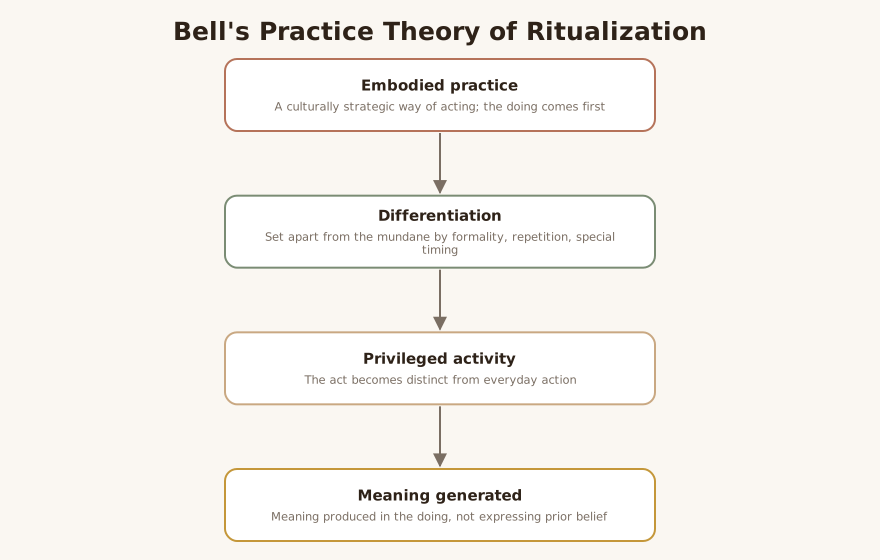
The central move is a shift from the noun ritual to the verb-like process ritualization. Bell defined ritualization as “a culturally strategic way of acting” 3. Rituals, on this account, are not special, paradigmatic acts that stand outside normal behavior; they are activities that get set apart and privileged relative to everyday action through how they are performed 3 1.
Several principles follow LLM:
- Ritual is not the expression of pre-existing belief. Bell rejected the older view that ritual merely dramatizes ideas people already hold. Instead, ritualization strategically constructs meaning and relationships through embodied practice 4. The doing comes first; the meaning is generated and reinforced in the doing 4.
- The thought–action divide is bridged in practice. Bell argued that treating ritual as “acted-out belief” reproduces a false split between thinking and doing; ritualization is itself a practical strategy, not a symbolic translation of something mental 3.
- Differentiation is the mechanism. What makes an act ritualized is contrast — it is distinguished from the mundane through formality, repetition, special timing, place, or bodily comportment 1 3.
- The ritualized body internalizes social structure. Through ritualized action the body becomes a “social body” linking individual to community; the body is not a mechanical instrument executing a script but the site where structure is absorbed and reproduced 4.
- Ritualization operates through power. It constructs relationships of domination, consent, and resistance. Bell argued that ritualization does not merely disguise power — it is itself a primary means through which power operates and is negotiated 4.
A related Bourdieu-derived idea is the “intrinsic blindness of practice”: participants are largely unaware of how ritualization actually transforms their social world, which is part of what gives it force 4.
Interventions & Techniques
Bell’s framework supplies no techniques in the clinical sense — there is no protocol in her work LLM. What it offers is a set of analytic questions and a stance the clinician can adopt when ritual-like phenomena appear in treatment LLM. Translated into practice, the lens prompts the therapist to attend to:
- Differentiation: How does the client set certain acts apart from ordinary life? Lighting a candle, a bedtime sequence, a recovery chip, a graveside visit — what marks these as privileged? 1 LLM
- Embodiment: What is the body doing, and what does that doing produce? The lens treats posture, repetition, and gesture as generative, not decorative 4 LLM.
- Strategy and function: What is the ritualization accomplishing — soothing, boundary-setting, identity-claiming, transition-marking — rather than merely what it “symbolizes” 3 LLM.
- Power and agency: Whose authority does the ritual encode, and does the client experience themselves as author or as subject of it? 4 LLM
In Ritual: Perspectives and Dimensions, Bell catalogued recurring genres of ritual action — rites of passage, calendrical rites, rites of exchange and communion, and rites of affliction among them 5 2. A clinician can use these genres as a quick taxonomy for the client’s existing or potential rituals LLM.
LLM-generated illustrative example (not a guideline): A client mourning a parent reports they “can’t move on.” Rather than treating mourning purely as a cognitive process, the therapist notices the absence of any set-apart, embodied act marking the loss. Collaboratively, they design a small graveside or anniversary practice — a rite of passage in Bell’s taxonomy — that differentiates the moment from ordinary time and gives the body something to do. The ritualization does not symbolize grief already resolved; it participates in producing the transition LLM.
Evidence Base
Honesty matters here. Ritualization is an established and influential theory within the humanities — it reshaped ritual studies and remains a standard reference in religious studies and anthropology 4. That is the sense in which its maturity is “established”: as scholarship, not as a clinical treatment LLM.
It has no clinical evidence base — no randomized trials, no manualized protocol, no effect sizes, because it was never a therapy and makes no clinical claims LLM. Any therapeutic use is an off-label conceptual adaptation by the clinician, and the burden of evidence falls on the delivery modality (for example, narrative, family systems, or behavioral work) rather than on Bell’s theory itself LLM. Clinicians should not present ritualization to clients, payers, or colleagues as an evidence-based intervention; it is a way of thinking that can enrich evidence-based practice LLM.
Populations & Indications
Bell’s analysis centered on communities, religious practitioners, families, individuals constructing identity, people in institutional settings, and people navigating life transitions — the natural habitats of ritual 2 4. These map onto clinical populations where ritual content is already salient LLM.
The lens is most indicated when ritual-adjacent material is alive in the work LLM:
- People in life transitions — bereavement, divorce, retirement, migration, gender transition, becoming a parent — where the absence of a marking rite can leave a transition feeling unfinished 2 LLM.
- Families negotiating shared practices, holidays, and rules of belonging, where ritualization is the medium of cohesion and of conflict 2 LLM.
- Individuals working on identity formation, for whom set-apart practices help author and stabilize a sense of self 4 LLM.
- Religious or culturally observant clients, where understanding ritual as strategic embodied practice — rather than as pathology or mere symbolism — supports respectful, non-reductive engagement 2 LLM.
- People in institutional settings (inpatient units, residential programs, the military), where institutional rituals shape identity and power, sometimes therapeutically and sometimes coercively 4 LLM.
Problems-for-Work
- Loss of meaning / disconnection: When life feels flat or undifferentiated, the lens suggests that the loss of set-apart, embodied practices may be part of the picture; rebuilding small rituals can re-introduce contrast and significance 3 LLM.
- Identity formation difficulties: Ritualization is a vehicle for constructing and consolidating identity; clinically, co-creating practices that “set apart” who the client is becoming can support this 4 LLM.
- Anxiety and the rigidity–flexibility tension: Ritual can organize and soothe, but the same repetition can calcify into compulsion. The clinical task is often to preserve the organizing function while loosening rigidity LLM.
- Power and agency conflicts: Bell’s emphasis on ritual as a site of domination, consent, and resistance gives language to clients who feel coerced by family, institutional, or cultural rituals — and to those reclaiming agency by revising them 4 LLM.
- Embodiment and presence deficits: The “ritualized body” frame supports work that re-engages the body as a generative participant rather than an afterthought 4 LLM.
LLM-generated illustrative example (not a guideline): A client with health anxiety performs an elaborate checking sequence each night. A reflexive read is “compulsion, eliminate it.” A ritualization-informed read asks what the sequence accomplishes (a sense of order and safety), then works — within an ERP or CBT frame — to retain a tolerable bedtime practice that marks the transition to rest while dismantling the parts that feed the anxiety loop LLM.
Contraindications, Cautions & Cultural Humility
Because ritualization is theory rather than treatment, the main risk is misuse LLM. Cautions:
- Do not relabel evidence-based care. Where a client presents with OCD, trauma, or a mood disorder, established protocols come first; the ritualization lens informs but never replaces them LLM.
- Distinguish meaningful ritual from clinical compulsion. Bell’s interest in repetition and set-apart action can be romanticized; the clinician must still assess for the distress, time cost, and ego-dystonia that mark a compulsion LLM.
- Mind the power dimension. Bell foregrounded ritual as a mechanism of power and hegemony 4. Rituals imposed by family, institution, or culture can be coercive; introducing or reinforcing ritual is not neutral, and the clinician should track whose authority a practice encodes 4 LLM.
- Cultural humility is non-negotiable. Bell warned against abstracting ritual away from its “actual contexts” and treating it as a universal phenomenon 4. A client’s religious and cultural rituals carry meaning the clinician does not own and should not reinterpret or appropriate; the stance is curious and collaborative, not expert 4 LLM.
- Avoid pathologizing observance. Devout or culturally grounded practice is not a symptom; the lens explicitly resists reading ritual as mere defense or illusion 4 LLM.
Treatment-Plan Suggestions & SMART Objectives
| Goal | SMART objective (example) | Mechanism |
|---|---|---|
| Mark an unprocessed transition | Within 4 sessions, client will design and enact one embodied, set-apart practice marking a named loss, and report on its effect | Differentiation; rite of passage 1 2 |
| Reduce compulsive rigidity while keeping organizing function | Over 6 weeks, client will collapse a 30-minute checking ritual to a 5-minute bedtime practice with anxiety rated ≤4/10 | Retain ritual’s strategy, dismantle the anxiety loop 3 |
| Strengthen identity coherence | In 8 weeks, client will adopt and sustain one weekly practice that “sets apart” a valued identity, tracked in a log | Ritualization as identity construction 4 |
| Restore meaning / counter flatness | Within 1 month, client will reintroduce two differentiated daily practices and rate weekly meaningfulness | Contrast restores significance 3 |
| Reclaim agency over an imposed ritual | Over 5 sessions, client will identify one family/institutional ritual and articulate a revised or opted-out version | Surfacing the power dimension of ritual 4 |
| Re-engage the body | Within 4 sessions, client will complete a brief embodied grounding practice daily and report on presence | The ritualized body as generative 4 |
| Stabilize family cohesion | In 6 weeks, the family will co-create one shared weekly practice and report on connection | Ritual as medium of belonging 2 |
Common Misconceptions
- “Ritual just expresses what people already believe.” Bell’s whole project rejects this; ritualization produces meaning and relationships rather than merely displaying pre-existing belief 4.
- “Ritual is a special category cut off from ordinary life.” Bell argued ritual is not isolable as a paradigmatic act; it is everyday action that has been strategically set apart 3 1.
- “Ritualization is about symbolism, so it’s all in the head.” The theory is anti-dualist: it bridges thought and action and centers the body, treating practice as practical strategy, not mental symbolism externalized 3 4.
- “More ritual is healthier.” The theory is descriptive, not prescriptive; it does not claim ritual is good, and Bell stressed ritual’s entanglement with power and hegemony 4 LLM.
- “It’s an evidence-based clinical technique.” It is an established humanities theory with no clinical trials; clinical use is an adaptation, not an endorsed intervention LLM.
Training & Certification
There is no certification in ritualization, because it is a scholarly theory rather than a credentialed therapy LLM. Clinicians develop competence by reading the primary sources — Ritual Theory, Ritual Practice for the core argument and Ritual: Perspectives and Dimensions for the broader survey of ritual genres and dimensions 1 2. The clinically responsible path is to pair this reading with formal training and supervision in the billable modality through which the ideas will be delivered (e.g., narrative therapy, family systems, CBT/ERP), where genuine certification and competency standards exist LLM.
Key Terms
- Ritualization: “A culturally strategic way of acting” that sets activities apart as privileged and distinct from the everyday 3.
- Differentiation: The contrast — via formality, repetition, timing, place, comportment — that marks an act as ritualized rather than ordinary 1 LLM.
- The ritualized / social body: The body as the site where social structure is internalized and reproduced through action, linking individual to community 4.
- Redemptive hegemony: Bell’s term for how ritualization functions as a primary mechanism of power — not merely disguising domination but enacting and negotiating it 4.
- Practice theory: The Bourdieu-derived framework treating actors as “disposed agents” who embody structured schemes while feeling free 4.
- Intrinsic blindness of practice: Participants’ lack of awareness of how ritualization actually reshapes their social world 4.
- Genres of ritual action: Recurring types such as rites of passage, calendrical rites, rites of exchange/communion, and rites of affliction 5 2.
Resources & Further Reading
▶ Watch — a video introduction to this concept:
- Bell, C. (1992). Ritual Theory, Ritual Practice (Oxford University Press)
- Bell, C. (1997/rev. 2009). Ritual: Perspectives and Dimensions (Oxford University Press)
- Ritual Theory, Ritual Practice — full text (Internet Archive)
- Ritual: Perspectives and Dimensions — Google Books listing
- Catherine Bell (religious studies scholar) — Wikipedia
Reflective / Supervision Questions
- When a client describes a repeated, set-apart practice, do I reflexively read it as symptom, symbolism, or strategy — and what does each reading miss? LLM
- For a client in transition, is the difficulty partly an absence of ritual — no embodied act marking the change — rather than a purely cognitive blockage? LLM
- Whose authority does a given ritual encode for this client, and do they experience themselves as its author or its subject? 4 LLM
- Am I respecting the client’s cultural and religious rituals on their own terms, or reinterpreting them through a frame I impose? 4 LLM
- When I introduce or reinforce a practice, am I attending to the power dimension Bell warned about — that ritualization is never neutral? 4 LLM
- Am I being honest, with myself and in my documentation, that this is a conceptual lens layered onto an evidence-based modality, not a treatment in its own right? LLM