
Type & Discipline
Social drama is a theoretical construct, not a therapy. It comes from processual anthropology — the study of how social order is made, broken, and remade through observable sequences of action over time 6. Victor Turner developed the model to “account for conflict and crisis resolution” within a group, framing conflict not as a static state but as something that unfolds in identifiable phases 6. For clinicians, the essential point is that this is an interpretive lens on how groups move through rupture and repair, not a manualized intervention with its own outcome literature LLM.
The model’s center of gravity is interpersonal and collective. Turner built it to track conflict “between persons or groups within the same system of social relations,” which is exactly the territory of family, couple, group, and organizational work 3. That makes social drama unusually portable into systemic and relational practice, provided the clinician imports it as a map and not as a validated treatment protocol LLM.
Creators & Lineage
Victor Witter Turner (1920–1983) was a British anthropologist, born in Glasgow 6. He studied poetry and classics at University College London before the Second World War, served as a conscientious objector doing bomb-disposal work, and afterward earned his anthropology degree and pursued graduate study at the University of Manchester under Max Gluckman 6. Gluckman arranged Turner’s fieldwork among the Ndembu people of Zambia (then Northern Rhodesia), where Turner discovered his lifelong interest in ritual and conflict 6. He received his PhD in 1955, became a leading figure of the Manchester School, and later held positions at Stanford, Cornell, the University of Chicago, and the University of Virginia 6. His mother was an actress, and Turner himself traced his sustained interest in performance and drama to that early exposure — a biographical thread that runs straight into the dramaturgical language of the social-drama model 6.
The model’s most direct intellectual debt is to Arnold van Gennep, whose three-phase rite-of-passage structure — separation, transition, incorporation — Turner expanded and reworked 6. The processual logic of social drama mirrors that passage logic: a stable order is breached, the group enters a charged in-between of crisis and redress, and it either re-incorporates or splits 62. Turner laid out the mature statement of the model in his 1980 essay Social Dramas and Stories about Them and in From Ritual to Theatre, where the analysis of conflict and performance is fully developed 12.
For therapists, two further lineages are worth naming explicitly, even though Turner did not write within them. The model resonates strongly with family systems theory, which similarly reads conflict as a property of a relational system rather than of an individual, and with conflict-resolution and mediation theory, whose staged accounts of dispute escalation and settlement parallel Turner’s breach–crisis–redress sequence LLM. Turner’s own framing as conflict that occurs “within the same system of social relations” is what makes those bridges natural 3.
Core Principles
Conflict is processual, not static. Turner’s foundational claim is that group conflict has a recognizable temporal shape — it moves through phases — rather than being a fixed condition to be diagnosed once and for all 6. The phases give an observer (or a clinician) a way to locate where a conflict currently sits and where it might go next LLM.
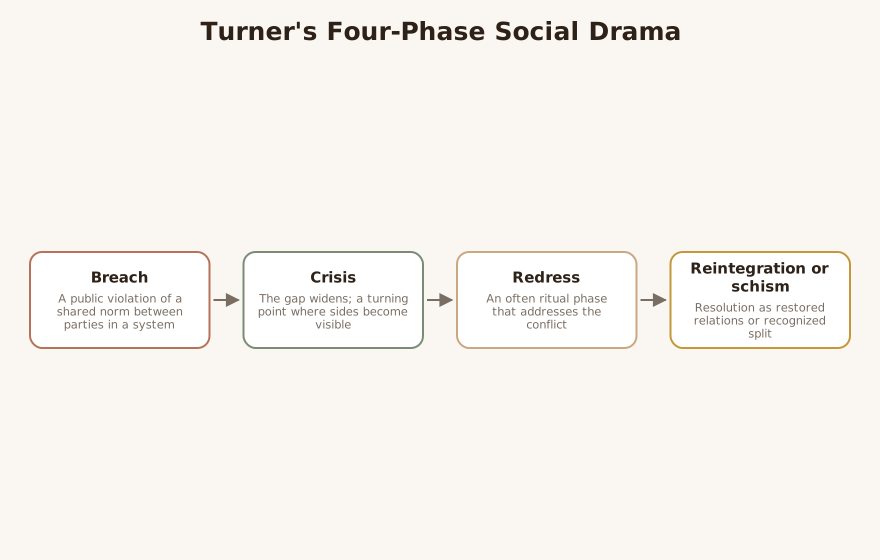
Phase one — breach. A social drama begins when “one individual or group publicly breaches the common norm,” that is, when a “breach of regular, norm-governed social relations occurs between persons or groups within the same system” 63. The breach is public and it is normative: it is a visible violation of a shared expectation that holds the relationship together 3.
Phase two — crisis. Once breached, “the crisis widens and extends the gap between parties” 6. Turner described crisis as a “turning point” or “moment of danger and suspense,” a state in which “a true state of affairs is revealed, when it is least easy to don masks or pretend that there is nothing wrong” 3. Crisis is the phase in which the conflict can no longer be politely ignored, and in which alignments and sides become visible 3.
Phase three — redressive action. To contain a widening crisis, “certain adjustive and redressive ‘mechanisms’… are swiftly brought into operation” 3. Redress is frequently ritual, formal, or procedural — a public process that the group convenes to handle the rupture 62. This is the pivotal phase: how redress is conducted largely determines whether the drama resolves or fractures LLM.
Phase four — reintegration or schism. The drama ends in one of two ways. Either there is reintegration, in which “resolution of the problem is being negotiated” and a “new equilibrium” is reached and legitimized, or there is schism — a recognition of irreparable break 63. Crucially, schism is a legitimate outcome of the model, not a failure of it: some breaches end in lasting division, and the model names that honestly 3.
The four phases are a structure, not a guarantee. In its illness-pathway application, the model’s authors framed it as a hypothesis that real pathways “follow the same underlying structure” of breach, crisis, redressive actions, and reintegration or schism — language that signals the phases are an analytic scaffold to test against lived experience, not an inevitability 3.
Interventions & Techniques
Turner designed no therapeutic techniques; what follows are clinical translations of his construct, offered as a framework rather than an evidence-based protocol LLM. The unit of work is almost always a relational system — a family, a couple, a group, or a team — because the model is fundamentally about collective process LLM.
The core technique is phase mapping: with the system in the room, locate where the current conflict sits — breach, crisis, redress, or reintegration/schism — and name it as a shared, de-shaming frame 63. Mapping does real work because it externalizes the conflict as a process the group is moving through rather than a verdict on any one member LLM. A clinician can ask, in effect, what norm was breached and by whom, how the crisis widened, what redressive moves have already been attempted, and what reintegration would actually require 3.
A second technique is deliberate redress design. Because the redressive phase is where dramas turn, the clinician can help a system convene a bounded, explicit repair process rather than leaving redress to happen by improvisation or avoidance 3. In the cancer-pathway study, redressive action included both formal treatment and a wide range of self-directed coping such as diet, exercise, and prayer — a reminder that, clinically, redress can be both the structured work of sessions and the rituals a client builds at home 3. A third move is naming schism honestly: helping a family or group recognize when a breach is moving toward legitimate separation, so that the work becomes managing the split with dignity rather than forcing a reconciliation that the system cannot sustain 3.
LLM-generated illustrative example (not a guideline): Two adult siblings enter therapy after their father’s estate triggered a cutoff. The clinician maps it aloud: the disputed will was the breach, eighteen months of escalating non-contact the crisis. The sessions themselves become a deliberate redressive process, and the dyad explicitly weighs whether the realistic endpoint is reintegration (a renegotiated relationship) or a schism held with less rancor LLM.
Evidence Base
Be precise here, because “established” applies in one register and not in another. As a theory within processual anthropology, the social-drama model is firmly established and durably influential; Turner developed it as a general account of conflict and crisis resolution, and it has been carried well beyond its original tribal-ritual setting 61. In that sense the construct is mature LLM.
As a clinical intervention, it is not established at all. There is no body of randomized trials, no manualized protocol, and no outcome evidence in these sources for applying social drama as a treatment LLM. The most rigorous applied work available here is a longitudinal qualitative study of nine Norwegian rectal-cancer patients, who were interviewed five times each over a year, with the data analyzed retrospectively through Turner’s framework 3. That study used social drama strictly as an analytic lens — the authors set out “to explore whether or not the model may be transferrable to patients’ accounts of pathways with long-term and severe conditions” — and it reported no treatment outcomes, efficacy measures, or clinical endpoints 3. It documents patients’ subjective experiences and coping, not clinical results 3. A clinician should cite it as evidence that the structure travels to illness narratives, never as evidence that social drama works as a therapy LLM.
The model also carries internal critique a careful clinician should hold. Turner’s allied concept of communitas has been criticized as “oversimplified and idealized” 6. More practically, the phase structure can impose a tidy narrative on conflicts that are messier than four steps — and its application to illness was explicitly framed as a hypothesis to be tested, not a settled fact 3. Treat the four phases as a heuristic to think with, not a law the conflict must obey LLM.
Populations & Indications
The model speaks most directly to relational systems and to people whose distress is defined by a conflict within such a system LLM. Families are a paradigm case: family discord, estrangement, and intergenerational rupture map cleanly onto a breach of a shared norm that widens into crisis and demands redress 3. Couples present the same structure at dyadic scale — an affair, a betrayal, or a broken agreement as breach, with the relationship’s survival hinging on the redressive phase LLM.
Therapy groups are a natural fit because the model was built to track conflict among parties “within the same system of social relations,” which is precisely what a group is 3. Organizations and teams experience social dramas around violated norms, leadership disputes, and factional splits, and the four-phase map gives a shared vocabulary for what is happening 6. Communities were the model’s original habitat, and Turner derived it from observing how groups surface and process conflict 6. Finally, people in chronic interpersonal conflict — those caught in long, unresolved cutoffs or feuds — are often stalled in a prolonged crisis phase that has never reached genuine redress, which the model can help name 3.
Problems-for-Work
- Relationship conflict and family discord can be reframed through the four phases, giving the system shared language for the breach that started it, the crisis that widened it, and the redress still owed 63.
- Group conflict resolution is a direct application: locating where a group sits in the drama — and what a redressive process would need to look like — turns diffuse tension into workable structure 3.
- Estrangement and cutoff often represent a schism that was never deliberately chosen, only drifted into; mapping the drama can clarify whether reintegration is genuinely wanted and possible 3.
LLM-generated illustrative example (not a guideline): A workplace team is gridlocked after a manager publicly overruled a colleague in a meeting. The consultant frames the override as the breach, the subsequent silent factionalism as the crisis, and proposes a facilitated, bounded redressive conversation — explicitly so the team does not slide unintentionally into a schism nobody actually wants LLM.
- Reconciliation and repair and rupture-and-repair processes are the model’s core use: the redressive phase is precisely the mechanism for moving a breach toward reintegration rather than schism 3.
- Scapegoating can be read as a distorted redressive move — loading the crisis onto one member instead of addressing the breached norm — which the model helps a clinician see and interrupt LLM.
- Conflict escalation corresponds to the crisis phase, in which “the gap between parties” widens; naming it as a phase, rather than a permanent state, can lower its charge 6.
Contraindications, Cautions & Cultural Humility
The first caution is conceptual honesty: this is anthropological theory, not therapy, and presenting it to clients as a validated treatment would misrepresent it LLM. There is no outcome evidence in these sources for clinical efficacy, and the one applied study used the model only to interpret experience after the fact 3.
The second caution is narrative imposition. A four-phase arc is satisfying precisely because it promises resolution, and a clinician can unconsciously steer a family toward “reintegration” because the model seems to want it LLM. But schism is an equally legitimate endpoint, and for some clients — survivors of abuse, those exiting coercive systems — a clean break is the healthy outcome, not a failure of redress 3. The model must not become a covert argument for reconciliation at any cost LLM.
The third concerns cultural humility and power. Turner abstracted social drama from specific Ndembu ceremonies and social arrangements, and the redressive rituals that resolve a drama are culturally particular, not universal 65. Different families and communities hold very different norms about what counts as a breach, who may convene redress, and what reintegration requires LLM. The clinician’s task is to invite the system’s own understanding of its breach and its own forms of repair, not to impose an anthropologist’s schema or a dominant-culture template onto it LLM. And because redress is a position of power — whoever convenes and steers it shapes the outcome — the clinician should stay alert to who in the room is setting the terms of “repair” LLM.
Treatment-Plan Suggestions & SMART Objectives
| Goal | SMART objective (example) | Mechanism |
|---|---|---|
| Build shared language for a family conflict | Family will map their current conflict onto the four phases (breach, crisis, redress, reintegration/schism) in 1 session | Externalizes conflict as a shared process rather than blame on one member 63 |
| Identify the originating breach | Couple will name the specific breached norm or agreement underlying their distress within 2 sessions | Locates the breach phase so redress targets the right rupture 3 |
| De-escalate an active crisis | Client will name 2 ways the crisis “widened the gap” and one boundary to slow escalation within 3 sessions | Reframes escalation as a phase, not a permanent state 6 |
| Convene a deliberate redressive process | Group will complete one bounded, structured repair conversation about a named rupture within 4 weeks | Uses the redressive phase as the turning point toward resolution 3 |
| Clarify reintegration vs. schism | Client will articulate what genuine reintegration would require and whether it is wanted, within 4 sessions | Makes the fourth-phase choice explicit rather than drifted-into 3 |
| Manage an estrangement with dignity | Estranged dyad will agree on terms for either contact or respectful schism within 6 sessions | Names schism as a legitimate, choosable outcome 3 |
| Interrupt scapegoating in a system | Team will identify when crisis is being loaded onto one member and redirect to the breached norm within 3 sessions | Corrects a distorted redressive move back toward the actual breach LLM |
Common Misconceptions
A frequent error is treating social drama as a clinical method with evidence behind it. It is a processual anthropology construct; the lone applied study used it only as an analytic lens and reported no outcomes 3. A second misconception is assuming every drama resolves: Turner’s fourth phase is reintegration or schism, meaning some conflicts legitimately end in lasting division 63. A third is reading the phases as rigidly sequential and discrete — in lived pathways they blur, recur, and overlap, which is why even the model’s proponents framed it as a hypothesized underlying structure rather than a fixed script 3. A fourth is confusing breach with mere disagreement: a breach is specifically a public violation of a shared norm, not any friction 3. Finally, some treat redress as automatic; Turner’s point is that redressive mechanisms must be deliberately “brought into operation,” which is precisely where clinical work lives 3.
Training & Certification
There is no certification in social drama, because it is an anthropological construct rather than a credentialed clinical method LLM. The relevant “training” is scholarly: primary engagement with Turner’s Social Dramas and Stories about Them and From Ritual to Theatre, supported by secondary and applied readings such as the cancer-pathway study that tested the model’s transferability 123. For clinicians, the responsible path is to learn the model as a conceptual frame and to apply it only within methods one is already credentialed in — family systems therapy, group psychotherapy, couples work, or mediation — rather than presenting “social drama therapy” as a standalone, certified discipline LLM.
Key Terms
- Social drama — Turner’s four-phase processual model for how conflict moves through a group: breach, crisis, redressive action, and reintegration or schism 63.
- Breach — the opening phase, a public violation of a shared, norm-governed expectation between parties in the same social system 36.
- Crisis — the widening phase, a “turning point” of “danger and suspense” in which the gap between parties extends and the conflict can no longer be masked 63.
- Redressive action — the pivotal phase, in which “adjustive and redressive mechanisms” — often ritual, formal, or procedural — are brought into operation to contain the crisis 3.
- Reintegration — the resolving outcome, in which a new equilibrium is negotiated and legitimized 63.
- Schism — the alternative outcome, a recognized and legitimate irreparable break between the parties 3.
Resources & Further Reading
▶ Watch — a video introduction to this concept:
- Turner, V. (1980). Social Dramas and Stories about Them (Critical Inquiry)
- Turner, V. (1982). From Ritual to Theatre: The Human Seriousness of Play
- Patient pathways as social drama: a qualitative study of cancer trajectories (PMC6691787)
- Victor Witter Turner — biography (Encyclopedia.com)
- The Anthropology of Victor Turner: Ritual, Liminality, and Cultural Performance
- Victor Turner (New World Encyclopedia)
Reflective / Supervision Questions
- When I map a family’s conflict onto the four phases, am I helping them see a shared process, or am I quietly steering them toward “reintegration” because the model wants a tidy ending 3? LLM
- Can I locate where this system currently sits — breach, crisis, redress, or reintegration/schism — and does naming that phase change what I do next 6? LLM
- For an estranged client, am I honoring that schism can be the healthy, legitimate outcome, rather than treating any non-reconciliation as failed work 3? LLM
- Whose norms define the “breach” here, and whose forms of repair am I privileging — the system’s own, or a template I have imported 5? LLM
- In the redressive phase, who in the room holds the power to set the terms of repair, and is anyone being scapegoated in place of addressing the actual breach 3? LLM