
Type & Discipline
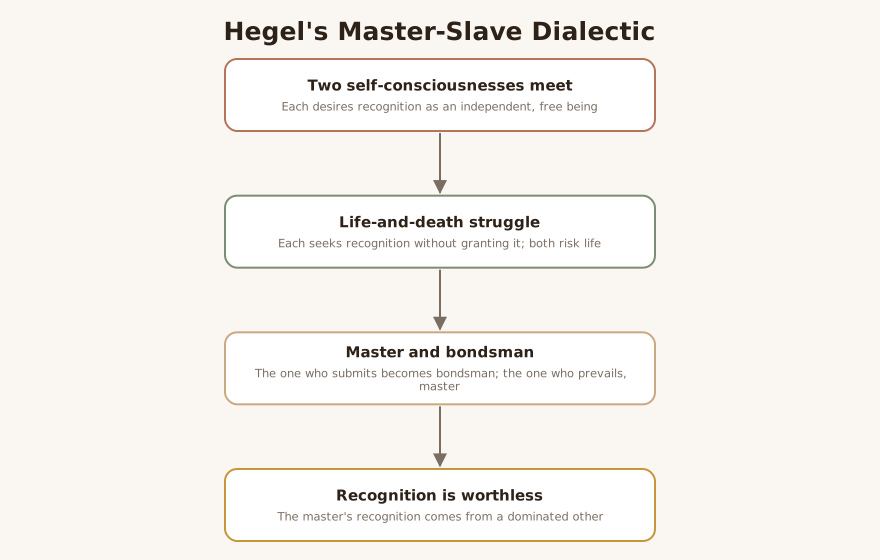
Recognition (Anerkennung) and its dramatization in the so-called master-slave or lord-bondsman dialectic is a philosophical concept, not a psychotherapy, a manualized protocol, or a clinical diagnosis 4. It belongs to German idealism and was set out by G.W.F. Hegel in the “Self-Consciousness” chapter of his 1807 Phenomenology of Spirit, in the section conventionally titled “Lordship and Bondage” 1. Hegel’s central claim is that self-consciousness is not something a person possesses in isolation but something that becomes real only by being recognized by another self-consciousness: it “exists in itself and for itself, in that, and by the fact that it exists for another self-consciousness; that is to say, it is only by being acknowledged or ‘recognized’” 1. Recognition, in this technical sense, is the mutual acknowledgment through which two subjects confirm each other as free, self-determining beings rather than mere objects 3.
For the clinician, the value of the concept is not that one delivers “recognition therapy” in session but that it supplies a precise vocabulary for a recognizable structure of suffering: the need to be seen and affirmed by another, the way domination corrupts that affirmation, and the difference between a relationship of mutual acknowledgment and one of control LLM. Hegel’s decisive move — that coercion can never yield genuine recognition, because the affirmation of a dominated, dehumanized other is worthless — gives a philosophical name to a pattern therapists meet constantly in couples, in survivors of coercive control, and in clients whose self-worth is hostage to validation they cannot trust 5. Understood this way, the dialectic is a construct that informs case conceptualization within established therapies, not a treatment in its own right LLM.
Creators & Lineage
The concept’s author is Georg Wilhelm Friedrich Hegel (1770–1831), the central figure of German idealism, whose Phenomenology of Spirit traces the development of consciousness through successive “shapes” toward absolute knowing 2. Within that larger project, the encounter between two self-consciousnesses is a pivotal episode: each seeks to be recognized as a free subject, and their meeting issues in a “life-and-death struggle” and then in the asymmetrical relation of lord and bondsman 2. Hegel’s account is notoriously dense and has generated centuries of competing interpretation, but its core narrative — two subjects, a struggle for recognition, a master who dominates and a slave who submits, and the eventual reversal of their positions — is stable across readings 4.
The lineage of the idea is unusually rich because Hegel’s dialectic was taken up far beyond philosophy LLM. In the nineteenth century it shaped Marx’s account of labor and the master-slave relation as a model of class domination, and in the twentieth it was transmitted to French thought through Alexandre Kojève’s influential lectures, which read the whole of human history as a struggle for recognition 4. The most consequential heirs for clinicians, however, are two later thinkers named in this article’s lineage LLM. The contemporary German philosopher Axel Honneth rebuilt Hegel’s insight into a systematic social theory in which the struggle for recognition is the moral engine of social life, organized across distinct spheres of acknowledgment, and in which the denial of recognition — disrespect, humiliation, invisibility — is a primary source of injustice and suffering 7.
The bridge into psychotherapy runs through the relational psychoanalyst Jessica Benjamin, who transposed Hegel’s dialectic into the intersubjective field of infant-caregiver and adult-couple relationships LLM. Benjamin’s central thesis — that genuine selfhood depends on mutual recognition between two subjects, each of whom can survive as a separate center of experience, and that domination and submission arise precisely when that mutuality collapses — is a direct psychoanalytic translation of Hegel’s claim that coerced recognition fails 3. Through Benjamin the dialectic enters relational and intersubjective psychoanalysis, attachment-informed work, object relations, and, indirectly, the recognition-centered stance of emotionally focused couples therapy LLM.
Core Principles
The first principle is that self-consciousness is constitutively social: a subject cannot become fully self-aware alone, but only by encountering another self-consciousness who recognizes it 1. Hegel stages this as a desire for recognition — each self-consciousness wants to be acknowledged by the other as an independent, free being, and this desire, not mere appetite, is what drives the encounter 6. Recognition is therefore not a nicety added to an already-complete self; it is part of what makes the self a self at all 3.
The second principle is the struggle and its asymmetrical resolution. When two self-consciousnesses meet, each initially seeks recognition without granting it, and the confrontation escalates into a “life-and-death struggle” in which each is willing to risk life to prove its freedom 6. The one who fears death and submits becomes the bondsman (slave); the one who risks everything and prevails becomes the lord (master), who now compels the bondsman to labor and to acknowledge him 5. At first glance the master has won: he is recognized, served, and freed from work 4.
The third principle — and the one with the most clinical force — is the dialectical reversal: the master’s victory is hollow 5. Because he has reduced the bondsman to a dominated, less-than-equal other, the recognition he receives is worthless; one is not truly confirmed as free by a being one has refused to treat as free 1. Hegel’s text states the problem directly: for the lord, “a form of recognition has arisen that is one-sided and unequal,” a recognition from a consciousness he does not himself recognize as an equal, and so the affirmation he craved fails to satisfy 1. Meanwhile the bondsman, through the discipline of labor — shaping the world by his work — and through having confronted the fear of death, develops a self-consciousness of his own and comes to a kind of independence the master lacks 1. The deep moral is that only mutual recognition between equals delivers what each sought, and any relation of domination is self-defeating for both parties 3.
Interventions & Techniques
Because the dialectic is a concept rather than a manual, it prescribes no techniques of its own; it reframes what is already happening between people and orients the clinician’s attention LLM. Its primary clinical use is structural: it helps the therapist hear a relationship — between partners, between a client and an abuser, even between client and therapist — in terms of who is being recognized, who is recognizing, and whether the acknowledgment flowing between them is mutual or coerced 3. Naming a stuck couple’s pattern as a failed struggle for recognition, in which each demands to be seen while refusing to see the other, can make an otherwise baffling escalation intelligible LLM.
A second move uses Hegel’s reversal as a therapeutic insight: validation extracted through control, guilt, or fear cannot satisfy the need it is meant to meet 5. For a client who manages others to secure their love, or who tyrannizes a partner into reassurance, the clinician can hold up the dialectic’s lesson — that the master’s recognition is worthless — to help the client grasp why the affirmation they engineer never lands LLM. A third move, drawn from Benjamin’s translation, treats the restoration of mutuality as the aim: helping each partner recover the capacity to experience the other as a separate subject with their own inner world, rather than as an object to be controlled or an extension of the self 3.
These moves are delivered through the clinician’s primary modality — couples work, trauma therapy, psychodynamic or relational therapy — while the dialectic supplies the structural picture of what mutual recognition would require LLM.
LLM-generated illustrative example (not a guideline): A couple presents with a cycle in which one partner demands constant reassurance and the other, feeling controlled, withholds it. Using the dialectic, the clinician names the pattern as two people each fighting to be recognized while neither feels able to recognize the other, and points to why the reassurance, when finally coerced, brings no relief: affirmation wrung from someone you are dominating cannot confirm you as loved. The work turns toward each partner’s capacity to see the other as a separate self whose acknowledgment, freely given, would actually count LLM.
Evidence Base
Honesty about evidence requires distinguishing two senses of “established” LLM. As a philosophical idea, recognition and the master-slave dialectic are firmly established and mature: the lord-bondsman passage is among the most discussed pages in all of modern philosophy, anchored in a canonical primary text and elaborated by a vast secondary literature across philosophy, political theory, and social thought 4. Recognition has, moreover, been developed into a sophisticated contemporary research program in social and political philosophy, where it functions as a central category for theorizing justice, identity, and social conflict 7. In that sense the concept is canonical and rigorously examined 3.
What it is not is an empirically validated clinical intervention with controlled outcome data, because it is a concept in philosophical anthropology and social theory rather than a treatment that has been trialed LLM. Its clinical descendants — Benjamin’s intersubjective psychoanalysis, recognition-informed couples work — are themselves largely theoretical and case-based rather than supported by their own randomized trials, even though some of the therapies that absorb the idea (such as emotionally focused therapy for couples) carry independent empirical support for their broader methods LLM. The scrutiny the dialectic has received is overwhelmingly philosophical and interpretive: scholars dispute what Hegel actually meant, whether the master-slave reading later imposed on the text is faithful, and how literally to take the “struggle” 2. Clinicians should therefore present the concept, when relevant, as a powerful interpretive frame and not as a scientific finding about the mind LLM.
The defensible clinical position is that the dialectic earns its place through descriptive and explanatory usefulness — the way it illuminates power, validation, and mutuality in relationships — while disorder-specific change is pursued through therapies with their own evidence base LLM.
Populations & Indications
The concept’s reach is wide, because the need for recognition belongs to every developing self, but it is especially indicated for clients whose distress is organized around the self-other relationship and the distribution of power within it LLM. Couples are the paradigmatic population: Hegel’s drama of two subjects each demanding acknowledgment while refusing to grant it is a recognizable template for the recognition struggles that drive much marital conflict, and Benjamin’s reworking was developed in significant part for exactly this terrain 3. People in power-imbalanced relationships of any kind find in the dialectic a way to understand why a relationship that lacks equality fails to nourish either party 5.
Survivors of abuse and coercive control are a further central population, because coercive control is, in the dialectic’s terms, a project of forcing recognition from a person one has dominated, and the framework names both why that project is dehumanizing and why it ultimately fails on its own terms 5. Clients with attachment difficulties and interpersonal dependency, whose sense of self collapses without external validation, can be understood through the principle that self-consciousness is constituted in being acknowledged by another 1. The infant-caregiver dyad is the developmental setting in which Benjamin located the origins of mutual recognition, and adolescents, engaged in the work of being recognized as independent agents by parents and peers, fit the same structure 3.
Problems-for-Work
The dialectic maps cleanly onto a cluster of relational and self-related problems LLM. For relationship conflict and difficulty with mutuality and intimacy, it names the precise impasse — two people locked in a struggle for recognition, each unable to acknowledge the other as a separate subject — and points toward mutual recognition as the resolution 3.
LLM-generated illustrative example (not a guideline): Partners who “can’t stop fighting about nothing” are reframed as two selves each waiting to be truly seen before they will risk seeing the other; the clinician works to interrupt the standoff so that one act of genuine acknowledgment can break the symmetry LLM.
For codependency and power imbalance and intimate partner violence dynamics, the concept supplies a moral and structural account of domination: the master’s recognition is worthless, so control can never deliver the security it seeks, and the relationship harms both the controller and the controlled 5. For low self-esteem and the need for validation and interpersonal dependency, the principle that the self becomes real only in being recognized explains why these clients hunger for acknowledgment, while the dialectic’s lesson about coerced recognition clarifies why manipulated or extracted validation never satisfies 1.
LLM-generated illustrative example (not a guideline): A client who “needs everyone to approve of me” but feels empty when they get it is helped to see that approval managed through people-pleasing is, like the master’s, a recognition that cannot count, because it does not come from someone the client has let see them honestly LLM.
For attachment insecurity, identity disturbance, and shame, the concept locates the wound in the failure or distortion of recognition — being unseen, misrecognized, or acknowledged only as an object — which connects individual symptoms to the relational history that produced them 7.
Contraindications, Cautions & Cultural Humility
The foremost caution is conceptual restraint: the master-slave dialectic is a philosophical heuristic, not a validated clinical law, and a clinician should not present “you are the master in this relationship” as a diagnostic verdict or wield the vocabulary as a measurement LLM. The constructs are interpretive lenses for understanding how recognition flows between people, and they lose their value when reified into fixed roles a client supposedly is LLM.
A second and serious caution concerns the language itself: the terms “master” and “slave” carry the weight of historical chattel slavery, and using them carelessly with clients — especially clients whose families or communities were subjected to actual enslavement or colonial domination — can be alienating or wounding LLM. The clinical concept can almost always be conveyed through the plainer language of recognition, domination, and mutuality without invoking the loaded historical terminology, and clinicians should default to that LLM. The framework should also never displace risk assessment: in cases of abuse and coercive control, safety planning and indicated trauma care take absolute priority over any elegant theory of recognition, and the dialectic must never be used in a way that implies a dominated person is a co-equal partner in their own subjugation LLM.
A third caution is cultural humility about what “mutual recognition between equals” looks like LLM. The framework can carry an implicit, individualist, Western assumption that the ideal relationship is a contract between two fully autonomous subjects, but in many collectivist and relational cultures, asymmetries of role, deference, and obligation within family and community are not necessarily failures of recognition but freely endorsed sources of meaning and belonging LLM. A clinician who reads every hierarchy as a master-slave pathology may impose a culturally specific ideal of equality on a client for whom interdependence and respect across roles is the very fabric of a good life LLM. Cultural humility here means interpreting recognition against the client’s own values, distinguishing genuinely harmful domination from culturally meaningful asymmetry, and staying alert to the therapist’s own power to define which relationships count as “mutual” and which as “unequal” LLM.
Treatment-Plan Suggestions & SMART Objectives
| Goal | SMART objective (example) | Mechanism |
|---|---|---|
| Recognize the partner as a separate subject | Within 8 sessions, client will describe, in 3 recurring conflicts, the partner’s inner experience in the partner’s own terms before stating their own | Restores the capacity for mutual recognition of the other as a distinct self 3 |
| Distinguish freely given from coerced validation | Over 6 weeks, client will identify 3 instances where they sought reassurance through pressure or control and note that the reassurance did not satisfy | Surfaces Hegel’s lesson that coerced recognition is worthless 5 |
| Reduce dependence on external validation | Within 10 sessions, client will record 2 occasions per week of self-acknowledgment that does not require another’s approval | Loosens the equation of self-worth with being recognized by others 1 |
| Interrupt domination patterns | Over 8 weeks, client will name 2 ways they attempt to control a partner’s acknowledgment and practice one alternative bid for mutual contact | Replaces control with reciprocal recognition 3 |
| Re-author a misrecognition narrative | Within 8 sessions, client will articulate one early experience of being unseen or treated as an object and connect it to a present relational pattern | Links current symptoms to a history of denied recognition 7 |
| Tolerate the other’s separateness | Over 10 weeks, client will allow a partner to hold a differing view in 3 discussions without withdrawing or coercing agreement | Builds the survival of the other as an independent center of experience 3 |
| Repair self-worth after coercive control | Within 12 sessions, client will distinguish 3 beliefs imposed by a controlling figure from their own endorsed values | Recovers selfhood from a relation of domination 5 |
Common Misconceptions
A first misconception is that the dialectic is about literal masters and slaves, or only about political and economic domination; while it has been read that way since Marx and Kojève, in Hegel’s own text the lordship-bondage relation is a philosophical allegory about the structure of self-consciousness and recognition, not a historical or sociological description 4. A second is that the master “wins”: Hegel’s whole point is the reversal — the master’s recognition is hollow precisely because it comes from a dominated other, while the bondsman, through labor and the confrontation with fear, attains a self-consciousness the master never reaches 5. A third misconception is that recognition is a one-way gift the stronger party bestows; the concept’s core is mutuality, the reciprocal acknowledgment between subjects, without which no real recognition occurs 3.
A fourth misconception is that the framework is a therapy one “does,” when it is a concept from philosophy that informs interventions delivered through other modalities LLM. A fifth is that “struggle for recognition” implies that conflict is always pathological; in Honneth’s reading the struggle for recognition is the very engine of moral and social development, and demands to be acknowledged can be healthy and just rather than symptoms to be eliminated 7. Finally, the concept is sometimes treated as a precise, measurable mechanism rather than an interpretive account of how selves are constituted in relation, which overstates what it can predict about any individual LLM.
Training & Certification
There is no certification in “the master-slave dialectic”; it is foundational philosophy studied within the history of ideas, German idealism, and social and political theory rather than a credentialed clinical technique LLM. Clinicians typically encounter it through coursework in philosophy or theory, through encyclopedic overviews of Hegel and of recognition, or through the psychoanalytic literature that absorbed it 2. Reading Hegel’s “Lordship and Bondage” passage in the Phenomenology of Spirit — bearing in mind its difficulty and the centuries of competing interpretation — remains the most direct route to the idea in its original terms, and reputable secondary sources offer a faster orientation 1.
For applied clinical competence, the relevant training lives in the modalities that operationalize the frame: relational and intersubjective psychoanalysis, where Jessica Benjamin’s work on mutual recognition and domination is foundational reading; couples therapy, including recognition-attentive approaches; and trauma therapy for survivors of coercive control LLM. As with any borrowed construct, the ethical requirement is competence and honest scope — the concept should inform formulation within one’s licensed practice, not be represented as a standalone evidence-based treatment LLM.
Key Terms
Recognition (Anerkennung) — the mutual acknowledgment through which two self-consciousnesses confirm each other as free subjects; for Hegel, self-consciousness “is only by being acknowledged or ‘recognized’” 1. Self-consciousness — awareness of oneself as a subject, which on Hegel’s account becomes real only in relation to another self-consciousness 6. Lord / master (Herr) — the self-consciousness that, in the struggle, risks death and dominates the other, but receives only a “one-sided and unequal” recognition that fails to satisfy 1. Bondsman / slave (Knecht) — the self-consciousness that submits out of fear of death, but who, through labor and that confrontation, develops an independent self-consciousness 1. Life-and-death struggle — the confrontation in which each self-consciousness risks life to be recognized as free 6. Mutual recognition — reciprocal acknowledgment between equals, the only form of recognition that genuinely confirms each subject; in Benjamin’s psychoanalytic translation, the basis of non-dominating intimacy 3. Misrecognition / denial of recognition — disrespect, humiliation, or invisibility; in Honneth’s social theory, a primary source of injustice and suffering 7. Dialectic — the process by which a relation (here, lordship and bondage) generates its own reversal and points beyond itself toward a higher resolution 4.
Resources & Further Reading
▶ Watch — a video introduction to this concept:
- Lordship and Bondage (Hegel, Phenomenology of Spirit) — Marxists Internet Archive
- Georg Wilhelm Friedrich Hegel — Stanford Encyclopedia of Philosophy
- Recognition — Stanford Encyclopedia of Philosophy
- Recognition, Social and Political — Internet Encyclopedia of Philosophy
- Lord–bondsman dialectic — Wikipedia
- Hegel’s Master-Slave Dialectic Explained — TheCollector
- Phenomenology of Spirit, Ch. 4: Self-Consciousness — SparkNotes
Reflective / Supervision Questions
- When a couple I am treating is locked in conflict, am I tracking who is recognizing whom, and whether the acknowledgment between them is mutual or coerced 3?
- With a client who hungers for validation, am I helping them see why approval extracted through control or people-pleasing cannot satisfy, rather than simply helping them get more of it 5?
- Am I using the loaded terms “master” and “slave” with a client for whom that language may be alienating or wounding, when the plainer language of recognition and domination would serve better LLM?
- Whose cultural ideal of “equality” am I applying when I judge a client’s relationship as a failure of mutual recognition, and have I checked it against the client’s own values LLM?
- In a case of coercive control, am I keeping safety and trauma care firmly ahead of any elegant theory of recognition, and never implying the dominated person is co-equal in their subjugation LLM?
- Where might I, as the therapist, be the more powerful party in the room, and how does my own holding of recognition shape what this client believes about being seen LLM?