
Type & Discipline
Coercive control is a theoretical and explanatory framework for understanding intimate partner abuse, not a treatment modality or a clinical technique 1. It originates at the intersection of sociology, forensic psychology, and feminist social science, and it reconceptualizes what abuse fundamentally is: rather than a series of discrete violent incidents, it names an ongoing, strategic course of conduct through which one partner dominates another by intimidating, isolating, degrading, and micro-regulating the conditions of their daily life 1. The central claim is that the harm of abuse lies less in any single assault than in a sustained pattern that strips a person of autonomy, resources, and liberty over time 6. For a practicing clinician, coercive control is best understood as a lens that reorganizes the clinical picture — it explains why a client who has experienced “only one” or “no” physical incidents may nonetheless be profoundly traumatized, entrapped, and unable to act on their own behalf LLM.
Because it is an analytic framework rather than a protocol, coercive control prescribes no specific therapy, and its clinical value is interpretive and orienting LLM. It equips the clinician to recognize a pattern that incident-based and injury-focused models routinely miss, to reframe a client’s “stuckness” as the predictable product of a deliberate strategy rather than a personal deficit, and to assess danger more accurately by attending to control rather than counting bruises 4. Everything that follows translates a descriptive social theory into stances and questions a clinician can use, and that translation is the author’s clinical reasoning rather than a direct claim from the source literature LLM.
Creators & Lineage
The framework’s principal architect is Evan Stark, a sociologist and forensic social worker affiliated with Rutgers University, whose 2007 book Coercive Control: How Men Entrap Women in Personal Life synthesized decades of research and advocacy into a coherent theory 1. Stark, who had co-founded one of the first battered women’s shelters in the United States, argued that the dominant “violence model” of abuse — which defines the problem by physical assaults and measures it by injury — had failed survivors by rendering the most damaging features of abuse invisible 1. His core move was to redefine the phenomenon as a “liberty crime”: a course of conduct better compared to kidnapping, stalking, or hostage-taking than to ordinary assault, because its defining injury is the deprivation of freedom and personhood 6.
The lineage runs through the broader feminist anti-violence movement and earlier work on the psychology of captivity and entrapment LLM. Stark drew on the recognition, developed across trauma studies, that prolonged subjection to coercion and control produces a distinct and severe psychological syndrome, and he located intimate abuse alongside other contexts of unfree existence rather than treating it as a private, episodic problem 1. His concept also resonates with sociological models of how institutions and relationships can absorb and reshape a person’s entire sense of self under conditions of total regulation LLM.
The framework’s influence has been amplified by its migration from theory into law and policy 6. England and Wales criminalized “controlling or coercive behaviour” in an intimate or family relationship under the Serious Crime Act 2015, and Scotland followed with the Domestic Abuse (Scotland) Act 2018, both directly shaped by Stark’s analysis 6. Advocacy organizations such as Women’s Aid have made coercive control central to public and professional understanding of domestic abuse, and family-law scholarship in the United States has increasingly pressed courts to redefine domestic abuse around control rather than incidents 34. This movement from concept to statute is itself part of the framework’s intellectual history and a marker of its established status 4.
Core Principles
The foundational principle is that abuse is a pattern, not an incident 1. Coercive control names a strategic, cumulative course of conduct designed to dominate; its meaning and harm cannot be captured by tallying assaults, because the same act (a glance, a text, a withheld payment) carries its force only within the larger pattern of which it is a part 4. A second principle is that the primary injury is to liberty and autonomy rather than to the body 6. The abuser’s project is to constrain the partner’s freedom — where they go, whom they see, what they wear, how they spend money, how they parent — so that the victim’s space for independent action shrinks toward nothing 1.
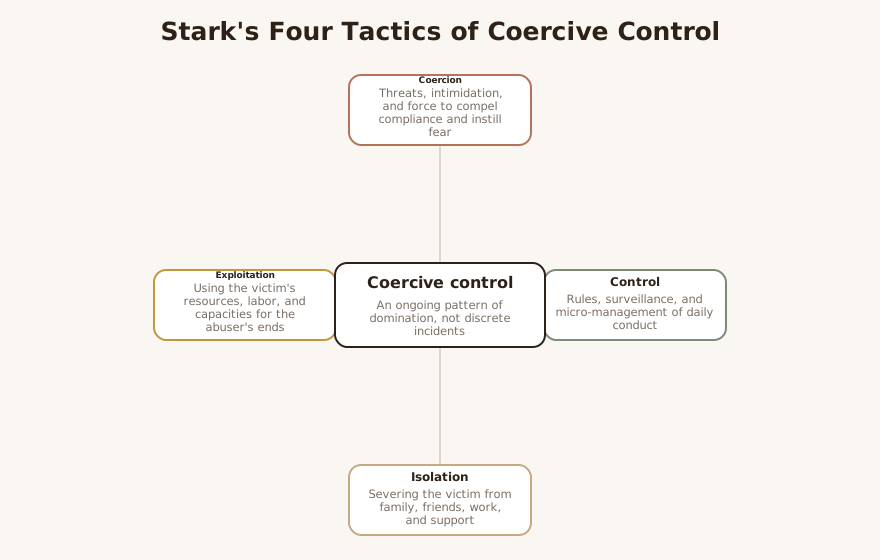
Stark’s framework is often organized around four interlocking tactics LLM. Coercion uses threats, intimidation, and force — including but not limited to physical violence — to compel compliance and instill fear 5. Control regulates the victim’s daily conduct through rules, surveillance, and the micro-management of ordinary life, often enforced by punishment for infractions 1. Isolation severs the victim from family, friends, work, and any source of independent support, information, or reality-testing, deepening dependence on the abuser 3. Exploitation appropriates the victim’s resources, labor, and capacities — money, time, sexuality, parenting — for the abuser’s benefit 1.
A further principle is that coercive control is profoundly gendered in its prevalent form 1. Stark’s analysis centers on the way men entrap women, drawing on the social reality that controlling tactics frequently target and exploit gendered expectations around domestic labor, caretaking, and sexuality, which makes the control both more effective and harder to see 1. A final principle is that the cumulative effect is entrapment: a condition, not merely an emotion, in which the victim’s options have been systematically foreclosed and their sense of self eroded, so that what looks from outside like passivity or “choosing to stay” is in fact the signature of a successful campaign of domination 6.
Interventions & Techniques
Coercive control supplies no interventions of its own, so what follows is the clinical application of the lens, and these recommendations are the author’s synthesis rather than directives from the source literature LLM. The most basic application is pattern-based assessment: rather than asking only “has he hit you?”, the clinician maps the architecture of control — surveillance, rules, financial restriction, isolation, monitoring of the phone or location, the policing of contact with others — because the presence and density of these tactics, more than any single act, indexes both severity and danger 4. This pairs with naming the pattern, in which the clinician offers the client a frame — that what they are describing is a recognized form of abuse organized around control — which can dissolve the self-blame and confusion that the abuse itself manufactures 3.
A second application is reframing entrapment, helping the client understand that their difficulty leaving is the intended outcome of a deliberate strategy rather than a sign of weakness, irrationality, or love gone wrong 6. A third is risk and safety planning calibrated to control rather than to incidents, since the most dangerous offenders are often those who control most completely, and since separation frequently escalates rather than ends the danger; the clinician therefore attends explicitly to post-separation abuse, stalking, and the continuation of control through children, courts, and finances 4. A fourth, drawn from the prominence of isolation in the framework, is the slow, careful rebuilding of connection and autonomy — re-establishing severed relationships, independent resources, and the client’s own perceptions — as both a clinical and a safety aim 3. Throughout, trauma-focused care for the resulting symptoms proceeds alongside, not instead of, attention to the controlling structure of the relationship 2.
LLM-generated illustrative example (not a guideline): A client referred for “anxiety and low self-esteem” reports no physical violence and is at first unsure why she feels so depleted. As the clinician asks about daily life, a pattern emerges: her partner tracks her location, requires her to account for every expenditure, has gradually cut her off from her sister and former friends, and “gets a mood” if she is late, so she has stopped seeing anyone. Using a coercive-control lens, the clinician names this as a recognized pattern of abuse organized around control rather than as a relationship problem or a personal failing, validates that her exhaustion and second-guessing are predictable effects of constant surveillance and isolation, and shifts the work toward safety, reconnection, and rebuilding autonomy while treating the anxiety LLM.
Evidence Base
The honest characterization is that coercive control is an established and highly influential theoretical framework whose empirical and legal evidence base is real and growing but still maturing in places 4. Its maturity is partly the maturity of a theory that has reshaped a field: since Stark’s 2007 synthesis it has been adopted into national criminal law in the United Kingdom, embedded in the practice of major advocacy and victim-services organizations, and increasingly built into family-law reform and risk-assessment tools internationally 64. As a conceptualization of abuse, it is widely regarded as established and as a corrective to the incident-based models that preceded it 1.
The mental-health evidence has begun to catch up to the theory 2. A systematic review and meta-analysis of the trauma and mental-health impacts of coercive control found consistent associations between exposure to coercive control and elevated rates of depression, anxiety, post-traumatic stress, and suicidality, supporting the framework’s claim that this form of abuse is independently and seriously harmful even apart from physical violence 2. At the same time, the authors of that literature note methodological limitations — heterogeneous definitions and measures of coercive control, a reliance on cross-sectional designs, and a relative scarcity of longitudinal and causal evidence — which means the size and mechanisms of the effects are still being clarified 2. There is, correspondingly, no body of randomized controlled trials of “coercive-control therapy,” because coercive control is an explanatory framework rather than a treatment, and it would be a category error to present it to a client as an evidence-based intervention LLM. For the clinician, the practical implication is to treat coercive control as a credible, well-developed, and legally recognized framework that organizes assessment and meaning-making, while drawing the actual treatment of resulting symptoms from established trauma therapies LLM.
Populations & Indications
The framework was developed primarily to explain the abuse of women by male partners in heterosexual relationships, and that remains its paradigmatic population, given the gendered patterning of controlling tactics that Stark documents 1. It is, however, increasingly applied across a wider range of populations whose circumstances make them especially vulnerable to entrapment LLM. Survivors of intimate partner violence of any gender are a core indication, because the lens captures harm that injury-focused screening misses and reframes their experience in a way that reduces self-blame 3.
Children exposed to domestic abuse are an important and often overlooked group, because coercive control reshapes the entire household and frequently uses children as instruments of control — through threats, surveillance, or post-separation litigation — so that they are harmed as targets, not merely as witnesses 4. LGBTQ+ partners are relevant, since control can exploit unique levers such as the threat of outing, though clinicians must apply the framework without importing assumptions drawn solely from heterosexual dynamics LLM. Immigrant and undocumented partners are particularly vulnerable, because immigration status, language barriers, and the threat of deportation provide powerful additional tools of control and isolation 4. People with disabilities or care needs, and older adults dependent on a partner or relative, are likewise heightened-risk groups, because dependency itself becomes a mechanism of exploitation and entrapment LLM. More broadly, the lens is indicated whenever a clinician notices that a client’s autonomy, social world, finances, or sense of self appear to be shrinking under a partner’s influence, even in the absence of reported physical violence LLM.
Problems-for-Work
The lens speaks most directly to traumatic entrapment — the client’s apparent inability to leave — which it reframes from a personal failing or a pathology into the engineered result of isolation, fear, dependence, and foreclosed options, and which it answers by rebuilding the very resources and connections the abuse removed 6. It addresses complex trauma symptoms, including the post-traumatic stress, hypervigilance, depression, anxiety, and suicidality that the empirical literature links to coercive control, by locating their source in a sustained condition of unfreedom rather than in a discrete event 2. It bears on the loss of autonomy and erosion of self that survivors so often describe, framing the dimming of a person’s own preferences, judgment, and identity as the intended product of relentless regulation rather than as who they “really are” 1.
LLM-generated illustrative example (not a guideline): A client who has recently separated presents with insomnia, panic, and a sense that she “can’t think straight.” She is being inundated with messages, monitored through shared accounts and the children’s schedules, and dragged into repeated court filings. A coercive-control-informed clinician names this as post-separation abuse — the continuation of control by other means — rather than as ordinary co-parenting conflict, validates that her panic is a rational response to ongoing surveillance and threat, and centers the work on safety planning, documentation, and reclaiming agency while treating the trauma symptoms LLM.
The lens applies squarely to isolation and the loss of support networks, making visible the systematic severing of relationships that masquerades as the client’s own withdrawal, and pointing the work toward careful reconnection 3. It addresses self-blame and shame, the corrosive conviction that the situation is the client’s fault, which the framework reframes as a manufactured effect of the abuse itself rather than an accurate self-assessment 3. And it directly names ongoing risk and post-separation abuse, correcting the dangerous assumption that leaving ends the danger and prompting risk assessment that tracks control across the entire arc of separation 4. Across these problems, the consistent therapeutic move is to honor the reality of the controlling structure while mobilizing whatever autonomy, connection, and safety the client can recover LLM.
Contraindications, Cautions & Cultural Humility
The central caution is one of safety: naming abuse, encouraging reconnection, or planning toward independence can increase danger if done without regard to timing, because separation and any visible reduction in the abuser’s control are recognized escalation points 4. The clinician must therefore pace the work to the client’s own assessment of safety, never push a client toward leaving on the clinician’s timeline, and integrate risk assessment and safety planning before acting on the framework’s implications LLM. A second caution concerns agency and self-determination: the lens explains entrapment, but it must not become a script in which the clinician decides what the client should do; the framework should expand the client’s understanding and options, not substitute the clinician’s judgment for the client’s LLM.
A third caution is against over- or mis-application. Not every controlling or conflictual behavior rises to coercive control, and reflexively labeling ordinary relationship difficulty as abuse can distort assessment, while the more dangerous error in practice is usually the opposite — missing genuine control because no physical violence is reported LLM. The skill is calibration: assessing the pattern and its effect on the client’s liberty, rather than applying the label as a slogan 4. Clinicians should also be alert that abusers sometimes weaponize the language of victimhood and “control,” which is a further reason to ground assessment in who is constraining whose freedom LLM.
Cultural humility is intrinsic rather than an add-on, because what counts as control, normal partnership, family obligation, or independence is shaped by culture, faith, and community, and a framework built largely from one cultural and gendered context must be applied without imposing its assumptions on every client 3. The clinician must take particular care with clients whose immigration status, religion, or community make leaving carry distinctive risks and costs, and must let the client’s own understanding of their situation lead, holding coercive control as a powerful but partial lens alongside the client’s lived knowledge of their world 4.
Treatment-Plan Suggestions & SMART Objectives
| Goal | SMART objective (example) | Mechanism |
|---|---|---|
| Build accurate understanding of the abuse pattern | Within 3 sessions, client will identify and name three controlling tactics (e.g., monitoring, financial restriction, isolation) operating in the relationship | Pattern-based assessment and psychoeducation 4 |
| Reduce self-blame and shame | Over 6 sessions, client will reframe two “it’s my fault” statements into accurate descriptions of the partner’s controlling behavior | Externalizing harm to the pattern rather than the self 3 |
| Establish a safety plan calibrated to risk | Within 4 weeks, client and clinician will complete a written safety plan that addresses separation and post-separation escalation points | Risk assessment grounded in control rather than incidents 4 |
| Reduce isolation and rebuild support | Over 8 weeks, client will re-establish or initiate one independent, safe source of support outside the relationship | Reversing isolation as a controlling tactic 3 |
| Reclaim autonomy and decision-making | Over 6 weeks, client will identify and complete one self-chosen action reflecting their own preferences and rate its effect on their sense of agency | Restoring foreclosed autonomy and selfhood 1 |
| Address trauma and mood symptoms | Over 10 sessions, client will reduce self-reported PTSD or anxiety symptoms on a standardized measure by a clinically meaningful margin | Trauma-focused treatment of coercive-control sequelae 2 |
| Recognize and respond to post-separation abuse | Within 5 sessions, client will identify two channels of ongoing control (e.g., litigation, children, finances) and corresponding documentation or response steps | Naming and tracking control across separation 4 |
Common Misconceptions
A frequent error is to equate abuse with physical violence and to assume that a client reporting “no hitting” is not being seriously abused; the entire point of the framework is that the gravest harm — the loss of liberty and self — can occur with little or no physical assault 1. A related misconception is that coercive control is merely “a toxic relationship” or ordinary conflict; the distinguishing feature is a strategic, one-directional pattern aimed at domination and the systematic constraint of another’s freedom, not mutual difficulty or poor communication 6. Another is the framing implicit in the question “why doesn’t she just leave?”, which misunderstands entrapment as a free choice; the framework reveals that the victim’s options have been deliberately foreclosed and that leaving is often the most dangerous moment 6.
Some clinicians assume coercive control is only a legal or political concept with no clinical relevance; in fact the mental-health literature documents its independent association with trauma, depression, anxiety, and suicidality, giving it direct bearing on assessment and treatment 2. Another misconception is that it is exclusively about women as victims and men as perpetrators; while Stark’s analysis centers and explains the gendered prevalence, the pattern can occur across genders and relationship types, and the framework’s tactics translate to other contexts even as its gendered analysis is retained 1. Finally, coercive control is sometimes mistaken for a treatment one can “do” with a client; it is an explanatory lens that informs care, while the treatment itself draws on established trauma and safety interventions LLM.
Training & Certification
There is no certification or credential in “coercive control,” and any clinician claiming to be a certified practitioner of it would be misrepresenting an explanatory framework as a qualification LLM. The concept is encountered in the scholarly literature on domestic abuse — foundationally in Stark’s Coercive Control — and in the training materials of advocacy and victim-services organizations such as Women’s Aid, which have made it central to professional education on domestic abuse 13. In jurisdictions where controlling or coercive behavior is a criminal offense, professional and statutory guidance for police, courts, and frontline services incorporates the framework directly, and family-law and forensic training increasingly does the same 64.
Within clinical training, coercive control typically appears in domestic-violence and trauma curricula, in continuing education offered by anti-violence organizations, and in interdisciplinary work with legal and advocacy partners LLM. Clinicians who wish to deepen their competence are best served by reading Stark’s original work and the surrounding mental-health literature, completing reputable domestic-abuse and risk-assessment training, building relationships with local advocacy services, and integrating the framework’s questions into routine assessment rather than seeking a separate qualification 12.
Key Terms
Coercive control — an ongoing, strategic pattern of domination in an intimate or family relationship, achieved through intimidation, isolation, regulation, and exploitation, whose primary harm is the deprivation of liberty and autonomy 1. Liberty crime — Stark’s framing of coercive control as a deprivation of freedom akin to kidnapping or hostage-taking, rather than as ordinary assault 6. Entrapment — the engineered condition in which a victim’s options and sense of self have been systematically foreclosed, accounting for apparent “stuckness” 6. Coercion — the use of threats, intimidation, and force to compel compliance and instill fear 5. Control — the micro-regulation of a partner’s daily conduct through rules, surveillance, and punishment 1. Isolation — the systematic severing of the victim from independent relationships, resources, and reality-testing 3. Exploitation — the appropriation of the victim’s money, labor, time, sexuality, and parenting for the abuser’s benefit 1. Post-separation abuse — the continuation of control after a relationship ends, through stalking, litigation, finances, and children 4. Controlling or coercive behaviour offence — the statutory criminalization of the pattern in jurisdictions such as England and Wales and Scotland 6.
Resources & Further Reading
▶ Watch — a video introduction to this concept:
- Stark, E. (2007). Coercive Control: How Men Entrap Women in Personal Life (Oxford University Press)
- The Trauma and Mental Health Impacts of Coercive Control: A Systematic Review and Meta-Analysis (PMC)
- Coercive Control — Women’s Aid
- Redefining Domestic Abuse: Coercive Control — American Bar Association
- Coercive Control: The Conceptual Origins and Subsequent Legal Applications — LPEP Law
- Controlling behavior in relationships — Wikipedia
- Evan Stark, Rutgers University, Author ‘Coercive Control’ — YouTube
Reflective / Supervision Questions
- When a client reports “no violence,” how thoroughly am I assessing for the pattern of control — surveillance, isolation, financial restriction, micro-regulation — that injury-focused screening would miss LLM?
- How do I distinguish coercive control from ordinary relationship conflict in my own assessment, and where might I be erring toward either over- or under-naming it LLM?
- Am I pacing any movement toward reconnection or separation to the client’s own assessment of safety, rather than to my sense of what they “should” do LLM?
- How do I name entrapment honestly without communicating that the client’s situation is hopeless or that leaving is the only acceptable outcome LLM?
- When my client’s culture, faith, immigration status, or community differs from the context the framework was built in, how do I apply it without imposing assumptions that do not fit their world LLM?
- Where in my work do I risk treating coercive control as a treatment to “do” rather than as a lens that should sit alongside established trauma and safety interventions LLM?