
Type & Discipline
Relational psychoanalysis is a theoretical and clinical tradition within psychoanalysis and depth-oriented clinical psychology, not a single manualized protocol. LLM Its defining claim is that the mind is fundamentally relational in nature—structured out of internalized relationships rather than out of discharge-seeking instinctual drives. 1 It belongs to the family of “two-person” psychologies, which contrast with the classical “one-person” model in which the analyst observes a patient’s intrapsychic process from outside it. 4
Rather than a free-standing modality, relational psychoanalysis is best understood as a sensibility and a set of theoretical commitments that can inform psychodynamic and psychoanalytic psychotherapy across frequencies and durations. LLM In practice it shapes how a clinician understands transference, countertransference, the therapeutic relationship, and the locus of therapeutic action. 4 The approach is explicitly integrative, drawing several previously distinct schools into a common frame. 2
Creators & Lineage
The tradition is conventionally dated to 1983, when Jay Greenberg and Stephen A. Mitchell published Object Relations in Psychoanalytic Theory, which argued that the history of psychoanalytic thought could be organized around two incompatible models of mind: a drive/structure model and a relational/structure model. 1 Stephen Mitchell (1946–2002) became the tradition’s principal architect; he trained at the William Alanson White Institute, the New York home of interpersonal psychoanalysis founded in the lineage of Erich Fromm, Clara Thompson, and Harry Stack Sullivan. 4
Mitchell’s 1988 Relational Concepts in Psychoanalysis: An Integration developed the positive program: a relational-conflict model that knits together interpersonal psychoanalysis and the British object-relations tradition. 2 The integration draws on several streams: interpersonal psychoanalysis (Sullivan), object-relations theory, self psychology (Kohut), and attachment theory. 2LLM Jessica Benjamin extended the tradition into intersubjectivity and recognition theory, emphasizing the mutual constitution of subjects. LLM The International Association for Relational Psychoanalysis and Psychotherapy (IARPP), founded to develop relational perspectives and explore their similarities and differences with other approaches, is the tradition’s principal professional home. 3
Core Principles
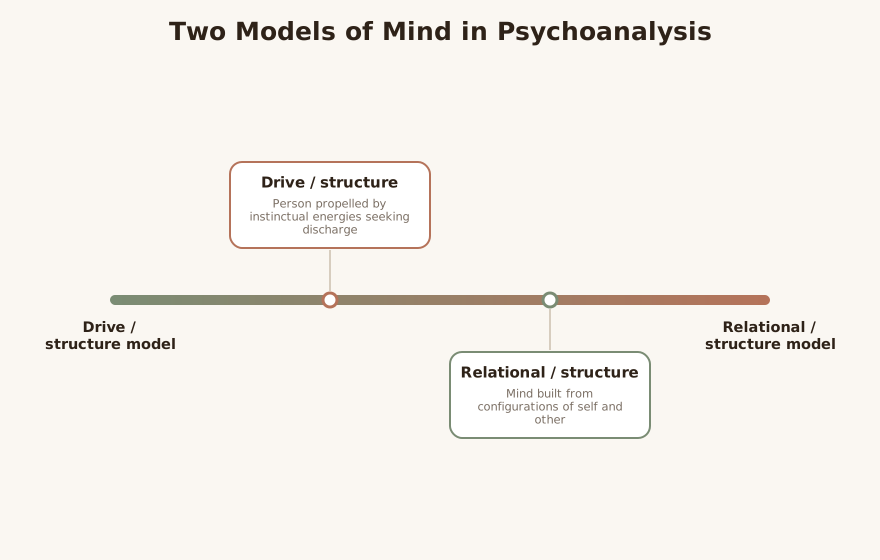
The foundational move is the rejection of Freud’s monadic, drive-centered conception in favor of a frame in which relationship is primary. 4 Greenberg and Mitchell framed this as a choice between two basic models: in the drive/structure model the person is propelled from within by instinctual energies seeking discharge, while in the relational/structure model the mind is built up from configurations of self and other in relationship. 15 The “relational matrix”—the field of actual and internalized relationships—is treated as the primary unit of psychological life. 4
Several principles follow. First, the unconscious is reconceived: not primarily repressed drive-derivatives but “non-integrated fragments that have their origin in relationship experiences.” 4 Second, the analytic situation is a two-person field; the analyst is “no longer an external, judgmental, interpretative observer, but always also a co-constituent of the psychoanalytic setting.” 4 Third, therapy proceeds through “understanding the dynamically developing intersubjective relationship” that takes shape between analyst and patient. 4
Mutuality is qualified by asymmetry. LLM Both parties shape the field and both are affected, but the relationship is not symmetrical in role, responsibility, or function—the clinician holds the frame, the ethical duty of care, and the task of reflection. LLM Affect, meaning, and self-experience are understood as emerging between people rather than residing solely inside one mind. 4
Interventions & Techniques
Relational work is less a toolkit than a stance, but recognizable techniques follow from the theory. LLM Central is sustained attention to the here-and-now of the therapeutic relationship: the clinician treats the patterns reenacted in the room as the most immediate and workable data. 4
- Working with enactment. Enactments—mutually constructed scenarios in which clinician and patient unconsciously play out a relational configuration—are treated not as technical failures to be eliminated but as inevitable and clinically rich events to be noticed, named, and metabolized. 4LLM
- Disciplined use of countertransference. The clinician’s emotional responses are read as information about the relational field rather than as contamination to be screened out, consistent with the analyst being a co-constituent of the situation. 4
- Judicious self-disclosure. Because the dyad is mutually constructed, selective, purposeful disclosure of the clinician’s experience can be a legitimate intervention, used to clarify the relational process rather than to unburden the clinician. LLM
- Interpretation reframed. Interpretation aims less at unveiling hidden drive-derivatives and more at articulating the relational configurations alive between the two people, including the patient’s experience of the analyst. 1LLM
- Negotiation and repair. Rupture and repair within the dyad are treated as a primary engine of change, with the clinician willing to acknowledge their own participation in misattunements. LLM
LLM-generated illustrative example (not a guideline): A patient repeatedly arrives late, then anxiously scans the therapist’s face for irritation. The therapist notices a pull to reassure—and a flicker of genuine irritation. Rather than interpreting the lateness as resistance, the therapist names the pattern as it lives between them: “I notice I want to quickly reassure you that I’m not angry—and I wonder if that’s a familiar dance, where you brace for someone’s anger and they rush to smooth it over.” This treats the enactment as shared data. LLM
Evidence Base
Relational psychoanalysis is established as a major contemporary psychoanalytic tradition—it is institutionally consolidated, with a dedicated international association, conferences, journals, and a substantial theoretical literature. 3 Its maturity, however, is primarily theoretical and clinical rather than experimental. LLM
Honesty requires distinguishing two senses of “evidence.” As intellectual and clinical scholarship, the tradition is deeply developed and influential. 12 As an empirically validated treatment in the randomized-controlled-trial sense, relational psychoanalysis itself has not been the subject of a large dedicated outcome-trial literature, in part because it is a sensibility informing psychodynamic practice rather than a discrete manualized protocol. LLM Clinicians should therefore present it to payers and patients as a psychodynamic framework, leaning on the broader evidence base for psychodynamic psychotherapy and on common-factors research (the therapeutic alliance, rupture–repair) that converges with relational constructs, while being candid that direct trials of “relational psychoanalysis” specifically are sparse. LLM
Populations & Indications
The framework is most often applied to adults in longer-term psychotherapy whose difficulties are characterological and relational rather than narrowly symptomatic. LLM Indicated populations include adults with chronic interpersonal problems, people with personality disorders, those with identity disturbance, clients with attachment difficulties, and trauma survivors—particularly survivors of relational or developmental trauma whose injuries occurred within attachment relationships. LLM
The relational lens is especially apt when the presenting problem is enacted in relationships rather than simply reported about them, because such patterns reliably appear in the therapeutic dyad where they can be observed and worked. 4LLM It pairs naturally with attachment-informed and object-relations conceptualizations of these same populations. 2
Problems-for-Work
- Chronic relationship patterns and interpersonal difficulties. Repetitive, self-defeating relational cycles are reframed as enacted configurations that surface in the transference, giving the dyad live material to examine. 4
- Transference and countertransference enactments. These are the central problem-for-work: the clinician’s task is to recognize the jointly constructed scenario and bring it into shared reflection rather than acting it out unconsciously. 4
- Identity disturbance and low self-esteem. Self-experience is understood as constituted within relationships, so destabilized identity is addressed by examining the internalized self-other configurations that organize the patient’s sense of who they are. 1LLM
- Relational / developmental trauma and attachment difficulties. Injuries sustained within relationships are understood to be revised within a new relationship, making the quality and reliability of the dyad itself therapeutic. LLM
- Affect dysregulation. Dysregulated affect is approached as something co-regulated in the room, with the clinician’s responsiveness and the rupture–repair process serving regulatory functions. LLM
LLM-generated illustrative example (not a guideline): A client with longstanding low self-esteem describes herself as “fundamentally too much for people.” Over months she becomes more demanding of the therapist, then apologizes profusely. The work focuses not on disputing the belief cognitively but on living through, and reflecting on, an interaction in which she is “too much” and is neither abandoned nor punished—revising an internalized self-other template in real time. LLM
Contraindications, Cautions & Cultural Humility
Relational technique grants the clinician more latitude—around self-disclosure, spontaneity, and use of countertransference—and that latitude carries risk. LLM The asymmetry of the relationship must be actively protected: mutuality of influence is not symmetry of role, and the clinician retains responsibility for the frame and the patient’s safety. LLM Self-disclosure and countertransference enactment can shade into boundary erosion or burdening the patient with the clinician’s needs if not disciplined by supervision and reflection. LLM
The approach is generally not the first choice when a focused, structured, time-limited symptom intervention is indicated, when acute risk demands stabilization, or where the patient cannot yet tolerate the ambiguity of relational exploration. LLM Cultural humility is integral rather than ornamental: because meaning and self are co-constructed, the clinician’s own cultural location, assumptions, and power shape the field. 4LLM Clinicians should hold their formulations of the patient’s relational world as tentative and collaboratively negotiated, attending to how race, culture, gender, and social power are enacted in the dyad rather than assuming a universal developmental template. LLM
Treatment-Plan Suggestions & SMART Objectives
| Goal | SMART objective (example) | Mechanism |
|---|---|---|
| Increase awareness of relational patterns | Within 8 sessions, client will identify and describe two recurring interpersonal cycles, including one as it occurs in session | Observing enacted configurations in the dyad 4 |
| Reduce reactivity in close relationships | Over 12 weeks, client will report using a pause-and-reflect step in 3 documented interpersonal conflicts | Co-regulation and reflective function developed in the relationship LLM |
| Strengthen sense of self / identity | Within 3 months, client will articulate two valued self-descriptions independent of others’ approval, rated weekly | Revising internalized self-other configurations 1 |
| Improve tolerance of relational rupture | Over 10 sessions, client will remain engaged and name feelings during at least 2 in-session misattunements rather than withdrawing | Rupture–repair within the therapeutic dyad LLM |
| Increase capacity to name countertransference-evoked dynamics | Within 6 sessions, client will collaboratively label one in-session enactment with the therapist | Making the relational field explicit and reflectable 4 |
| Reduce shame-based self-appraisal | Over 12 weeks, client will reduce self-rated shame in interpersonal situations from baseline by a meaningful margin on a standard self-report | Disconfirming relational expectancies in a new relationship LLM |
| Improve affect regulation | Within 8 weeks, client will demonstrate 3 instances of staying present with strong affect in session and naming it aloud | Affect co-regulation and containment LLM |
Common Misconceptions
- “Relational means being warm and supportive instead of analytic.” The relational turn is a claim about how mind is structured and where therapeutic action lies, not a license to abandon analytic discipline; enactment and countertransference are worked with rigor, not simply soothed away. 4LLM
- “Anything goes—self-disclosure is encouraged across the board.” Disclosure is selective and purposeful, governed by the patient’s needs and the protected asymmetry of the relationship, not a default. LLM
- “It rejects the unconscious.” It retains the unconscious but reconceives it—as non-integrated fragments rooted in relationship experience rather than as repressed drive-derivatives. 4
- “It is just interpersonal psychoanalysis renamed.” It is an integration that incorporates interpersonal ideas alongside object relations, self psychology, and attachment thinking. 2
- “It abandoned drive theory because drives don’t matter.” The argument is that mind is better organized around relational configurations than around drives as the primary motivational bedrock, a structural-theoretical claim rather than a denial of bodily life. 15
Training & Certification
There is no single licensing pathway specific to relational psychoanalysis; practitioners are typically licensed mental-health clinicians who pursue psychoanalytic or psychodynamic training and adopt a relational orientation within it. LLM Formal training has historically been associated with psychoanalytic institutes, including the William Alanson White Institute lineage central to the tradition’s development. 4
The IARPP functions as the international professional community for the orientation, supporting development of relational perspectives through conferences, colloquia and webinars, a bulletin, recorded interviews with senior clinicians, and listserv discussion; it does not, on its public materials, present itself as issuing a formal credential. 3 Clinicians generally develop competence through institute coursework, personal analysis, and ongoing case supervision rather than a discrete certificate. LLM
Key Terms
- Relational matrix: the field of actual and internalized relationships treated as the primary unit of psychological life. 4
- Drive/structure vs. relational/structure model: the two basic models of mind Greenberg and Mitchell used to organize psychoanalytic theory—mind as propelled by drives versus mind as built from relational configurations. 15
- Two-person psychology: the view that the analytic situation is a mutually constituted field rather than one mind observed by a detached other. 4
- Intersubjectivity: the dynamically developing relationship between two subjectivities that becomes the focus of analysis. 4
- Enactment: a jointly constructed, unconsciously driven relational scenario lived out between clinician and patient. 4LLM
- Mutuality and asymmetry: both parties shape and are affected by the field, yet roles, responsibilities, and functions remain unequal. LLM
Resources & Further Reading
▶ Watch — a video introduction to this concept:
- Object Relations in Psychoanalytic Theory (Greenberg & Mitchell, 1983, Harvard University Press) 1
- Relational Concepts in Psychoanalysis: An Integration (Mitchell, 1988, Harvard University Press) 2
- IARPP — International Association for Relational Psychoanalysis and Psychotherapy 3
- Relational Psychoanalysis (Sigmund Freud Museum) 4
- Object Relations in Psychoanalytic Theory — full text, “The Drive/Structure Model” (UPenn PDF) 5
Reflective / Supervision Questions
- When I notice a strong pull to reassure, advise, or self-disclose with this patient, what relational configuration might be enacting itself between us, and whose need is it serving? LLM
- How am I distinguishing mutuality of influence from symmetry of role, and where in this case is the protected asymmetry at risk? 4LLM
- What countertransference am I treating as noise that might instead be data about the patient’s relational world? 4
- How do my own cultural location and power shape the field I am calling “the patient’s pattern,” and how collaboratively have I negotiated my formulation? LLM
- Where has a rupture occurred in this work, and have I been willing to acknowledge my participation in it as part of the repair? LLM
- If I had to justify this work to a skeptical payer, how would I describe its mechanisms and measurable outcomes within a recognized psychotherapy modality? LLM