
Type & Discipline
Principlism is a framework for practical clinical ethics, not a psychotherapy modality, a manualized protocol, or a treatment to be delivered.4 It belongs to bioethics and applied moral philosophy, and within that field it is the dominant working framework for everyday clinical decision-making.6 Its method is to identify four general, prima facie binding moral principles and then to specify and balance them against one another in the concrete circumstances of a case.2 Where a single moral theory—utilitarianism, Kantian deontology, virtue ethics—asks the clinician to commit to one master account of the good, principlism deliberately stays “mid-level”: it gathers commitments that adherents of competing theories can all endorse, and uses them as a common deliberative language.4 For practicing therapists, that is its appeal and its limit: it gives a structured, shared vocabulary for reasoning about consent, risk, confidentiality, and fairness, but it does not by itself decide cases.LLM
Creators & Lineage
The framework was formulated by philosopher Tom Beauchamp and theologian-ethicist James Childress, first published in Principles of Biomedical Ethics in 1979 and now in its later editions.6 Beauchamp had also worked on the U.S. National Commission’s Belmont Report, and the four-principles approach grew out of the same post-Nuremberg, post-Tuskegee effort to give research and clinical practice an accountable ethical structure.6 Over four decades the authors have repeatedly revised the work in response to critique, refining how the principles are grounded and applied while keeping the core four intact.2 The framework draws its content from what Beauchamp and Childress call the “common morality”—the set of norms that morally serious people across traditions already share—rather than deriving the principles from a single foundational theory.2 It sits alongside other clinical-ethics methods such as casuistry (case-based reasoning) and care ethics, and is often taught beside, not against, them.6LLM
Core Principles
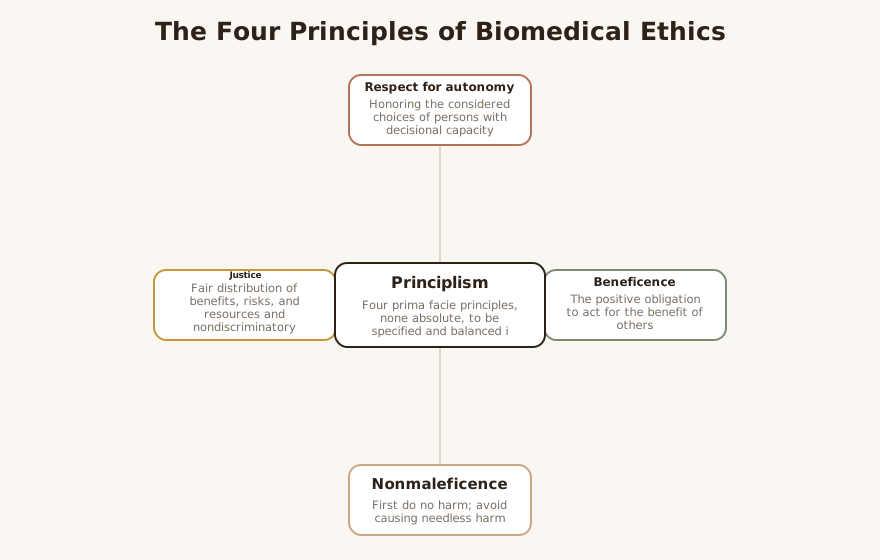
The framework rests on four principles, each binding prima facie—that is, binding unless it conflicts with an equal or stronger obligation in the specific case.3 Respect for autonomy requires honoring the considered choices of persons with decisional capacity, including their right to be informed and to refuse.4 Beneficence is the positive obligation to act for the benefit of others, weighing benefits against risks and costs.4 Nonmaleficence—the classical primum non nocere, first do no harm—obliges the clinician to avoid causing needless harm.4 Justice concerns the fair distribution of benefits, risks, and resources, and fair, nondiscriminatory treatment of persons.4 Crucially, none of the four is absolute or lexically prior to the others; they have no fixed ranking, and real cases routinely pit one against another.3 The work of ethics, on this view, is twofold: specification, narrowing an abstract principle to the case at hand, and balancing, adjudicating when principles conflict.2
Interventions & Techniques
Because principlism is a reasoning framework rather than a clinical procedure, its “techniques” are methods of deliberation, not interventions delivered to a client.LLM The standard move is to take a dilemma and ask, for each of the four principles, what it requires here—then to surface and reason through the conflicts.3 A clinician can run this as a structured case analysis: state the facts, identify which principles are engaged, specify each to the situation, and balance them transparently, documenting the reasoning.3LLM Specification turns “respect autonomy” into a concrete commitment—“obtain genuine informed consent for the exposure protocol, including the right to decline”—while balancing handles the collision when, say, a client’s autonomous refusal conflicts with the clinician’s beneficent judgment.2LLM In therapy practice the framework underwrites familiar tools: informed-consent conversations, capacity screening, confidentiality-and-limits discussions, risk assessment with duty-to-protect analysis, and consultation or ethics-committee review for hard cases.4LLM It is also a supervision and team instrument—a shared map that lets a treatment team name exactly where they disagree.LLM
Evidence Base
Honesty requires separating two senses of “established.”LLM As a normative framework, principlism is mature and authoritative: it is the most widely taught and applied approach in clinical ethics, with a deep scholarly literature and decades of refinement.62 As an empirical tool, the picture is more modest, and clinicians should say so plainly.LLM The four principles are a method for structuring moral reasoning; they are not validated to predict or improve clinical outcomes the way a treatment protocol is.LLM One line of research has even tried to measure whether people’s endorsement of the four principles predicts their actual ethical decisions, using instruments built around the principles—and found the relationship weak, raising real questions about whether the principles, as measured, drive decisions.1 The framework has also drawn sustained philosophical critique: that four mid-level principles without a fixed hierarchy give little action-guidance when they conflict, leaving “balancing” underspecified and potentially arbitrary.6 Beauchamp and Childress have answered these objections across editions, but the framework is best presented as a rigorously developed deliberative method, not as an evidence-based algorithm that resolves cases on its own.2LLM
Populations & Indications
Principlism is indicated whenever a therapist faces an ethical—rather than a purely clinical—decision, and it is especially useful where the four principles visibly pull apart.3LLM It is central to work with clients facing high-stakes medical or treatment decisions, where autonomy and beneficence must be weighed explicitly.4LLM It is essential with minors and their guardians, and with clients whose decisional capacity is impaired or fluctuating—because respect for autonomy presupposes capacity, and its absence shifts weight toward beneficence and surrogate decision-making.4LLM It guides care for older adults navigating consent and dependency, and for clients at risk of harm to self or others, where nonmaleficence and a duty to protect may bound autonomy.4LLM The justice principle makes the framework directly relevant to marginalized and under-resourced populations and to questions of access and fair allocation.4 It is also foundational to research ethics, where informed consent and equitable participant selection trace back to the same lineage.6
Problems-for-Work
The framework helps most when a clinician can name which principle is in tension with which.LLM For informed-consent and capacity questions, autonomy specifies the duty to disclose and to honor competent choice, while a capacity deficit redistributes responsibility toward beneficence.4LLM For confidentiality versus duty-to-protect conflicts, nonmaleficence toward a potential victim is balanced against the autonomy and confidentiality owed the client.4LLM For treatment refusal, the framework legitimizes a capacitated client’s right to decline even beneficial care, rather than overriding it reflexively.4LLM For coercion and undue influence, respect for autonomy flags pressures—family, institutional, financial—that compromise voluntary choice.4LLM For boundary and dual-relationship dilemmas, nonmaleficence and beneficence anchor the analysis of foreseeable harm and benefit.LLM For resource and access inequities and for clinician moral distress, the justice principle and transparent balancing give language to what is otherwise a diffuse sense of wrongness.4LLM
LLM-generated illustrative example (not a guideline): A capacitated adult client declines a clinically indicated higher level of care. The therapist maps the case: respect for autonomy supports the client’s informed refusal; beneficence and nonmaleficence raise concern about deterioration. Specifying and balancing them—rather than overriding the refusal—the clinician documents an enhanced safety plan, clarified limits, and a reassessment timeline, honoring autonomy while discharging the duty of care.LLM
Contraindications, Cautions & Cultural Humility
Principlism’s chief hazard is being mistaken for an algorithm.LLM Because the four principles carry no fixed ranking and “balancing” is not formula-bound, a clinician can reach the conclusion they already favored and then dress it in principlist language—a real risk the framework’s critics emphasize.6LLM It should therefore be used to open deliberation and consultation, not to foreclose it; hard cases warrant supervision or ethics-committee review.3 Two further cautions are especially salient in therapy.LLM First, the framework’s center of gravity is individual autonomy, which reflects a particular—largely Western, liberal—moral outlook; in collectivist and family-centered cultures, decision-making may be relational by design, and treating individual autonomy as the default can itself be a harm.6LLM Cultural humility means specifying autonomy in a way that respects how this client and family actually locate decisional authority.LLM Second, justice obligates the clinician to notice how access, bias, and resource constraints fall unequally on marginalized clients, rather than treating each case as a closed dyad.4LLM Finally, principlism is not a substitute for jurisdiction-specific law, licensing-board ethics codes, or mandatory-reporting duties, which constrain what balancing is permissible.LLM
Treatment-Plan Suggestions & SMART Objectives
| Goal | SMART objective (example) | Mechanism |
|---|---|---|
| Strengthen informed, autonomous decision-making | Within 3 sessions, client states in their own words the rationale, risks, and alternatives of the proposed plan and documents a considered choice | Specifying respect for autonomy into genuine informed consent 4LLM |
| Resolve a confidentiality vs. safety conflict | Within 1 session of a disclosed risk, clinician completes a structured four-principle analysis and a written duty-to-protect decision | Balancing nonmaleficence against confidentiality and autonomy 4LLM |
| Clarify capacity and surrogate roles | Within 2 sessions, clinician completes a capacity screen and, if needed, identifies the appropriate surrogate decision-maker | Shifting weight from autonomy to beneficence when capacity is impaired 4LLM |
| Reduce coercion in treatment choices | Over 4 weeks, client identifies external pressures on a pending decision and reaches a choice rated as voluntary on a self-report check | Protecting voluntariness as a condition of autonomy 4LLM |
| Address access/justice barriers | Within 4 weeks, clinician documents 2 concrete steps taken to mitigate an identified access or resource inequity affecting care | Operationalizing the justice principle 4LLM |
| Improve risk-benefit transparency | By session 4, clinician and client co-document the benefits, risks, and costs of the treatment plan and review them | Making beneficence/nonmaleficence balancing explicit 4LLM |
| Reduce clinician moral distress | Over 6 weeks, clinician brings 2 value-conflict cases to supervision using a four-principle case-analysis format | Naming and structuring the principle conflict 3LLM |
Common Misconceptions
A frequent error is treating the four principles as a ranked checklist that mechanically yields the right answer; in fact the principles are prima facie and unranked, and the framework explicitly requires case-specific specification and balancing.32 A second is collapsing the whole framework into “autonomy first,” as if respecting choice always trumps the other three—it does not, and beneficence, nonmaleficence, and justice can outweigh autonomy in a given case.3 A third is assuming principlism is itself a complete moral theory; it is deliberately mid-level, assembling shared norms rather than deriving everything from one foundation.4 A fourth is reading the empirical critique—that endorsing the principles weakly predicts actual decisions—as proof the framework is useless; more cautiously, it shows the principles are a reasoning aid, not a behavioral lever.1LLM Finally, principlism is sometimes confused with simple “common sense” or with following a code of conduct, when its value lies precisely in forcing explicit, transparent reasoning about conflicts a code leaves unresolved.6LLM
Training & Certification
There is no certification or credential in “principlism,” because it is an ethics framework taught as part of professional formation, not a licensable clinical method.LLM Most therapists first encounter it in graduate ethics, health-care ethics, or research-ethics coursework, and through their discipline’s code of ethics, which embeds versions of the same commitments.4LLM The authoritative primary text is Beauchamp and Childress’s Principles of Biomedical Ethics, now in its later editions, and clinicians who want depth should read it directly.5 Accessible secondary introductions include the University of Washington’s Ethics in Medicine overview and the UK Clinical Ethics Network’s framework guidance, both written for practitioners.43 Applied competence is best developed not through a course alone but through structured case discussion, ethics consultation, and supervision in which the four-principle analysis is practiced on real dilemmas.3LLM
Key Terms
- Prima facie principle: A principle that is binding unless, in the specific case, it is outweighed by an equal or stronger obligation.3
- Respect for autonomy: The obligation to honor the informed, voluntary choices of persons with decisional capacity, including refusal.4
- Beneficence: The positive duty to act for others’ benefit, weighing benefits against risks and costs.4
- Nonmaleficence: The duty to avoid inflicting needless harm—primum non nocere.4
- Justice: Fair, nondiscriminatory treatment and equitable distribution of benefits, risks, and resources.4
- Specification: Narrowing an abstract principle to the concrete demands of a particular case.2
- Balancing: Adjudicating between principles when they conflict, with transparent reasons.2
- Common morality: The shared set of norms held by morally serious people, from which the principles draw their content.2
Resources & Further Reading
▶ Watch — a video introduction to this concept:
- The four principles: Can they be measured and do they predict ethical decision making? (PMC)
- Forty Years of the Four Principles: Enduring Themes from Beauchamp and Childress (Journal of Medicine and Philosophy)
- Four Principles — UK Clinical Ethics Network (UKCEN)
- Principles of Bioethics — University of Washington Department of Bioethics & Humanities
- Principles of Biomedical Ethics — Beauchamp & Childress (OUP)
- Principlism — Wikipedia
Reflective / Supervision Questions
- In my last ethical dilemma, can I name which of the four principles were in conflict—or did I reach for the conclusion I already preferred and justify it afterward?6LLM
- Where do I default to “autonomy first,” and are there cases where beneficence, nonmaleficence, or justice should carry more weight?3LLM
- How does this particular client and family actually locate decisional authority, and am I imposing an individualistic model of autonomy that does not fit them?6LLM
- When I specify and balance principles, is my reasoning transparent enough that a supervisor or ethics committee could follow and challenge it?3LLM
- Where is the justice principle asking me to look beyond the consulting room—at access, bias, or resource constraints shaping this client’s options?4LLM
- For which recurring dilemmas in my caseload would a standing four-principle case-analysis format, brought to supervision, reduce my moral distress?3LLM