
Type & Discipline
The ethics of care is a normative moral theory within Western philosophy and moral psychology, belonging to the family of feminist and relational moral philosophy.1 It is not a clinical treatment, a psychotherapy modality, or a manualized protocol; it is a meta-ethical stance about what makes actions and relationships good.LLM Where deontology asks which universal rule applies and consequentialism asks which outcome maximizes the good, care ethics asks what this particular relationship, in this concrete context, needs in order to be sustained well.1 For practicing therapists, that distinction matters: care ethics describes the moral texture of the helping relationship itself, and it offers a vocabulary for the relational work clinicians already do.LLM
Creators & Lineage
The theory has two principal architects.4 Carol Gilligan, a developmental psychologist, identified care ethics empirically by challenging Lawrence Kohlberg’s stage theory of moral development, on which girls tended to score lower than boys.1 In In a Different Voice, Gilligan argued this reflected not deficient reasoning but a different and equally legitimate orientation: a “morality of responsibility” attentive to relationships, set alongside Kohlberg’s “morality of rights” oriented to independence and abstract justice.2 Nel Noddings, an educational philosopher, then gave the perspective its systematic ethical structure in Caring (1984).3 Its lineage runs through feminist ethics and moral psychology, and it sits beside relational-cultural theory as a clinically oriented cousin.2LLM
Core Principles
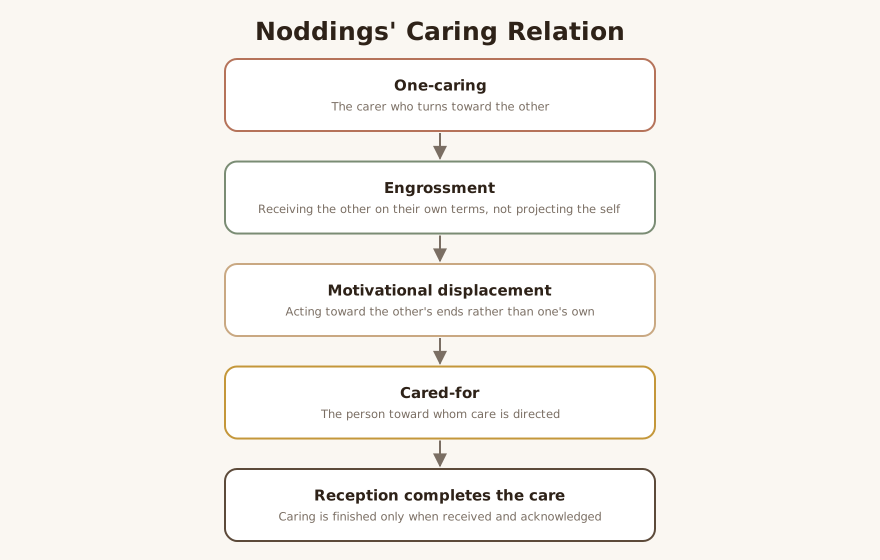
Care ethics holds that morality is grounded in actual relationships and lived practice rather than hypothetical dilemmas or impartial rules.1 Noddings frames the moral situation as a dyad between the “one-caring” and the “cared-for,” in which caring is completed only when it is received and acknowledged by the cared-for.3 She distinguishes natural caring, which flows from spontaneous affective response, from ethical caring, which is summoned from our memory of having been cared for when natural inclination fails.1 Central to genuine care is “engrossment”: receiving the other on their own terms while resisting the projection of one’s own self onto them, accompanied by a “motivational displacement” toward the other’s ends.1 Care ethics also values emotion, vulnerability, and interdependence rather than treating detached autonomy as the moral ideal.4
Interventions & Techniques
There are no manualized “ethics of care” interventions; the theory shapes therapeutic posture rather than supplying procedures.LLM In practice it informs how a clinician attends—prioritizing attunement, receptive listening, and responsiveness to the particular person over the formulaic application of technique.4 Noddings’ concept of engrossment maps closely onto clinical empathic attunement: receiving the client’s experience without overlaying the therapist’s assumptions.3LLM Motivational displacement parallels the therapist’s orientation toward the client’s goals rather than their own agenda.LLM Care ethics can be operationalized through reflective practice on relational rupture and repair, through care-centered informed consent that foregrounds the client’s concrete situation, and through supervision that examines the moral quality of the alliance.LLM Relational-cultural therapy offers the most developed clinical translation of these commitments, treating growth-fostering connection itself as the mechanism of change.LLM
Evidence Base
Honesty requires distinguishing two senses of “established.”LLM As moral philosophy, care ethics is mature and well-established: it has a deep scholarly literature, standard encyclopedia entries, and decades of academic debate.12 As a clinical intervention, it has essentially no evidence base—there are no randomized controlled trials of “ethics of care therapy,” because it is not a discrete treatment to be trialed.LLM Its empirical origin lies in Gilligan’s developmental research on moral reasoning, not in outcome studies of psychological symptoms.1 Clinicians should therefore present it as a values framework and relational lens, never as an evidence-based protocol with demonstrated efficacy.LLM Where measurable clinical traction exists, it is through descendant approaches such as relational-cultural therapy, not through care ethics as such.LLM
Populations & Indications
Care ethics is especially resonant for caregivers, healthcare and other helping professionals, and people occupying intensive relational roles, because it names the moral labor and the relational vulnerability inherent in caring for others.4LLM It speaks directly to families and couples, where moral life is conducted through concrete, particular obligations rather than abstract fairness.4LLM Historically it emerged from and centers women’s experience of relationship and responsibility, though contemporary scholarship treats the care orientation as a human capacity rather than an essentially female one.2 It also bears on work with marginalized and dependent populations, where webs of care and need—rather than contracts between equal autonomous agents—structure the ethical terrain.7LLM
Problems-for-Work
Care ethics provides a useful frame for several presenting concerns, though always as a lens layered onto an evidence-based modality.LLM For caregiver burnout and compassion fatigue, it helps articulate that one-way, unreciprocated caring is unsustainable, legitimizing the caregiver’s own need to be cared for.1LLM For moral distress, it gives language to the felt wrongness of being unable to provide the care a situation demands.LLM For boundary difficulties and self-neglect, it reframes self-care not as selfishness but as a precondition of authentic caring.LLM For relational conflict, interpersonal disconnection, and empathy deficits, it directs attention to repairing connection rather than adjudicating who was right.LLM
LLM-generated illustrative example (not a guideline): A hospice nurse presents with exhaustion and guilt. Reframed through care ethics within an ACT-informed treatment, she examines how unreciprocated caring has eroded her, and clarifies that sustaining her own care is what makes continued caring for patients possible—not a betrayal of it.LLM
Contraindications, Cautions & Cultural Humility
The theory’s own critics flag the clinical risks.1 Care ethics has been charged with essentialism—wrongly assuming women uniformly possess caring dispositions—and with romanticizing traditionally feminine roles shaped by oppression.12 The “slave morality” critique warns that valorizing self-sacrifice can encourage clients, especially women and exploited caregivers, to accept disadvantageous positions rather than demand justice.1 Applied uncritically in therapy, this could reinforce a self-neglecting client’s belief that endless self-abnegation is virtuous—an iatrogenic risk the clinician must actively guard against.LLM Care ethics has also been criticized as parochial, privileging proximate relationships over distant or systemic obligations, and as lacking clear action-guiding principles.1 Cultural humility is essential: norms of care, dependence, and reciprocity vary widely across cultures, and the dyadic mother-child model underlying the theory should not be universalized.1LLM
Treatment-Plan Suggestions & SMART Objectives
| Goal | SMART objective (example) | Mechanism |
|---|---|---|
| Reduce caregiver burnout | Within 8 weeks, client identifies and acts on 3 of her own care needs weekly, rated via a self-report log | Restoring reciprocity to one-way caring 1LLM |
| Address moral distress | Within 6 sessions, client articulates the value conflict in 2 distressing situations and one tolerable response to each | Naming the gap between care owed and care possible LLM |
| Improve boundary-setting | Over 10 weeks, client declines 2 over-extending requests weekly without guilt rated >4/10 | Reframing self-care as precondition of caring LLM |
| Reduce compassion fatigue | Within 8 weeks, client implements a daily restorative practice on 5/7 days, tracked in a diary | Replenishing the capacity for ethical caring 1LLM |
| Repair relational disconnection | Within 12 sessions, client initiates 1 repair conversation with a key relationship and reports felt reconnection | Prioritizing connection over adjudication LLM |
| Strengthen empathic attunement | Within 6 sessions, client demonstrates reflective listening in 2 logged interactions per week | Practicing engrossment and motivational displacement 1LLM |
| Reduce self-neglect | Over 8 weeks, client meets 2 basic self-care targets daily, verified by partner or log | Affirming the caregiver as also worthy of care 3LLM |
Common Misconceptions
A frequent error is treating care ethics as an evidence-based treatment; it is a moral theory with no clinical trial base.LLM Another is equating it with simply “being nice” or with limitless self-sacrifice—Noddings’ framework actually requires that caring be completed by reception and that the one-caring not be consumed.3 It is also wrongly assumed to be exclusively about women or to claim women are morally superior; Gilligan framed the difference thematically rather than strictly by gender, and contemporary work treats care as a human orientation.12 Finally, it does not reject justice or rules wholesale; it argues that impartial principles alone are an incomplete account of moral life.4
Training & Certification
There is no certification, credential, or licensure in “ethics of care,” because it is an academic moral theory rather than a clinical method.LLM Clinicians typically encounter it through graduate coursework in ethics, feminist theory, or moral psychology, and through primary texts—most centrally Gilligan’s In a Different Voice and Noddings’ Caring.23 Therapists who wish to apply its commitments clinically are better served by training in relational-cultural therapy, which has its own institutes, training pathways, and supervision structures.LLM Accessible introductions for self-study include the encyclopedia entries, the Ethics Centre explainer, and popular treatments such as the Philosophize This! podcast episode.45
Key Terms
- One-caring / cared-for: The two roles in Noddings’ caring dyad; caring is completed only when received by the cared-for.3
- Engrossment: Receiving the other on their own terms, resisting projection of one’s own self onto them.1
- Motivational displacement: The shift of the carer’s motive energy toward the cared-for’s ends and needs.1
- Natural caring: Caring that flows spontaneously from affective inclination.1
- Ethical caring: Caring summoned from the memory of having been cared for, when natural inclination is absent.1
- Care vs. justice: The contrast between a morality of relationship and responsibility and one of rights, autonomy, and impartial rule.2
Resources & Further Reading
▶ Watch — a video introduction to this concept:
- Care Ethics — Internet Encyclopedia of Philosophy
- Feminist Ethics — Stanford Encyclopedia of Philosophy
- Caring: A Feminine Approach to Ethics and Moral Education (Noddings, 1984) — UC Press
- Ethics Explainer: Ethics of Care — The Ethics Centre
- Introduction to an Ethics of Care — Philosophize This!
- The Ethics of Care — YouTube
- Ethics of care — Wikipedia
Reflective / Supervision Questions
- In my caseload, where am I applying impartial “rules” when this particular client and relationship may need a more contextual, responsive stance?LLM
- How do I know when caring has been received by a client, and what do I do when it has not?3LLM
- Where might I be inadvertently reinforcing a client’s self-sacrificing “slave morality” rather than supporting their legitimate claim to be cared for?1LLM
- How is my own capacity for ethical caring being replenished—am I the one-caring who is no longer being cared for?1LLM
- Whose cultural norms of care, dependence, and reciprocity am I assuming, and how might they differ from my client’s?1LLM