
Type & Discipline
The Ethics of the Other, or alterity, is a strand of twentieth-century Western moral philosophy rooted in phenomenology rather than a clinical method or treatment model 1. It is most closely associated with Emmanuel Levinas, who argued that ethics — not metaphysics or ontology — should be understood as “first philosophy,” the ground on which all other inquiry stands 1. For the practicing therapist this matters because the concept does not deliver techniques; it delivers a way of seeing the clinical encounter, a moral phenomenology of what happens when one person turns to face another LLM.
The discipline is continental philosophy in the phenomenological tradition, the lineage of Husserl and Heidegger, under whom Levinas studied in Freiburg in 1928–29 2. Where Husserl described how consciousness intends its objects and Heidegger asked after the meaning of being, Levinas redirected the question: before I know or comprehend anything, I am already addressed and obligated by another person 1. This article treats alterity as a clinical sensibility — a frame for empathy, presence, and the asymmetry of the helping relationship — while remaining explicit that it is a philosophy, not an evidence-based intervention LLM.
Creators & Lineage
Emmanuel Levinas (1905–1995) was born in Kaunas, Lithuania, and died in Paris 2. He began philosophy studies at Strasbourg in 1923 and attended seminars with Edmund Husserl and Martin Heidegger at Freiburg, whose phenomenological methods decisively shaped his thinking 2. Imprisoned by the Nazis during the Second World War, he survived to become one of the century’s most influential moral philosophers 1.
Levinas came to formal Jewish study relatively late, learning Talmud in postwar Paris with the enigmatic teacher known as Monsieur Chouchani, and his first essays on Jewish thought, Difficile liberté (Difficult Freedom), appeared in 1963 2. His two major philosophical works are Totality and Infinity (1961), which presents ethics as the interruption of being’s totality by the infinite alterity of the Other, and Otherwise than Being, or Beyond Essence (1974), which deepens that account into a description of the subject as constituted by responsibility 12. The lineage runs from phenomenology into existential philosophy and, by extension, into existential psychotherapy and the ethics of care, where his vocabulary of responsibility, vulnerability, and the face continues to be taught and studied 56.
Core Principles
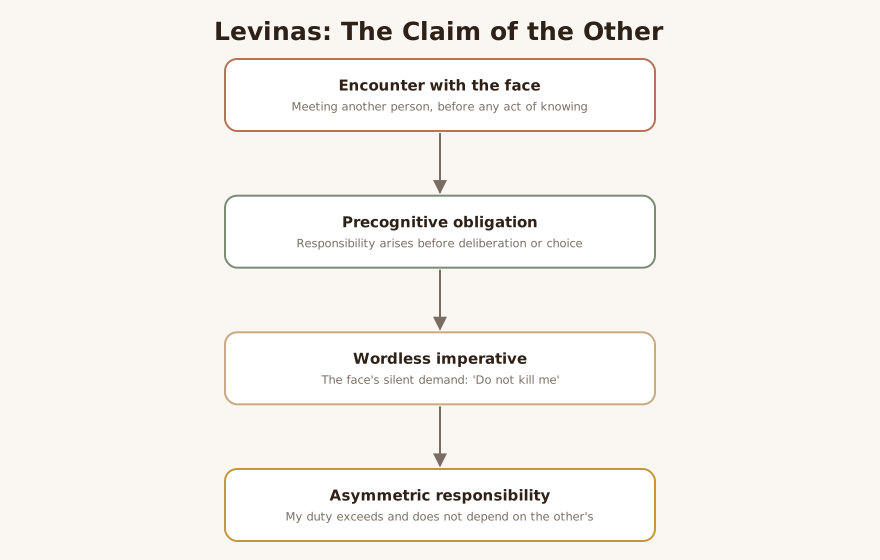
The central claim is that the encounter with another person is not first a problem of knowledge but an event of obligation 1. Responsibility arises, in Levinas’s terms, at a “precognitive level” — it is in place before I deliberate, choose, or form a judgment about the person in front of me 1. The other person’s face poses a wordless imperative, which Levinas condenses as “Do not kill me,” interrupting my freedom and self-interest 1.
Two technical ideas organize everything else: alterity and asymmetry. Alterity is the radical otherness of the Other, the insistence that others “always remain irreducible to representation” and cannot be assimilated into my consciousness — “the Other is what I myself am not” 4. The Other is not a mirror of me, not an alter ego, but genuinely exterior 4. Asymmetry means the relation lacks reciprocity: my responsibility for the Other exceeds, and does not depend on, the Other’s responsibility for me 4. “Our relations are never reversible,” and I cannot offset my duty by appealing to what the Other owes me in return 43.
Levinas links these to a critique of “totality” — the philosophical and political tendency to absorb difference into a single system, reducing the other to a category I already possess 1. The face resists this; it introduces “infinity,” a claim that “cannot be satisfied” and that deepens rather than fulfills desire 1. In his later work he distinguishes the “Saying” — the pre-linguistic exposure and sincerity that underlies any communication — from the “Said,” the propositional content that always risks flattening that living immediacy 1. Responsibility, at its most radical, is described as “substitution”: the self existing for-another, a fundamental passivity in which “all my inwardness is invested” in the other person 1.
Interventions & Techniques
Levinas wrote no manual and prescribed no exercises; what follows are clinical translations, not Levinasian doctrine LLM. The first “intervention” is a stance: meeting the client as irreducibly other, resisting the clinician’s natural move to file the person under a familiar formulation before they have finished speaking 4. This is a disciplined suspicion of premature totalization — holding the diagnosis lightly so the person is not reduced to the category 1LLM.
A second translation is attention to the face-to-face structure of contact: the wordless register of expression, vulnerability, and address that precedes and exceeds the content of what is said 3. Clinically this maps onto presence, unhurried attunement, and the willingness to be affected by the person rather than only to process information about them 3LLM. A third is honoring asymmetry: the therapeutic relationship is structurally non-reciprocal, and the clinician’s obligation does not wait for the client to earn it or reciprocate it 4LLM.
LLM-generated illustrative example (not a guideline): A therapist notices she has mentally “solved” a new client within ten minutes — “avoidant, intellectualizing, like the last three.” A Levinasian discipline would have her treat that closure as a warning sign of totalization, deliberately reopen the encounter, and ask what about this person she has not yet allowed herself to be surprised by LLM.
Evidence Base
Honesty requires a clear statement: this is an established philosophy, not an empirically validated treatment 1. Its maturity is intellectual and scholarly — a large, peer-engaged literature spanning phenomenology, ethics, theology, and political philosophy — not clinical 1. There are no randomized trials of “Levinasian therapy,” no manualized protocol, and no outcome data, because alterity is not a therapy LLM.
What it offers the evidence-minded clinician is conceptual scaffolding for constructs that are studied: empathy, therapeutic presence, the working alliance, and the ethics of care 4LLM. Levinas’s account of asymmetric, non-reciprocal responsibility resonates with how the alliance is theorized, and his critique of reducing persons to categories anticipates clinical cautions about over-identification with diagnosis 14LLM. Used this way — as a source of clinical philosophy rather than evidence of efficacy — the framework is durable and well-developed, but it must be paired with empirically supported modalities for any specific treatment claim LLM.
Populations & Indications
Because alterity is a sensibility rather than a protocol, its primary “population” is arguably clinicians and therapists themselves, as a discipline of attention and humility in the consulting room 5LLM. Among clients, it has natural affinity with adults in existential therapy who are grappling with meaning, obligation, and the boundaries of the self 1LLM. Caregivers — formal and informal — often live the asymmetric structure Levinas describes, giving without symmetrical return, and may find his framing both validating and clarifying 4LLM.
The framework speaks to people struggling with empathy or relationships, where the difficulty is precisely a failure to register the other as genuinely other 4LLM. Spiritual seekers may find resonance given Levinas’s own grounding in Jewish thought and his language of election and responsibility 2LLM. Individuals in moral crisis — wrestling with guilt, obligation, or what they owe others — encounter in alterity a vocabulary that takes their moral seriousness seriously rather than pathologizing it 1LLM.
Problems-for-Work
Empathy deficits and narcissistic patterns. Levinas’s account names the core difficulty: the other has been collapsed into a function of the self, an alter ego rather than a genuine Other 4. Therapeutically, the work is to restore the experience of alterity — that the other person exceeds one’s representations of them 4LLM.
LLM-generated illustrative example (not a guideline): A client who describes his partner only in terms of how she fails to meet his needs is gently invited to articulate one thing about her inner life he genuinely cannot predict — a small exercise in encountering her as other rather than as instrument LLM.
Interpersonal disconnection, relational conflict, and alienation. Where connection has flattened into mutual objectification, the face-to-face frame reorients toward the wordless register of address and vulnerability that precedes argument 3LLM.
Moral and existential distress, meaning-related distress. For clients in moral crisis, the asymmetry of responsibility can be both burden and orientation; the clinical task is to hold the seriousness of obligation without letting it become crushing 14LLM.
Compassion fatigue. Levinas’s “infinite” responsibility, taken literally, risks burnout; here the philosophy is best used diagnostically — to name why caregiving feels boundless — while clinical work introduces the corrective of limits, which Levinas himself approaches through “the third party” and justice 1LLM.
Contraindications, Cautions & Cultural Humility
The most important caution is the one the framework itself supplies. Responsibility for the Other is described as “infinite,” “constantly present,” and “relentlessly renewed,” an “immense burden” laid on us by every human being we encounter 3. Presented to a client who is already over-responsible, scrupulous, depressed, or in compassion fatigue, this can be actively harmful — reinforcing self-abnegation rather than relieving it 3LLM. The clinician must translate, not transmit: alterity is a lens for the therapist’s own posture far more safely than a directive handed to a vulnerable client LLM.
Levinas’s own answer to runaway obligation is the “third party” — the moment when more than one Other appears and the question of justice, calculation, and limits necessarily enters, requiring law and fair distribution 1. Clinically this is the warrant for boundaries: care for one cannot be unlimited because it must be just among many 1LLM. Cultural humility follows directly from alterity’s core: the insistence that the other is irreducible to my categories is itself a caution against imposing a culturally specific moral idiom — including Levinas’s own — onto clients whose frameworks differ 4LLM. The notion of asymmetric self-sacrifice carries gendered and cultural histories of expected caregiving that the clinician should hold critically rather than valorize uncritically LLM.
Treatment-Plan Suggestions & SMART Objectives
| Goal | SMART objective (example) | Mechanism |
|---|---|---|
| Increase perspective-taking in a client with empathy deficits | Within 8 sessions, client will identify, in 3 separate logged instances, an aspect of another person’s experience he could not predict in advance | Restoring alterity — the other as irreducible, not an alter ego 4 |
| Reduce relational objectification of a partner | Over 6 weeks, client will practice and report 4 “face-to-face” check-ins focused on the partner’s expressed feeling rather than content of disagreement | Attending to the pre-reflective register of address and vulnerability 3 |
| Relieve over-responsibility in moral distress | Within 10 sessions, client will articulate 3 situations where competing obligations (“the third party”) justify limiting any single duty | Justice and limit as the corrective to “infinite” responsibility 1 |
| Address compassion fatigue in a caregiver | Over 4 weeks, client will name the asymmetric structure of her caregiving in writing and define 2 concrete personal limits | Naming asymmetry, then bounding it through justice among many 14 |
| Reduce alienation/disconnection | Within 8 sessions, client will report 3 encounters in which he allowed himself to be affected by another rather than only managing the interaction | The “Saying” — exposure and sincerity beneath the “Said” 1 |
| Strengthen the working alliance frame for the clinician | Each session, clinician will note one moment of premature “totalization” of the client and deliberately reopen curiosity | Resisting reduction of the person to a category 14 |
| Support meaning-making in existential distress | Over 12 sessions, client will connect 2 personal sources of meaning to felt obligations toward specific others | Responsibility-for-the-Other as a source of meaning 1 |
Common Misconceptions
A frequent error is treating “Ethics of the Other” as a therapy with techniques; it is a moral phenomenology, and its clinical use is interpretive rather than procedural 1LLM. Another is reading alterity as mere tolerance of difference or diversity; Levinas means something far stronger — a radical, non-reducible otherness that resists all assimilation to the same, not a catalogue of differing traits 4.
People also mistake the face (visage) for the literal physical face; Levinas uses it to mean the site where ethical demand originates, the way the other addresses and exceeds me, not facial features one could photograph 3. The relationship he describes is sometimes conflated with Buber’s mutual “I–Thou,” but Levinas explicitly rejects reciprocity: the relation is asymmetric, “never reversible,” not a meeting of equals 4. Finally, the language of infinite responsibility is misread as a recipe for self-sacrifice without limit, when Levinas’s own appeal to the third party and justice introduces measure and constraint 1.
Training & Certification
There is no certification in alterity, and any clinician claiming one should be regarded skeptically — it is an academic philosophy, not a credentialed clinical method LLM. Engagement happens through study rather than licensure: primary texts (Totality and Infinity; Otherwise than Being) and reference scholarship such as the Stanford Encyclopedia of Philosophy entry provide the rigorous grounding 12. Accessible secondary routes include continuing-education-style courses, for example the Brooklyn Institute for Social Research’s seminar “Emmanuel Levinas: Philosophy in the Face of the Other,” and recorded university lectures on Levinas and the face of the Other 56.
For clinicians, the most useful “training” is supervised reflection: bringing the framework into case consultation and existential-therapy supervision, where the abstractions are tested against actual clinical encounters 5LLM. Pairing this reading with formal training in an evidence-based modality keeps the philosophy in its proper role — informing stance and conceptualization, not substituting for clinical competence LLM.
Key Terms
Alterity — the radical otherness of the Other; the insistence that others remain irreducible to my representation or consciousness, “what I myself am not” 4.
Asymmetry — the non-reciprocal structure of ethical relation; my responsibility for the Other exceeds and does not depend on the Other’s for me, and “our relations are never reversible” 4.
The face (visage) — the site where ethical obligation originates; the way the Other addresses, resists objectification, and commands “Do not kill me,” irreducible to physical features 31.
Ethics as first philosophy — Levinas’s thesis that ethics, not ontology or metaphysics, is foundational; obligation precedes knowledge at a precognitive level 1.
Totality — the system or concept that absorbs difference into the same; alterity and “infinity” resist it 1.
Saying and Said — the pre-linguistic exposure and sincerity (Saying) underlying communication, versus its propositional content (Said), which risks flattening immediacy 1.
Substitution — the radical form of responsibility in which the self exists for-another, a passivity where “all my inwardness is invested” in the Other 1.
The third party — the appearance of more than one Other, introducing justice, calculation, and limit into otherwise boundless responsibility 1.
Resources & Further Reading
▶ Watch — a video introduction to this concept:
- Emmanuel Levinas — Stanford Encyclopedia of Philosophy (rigorous primary reference) 1
- Emmanuel Lévinas — Encyclopaedia Britannica (concise biography and overview) 2
- Facing the Other: Levinas on the Face-to-Face Encounter — TheCollector (accessible explainer) 3
- Alterity and Asymmetry in Levinas’s Ethical Phenomenology — Journal of Scriptural Reasoning (focused scholarly treatment) 4
- Emmanuel Levinas: Philosophy in the Face of the Other — Brooklyn Institute for Social Research (continuing-education seminar) 5
- Emmanuel Levinas and the Face of the Other — lecture (video) (introductory lecture) 6
Reflective / Supervision Questions
- Where in my caseload do I notice myself “totalizing” a client — closing them into a formulation before they are finished revealing themselves — and what would reopening that encounter require 1?
- How do I hold the structural asymmetry of the therapeutic relationship — my responsibility that does not wait for reciprocity — without it tipping into over-responsibility or burnout 43?
- When a client presents with empathy deficits or narcissistic patterns, can I help them recover the experience of the other as genuinely other, rather than as a function of their own needs 4?
- For clients in moral or existential distress, how do I honor the seriousness of their sense of obligation while introducing the corrective of justice and limit (“the third party”) 1?
- Whose moral idiom is operating in the room — mine, the client’s, or Levinas’s — and how does the principle of alterity itself caution me against imposing any of them 4?