
Type & Discipline
Principled negotiation is a framework, not a psychotherapy. It originates in the discipline of negotiation and conflict studies and belongs to the family of interest-based (as opposed to positional) bargaining 4. It is also called “negotiation on the merits,” with the stated aim of producing wise outcomes efficiently and amicably 1. Its lineage runs through conflict resolution and mediation, interest-based bargaining, and communication skills training, with conceptual roots in game-theoretic reasoning about how parties with differing interests can reach agreement 3.
Clinicians encounter principled negotiation not as a treatment protocol but as a portable structure for teaching couples, families, co-parents, and colleagues how to disagree productively LLM. In a therapeutic context it functions most naturally as a content module inside broader communication and conflict-resolution work rather than as a freestanding modality LLM.
Creators & Lineage
The framework was developed by Roger Fisher, William Ury, and Bruce Patton of the Harvard Negotiation Project and laid out in Getting to Yes: Negotiating Agreement Without Giving In 3. The book was first published in 1981 by Fisher and Ury; Patton joined as co-author for the 1991 second edition and remained through the 2011 third edition 3. As of 2022 it had sold roughly 15 million copies across more than 35 languages, making it one of the most widely read texts in the field 3.
The method was explicitly framed as an alternative to “positional bargaining,” in which each side stakes out and defends a fixed demand 4. Its intellectual neighbors are mediation practice, interest-based bargaining in labor relations, and structured communication-skills training—lineages that clinicians already draw on when teaching conflict de-escalation LLM.
Core Principles
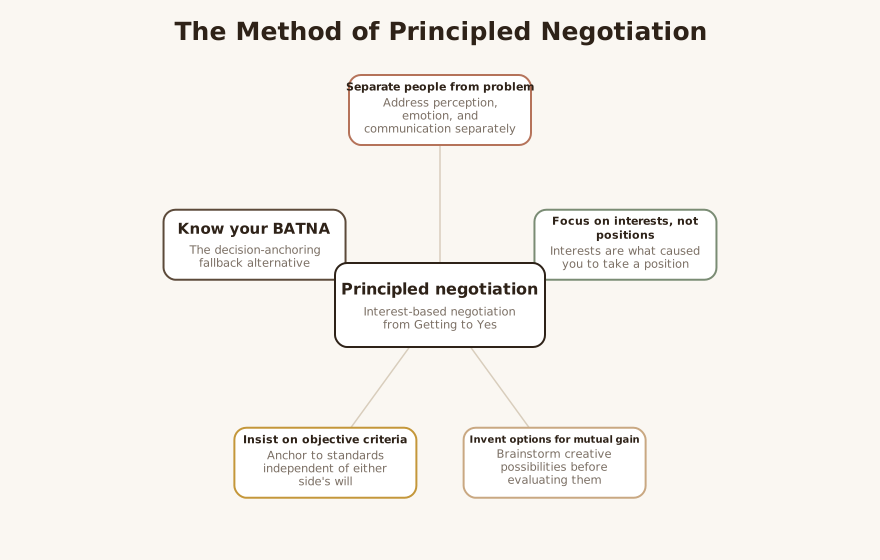
The framework rests on four method elements plus one decision-anchoring concept. Separate the people from the problem: address perception, emotion, and communication breakdowns as distinct from the substantive issue, using active listening, acknowledging feelings without judgment, and reframing disputes as shared challenges 2. Focus on interests, not positions: as Fisher and Ury put it, “Your position is something you have decided upon. Your interests are what caused you to so decide” 2. Multiple positions can serve the same underlying interest, which is where hidden solutions live 2.
Invent options for mutual gain: separate brainstorming from evaluation, generating creative possibilities—including contingencies, timing adjustments, performance incentives, and issue trades—before judging any of them 1. The authors advise looking for items “of low cost to you and high benefit to them, and vice versa,” an asymmetry that lets both sides gain 2. Insist on objective criteria: when interests conflict directly, anchor decisions to standards independent of either side’s will—market value, precedent, expert opinion, or professional norms—to preserve the relationship and avoid a battle of wills 1.
The fifth concept is the BATNA (Best Alternative to a Negotiated Agreement): the result a party can obtain without negotiating at all 2. The reason to negotiate is to produce something better than your BATNA, and any agreement should exceed it; a strong BATNA is the real source of negotiating power, and walking away from an inferior deal is disciplined judgment, not failure 12.
Interventions & Techniques
Several concrete techniques flow from the principles. The interests interview—asking “why is this important to you?” rather than debating stated demands—surfaces the motivations beneath a position 6. Structured brainstorming, deliberately separated from evaluation, widens the option set before anyone commits 1. Objective-criteria anchoring moves a stalemate from “what I want versus what you want” to “what standard should decide this” 1.
Two tactical moves address a counterpart who refuses to cooperate. Negotiation jujitsu: rather than counterattacking positional pressure, deflect it back onto the problem—ask for the reasoning behind a position, treat criticism as feedback, and reframe personal attacks as concerns about the issue 2. The one-text procedure: a neutral third party interviews each side separately about underlying interests, drafts a proposal, and iteratively redrafts based on critique until no further improvement is possible 2. The PON guidance adds relational moves—perspective-taking, managing emotions so they are expressed constructively rather than suppressed, expressing appreciation, and framing messages from one’s own experience rather than as accusation 6.
In clinical adaptation, these map onto familiar communication-skills targets: the interests interview parallels reflective inquiry, objective criteria parallel agreeing on shared standards in advance, and negotiation jujitsu parallels de-escalation and not matching a partner’s escalation LLM.
LLM-generated illustrative example (not a guideline): A co-parenting pair stuck on “every other weekend” versus “I need more time” shifts when the clinician runs an interests interview: one parent’s interest is predictable work scheduling, the other’s is bedtime presence on school nights. Naming those interests opens options (a midweek dinner, a fixed handoff time) that neither rigid position contained LLM.
Evidence Base
Honesty about evidence matters here. Principled negotiation is established as a framework within negotiation and conflict studies—durable, widely taught, and foundational to the field 3. It is not, however, an empirically validated psychotherapy: there is essentially no body of clinical randomized trials testing it as a treatment, and its therapeutic use rests on analogy to communication-skills and conflict-resolution work rather than on direct outcome data LLM.
Even within its home discipline the original text drew substantive critique. James J. White (1984) argued the book “relies on anecdotal evidence” and tends to “oversimplify or explain away many of the most troublesome problems inherent in the art and practice of negotiation,” particularly distributive bargaining 3. Gerald Steinberg (1982) charged that it describes “the world as it should be, and not as it is,” noting how hard it can be to find mutually agreeable objective criteria in practice 3. Carrie Menkel-Meadow (1984) questioned whether “separate the people from the problem” applies cleanly to legal negotiation, and Chris Provis (1996) challenged the interests-versus-positions distinction itself 3. William McCarthy (1985) faulted the method for underweighting power struggles 3. The honest clinical reading: a clinically useful heuristic with strong face validity and real-world traction, but thin direct evidence as a stand-alone intervention LLM.
Populations & Indications
The framework is indicated wherever two or more parties have an ongoing relationship and a substantive disagreement they must resolve without destroying that relationship 5. In practice this includes couples, families, co-parents and divorcing parents, workplace teams and colleagues, adults with interpersonal conflict, and organizations or groups LLM. It fits best when both parties retain genuine agency, can articulate interests, and have some shared stake in continuing the relationship LLM.
It is most apt as an adjunct skills module for clients whose presenting difficulties are interpersonal rather than primarily intrapsychic—communication difficulties, difficulty with compromise, and recurrent relationship or family conflict LLM. It is less suited as a primary intervention for clients whose conflict is driven by untreated affect dysregulation, trauma, or psychosis, where stabilization and other modalities take precedence LLM.
Problems-for-Work
Relationship conflict and family conflict: couples and family members default to defending positions (“we always go to your mother’s“); the clinician coaches them to surface interests (predictability, feeling chosen, rest) and invent options together LLM. Co-parenting disputes: the interests interview plus objective criteria (the school calendar, the parenting plan, a pediatrician’s recommendation) reduces the power struggle and gives both parents a fair external anchor LLM. Workplace conflict: colleagues learn to reframe a turf dispute as a shared problem and to brainstorm low-cost/high-benefit trades before evaluating them LLM.
Communication difficulties and assertiveness deficits: the framework gives an under-assertive client a non-aggressive script—state your interest, ask about theirs, propose options, point to a standard—that asserts needs without escalation LLM. Anger and hostility: negotiation jujitsu and managing-emotions guidance give a reactive client a concrete alternative to counterattack, redirecting energy onto the problem LLM. Difficulty with compromise: separating people from problem and inventing options reframes “compromise as loss” into “expanding the pie,” loosening zero-sum thinking LLM.
LLM-generated illustrative example (not a guideline): A client with assertiveness deficits rehearses a raise conversation. Instead of either silence or an ultimatum, she names her interest (recognition and a sustainable workload), asks her manager’s interests, and points to an objective criterion (industry salary benchmarks), modeling the principled stance in session LLM.
Contraindications, Cautions & Cultural Humility
The most important caution is a safety one the framework itself does not supply: principled negotiation assumes two parties with roughly comparable agency and good-faith willingness to problem-solve LLM. Where there is intimate partner violence, coercive control, or a serious power imbalance, “negotiating interests” is contraindicated—you do not negotiate with an abuser, and safety, screening, and protection take absolute precedence over any conflict-resolution exercise LLM. The field’s own critics noted the method underweights power struggles, which reinforces this clinical limit 3.
It can also fail when one party is not negotiating in good faith, when affect is too dysregulated for joint problem-solving, or when no mutually acceptable objective criterion exists—the very gaps Steinberg and White flagged 3. Cultural humility: a 2022 literature review found that the successful application of most principled-negotiation techniques is often hindered by the predominantly Western perspective through which they were conceptualized 3. Norms about directness, emotional expression, hierarchy, and what counts as a “fair” objective standard vary widely across cultures, so clinicians should hold the framework lightly and adapt it to the client’s relational world rather than imposing it LLM.
Treatment-Plan Suggestions & SMART Objectives
| Goal | SMART objective (example) | Mechanism |
|---|---|---|
| Distinguish interests from positions | Within 4 sessions, client will identify the underlying interest beneath at least 3 of their own stated positions in a recurring conflict LLM | Focus on interests, not positions 2LLM |
| Reduce escalation in conflict | Over 6 weeks, client will use one de-escalation move (“ask why” or redirect to the problem) in 2 of 3 logged conflicts LLM | Separate people from problem; negotiation jujitsu 2LLM |
| Expand options before deciding | By session 8, client and partner will brainstorm 3+ options before evaluating any, in 2 in-session role-plays LLM | Invent options for mutual gain 1LLM |
| Anchor decisions to fair standards | Within 5 sessions, co-parents will agree on 2 objective criteria (school calendar, parenting plan) to settle scheduling LLM | Insist on objective criteria 1LLM |
| Build assertive communication | Over 6 weeks, client will deliver one interest-based request per week without aggression or withdrawal, self-rated LLM | Interests interview; positive framing 6LLM |
| Clarify walk-away thresholds | By session 6, client will articulate their BATNA for one major decision and a criterion for accepting agreement LLM | Know and strengthen your BATNA 2LLM |
| Manage conflict-related emotion | Within 4 sessions, client will name and express one emotion constructively rather than suppressing or attacking, in 2 sessions LLM | Manage emotions; express appreciation 6LLM |
Common Misconceptions
“Principled negotiation means being soft or always compromising.” It is explicitly neither hard nor soft positional bargaining; it can be firm on the merits while staying gentle with the person, and it discourages reflexive compromise in favor of inventing better options 1LLM. “It is a validated therapy.” It is an established negotiation framework borrowed into clinical work, not an evidence-based treatment with its own trial base LLM. “Focusing / Focusing-Oriented Psychotherapy on interests means giving in.” Knowing your BATNA and insisting on objective criteria are precisely the levers that let you decline a bad deal without hostility 2LLM.
“Win-win means everyone gets everything.” It means expanding value and trading on differences in priority, not erasing genuine conflicts of interest 2LLM. “It works in any conflict.” Its critics and clinical safety logic both show it fails amid bad faith, severe power imbalance, or abuse 3LLM.
Training & Certification
There is no clinical license or certification specific to principled negotiation; it is taught as content, not as a credentialed therapy LLM. The foundational training resource is the book Getting to Yes and the materials of Harvard’s Program on Negotiation, which descends from the Harvard Negotiation Project where the authors worked 34. Negotiation and mediation training programs—including those run through the Program on Negotiation—teach the method to professionals, and mediators commonly absorb it through conflict-resolution coursework 4LLM. For clinicians, the practical path is to integrate the framework into existing competence in couples, family, and communication-skills work rather than to seek a stand-alone credential LLM.
Key Terms
Position: a stated demand or decision a party has settled on 2. Interest: the underlying need or motivation that produced the position; “what caused you to so decide” 2. BATNA: Best Alternative to a Negotiated Agreement—the outcome available without any deal, and the true measure of negotiating power 2. Objective criteria: standards independent of either side’s will (market value, precedent, professional norms) used to settle conflicting interests 1. Options for mutual gain: solutions, often built on differences in priority, that benefit both sides rather than dividing a fixed pie 2. Negotiation jujitsu: deflecting positional pressure back onto the problem instead of counterattacking 2. One-text procedure: a neutral third party drafts and iteratively revises a single proposal based on each side’s critique 2.
Resources & Further Reading
▶ Watch — a video introduction to this concept:
- Principled Negotiation: Focus on Interests to Create Value — Program on Negotiation, Harvard Law School
- Summary of “Getting to Yes” — Beyond Intractability
- Getting to Yes — Wikipedia
- Getting to Yes: Negotiating Agreement Without Giving In (Fisher, Ury & Patton) — Program on Negotiation, Harvard Law School
- Principled Negotiation — A Guide to Effective Negotiations (eCampusOntario Pressbooks)
- Six Guidelines for “Getting to Yes” — Program on Negotiation, Harvard Law School
Reflective / Supervision Questions
- When my client describes a conflict, am I helping them surface interests, or am I subtly helping them win a position LLM?
- Have I screened for power imbalance, coercive control, or intimate partner violence before introducing any negotiation exercise LLM?
- Whose cultural norms about directness, emotion, and “fairness” am I treating as the default standard, and does that fit this client’s relational world 3LLM?
- Am I presenting this framework as a validated therapy, or honestly as a borrowed skills structure with limited direct evidence LLM?
- Does my client understand their BATNA well enough that declining a bad agreement is a real, safe option for them 2LLM?
- Where does the interests-versus-positions distinction break down for this client, and what does that tell me about deeper needs 3LLM?