
Game theory is a branch of applied mathematics for analyzing situations in which interacting choices by multiple decision-makers, called players, produce outcomes that none of them may have individually intended 12. For practicing clinicians, its value is not as a treatment protocol but as a conceptual lens: it gives precise language for the relational standoffs we see daily—couples locked in mutual withdrawal, coparents who each refuse to concede first, teams where everyone defends turf at the collective expense LLM. This article frames what game theory is, what the evidence does and does not support, and how to fold its concepts into recognized, billable therapy.
Type & Discipline
Game theory is a theory of strategic interaction housed primarily within behavioral economics and decision theory, with deep roots in mathematics 12. Its defining premise is interdependence: a player’s best move depends on what the other players are expected to do, so outcomes emerge from the interaction of choices rather than from any one person’s plan in isolation 1. This makes it conceptually adjacent to systems theory and social exchange theory, both of which also treat behavior as relational rather than purely intrapsychic LLM. In a clinical frame, game theory is a descriptive and analytic model of how rational—and sometimes mistrustful—agents behave under interdependence, not a school of psychotherapy with its own clinical canon LLM.
Creators & Lineage
The field’s foundational text is Theory of Games and Economic Behavior, published by John von Neumann and Oskar Morgenstern through Princeton University Press in 1944, which established game theory as an entirely new field of scientific inquiry 4. Von Neumann and Morgenstern provided the first general mathematical formulation of the theory 1. John Nash extended their framework significantly around 1950, establishing principles that enabled far broader application to rivalries among competitors with mixed interests 12. For clinicians, the relevant intellectual lineage runs from this economic and mathematical origin into behavioral economics, and—by analogy—into systems-oriented and strategic family therapy traditions and into social exchange theory, all of which share the assumption that relational outcomes are produced by interlocking choices LLM.
Core Principles
A small set of concepts carries most of the clinical utility. A Nash equilibrium is a set of strategies in which no player could improve her payoff by unilaterally changing her own strategy, given what everyone else is doing 1. This is the formal version of a clinical insight therapists know intuitively: partners can be stuck in a stable, mutually unsatisfying pattern that neither will change alone because changing alone feels like losing LLM. A dominant strategy is one that yields a better payoff regardless of what the other party does, and players are expected to avoid strategies that are dominated 1.
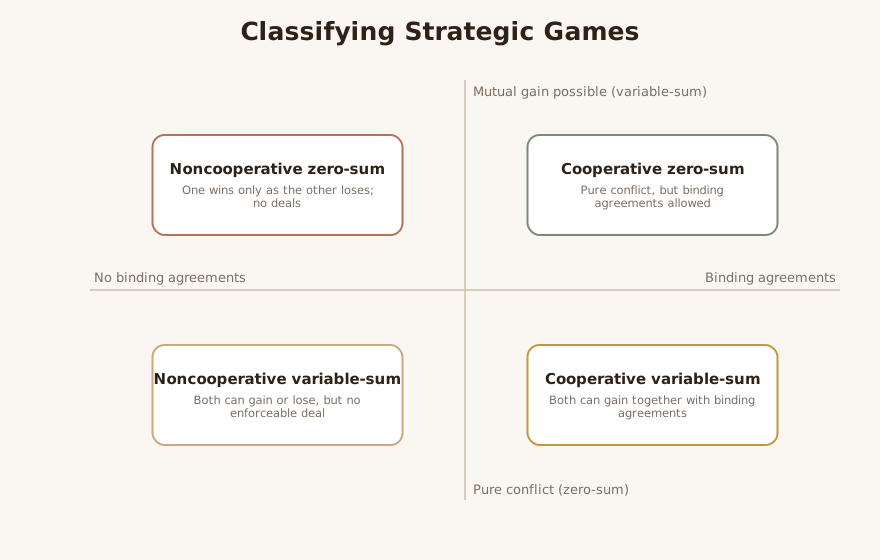
Games are also classified along two axes. Zero-sum (constant-sum) games are pure conflict, where one player can be made better off only by making the other worse off 12. Variable-sum (non-zero-sum) games allow all participants to gain or lose together, as in a negotiation where both sides benefit by avoiding a strike 2. The clinical reframe of moving a couple from a zero-sum “someone wins this argument” stance toward a variable-sum “we both lose if this continues” stance maps directly onto this distinction LLM. Finally, cooperative games allow binding, enforceable agreements, whereas noncooperative games permit talk but no enforcement, so promises become “cheap talk” without a mechanism to hold them 12.
The most clinically resonant model is the prisoner’s dilemma: two parties each choose between cooperating and defecting, and the individually “rational” choice is to defect, yet mutual defection leaves both worse off than mutual cooperation would 13. Crucially, dynamics shift when the interaction repeats. In the iterated prisoner’s dilemma, a tit-for-tat strategy—cooperate first, then mirror the other’s last move—is highly successful because it rewards cooperation and retaliates against defection 3. This is the formal scaffolding behind why reciprocity, repair, and predictable responsiveness build trust over a relationship’s long arc LLM.
Interventions & Techniques
Game theory does not supply standalone “techniques” in the way that, say, exposure or cognitive restructuring do; it supplies a map that informs interventions delivered within established modalities LLM. In practice, the clinical moves are translational. First, externalize and diagram the game: name the players, the available moves, and the payoffs each person believes they face, which converts a chaotic argument into a visible structure LLM. Second, identify the standoff (equilibrium): help the dyad see that they are caught in a stable pattern neither will exit alone, which reduces blame and reframes the problem as structural 1LLM.
Third, reframe zero-sum to variable-sum: surface the shared losses of continued conflict so the interaction stops being read as pure winner-take-all 2LLM. Fourth, build the conditions for cooperation: because noncooperative games lack enforcement and promises become cheap talk, the work is often to create something closer to a binding, mutually monitored agreement—explicit commitments, shared routines, and follow-through 1LLM. Fifth, install tit-for-tat repair norms: encourage an opening cooperative move and a reliable, proportionate response to the other’s behavior, leveraging the iterated-game finding that reciprocity sustains cooperation over time 3LLM.
LLM-generated illustrative example (not a guideline): A couple presents with chronic standoff: each waits for the other to apologize first after fights. The therapist draws a 2x2 grid—“reach out” vs. “wait”—and the partners recognize that mutual waiting is a stable equilibrium where both stay hurt and lonely, even though both would prefer mutual repair. The intervention, delivered within couples therapy, is an agreed tit-for-tat norm: whoever notices the rupture first makes a small repair bid, and the other commits to responding in kind within the hour LLM.
Evidence Base
Honesty about maturity is essential. The mathematical theory itself is firmly established: it is a recognized branch of applied mathematics with a defined formal apparatus and a foundational 1944 text 124. What is not established is game theory as a validated, manualized psychotherapy with outcome trials demonstrating symptom reduction; that body of evidence does not exist, and clinicians should present it accordingly LLM.
The empirical clinical literature is largely mechanistic and analogical rather than interventional. One quasi-experimental study compared 46 individuals with schizophrenia-spectrum diagnoses and current persecutory delusions against 43 nonclinical controls using the Prisoner’s Dilemma Game, finding the clinical group competed significantly more often (54% vs. 31%; χ²=4.90, p=.027) 5. The data supported a serial mediation pathway in which higher trait paranoia predicted state paranoia in the game, which predicted distrust of the opponent, which in turn predicted competitive behavior 5. The authors suggested that interventions such as mindfulness-based therapy for psychosis, or approaches aimed at increasing interpersonal forgiveness, might disrupt this distrust-to-competition pathway—an intriguing hypothesis rather than a demonstrated treatment effect 5.
A second paper modeled the decision to enroll in a clinical trial as a trust version of the prisoner’s dilemma between patients and researchers, incorporating trust, regret, and guilt 6. Its simulations were sobering: simultaneous cooperation occurred only 19% of the time, patients showed roughly 69% inclination to trust, yet researchers honored that trust only about 41% of the time 6. Notably, higher experimental-treatment success rates increased researchers’ incentive to violate trust, and the authors recommended transparency, oversight, and conflict-of-interest controls to strengthen the patient-researcher social contract 6. Both studies illustrate game theory’s current clinical role: explaining and measuring trust-driven behavior, not yet prescribing treatment LLM.
Populations & Indications
The model is best suited to relational and multi-party presentations where interdependence is the core problem LLM. It applies naturally to couples caught in mutual withdrawal or escalation, families with entrenched roles, and coparenting or divorcing partners negotiating across low trust LLM. It extends to organizations and teams facing collective-action problems and turf protection, and to negotiating parties in any dispute that is being treated as zero-sum when it could be variable-sum 2LLM. With adolescents in peer conflict, the framework can make social standoffs and reputational tit-for-tat dynamics concrete and discussable 3LLM. The schizophrenia-spectrum data also indicate the model can illuminate trust and competitiveness in individuals with persecutory ideation, though here it is a lens on mechanism rather than an indication for a specific game-based treatment 5.
Problems-for-Work
- Relationship conflict and avoidance/standoff patterns: Map the mutual-withdrawal equilibrium so each partner sees the shared cost of waiting for the other to move first 1LLM.
- Communication problems: Distinguish cheap talk from binding commitment, and help the couple convert vague promises into monitored, follow-through agreements 1LLM.
- Trust issues: Use the iterated-game frame to rebuild trust through an opening cooperative move and reliable reciprocity rather than a single grand gesture 3LLM.
- Coparenting conflict: Reframe child-related decisions from zero-sum custody battles toward variable-sum outcomes where the child’s stability is a shared payoff 2LLM.
- Workplace conflict and power struggles: Surface the collective-action trap in which everyone defends position and the whole team loses, then negotiate enforceable norms 2LLM.
- Decision-making difficulties: Lay out options, anticipated responses of others, and payoffs to externalize a paralyzing choice into a structured decision 1LLM.
LLM-generated illustrative example (not a guideline): Two divorced coparents each refuse to be flexible on the schedule, fearing the other will exploit any concession. Reframing within family therapy, the clinician names the prisoner’s dilemma explicitly—mutual rigidity is the worst outcome for the child—and helps them build a small, written, reciprocal agreement (one accommodation each, reviewed in two weeks), turning cheap talk into something closer to a binding cooperative move LLM.
Contraindications, Cautions & Cultural Humility
The chief caution is misapplication: game theory describes interdependent decision-making and must never be used to rationalize staying in or “winning” against an abusive or coercive relationship, where the framing of strategic parity is itself dangerous LLM. Where there is intimate partner violence, coercive control, or a significant power or safety asymmetry, the analytic stance of two strategic equals is inappropriate, and safety planning takes precedence over any reframing exercise LLM. The model is also a simplification: real relationships involve emotion, history, and attachment that a payoff grid cannot capture, so it should complement, not replace, attuned clinical formulation LLM.
Cultural humility matters because the theory’s notion of “rational self-interest” and the value placed on individual payoff maximization carry Western, individualist assumptions that may not fit clients from collectivist or interdependent cultural contexts, where the relevant “payoff” is often the family or community rather than the self 1LLM. The clinical-trial trust data are a reminder that distrust can be a rational response to genuine structural inequities and histories of exploitation, not merely a cognitive distortion to be corrected 6LLM. Likewise, the schizophrenia findings show that elevated distrust can be symptom-linked, so a clinician should locate distrust in its real context before treating it as something the client should simply relinquish 5LLM.
Treatment-Plan Suggestions & SMART Objectives
| Goal | SMART objective (example) | Mechanism |
|---|---|---|
| Reduce mutual-withdrawal standoff in a couple | Within 6 sessions, each partner initiates a repair bid after 80% of conflicts rather than waiting for the other | Names and exits the unsatisfying Nash equilibrium 1LLM |
| Shift coparenting from zero-sum to variable-sum | Over 8 weeks, partners reach written agreement on 3 child-related decisions framed around the child’s shared benefit | Reframes constant-sum conflict as variable-sum 2LLM |
| Rebuild trust after rupture | Within 4 weeks, client makes one cooperative opening move weekly and tracks the partner’s reciprocal response | Leverages iterated-game tit-for-tat reciprocity 3LLM |
| Convert “cheap talk” into reliable follow-through | Within 6 sessions, dyad creates 2 monitored agreements with explicit check-ins | Adds enforcement absent in noncooperative games 1LLM |
| Reduce distrust-driven competitiveness | Over 10 sessions, client identifies 3 situations where defensive competition worsened the outcome and rehearses a cooperative alternative | Disrupts the distrust-to-competition pathway 5LLM |
| De-escalate workplace/team standoff | Within 8 weeks, team articulates the shared loss of continued conflict and agrees to 2 enforceable norms | Solves a collective-action trap via variable-sum framing 2LLM |
| Support a stalled decision | Within 2 sessions, client maps options, others’ likely responses, and payoffs on paper before deciding | Externalizes interdependent decision-making 1LLM |
Common Misconceptions
A frequent error is treating game theory as a recognized psychotherapy with its own outcome evidence; the theory is established, but a manualized “game-theory therapy” with efficacy trials does not exist 14LLM. Another is conflating “game” with triviality—the term denotes any situation of interdependent strategic choice, including high-stakes, emotionally loaded relational ones, not playfulness 1LLM. Clinicians sometimes assume the “rational” choice is always to defect; in repeated interactions, cooperation supported by reciprocity is often the superior and stable strategy 3LLM.
A further misconception is that all conflicts are zero-sum, when most relational disputes are variable-sum and the therapeutic leverage lies precisely in revealing the shared gains of cooperation 2LLM. Finally, people assume distrust is simply irrational; the clinical-trial and schizophrenia analyses both show distrust can be either a reasoned response to real structural risk or a symptom-linked state, and the clinical task is to distinguish which 56LLM.
Training & Certification
There is no clinical credential, license, or certification in “game-theory therapy,” and clinicians should be wary of any program implying otherwise, because the construct is an interdisciplinary theory rather than a regulated clinical practice LLM. Foundational fluency is best gained from primary and reference sources—the von Neumann and Morgenstern text and high-quality encyclopedic treatments—rather than from clinical workshops 124. The appropriate path for therapists is to develop competence in the actual billable modality (for example, evidence-based couples, family, or cognitive-behavioral therapy) and to use game-theoretic concepts as a supplementary formulation tool within that scope of practice LLM.
Key Terms
- Player: A decision-maker whose choices, interacting with others’, help determine outcomes 12.
- Nash equilibrium: A strategy set in which no player can improve her payoff by changing her strategy alone 1.
- Dominant strategy: A strategy that is best regardless of what others do; dominated strategies should be avoided 1.
- Prisoner’s dilemma: A game in which individually rational defection yields a collectively worse outcome than mutual cooperation 13.
- Iterated prisoner’s dilemma / tit-for-tat: Repeated play in which mirroring the other’s last move sustains cooperation over time 3.
- Zero-sum vs. variable-sum: Pure-conflict games versus games where parties can gain or lose together 12.
- Cooperative vs. noncooperative: Whether binding, enforceable agreements are possible or promises remain “cheap talk” 12.
Resources & Further Reading
▶ Watch — a video introduction to this concept:
- Game Theory — Stanford Encyclopedia of Philosophy
- Game theory | Definition, Facts, & Examples — Britannica
- Prisoner’s Dilemma — Psychology Today
- Theory of Games and Economic Behavior — Princeton University Press
- Schizophrenia and Increased Distrust-Based Competitiveness in Interpersonal Interactions — PMC
- When is it rational to participate in a clinical trial? A game theory approach incorporating trust, regret and guilt — PMC
Reflective / Supervision Questions
- When a client describes a relational standoff, can I identify the equilibrium that keeps it stable, and am I helping both parties see why neither will move first 1LLM?
- Am I treating this conflict as zero-sum when reframing it as variable-sum would reveal a shared path forward 2LLM?
- Where am I relying on “cheap talk”—promises without enforcement—and how could I help the client build a more binding, monitored commitment 1LLM?
- Is the distrust I am observing a symptom, a reasoned response to real structural risk, or both, and does my plan honor that distinction 56LLM?
- Does my use of “rational self-interest” fit this client’s cultural frame, or am I importing individualist assumptions that misread an interdependent value system 1LLM?
- Have I confirmed there is no abuse or coercive power asymmetry before applying a model that assumes two strategic equals LLM?