
Predictive processing (PP), also called predictive coding, is a framework from computational neuroscience proposing that the brain is not a passive stimulus-response device but a continuously active prediction engine. 7 For the practicing therapist, it offers a unifying mechanistic vocabulary — prediction, prior, prediction error, precision — that reframes how perception, emotion, the body, and symptoms are constructed, and that maps surprisingly well onto what we already do in the room. LLM This article summarizes the theory, what is and is not yet established, and how it can inform — but not dictate — clinical reasoning. LLM
Type & Discipline
Predictive processing is a theoretical framework, not a treatment modality. LLM It originates in computational and cognitive neuroscience and the philosophy of mind, and it postulates that the brain is constantly generating and updating an internal “mental model” of the environment, comparing predicted sensory input against actual input and using the resulting mismatches to refine that model. 7 It is most usefully understood as a meta-theory: a set of organizing principles that can be applied to perception, action, decision-making, interoception, and psychopathology rather than a stand-alone clinical protocol. 1 In therapy it functions as an explanatory lens that can be layered onto existing modalities, not as something a clinician “delivers.” LLM
Creators & Lineage
The intellectual roots run deep. The nineteenth-century physiologist Hermann von Helmholtz proposed that perception involves unconscious inference — the brain filling gaps in sensory information using prior knowledge. 7 Mid-twentieth-century “New Look” psychology (Jerome Bruner) studied how expectation shapes perception, and connectionist models in the 1980s (McClelland and Rumelhart) formalized the interplay of top-down and bottom-up processing. 7 The modern computational formulation arrived with Rao and Ballard (1999), who built the first influential hierarchical model of visual cortex in which higher regions predict lower-level activity and feedback error signals drive learning. 7
The framework was then generalized and popularized by several figures. Karl Friston embedded predictive coding within the free energy principle and active inference, casting both perception and action as forms of prediction-error minimization. 7 Philosophers and theorists Andy Clark and Jakob Hohwy articulated the “prediction machine” view of mind, with Clark’s Surfing Uncertainty (2016) framing the brain as an organ that “surfs” waves of uncertainty by anticipating sensory inputs and acting to confirm its predictions. 5 Anil Seth and Lisa Feldman Barrett extended the account to consciousness, emotion, and the felt sense of the body, proposing that experienced reality is a brain-constructed “best guess” — a controlled hallucination — and that emotions arise from predictive models of interoceptive (bodily) states. 76 This lineage connects PP to active inference, to interoception-focused and somatic therapies, and conceptually to memory reconsolidation, since all describe how predictions and priors are updated by new evidence. LLM
Core Principles
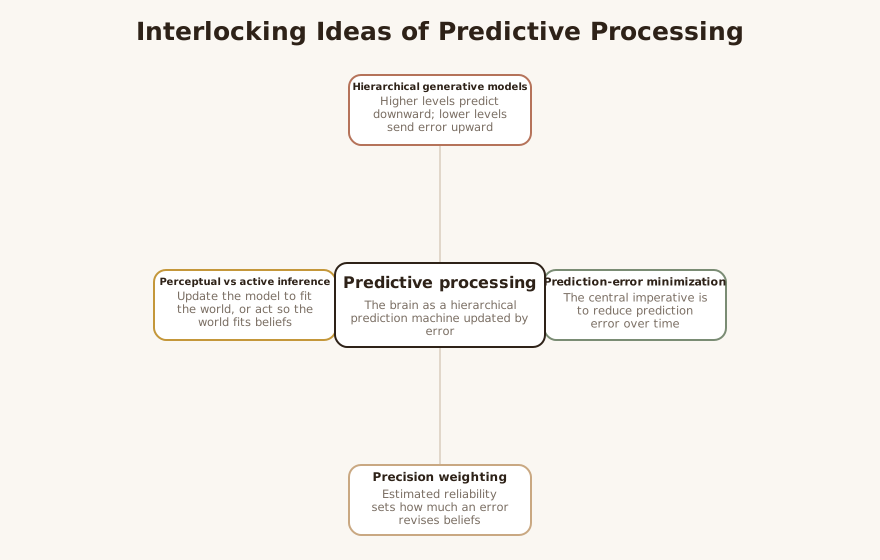
A handful of interlocking ideas carry most of the clinical weight. LLM
Hierarchical generative models. The cortex is organized in stacked levels. Higher levels generate predictions that are passed downward; lower levels send prediction errors — the difference between what was predicted and what arrived — upward. 7 Perception is thus largely top-down: what you experience is closer to the brain’s prediction than to the raw sensory signal, with sensory data serving to correct the prediction. 64
Prediction error minimization. The system’s central imperative is to reduce prediction error over time. 1 It can do this two ways: by updating the model (perceptual inference — changing beliefs to fit the world) or by acting on the world so that sensations come to match predictions (active inference — changing the world, or one’s sampling of it, to fit beliefs). 7 Perception and action become two routes to the same goal. 1
Precision weighting. Not all prediction errors are treated equally. Precision is the brain’s estimate of the reliability of a signal; it sets how much a given prediction error is allowed to revise beliefs. 7 As the PMC review puts it, more reliable prediction errors demand belief change, while more reliable priors are robust to deviation. 2 Precision is thought to be implemented partly by neuromodulators and to function much like attention — turning the gain up or down on incoming evidence. 7 Aberrant precision is the lever most clinical accounts reach for. 2
Priors and hyperpriors. Predictions are anchored in priors — expectations built from prior experience — and high-level hyperpriors about how the world generally behaves. 2 Overly strong or miscalibrated priors can dominate experience even when sensory evidence contradicts them. 2
Interventions & Techniques
PP itself prescribes no techniques, but it offers a mechanistic rationale for many established ones, and that reframing can sharpen case formulation. LLM Several mappings are commonly drawn. LLM
-
Exposure-based work can be read as deliberately generating prediction error: the feared prediction (“I will be harmed / I will lose control”) is disconfirmed by sensory evidence, and repeated, well-titrated mismatch updates the prior. LLM PP suggests that exposure works best when the prediction error is salient (high precision) and the new evidence is allowed to win, which aligns with inhibitory-learning emphases on expectancy violation. LLM
-
Behavioral experiments and cognitive restructuring are framed as testing and revising priors by gathering high-precision counter-evidence. LLM
-
Interoceptive and somatic techniques — interoceptive exposure, breath and body awareness, grounding — can be understood as recalibrating predictions about bodily signals and the precision assigned to them. 4 If catastrophic interoceptive predictions drive panic, attending to and reweighting those signals targets the mechanism directly. LLM
-
Attentional and mindfulness practices map onto precision: deliberately shifting how much weight is given to present sensory data versus habitual prediction. LLM
LLM-generated illustrative example (not a guideline): A client with panic predicts that a racing heart means imminent collapse. Interoceptive exposure (e.g., brief controlled exertion) repeatedly produces the sensation without the catastrophe, generating prediction error that, over sessions, loosens the catastrophic prior and lowers the precision the client assigns to chest sensations. LLM
Evidence Base
Honesty here matters: as a clinical framework, predictive processing is emerging, not established. LLM The theoretical literature is mature and influential, with strong formal models of perception, perceptual learning, and decision-making. 1 Bayesian and predictive-coding accounts successfully explain phenomena such as visual illusions and associative-learning effects, and there is suggestive neural evidence — for example, candidate error-signaling neurons in superficial cortical layers and prediction units in deeper layers. 7
The clinical evidence is far thinner. The PMC review is explicit that many psychiatric applications remain speculative, noting that for several proposed mechanisms the empirical data “are not yet forthcoming.” 2 Recognized limitations include the imprecision of exactly how prediction-error minimization is implemented, questions about computational tractability, and the difficulty of uniquely linking EEG/ERP components (such as mismatch negativity) to prediction error rather than to overlapping processes. 7 Critics have raised concerns about falsifiability and originality. 2 More recent work is attempting to operationalize the framework for psychiatry: a transdiagnostic predictive-coding framework has been proposed to move “from symptoms to signatures,” seeking computational markers that cut across diagnostic categories for precision psychiatry. 3 This is a promising direction but early-stage. LLM Clinicians should treat PP as a generative formulation tool, not as an evidence-based intervention in its own right. LLM
Populations & Indications
PP has been applied conceptually across a wide range of presentations seen by behavioral health clinicians. LLM Proposed accounts include psychosis, where dysregulated precision may overweight sensory prediction errors or weaken priors, offering a candidate mechanism for hallucinations and delusions, consistent with findings of reduced mismatch negativity in schizophrenia. 7 In anxiety and depression, miscalibrated hyperpriors about an uncontrollable or threatening world have been proposed. 2 In PTSD and trauma, overly precise trauma-related priors are theorized to drive intrusive, prediction-dominated experience. 2 Interoceptive and emotion-construction accounts make the framework relevant to chronic pain, functional somatic symptoms, interoceptive dysregulation, and disordered eating, where predictions about bodily state shape experience. 47 Indicated populations therefore include adults with anxiety, people experiencing psychosis, trauma survivors, people with chronic pain, and clients in interoception-focused therapy — always as a formulation aid, not a diagnostic test. LLM
Problems-for-Work
Translated to the problems clinicians actually target, PP suggests where the leverage is. LLM
- Anxiety disorders / hypervigilance: Overweighted threat predictions and excessive precision on potential-danger cues; work aims to generate disconfirming prediction error and reweight threat priors. LLM
- Psychosis and perceptual distortions: Imbalanced precision between priors and sensory error; work supports reality-testing and re-anchoring of predictions. 7
- Chronic pain / functional somatic symptoms: Pain experienced as a precise prediction partly decoupled from tissue signals; work targets the predictions and their precision through graded exposure and interoceptive retraining. 4
- PTSD: Trauma priors so precise they dominate present perception; work loosens those priors via safe, repeated counter-evidence. 2
- Interoceptive dysregulation: Catastrophic predictions about heartbeat, breath, or gut sensations; work recalibrates interoceptive predictions and their weighting. 4
Contraindications, Cautions & Cultural Humility
Because PP is a theory rather than a treatment, the main risks are interpretive. LLM It should never replace validated, condition-specific interventions, and framing a person’s distress as “bad predictions” can slide into invalidation if delivered carelessly. LLM A client’s priors are often accurate responses to real, ongoing adversity — danger, discrimination, poverty, unsafe relationships — so reframing hypervigilance as a “miscalibrated prior” without naming the genuine context risks pathologizing adaptive learning. LLM Cultural humility is essential: priors are shaped by lived experience and social location, and what looks like an overweighted threat prediction may be a well-calibrated response to a hostile environment. LLM The framework’s elegance can also seduce clinicians into over-explaining; the PMC and Wikipedia sources both stress that clinical claims remain partly speculative, so language with clients should be tentative and metaphorical, not presented as established neuroscience. 27 PP is also not a substitute for risk assessment, medical evaluation of somatic symptoms, or psychiatric care for psychosis. LLM
Treatment-Plan Suggestions & SMART Objectives
The table offers examples of how a PP-informed formulation can be translated into measurable objectives. These are illustrative, not prescriptive. LLM
| Goal | SMART objective (example) | Mechanism |
|---|---|---|
| Reduce panic-related catastrophizing | Within 8 sessions, client completes 3 interoceptive exposure trials/week and reports peak SUDS for heart-rate sensations dropping from 8 to ≤4 | Generates prediction error against catastrophic interoceptive priors; lowers precision on chest sensations LLM |
| Decrease avoidance in social anxiety | Within 6 weeks, client runs 2 behavioral experiments/week and revises predicted-vs-actual outcome ratings toward accuracy | Disconfirms threat priors with high-precision counter-evidence LLM |
| Loosen trauma-driven hypervigilance | Within 10 sessions, client tolerates a graded trauma-cue hierarchy with self-rated safety improving ≥30% on a session log | Repeated safe counter-evidence updates overly precise trauma priors 2 |
| Improve interoceptive accuracy | Over 8 weeks, client completes daily 5-minute body-scan practice 5 days/week and logs reduced misattribution of bodily signals | Recalibrates interoceptive predictions and their weighting 4 |
| Strengthen reality-testing in psychosis | Within 12 weeks, client uses a check-the-evidence worksheet for 80% of flagged perceptual experiences | Rebalances precision between priors and sensory prediction error 7 |
| Reduce pain-related activity avoidance | Over 6 weeks, client follows a graded-activity schedule, increasing tolerated activity by 10% weekly without symptom flare | Updates protective pain predictions through paced disconfirmation 4 |
| Build distress tolerance for uncertainty | Within 8 sessions, client practices 1 uncertainty-exposure task/week and reports lower distress on a standardized intolerance-of-uncertainty measure | Reduces excessive precision demanded of predictions; increases tolerance of residual error LLM |
Common Misconceptions
Several misreadings recur. LLM First, that PP is a therapy you can “do” — it is a theoretical framework, and any clinical action belongs to an established modality. LLM Second, that “the brain hallucinates reality” means perception is arbitrary; the controlled-hallucination claim is that perception is a constrained best guess shaped by sensory evidence, not a free-for-all. 6 Third, that prediction error is simply “error” in the everyday sense of a mistake; it is a technical signal that drives learning, and a healthy system generates it constantly. 1 Fourth, that PP is settled clinical science — its psychiatric applications are explicitly described as preliminary and partly speculative. 2 Fifth, that strong priors are pathological by default; priors are usually adaptive and only become problematic when their precision is miscalibrated relative to context. 7
Training & Certification
There is no certification in predictive processing, and clinicians should be wary of anyone offering one as if it were a credentialed modality. LLM Competence here is conceptual literacy gained from primary and secondary sources rather than a credential. LLM Accessible entry points include Andy Clark’s Surfing Uncertainty for the philosophical and cognitive account, Anil Seth’s public talks for the perception-and-self angle, and review articles such as the PMC overview and the Sprevak and Smith introduction for the computational mechanics. 5621 Clinicians wanting to apply the ideas should ground them in training for the actual evidence-based modalities (exposure-based therapies, interoceptive and somatic approaches, CBT for psychosis) that PP helps explain. LLM
Key Terms
- Generative model: The brain’s internal model that generates predictions about the causes of sensory input. 7
- Prediction error: The mismatch between predicted and actual signal; the currency of learning that flows up the hierarchy. 7
- Precision: The estimated reliability of a signal, setting how much a prediction error revises beliefs; functions like attentional gain. 7
- Prior / hyperprior: Prior expectations, and high-level expectations about how the world generally behaves, that shape perception. 2
- Active inference: Minimizing prediction error by acting on the world so sensations match predictions, unifying perception and action. 7
- Free energy principle: Friston’s broader formalism casting self-organizing systems as minimizing a quantity (free energy) that bounds prediction error. 7
- Controlled hallucination: The view that conscious perception is a brain-constructed best guess constrained by sensory evidence. 6
Resources & Further Reading
▶ Watch — a video introduction to this concept:
- An Introduction to Predictive Processing Models of Perception and Decision-Making (Sprevak & Smith)
- What we think about when we think about predictive processing (PMC)
- From symptoms to signatures: a transdiagnostic predictive coding framework for precision psychiatry (Nature Mental Health)
- Predictive Processing — an overview (ScienceDirect Topics)
- Surfing Uncertainty: Prediction, Action, and the Embodied Mind (Andy Clark, 2016)
- Your brain hallucinates your conscious reality — Anil Seth (TED)
- Predictive coding (Wikipedia)
Reflective / Supervision Questions
- When I describe a client as “hypervigilant” or “catastrophizing,” am I attending to whether their priors are actually well-calibrated to a genuinely unsafe context? LLM
- Where in my current cases am I already generating therapeutic prediction error (exposure, behavioral experiments), and could I make the expectancy violation more salient? LLM
- How do I hold a mechanistic framework like predictive processing lightly enough that it informs formulation without becoming a totalizing or invalidating explanation? LLM
- For clients with interoceptive or somatic distress, how am I distinguishing predictions about the body from the bodily signals themselves, and which am I targeting? LLM
- Given that the clinical evidence is emerging, how will I communicate PP-informed ideas to clients in tentative, non-overclaiming language? LLM