
Type & Discipline
Ego psychology is a theoretical school within psychoanalysis and clinical psychology rather than a freestanding, manualized treatment 1. It belongs to the family of post-Freudian psychoanalysis and is best understood as a developmental and structural framework that informs how a clinician listens, formulates, and intervenes 1. Where classical Freudian work centered the vicissitudes of instinctual drives, ego psychology examines how a person manages external demands and internal pressures through a set of ego functions 1. For the practicing therapist, its value is less as a brand of therapy and more as a lens: it supplies a vocabulary for assessing ego strength, defensive organization, and adaptive capacity that continues to underpin contemporary psychodynamic case formulation LLM.
It sits historically between Freud’s structural model and the later movements of object relations theory and self psychology, both of which grew partly in dialogue with and reaction against it 1. Understanding ego psychology therefore also clarifies what those later schools were responding to LLM.
Creators & Lineage
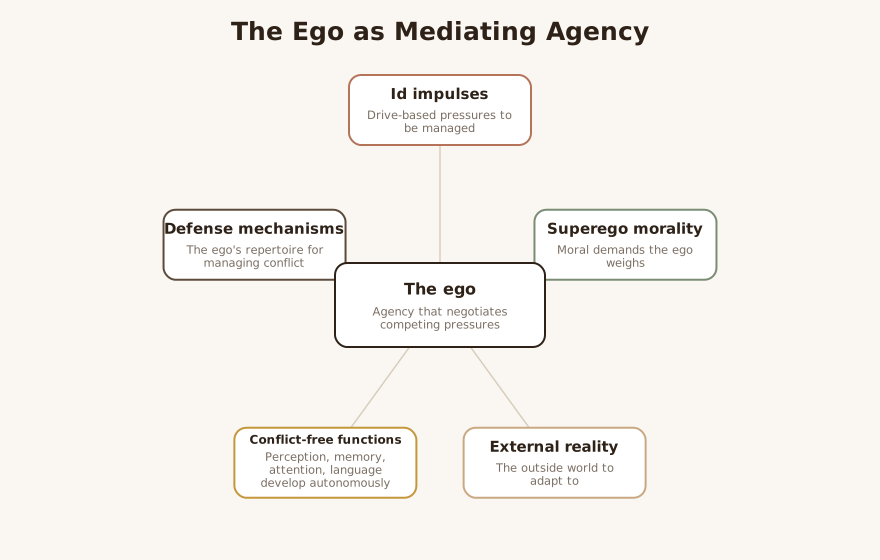
The lineage begins with Sigmund Freud’s structural theory, in which the mind is partitioned into id, ego, and superego, with the ego mediating between instinctual impulses, moral demands, and the constraints of reality 1. Ego psychology takes the ego from this model and makes it the protagonist LLM.
Anna Freud is the pivotal transitional figure. In her work on defense she argued that the ego is predisposed to supervise, regulate, and oppose the id through a variety of defenses, and she reframed those defenses as observable, analyzable operations rather than mere symptoms 1. She is often credited with shifting the field’s attention from the unconscious content of drives toward the ego’s defensive operations 4.
Heinz Hartmann is generally regarded as the principal systematizer. His 1939 work Ego Psychology and the Problem of Adaptation — presented to the Vienna Psychoanalytic Society in 1937 and widely disseminated in America after David Rapaport’s 1958 English translation — shifted psychoanalytic focus from instinct theory to the adaptive functions of the ego 23. Hartmann proposed that the ego has innate capacities that develop autonomously, given what he called an “average expectable environment” 1. After emigrating to New York in 1941, he was instrumental in making ego psychology the dominant American psychoanalytic approach for roughly fifty years, and co-founded The Psychoanalytic Study of the Child with Ernst Kris and Anna Freud in 1945 2.
David Rapaport pressed ego psychology toward a systematic, testable theory, treating psychoanalysis as a general psychology rather than only a theory of pathology 1. Erik Erikson, along with observers such as René Spitz, Margaret Mahler, and Edith Jacobson, folded developmental observation into the framework, extending the ego’s story across the whole life span 1. From this tradition the field branched: object relations theory and Heinz Kohut’s self psychology both built upon, and partly diverged from, the ego-psychological foundation 12.
Core Principles
The first principle is the structural one inherited from Freud: psychic life involves continual mediation by the ego among id impulses, superego morality, and external reality 1. The ego is the agency that negotiates these competing pressures 1.
The second, and most distinctive, principle is the conflict-free sphere. Hartmann proposed that alongside the zone of the ego devoted to managing conflict, there exists a conflict-free zone fundamentally dedicated to adaptation to the outside world 3. Within it, certain ego capacities — perception, attention, memory, concentration, motor coordination, and language — develop relatively independently of psychological conflict, provided the environment is adequate 4. These are described as autonomous functions 1.
The third principle is adaptation. For Hartmann, the basic task of these conflict-free functions was adaptation to the external world, and adaptation represents a function of a different order than defense 3. This reframing opened psychoanalysis to somatic, social, behavioral, and anthropological dimensions previously outside its scope 3. The fourth principle reconceives defense: Anna Freud’s successors increasingly treated defense mechanisms not simply as pathology but as the ego’s protective operations, some more mature and some more primitive 4. Together these principles move the clinical question from “what drive is being expressed?” toward “how well, and by what means, is this person adapting?” LLM.
Interventions & Techniques
Ego psychology yields a recognizable cluster of techniques, most of which are delivered inside a broader psychodynamic or supportive psychotherapy LLM.
Defense analysis is central: the clinician clarifies and interprets a client’s typical defensive patterns so the client gains more conscious control over them 4. Rather than confronting a defense as an obstacle, the therapist names it, traces where it operates, and helps the client see its cost and function 4.
Ego strengthening aims to develop more mature defenses and improve reality testing — the capacity to distinguish internal from external reality 14. The same family of work targets impulse control, affect regulation, judgment, and the synthetic function of integrating contradictory experiences 1.
Environmental modification sits comfortably within the model: because adaptation involves the fit between person and environment, reducing external stressors is a legitimate intervention alongside internal work 4. The overarching treatment goal is to help clients develop more mature defense mechanisms, improve reality testing, and enhance their capacity for effective problem-solving — building adaptive functioning rather than only eliminating symptoms 4.
LLM-generated illustrative example (not a guideline): A client who reflexively makes a joke whenever grief surfaces might hear the therapist gently note, “I notice humor arrives right as something sad gets close — I wonder what it protects you from.” The aim is not to strip the humor away but to make its timing visible, so the client can choose when to let the feeling stay LLM.
Evidence Base
Honesty about maturity matters here. Ego psychology is established in the sense that it is a foundational, historically dominant, and clinically influential framework — for roughly half a century it was the leading American psychoanalytic approach 2. But “established” describes its standing as a theory and clinical tradition, not the existence of a randomized-trial evidence base for “ego psychology” as a discrete protocol LLM. It is not a manualized therapy that has been tested head-to-head in controlled trials; its constructs are instead embedded within the broader category of psychodynamic psychotherapy, which carries the empirical literature LLM.
Its concepts have proven durable and have migrated outward: ego psychology helped move psychoanalysis and psychology closer together and aligns with contemporary strengths-based approaches that identify existing capacities to build upon, including influences felt in cognitive-behavioral and mindfulness-informed work 14. The framework has also drawn serious criticism. The conflict-free sphere in particular was challenged by theorists including Jacques Lacan and the Kleinians as philosophically incoherent and inconsistent with Freud’s vision of the ego as inherently conflictual, and by the 1970s the school faced pressure from object relations theory and self psychology 1. Clinicians should therefore hold its constructs as useful organizing heuristics rather than as empirically settled mechanisms LLM.
Populations & Indications
Ego psychology was developed primarily for adult psychotherapy clients seen in longer-term, exploratory treatment, and it remains most natural in that setting 1LLM. It is particularly suited to clients with neurotic-level conflicts, where reasonably intact ego functions allow defense analysis and insight to do their work LLM.
The framework also speaks directly to clients with personality disorders and to individuals with impaired ego functioning, where the assessment of ego strength — reality testing, impulse control, affect regulation — guides how supportive versus expressive the work should be 1LLM. Because adaptation is central, it fits well with people facing adjustment difficulties and life transitions, and the developmental extensions contributed by Erikson and others make it applicable to adolescents negotiating identity 14. Clients in long-term psychodynamic treatment are its prototypical population, since defense analysis and ego strengthening unfold over time LLM.
Problems-for-Work
The model maps onto a range of presenting problems. With maladaptive defense mechanisms, the work is to assess whether a client leans on primitive defenses such as denial, projection, or splitting versus mature ones such as humor and sublimation, and to widen the repertoire toward flexibility 14. For anxiety disorders, the lens treats anxiety as a signal the ego is mobilizing defense, inviting curiosity about what the defense is managing LLM.
With personality disorders and identity disturbance, assessment of ego strength and the coherence of the synthetic function organizes the treatment frame 1LLM. Adjustment disorder is almost paradigmatic for an adaptation-centered model, where both internal coping and environmental modification are in play 4. Impulse control problems and interpersonal difficulties are framed as deficits in the regulatory and object-relating functions of the ego 1. In depression, ego psychology attends to harsh superego pressure, the state of self-regard, and the defenses recruited against loss LLM.
LLM-generated illustrative example (not a guideline): A client with recurrent conflict at work who consistently externalizes blame might be helped to notice the pattern of projection — not as an accusation, but as a recurring move the ego makes under threat — and to test what happens when, in one low-stakes situation, the feeling is held internally and named instead LLM.
Contraindications, Cautions & Cultural Humility
Ego psychology is a framework, not a procedure, so “contraindication” applies less to the lens than to specific techniques delivered within it LLM. Insight-oriented defense analysis can destabilize clients whose ego functioning is fragile or who are in acute crisis; with such clients the same model points the clinician toward a more supportive stance — ego strengthening, reality support, and environmental modification rather than uncovering work 4LLM. Interpreting a defense before a client has the resources to tolerate what it covers can be harmful, and timing and dosage are clinical judgments LLM.
Cultural humility is essential because the framework’s core ideas embed cultural assumptions. Hartmann’s “average expectable environment” presumes a normative developmental context, and judgments about which defenses are “mature” or “primitive,” what counts as good “adaptation,” or what constitutes healthy “reality testing” can carry the values of the clinician’s culture 14LLM. Behavior that looks like a primitive defense may be a reasonable adaptation to racism, poverty, migration, or an unsafe environment, and adaptation should be read against the client’s actual world rather than an idealized one LLM. The conflict-free sphere has itself been criticized as conceptually shaky, which should keep clinicians appropriately humble about treating these categories as objective facts 1.
Treatment-Plan Suggestions & SMART Objectives
| Goal | SMART objective (example) | Mechanism |
|---|---|---|
| Increase awareness of a recurring defense | Within 8 sessions, client will identify and name two situations per week in which a habitual defense (e.g., intellectualizing) is triggered, recorded in session | Defense analysis — making automatic operations conscious 4 |
| Broaden the defensive repertoire | Over 12 weeks, client will demonstrate at least one more mature coping response (e.g., sublimation, humor) in a previously distressing situation | Ego strengthening toward flexible, mature defenses 4 |
| Improve reality testing | Within 6 weeks, client will distinguish an assumption from a verified fact in three documented interpersonal conflicts | Strengthening the reality-testing ego function 1 |
| Strengthen impulse control / affect regulation | Over 8 sessions, client will use one identified regulation strategy before acting on urges, on at least 3 of 5 occasions | Supporting regulatory ego functions 1 |
| Enhance adaptive problem-solving | Within 10 sessions, client will generate and evaluate at least two options before deciding in two real-life stressors | Building effective problem-solving capacity 4 |
| Reduce a modifiable external stressor | Within 4 weeks, client will take one concrete step to alter an identified environmental stressor (e.g., schedule change) | Environmental modification supporting adaptation 4 |
| Support a more coherent sense of identity | Over the treatment, client will articulate two stable self-descriptions that hold across differing relationships, reviewed monthly | Strengthening the synthetic/integrative function 1 |
Common Misconceptions
A first misconception is that “ego” here means egotism or self-esteem; in this tradition the ego is a structural agency that mediates among drives, conscience, and reality, not vanity 1. A second is that ego psychology is anti-Freudian or replaces drive theory; it extends the structural model rather than discarding it, adding the ego’s adaptive functions alongside the drives 13.
A third is that defenses are inherently pathological. Anna Freud’s lineage reframes defenses as the ego’s normal protective operations, with the clinical question being maturity and flexibility, not presence or absence 4. A fourth is that ego psychology is an empirically validated treatment protocol; it is an influential theory and clinical tradition whose constructs live within broader psychodynamic practice, and whose signature idea — the conflict-free sphere — has been seriously contested 1LLM.
Training & Certification
There is no “ego psychology certification,” because it is a theoretical orientation rather than a discrete modality LLM. Clinicians typically absorb it as part of psychodynamic and psychoanalytic training LLM. Reading lists such as the Boston Psychoanalytic Society and Institute (BPSI) ego psychology syllabus map the primary literature used in formal psychoanalytic curricula, including the foundational texts of Anna Freud, Hartmann, and Rapaport 5. Formal competence in defense analysis and expressive technique is generally developed through supervised psychodynamic psychotherapy training or psychoanalytic institute coursework, grounded in the historical works that established the field 25.
Key Terms
Ego functions — the operations through which a person manages internal and external demands, including reality testing, impulse control, affect regulation, judgment, object relations, defensive functioning, and synthesis 1.
Conflict-free sphere — Hartmann’s proposed zone of the ego, dedicated to adaptation, in which certain functions develop relatively independently of conflict 3.
Autonomous functions — innate ego capacities such as perception, memory, motor coordination, and language that develop autonomously given an adequate environment 14.
Adaptation — the ego’s task of fitting to the external world; for Hartmann, a function of a different order than defense 3.
Average expectable environment — the normative developmental conditions under which autonomous ego functions are expected to unfold 1.
Defense mechanisms — the ego’s protective operations (e.g., repression, projection, denial, splitting, displacement, reaction formation, sublimation, humor), assessed for maturity and flexibility 14.
Resources & Further Reading
▶ Watch — a video introduction to this concept:
- Ego psychology (Wikipedia) 1
- Heinz Hartmann (Wikipedia) 2
- Ego Psychology and the Problem of Adaptation (Encyclopedia.com) 3
- Understanding Ego Psychology: Insights from Freud, Anna Freud, and Hartmann (Social Work Institute) 4
- Ego Psychology reading syllabus, 2014 (BPSI) 5
- Ego Psychology — an overview (ScienceDirect Topics) 6
Reflective / Supervision Questions
- When I describe a client’s defense as “primitive” or “immature,” whose standard of maturity am I applying, and could the behavior be a reasonable adaptation to a hostile environment? LLM
- For this client, is the work indicating expressive defense analysis or supportive ego strengthening, and what in their current ego functioning tells me which? LLM
- How do I time an interpretation of a defense so that I am not removing protection faster than the client can build alternatives? LLM
- Am I attending to the fit between this person and their environment, or am I locating all the difficulty inside the client? 4LLM
- Where might Hartmann’s “average expectable environment” assumption be blinding me to the realities of my client’s actual world? 1LLM
- Which billable psychotherapy frame am I delivering this work within, and does my documentation make the link between ego-psychological technique and that modality explicit? LLM