
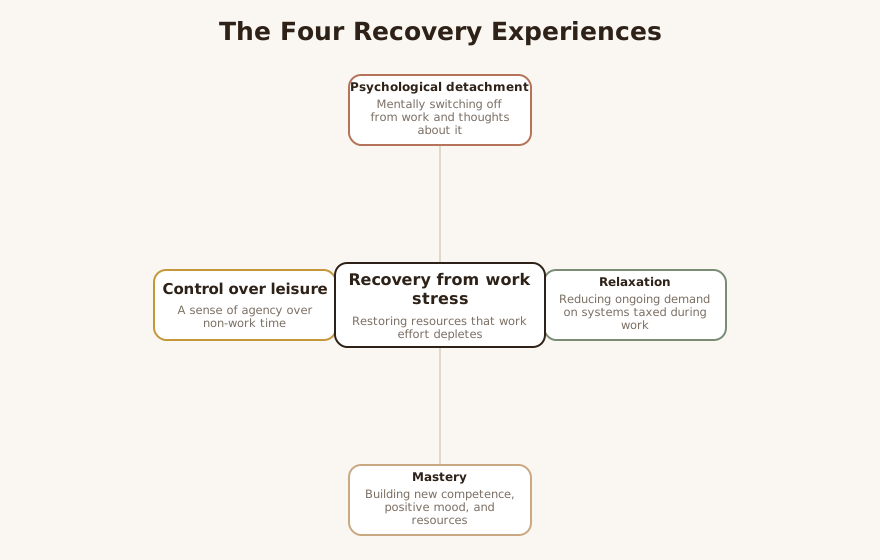
The Recovery Experiences Model holds that the strain accumulated during a working day is not simply a matter of how hard a person works, but of whether and how they recover from that effort during off-job time 1. Sabine Sonnentag and Charlotte Fritz proposed that four distinct experiences during leisure — psychological detachment from work, relaxation, mastery experiences, and a sense of control over one’s free time — are the active ingredients of recuperation, restoring the internal resources that work effort depletes and buffering the carryover of strain from one day to the next 1. For the clinician, the model is useful because it reframes a familiar complaint — “I can never switch off,” “I’m exhausted but I can’t rest” — as a recovery deficit with named, modifiable components, rather than as a vague burnout state to be endured LLM.
Type & Discipline
The Recovery Experiences Model is a framework — an explanatory model of how off-job experiences restore depleted resources — rather than a packaged psychotherapy 1LLM. Its disciplinary home is occupational health psychology, the field concerned with the interface between work demands, well-being, and health, and it belongs within the broader family of work-stress and burnout models 2. The model’s unit of analysis is the recovery experience: a subjective quality of off-job time, distinct from the activity itself, that determines whether time away from work actually replenishes the person 1.
A defining move of the framework is to separate the setting of recovery (evenings, weekends, vacations, breaks) from the experiences that occur within it, insisting that it is the experience and not merely the duration of rest that matters 1. Two people can spend the same evening at home, but the one who mentally disengages from work, feels relaxed, pursues something absorbing, and chooses how to spend the time recovers more fully than the one who ruminates about tomorrow’s deadlines 1LLM. Because the model is a framework rather than a modality, it is defined by an empirical structure — a validated four-factor measure of recovery experiences — and by the resource-based theory that explains why those experiences work, not by a fixed set of clinical procedures 1.
Creators & Lineage
The model is associated above all with Sabine Sonnentag and Charlotte Fritz, whose 2007 paper introduced and validated the Recovery Experience Questionnaire, the instrument that operationalized the four experiences and gave the framework its empirical backbone 1. Their validation work established psychological detachment, relaxation, mastery, and control as separable factors that each related to indicators of well-being and strain, and it has since become the standard measurement tool in the recovery literature 1.
The intellectual lineage runs through Theo Meijman’s effort-recovery model, which holds that work effort produces load reactions that are reversible if the person is no longer exposed to the demand and the affected psychobiological systems can return to baseline; sustained demand without recovery, by contrast, allows load reactions to accumulate into chronic strain 2. Sonnentag and Fritz built on this by specifying which off-job experiences best allow those systems to unwind, and they later integrated the framework into the broader stressor-detachment model, which positions psychological detachment as a central mechanism linking job stressors to impaired well-being 2. A second strand of lineage is the conservation-of-resources tradition, which frames recovery as the restoration and acquisition of personal resources — energy, attention, positive mood — that demanding work depletes 4. Sonnentag’s subsequent reviews consolidated psychological detachment in particular as the experience most consistently tied to mental health and engagement, sharpening the model’s clinical relevance 5.
Core Principles
The first principle is that recovery is about experiences, not just rest time 1. The four recovery experiences are theorized to restore resources through partly distinct routes: psychological detachment and relaxation work primarily by reducing the ongoing demand on systems taxed during work, while mastery and control work primarily by building new resources such as competence, positive mood, and a sense of agency 1. The questionnaire’s four-factor structure supports treating these as related but separable experiences rather than a single global “feeling rested” 1.
The second principle is the centrality of psychological detachment — the experience of mentally switching off from work during non-work time, being neither occupied by job tasks nor by thoughts about them 5. Detachment is repeatedly the strongest and most consistently studied of the four experiences, linked to lower fatigue, better mood, reduced need for recovery, and higher engagement; its absence (continued rumination about work) is a hallmark of impaired recovery 5. The effort-recovery logic explains why: only when a person stops being exposed to the work demand — including its mental representation — can the load reactions it produced begin to reverse 2.
The third principle is resource restoration and strain buffering 4. Good recovery experiences replenish the internal resources that work depletes, so that the person begins the next workday with a fuller tank; poor recovery allows incomplete recuperation to compound across days into the exhaustion and disengagement that define burnout 4. The fourth principle, increasingly emphasized, is that the relationship between detachment and well-being may not be purely linear: there is evidence that some of each — including remaining moderately reachable or reflective about work — can coexist with health, and that the question is dose and context, not simply “more detachment is always better” 6.
Interventions & Techniques
The model’s “interventions” are not a branded therapy but a set of targets — raise the four recovery experiences, especially detachment — pursued through behavioral and cognitive methods the clinician already possesses 1LLM. The foundational step is assessment: using the Recovery Experience Questionnaire (or its logic) to map which of the four experiences a client is and is not getting, so that intervention is matched to the specific deficit rather than aimed at “relaxing more” in general 1. A client may detach well but never pursue mastery; another may control their schedule yet ruminate constantly; the profiles call for different work 1LLM.
For psychological detachment, the leverage points are the boundary between work and non-work and the management of work-related rumination 5. Practical methods include behavioral transition rituals that signal the end of the workday, restricting after-hours connectivity, and cognitive techniques — worry postponement, defusion from work thoughts, attentional refocusing — that interrupt the rumination keeping the work demand mentally “on” 5LLM. For relaxation, the targets are low-activation, low-demand states — slow breathing, time in nature, unhurried leisure — that reduce sympathetic arousal 1. For mastery, the work is to help the client schedule absorbing, moderately challenging off-job pursuits (a sport, an instrument, a craft, a class) that build competence and positive affect rather than further deplete energy 1. For control, the focus is restoring the client’s sense of choice over leisure time — protecting it from work encroachment and from over-obligation — since perceived control over free time is itself a recovery experience 1.
LLM-generated illustrative example (not a guideline): A mid-career clinician’s client, a hospital nurse, reports chronic exhaustion and dread on Sunday evenings. A recovery-experiences assessment shows adequate relaxation on days off but near-zero psychological detachment: she replays shifts, checks the staffing app, and mentally rehearses the next rotation. The therapist targets detachment specifically — a fixed “shift-shutdown” ritual, removing the staffing app from her phone after hours, and a worry-postponement plan for intrusive case thoughts — while adding one mastery activity (a weekly pottery class) she had abandoned. Over several weeks her Sunday dread softens as the work demand stops occupying her evenings LLM.
Evidence Base
The maturity of the framework is best described as established 1. The Recovery Experience Questionnaire has been validated and replicated, giving the field a reliable measure of the four experiences, and the model’s central claims have been tested in numerous primary studies and consolidated in large meta-analyses 13. This is a relatively mature, well-measured corner of occupational health psychology rather than a speculative proposal 34.
Two meta-analyses anchor the evidence. Bennett and colleagues’ meta-analysis of recovery from work-related effort synthesized the primary literature and supported the proposed links between recovery experiences and indicators of well-being and strain 3. A larger 2022 meta-analysis examined recovery experiences against both health and engagement outcomes and proposed a recovery-engagement-exhaustion model, distinguishing the pathways by which recovery relates to vigor and engagement on one side and to exhaustion and ill-health on the other — refining, rather than overturning, the original framework 4. Across this work, psychological detachment consistently emerges as the experience most robustly tied to mental health and engagement, which is why reviews single it out 5.
Honesty about limits matters. Much of the underlying evidence is correlational and self-report, and the recovery experiences, the strain outcomes, and the appraisal of stressors are often measured by the same person, raising the usual concerns about shared-method variance 3LLM. The relationship between detachment and outcomes may be curvilinear rather than strictly linear: at least one study found that the association of detachment with mental health and work engagement was not uniformly “more is better,” suggesting that complete, rigid disengagement is not always optimal and that moderate detachment may suffice or even be preferable in some roles 6. The fair summary is that the components and the measure are well established, while the precise dose-response shape and the causal direction in everyday settings remain areas of active refinement 46.
Populations & Indications
The model was developed for, and is most directly indicated in, work with the employed adult population — the working person whose strain is shaped by the balance between daily work demands and off-job recuperation 1. It is especially apt for clients in high-demand, emotionally laborious, or high-connectivity occupations — healthcare workers, first responders, teachers, knowledge workers tethered to after-hours email — for whom incomplete recovery is a recognized pathway into exhaustion 4LLM.
Within these groups, the framework is most indicated when a client presents with early or established burnout, work-related fatigue, or “always-on” rumination — the inability to mentally leave work that the detachment construct names directly 5. It is also indicated as a formulation lens for clients whose low mood or anxiety is entangled with chronic overwork: distinguishing a recovery deficit from a primary mood or anxiety disorder changes the treatment plan, even when the two coexist 4LLM. Because the four experiences are measurable, the model lends itself to clients who benefit from concrete tracking and behavioral targets rather than purely insight-oriented work 1LLM.
Problems-for-Work
The model reframes work strain into discrete, trackable problems by pointing to which recovery experience is missing 1LLM.
- Inability to psychologically detach from work is the flagship problem-for-work: when a client cannot stop thinking about the job during off hours, the model directs intervention at the work-home boundary and at work-related rumination, the mechanism most tied to impaired well-being 5.
- Insufficient relaxation / chronic over-arousal is a target when a client’s off-job time is full of low-grade tension; relaxation-promoting routines reduce the sympathetic activation that blocks recovery 1.
- Loss of mastery and depleted positive affect becomes a problem-for-work when a client has dropped the absorbing, competence-building pursuits that build resources; reinstating one such pursuit is a concrete objective 1.
- Loss of control over leisure time is targeted when work and obligation have eroded the client’s sense of choice over their free time, since perceived control is itself recuperative 1.
- Accumulating exhaustion / early burnout is the downstream problem the model is built to address, by treating incomplete daily recovery as the modifiable upstream driver of compounding strain 4.
LLM-generated illustrative example (not a guideline): A software engineer presents with irritability, poor sleep, and the sense that “weekends don’t help anymore.” Mapped against the four experiences, his profile shows reasonable control and relaxation but collapsed mastery (he stopped climbing two years ago) and poor detachment (he keeps Slack open on his phone). The plan targets the two deficits specifically: a Slack-off-device rule with a defined end-of-day shutdown to rebuild detachment, and a return to one weekly climbing session to rebuild mastery — leaving the already-adequate experiences alone LLM.
Contraindications, Cautions & Cultural Humility
The principal caution is that the model addresses recovery but not the demands that overwhelm it: telling a chronically overloaded worker to “detach better” can become a way of locating the problem in the individual while leaving an unsustainable job untouched 2LLM. The stressor-detachment logic itself implies that high job stressors make detachment harder to achieve, so genuine help often requires attention to the demand side — workload, boundaries, organizational culture — not only to the worker’s leisure behavior 2. Framing a structural overload as a personal recovery failure would misuse the model LLM.
A second caution concerns the shape of the detachment-health relationship: because the association may be curvilinear, pushing every client toward total, rigid disconnection is not clearly supported, and for some roles or temperaments moderate detachment appears sufficient or even preferable 6. The clinical task is to titrate, not to maximize a single variable 6LLM. A third caution is acuity: in clients with significant depression, anxiety, or trauma, an inability to “switch off” may reflect a primary disorder rather than a simple recovery deficit, and recovery-behavior work is an adjunct to, not a substitute for, indicated treatment 4LLM.
On cultural humility, the four experiences are not culturally neutral LLM. What counts as “control over leisure,” what activities afford “mastery,” and how permeable the work-home boundary is vary widely across cultures, family systems, economic circumstances, and gendered caregiving roles 1LLM. A client juggling shift work and caregiving may have little objective control over their time regardless of motivation, and the responsible stance is to ask what recovery realistically looks like in this person’s life rather than to impose a template drawn from samples in different contexts 4LLM.
Treatment-Plan Suggestions & SMART Objectives
| Goal | SMART objective (example) | Mechanism |
|---|---|---|
| Establish a recovery-experience baseline | Within 2 sessions, client completes a recovery-experiences self-assessment profiling detachment, relaxation, mastery, and control | The validated four-factor structure localizes the specific deficit 1 |
| Improve psychological detachment | Over 6 weeks, client implements a fixed end-of-workday shutdown ritual and reports reduced after-hours work rumination on most evenings | Detachment reverses load reactions and is most tied to well-being 5 |
| Reduce after-hours connectivity | Within 4 weeks, client sets and keeps a defined cutoff for work email/messaging on ≥4 evenings per week | Limiting exposure to the work demand enables recuperation 2 |
| Increase relaxation | Within 3 weeks, client practices a low-activation relaxation routine (e.g., breathing, walk in nature) ≥4 days weekly | Relaxation lowers arousal and restores resources 1 |
| Rebuild a mastery experience | Within 6 weeks, client schedules one absorbing, moderately challenging off-job pursuit at least weekly | Mastery builds competence and positive affect 1 |
| Restore control over leisure | Over 8 weeks, client protects at least one block of self-chosen, work-free time per week | Perceived control over free time is itself recuperative 1 |
| Reduce accumulating exhaustion | Over 12 weeks, client’s self-rated need-for-recovery/exhaustion decreases by a clinically meaningful margin | Improved daily recovery interrupts strain accumulation 4 |
| Calibrate, not maximize, detachment | By session 8, client and clinician identify a sustainable level of detachment appropriate to the client’s role | The detachment-health link may be curvilinear, not “more is better” 6 |
Common Misconceptions
The most common misconception is that recovery is just about taking more time off; the model’s core claim is that the quality of experience during off-job time, not its mere duration, determines whether resources are restored 1. A second is that the four experiences are interchangeable; the validated four-factor measure shows they are separable, work through partly distinct routes, and can be present or absent independently in a given person 1. A third is that detachment means total disconnection is always best; the evidence that the detachment-health relationship may be curvilinear cautions against treating maximal disengagement as a universal goal 6. A fourth is that recovery is purely the worker’s responsibility; the stressor-detachment model makes clear that high job demands themselves impair detachment, implicating the demand side and not only individual leisure habits 2. A fifth is that the framework is speculative; it rests on a validated instrument and replicated meta-analytic evidence, placing it among the better-established models of work strain even as its dose-response details are refined 34.
Training & Certification
There is no license or certification in the Recovery Experiences Model; it is a research-grounded framework that clinicians adopt to assess and target off-job recovery, not a credentialed modality 1LLM. Competence is built primarily by reading the foundational validation paper and the integrative reviews, learning the four constructs and the effort-recovery and stressor-detachment logic that underpin them, and by becoming familiar with the Recovery Experience Questionnaire as an assessment tool 12. The practical skill the model asks for is the ability to profile a client’s recovery deficits and then deploy ordinary behavioral and cognitive methods against the specific experience that is missing 15.
Because the framework’s targets overlap heavily with established clinical techniques, training in it sits comfortably alongside cognitive-behavioral, behavioral-activation, and mindfulness-based skill sets that clinicians already hold 5LLM. Deeper grounding comes from the occupational health psychology literature — the meta-analyses and reviews that situate recovery within work-stress and burnout science — which helps clinicians read individual cases against the larger evidence and stay honest about what recovery work can and cannot fix 34.
Key Terms
- Recovery experiences: the four subjective qualities of off-job time — psychological detachment, relaxation, mastery, and control — theorized to restore resources depleted by work effort 1.
- Psychological detachment: the experience of mentally switching off from work during non-work time, not being occupied by job tasks or thoughts about them; the experience most consistently tied to well-being 5.
- Relaxation: a low-activation, low-demand state that reduces arousal and supports recuperation 1.
- Mastery: off-job pursuit of moderately challenging activities that build competence and positive affect, adding resources rather than only reducing demand 1.
- Control: the sense of being able to decide how to spend one’s free time; perceived control over leisure is itself a recovery experience 1.
- Effort-recovery model: Meijman’s framework holding that work load reactions are reversible when demand is removed, but accumulate into strain when recovery is incomplete 2.
- Stressor-detachment model: the integrative framework positioning psychological detachment as a central mechanism linking job stressors to well-being 2.
- Recovery Experience Questionnaire: the validated four-factor self-report measure of the recovery experiences, the field’s standard assessment tool 1.
- Need for recovery / strain accumulation: the build-up of incomplete recuperation across days that, unchecked, contributes to exhaustion and burnout 4.
Resources & Further Reading
▶ Watch — a video introduction to this concept:
- Sonnentag & Fritz (2007), The Recovery Experience Questionnaire: Development and Validation of a Measure for Assessing Recuperation and Unwinding from Work
- Sonnentag & Fritz (2015), Recovery from job stress: The stressor-detachment model as an integrative framework — Journal of Organizational Behavior
- Bennett et al. (2018), Recovery from work-related effort: A meta-analysis — Journal of Organizational Behavior
- Recovery Experiences for Work and Health Outcomes: A Meta-Analysis and Recovery-Engagement-Exhaustion Model (2022) — Journal of Business and Psychology
- Sonnentag (2012), Psychological Detachment From Work During Leisure Time — Current Directions in Psychological Science
- Psychological detachment from work during non-work time: linear or curvilinear relations with mental health and work engagement — PMC
Reflective / Supervision Questions
- For an exhausted, overworked client in front of me, have I assessed which of the four recovery experiences is actually missing, or have I defaulted to advising “rest more”? 1
- When a client cannot switch off from work, am I treating the rumination and the work-home boundary directly, given that detachment is the experience most tied to well-being? 5
- Am I attending to the demand side of this client’s situation, or am I quietly locating an organizational overload inside the individual and calling it a recovery deficit? 2
- Where is the line between helpful detachment and rigid over-disconnection for this client and role, given evidence that the relationship may not be simply “more is better”? 6
- Have I considered that this client’s “inability to recover” might reflect a primary mood, anxiety, or trauma condition that needs its own treatment rather than recovery-behavior work alone? 4
- What does realistic recovery look like in this client’s actual life — their caregiving, shift work, finances, and culture — rather than in the samples the model was built on? 1