
Milan Systemic Therapy is one of the foundational schools of family therapy, developed in Italy in the 1970s by a four-person team working with families that contained a member diagnosed with schizophrenia or anorexia nervosa 1. Its enduring contributions — circular questioning, hypothesizing, and the neutral, curious therapeutic stance — have diffused so widely that many systemic clinicians use them without knowing their origin 5. This article orients practicing therapists to what the model is, what is durable, and what has been superseded.
Type & Discipline
Milan Systemic Therapy is a modality within the discipline of family therapy, belonging to the broader family of systemic family therapy 3. It is “systemic” in the strict sense: the unit of treatment is the relational system and its patterns, not the individual carrying the symptom 3. Where individual models locate pathology inside a person, the Milan approach looks past individual behaviour to the beliefs and interaction patterns that shape family life 3. The “identified patient” is understood as the bearer of a systemic difficulty rather than the sole site of disorder 3. In its mature form the model is also constructivist — it treats the family’s shared meanings, not objective facts, as the primary therapeutic target 2.
Creators & Lineage
In 1971 four Milanese clinicians — psychiatrist Mara Selvini Palazzoli together with Luigi Boscolo, Gianfranco Cecchin, and Giuliana Prata — co-founded the Center for the Study of the Family and began developing what became the Milan systemic approach 2. Selvini Palazzoli had come to the work through her earlier study of anorexia nervosa, reframing eating disorders through a family lens rather than as individual pathology 2. The team’s landmark text, Paradox and Counterparadox (1978), set out a new model for treating families in what they called “schizophrenic transaction,” shifting the language from individual illness toward systemic dysfunction 1.
The intellectual lineage runs through Gregory Bateson’s cybernetics, the Mental Research Institute (MRI) in Palo Alto, and Paul Watzlawick’s communication theory 2. The Milan group is therefore a sibling of the MRI brief and strategic traditions, sharing their interest in paradox and communication while diverging in method 6. Around 1979–1980 the original team split: Selvini Palazzoli and Prata continued clinical-research work on family “games” and the invariant prescription, while Boscolo and Cecchin turned toward training and a more conversational, second-order systemic practice LLM. That second strand carried the principles of hypothesizing, circularity, and neutrality into the wider field and toward later dialogical approaches 5. The model’s five-decade influence and its intergenerational evolution have been reflected on directly by Selvini Palazzoli’s son, Matteo Selvini 4.
Core Principles
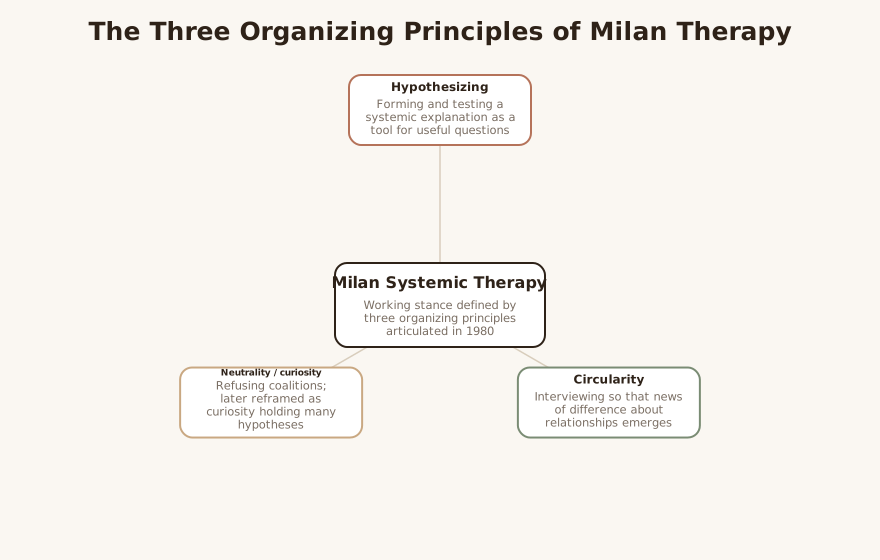
Three organizing principles, articulated by the team in 1980, define the working stance: hypothesizing, circularity, and neutrality 5. Hypothesizing means the team forms and continually tests a systemic explanation of how the symptom functions within the family’s relationships, using each hypothesis as a tool for generating useful questions rather than as a truth to be proven 3. A hypothesis that the data contradict is simply replaced by a better one LLM.
Circularity refers to conducting the interview so that information about relationships and differences emerges, rather than collecting linear cause-and-effect accounts 5. The therapist asks one member to comment on the relationship between two others, eliciting “news of difference” that the family rarely articulates aloud 3. Neutrality is the therapist’s refusal to enter coalitions or endorse any one member’s view as the correct one, holding all positions with equal curiosity 5. In the model’s later development, Cecchin reframed neutrality as curiosity — a stance that keeps the therapist generating multiple hypotheses instead of becoming attached to a single story LLM. Underlying all three is the systemic premise that the symptom is a communication and may serve a function in maintaining the family’s organization 3.
Interventions & Techniques
Circular questioning is the model’s signature technique and its most exported one 5. Question types include difference questions (“Who worries most about your son?”), relationship questions, triadic questions (asking one person about the relationship between two others), ranking questions, and hypothetical or future-oriented questions 3. The aim is not to gather facts but to introduce difference into a system that has become rigid and to let new meanings surface 3.
Positive connotation reframes the symptom and the behaviour around it as serving a benevolent purpose for the cohesion of the family — for example, construing a child’s symptom as the family’s way of staying connected 3. This disarms the family’s defensive expectation of blame and opens room for change LLM. Systemic prescriptions and rituals are structured tasks or ceremonies assigned between sessions to interrupt the repetitive sequence — the “game” — that sustains the problem 3. The early team also used paradox and counterparadox, in which the therapeutic system deliberately responds to the family’s paradoxical communication with a paradox of its own 1.
Two structural features shaped the original practice. First, the team behind the one-way mirror: a treating therapist works in the room while colleagues observe, and the team confers to build hypotheses and design the closing intervention 3. Later practice opened this into the reflecting team, in which observers offer multiple perspectives more transparently 3. Second, the “long-brief” format: sessions were spaced weeks or a month apart over a limited total number, on the reasoning that the family needs time to metabolize an intervention LLM.
LLM-generated illustrative example (not a guideline): A family presents because a 15-year-old has stopped eating. Rather than asking the adolescent why, the therapist asks the younger sibling, “When your sister doesn’t eat, who in the family gets most upset, and who stays calmest?” The answer surfaces a coalition between mother and daughter that excludes the father — information the family had never stated, now available for reflection LLM.
Evidence Base
Honest appraisal: Milan Systemic Therapy is established in the sense that it is historically foundational, widely taught, and the source of techniques now embedded across systemic practice 5. It is not “established” in the sense of a deep, current, randomized-trial base LLM. Most of the empirical and clinical literature is the team’s own series of case descriptions and conceptual papers from the late 1970s and early 1980s rather than controlled outcome trials 1. The original applications to families with schizophrenia and to anorexia nervosa were advanced as new clinical models, not as efficacy claims meeting modern standards 1.
Several of the most distinctive original techniques — elaborate paradox and counterparadox, and the later “invariant prescription” — have been largely superseded, refined, or quietly abandoned in contemporary systemic practice, and were never validated by rigorous trials LLM. What has endured, and what carries the model’s reputation, is the methodological core: circular questioning, hypothesizing, and the neutral/curious stance, which migrated into dialogical and broader systemic work and remain teachable, transferable skills 5. Clinicians should therefore present Milan technique as a well-developed framework and skill set rather than as an evidence-based treatment for any specific diagnosis LLM.
Populations & Indications
The model was developed with families, and the family — across generations — remains its natural unit 3. It is applied with couples, and with families containing children or adolescents, where relational and developmental dynamics are central 3. Its founding indications were families with a member diagnosed with psychosis or schizophrenia and families with eating disorders, the contexts in which Selvini Palazzoli and colleagues first worked 1. Reported clinical applications extend to family conflict, eating disorders, and serious mental health difficulties including psychosis 3. The approach is best indicated when the presenting difficulty is embedded in, and maintained by, repeating relational patterns rather than when an individual condition is best treated individually LLM.
Problems-for-Work
The model is organized around the recurring relational pattern, so the most natural problems-for-work are relational LLM.
- Family conflict and relationship conflict. Circular questioning maps who sides with whom and how disputes recruit other members, making covert coalitions visible without assigning blame 3.
- Communication problems and rigid family dynamics. Hypothesizing plus difference questions introduce “news of difference” into a stuck conversational system, loosening fixed positions 5.
- Enmeshment and parent–child relational problems. Positive connotation reframes over-involvement as loyalty or protection, lowering defensiveness so the family can renegotiate closeness and distance 3.
- Behavioral problems in children. The child’s behaviour is examined as a move in a family game; rituals and prescriptions target the sequence that maintains it rather than the child alone 3.
- Anorexia nervosa. The founding work reframed self-starvation through the family system rather than as isolated individual pathology, attending to the relational meanings the symptom carries 2.
- Psychosis and schizophrenia. The original Paradox and Counterparadox model addressed families in “schizophrenic transaction,” focusing on systemic communication patterns rather than the diagnosed individual alone 1.
LLM-generated illustrative example (not a guideline): For a couple in chronic conflict, a future-oriented circular question — “If this argument pattern continued unchanged for five years, what would each of you predict about the marriage?” — can surface a shared dread that motivates collaboration more than any direct plea to stop fighting LLM.
Contraindications, Cautions & Cultural Humility
Milan technique is not a stand-alone treatment for acute individual risk: active suicidality, acute psychotic crisis, severe medical compromise in an eating disorder, or active domestic violence require appropriate individual, medical, or safety-focused intervention first LLM. Therapist neutrality is contraindicated where there is abuse or coercive control; refusing to take a position can communicate tacit endorsement and must yield to a clear safety stance LLM. Paradoxical and prescriptive techniques carry the most caution: they can feel manipulative or confusing if used without transparency and a strong alliance, which is part of why contemporary practice has moved toward more collaborative, reflecting-team formats 3.
Cultural humility is built into the stance but must be practiced deliberately: curiosity and avoidance of a single “right” solution should extend to respecting the family’s cultural context and meaning-making rather than imposing the clinician’s family norms 3. What looks like enmeshment through one cultural lens may be appropriate interdependence through another, so the therapist holds hypotheses about “rigid” or “over-close” dynamics lightly and checks them against the family’s own values LLM.
Treatment-Plan Suggestions & SMART Objectives
| Goal | SMART objective (example) | Mechanism |
|---|---|---|
| Reduce blame-driven family conflict | Within 8 sessions, family members will describe the presenting problem in relational rather than person-blaming terms in 3 of 4 consecutive sessions | Circular questioning surfaces patterns over culprits 3 |
| Loosen a rigid interaction pattern | Within 6 sessions, the family will identify one repeating sequence around the symptom and trial one alternative response between sessions | Hypothesizing plus systemic prescription interrupts the “game” 3 |
| Lower defensiveness about a symptom | By session 4, caregivers will articulate one possible protective function the symptom serves for the family | Positive connotation reframes intent 3 |
| Make covert coalitions visible | Within 5 sessions, family will name how disputes recruit other members, observed in session by the therapist | Triadic/relationship questions reveal alliances 5 |
| Renegotiate closeness/distance | Within 10 sessions, an enmeshed dyad will report two instances of tolerated separateness without crisis | Curiosity-based questioning + ritual tasks 3 |
| Shift from linear to systemic understanding | By midpoint, each member will describe the problem from at least one other member’s viewpoint | Circularity introduces “news of difference” 5 |
| Support the family of a member in psychosis/anorexia | Over the episode of care, family will adopt one shared, non-blaming narrative of the difficulty | Systemic reframing of the identified patient 1 |
Common Misconceptions
“Milan therapy is mainly about clever paradoxical prescriptions.” The paradox/counterparadox material is the model’s most dated layer; its durable core is the questioning method and the curious, hypothesizing stance 5. “Neutrality means the therapist is passive or has no opinion.” Neutrality is an active discipline of holding all positions in mind and refusing premature coalition, not indifference — and it is explicitly suspended where safety is at stake 5. “Positive connotation means approving of the symptom.” It names a possible function the symptom serves for the system in order to reduce blame and open change, not to endorse the behaviour 3. “It is one fixed method.” The approach split and evolved: the original clinical-research line and the Boscolo/Cecchin training line diverged, and the principles later fed into dialogical and reflecting-team practice 4. “Milan and MRI strategic therapy are the same thing.” They share cybernetic and communication roots but are distinct systemic traditions with different methods 6.
Training & Certification
There is no single global credential specific to “Milan therapy”; in contemporary practice it is taught as part of broader systemic and family-therapy training rather than as a separate certification track LLM. After the original team divided, Boscolo and Cecchin’s branch became known specifically for training clinicians in the systemic interview, and that pedagogical legacy is a large part of how the principles spread internationally LLM. Clinicians typically acquire the skills through accredited family/systemic therapy programs, supervised practice with live or recorded sessions, and behind-the-mirror or reflecting-team experience 3. The five-decade transmission of the approach across generations of practitioners is itself a documented feature of its history 4.
Key Terms
- Identified patient. The family member who carries the symptom and is presented as “the problem,” reframed by the model as the bearer of a systemic difficulty 3.
- Hypothesizing. Forming and continually revising a systemic explanation that guides the interview 5.
- Circularity / circular questioning. Interviewing to elicit relationships and differences rather than linear causes 5.
- Neutrality / curiosity. Holding all members’ positions with equal interest and avoiding coalition 5.
- Positive connotation. Reframing the symptom as serving a function for the system 3.
- Systemic prescription / ritual. A between-session task designed to interrupt the maintaining pattern 3.
- Paradox and counterparadox. Responding to the family’s paradoxical communication with a deliberate therapeutic paradox 1.
- Behind-the-mirror team / reflecting team. Colleagues observing and contributing perspectives to the treatment 3.
Resources & Further Reading
▶ Watch — a video introduction to this concept:
- Paradox and Counterparadox: A New Model in the Therapy of the Family in Schizophrenic Transaction (1978)
- Mara Selvini Palazzoli (Wikipedia)
- Milan Systemic Therapy (TherapyRoute)
- The influence of the Milan approach: Five decades of intergenerational change — a conversation with Matteo Selvini (ANZJFT)
- The Milan Principles of Hypothesising, Circularity and Neutrality in Dialogical Family Therapy (PDF)
- MRI and Milan: Systemic Family Therapies Part I (YouTube)
Reflective / Supervision Questions
- When I form a hypothesis about a family, how attached do I become to it — and what would it take for me to discard and replace it? LLM
- Where in my recent family sessions did I slip out of neutrality into coalition, and was that a clinical error or a justified safety stance? LLM
- Am I using circular questions to genuinely introduce difference, or have they become a formula I run regardless of what the family needs? LLM
- When I reframe a symptom with positive connotation, am I clear in my own mind that I am naming a function, not endorsing the behaviour? LLM
- How does my own family-of-origin sense of “normal” closeness shape which families I label as enmeshed or rigid? LLM
- For this family’s cultural context, which of my systemic assumptions might not transfer, and how will I check them? LLM