
Type & Discipline
Reframing and therapeutic paradox are not a self-contained “school” of therapy but a set of theory-driven techniques drawn from communication theory and cybernetics as applied to clinical work 1. Reframing is the deliberate act of changing the conceptual or emotional frame around a situation so that the same facts acquire different meaning, without altering the facts themselves 5. Paradoxical interventions — chiefly symptom prescription — instruct the client to deliberately enact or amplify the very symptom they came to eliminate, on the logic that voluntary performance disrupts the involuntary feedback loop sustaining it 4.
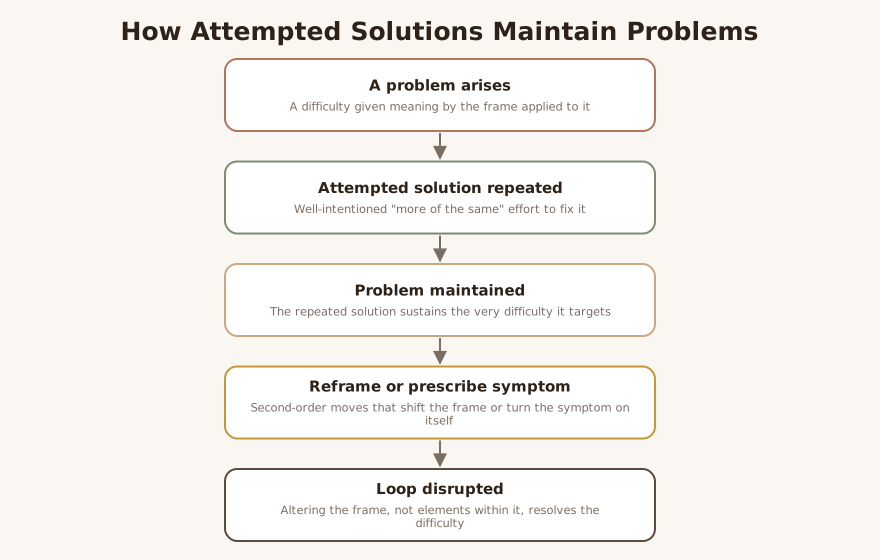
Both techniques sit within the strategic and brief therapy family, with intellectual roots in the Mental Research Institute (MRI) in Palo Alto and in the systemic view that problems are maintained by patterns of interaction rather than by intrapsychic deficits alone 1. The defining theoretical move is that the attempted solution often becomes the problem: rational, “more-of-the-same” efforts to fix a difficulty frequently entrench it 1. Because the techniques are modular, they have been absorbed into cognitive behavioral therapy (reframing as a relative of cognitive restructuring) and into family-systems work, rather than remaining proprietary to any one model 6.
Creators & Lineage
The most direct lineage runs through Paul Watzlawick, John Weakland, and Richard Fisch, whose 1974 book Change: Principles of Problem Formation and Problem Resolution formalized reframing and the theory of first- versus second-order change 1. Their work grew out of the MRI Brief Therapy Center and the broader communications-theory tradition; the central thesis is that genuine change (“second-order change”) requires stepping outside the frame in which the problem is defined, not applying more effort within it 1.
Milton Erickson is the acknowledged clinical precursor: his use of indirect suggestion, utilization of resistance, and prescription of symptoms supplied many of the maneuvers that strategic therapists later systematized 4. Jay Haley, who studied Erickson closely, carried these ideas into strategic family therapy, foregrounding directives and the management of therapeutic power 4. A parallel, independent lineage is Viktor Frankl’s paradoxical intention, in which clients are encouraged to wish for or exaggerate the feared outcome (for example, trying to sweat profusely or to stay awake) — an approach that anticipated symptom prescription from within the logotherapy tradition 5. The Milan systemic group and later solution-focused therapists extended reframing into questions and positive connotation of symptoms 1.
Core Principles
1. Meaning is framed, not given. A behavior has no fixed significance; it acquires meaning from the frame applied to it. Reframing keeps the facts constant and shifts the interpretation, converting, for instance, a “problem” into a “challenge” or hostility into masked fear 5. This is the same logical operation underlying cognitive reframing in CBT, where the clinician helps the client identify and change how an event is viewed 6.
2. Problems are maintained by attempted solutions. Watzlawick and colleagues argued that many difficulties persist precisely because of the well-intentioned, repetitive solutions applied to them — the “more of the same” trap 1. Effective intervention therefore often targets the solution behavior rather than the original complaint 1.
3. First- vs. second-order change. First-order change rearranges elements inside the existing frame; second-order change alters the frame itself, which is where lasting resolution typically occurs 1. Reframing and paradox are both second-order maneuvers 1.
4. The symptom can be turned against itself. If a symptom is partly sustained by the client’s anxious effort to suppress it, prescribing the symptom removes the struggle and the feedback loop that the struggle feeds 4. The “spontaneity paradox” — being commanded to do voluntarily what was experienced as involuntary — is the engine here 4.
Interventions & Techniques
Reframing (meaning and context). Two classic variants are distinguished: meaning reframing, which changes what a behavior signifies, and context reframing, which locates the behavior in a setting where it is adaptive 6. A clinician might reframe a partner’s nagging as a clumsy expression of care, or a teenager’s defiance as a developmentally appropriate bid for autonomy 5.
Positive connotation. A systemic relative of reframing in which the symptom is ascribed a benign, often protective function for the family system, lowering defensiveness and opening room to change 1.
Symptom prescription. The clinician directs the client to perform the symptom deliberately — to schedule worry, to try hard to bring on the compulsion, or to attempt to produce the feared physiological response 4. The act of trying typically reduces the symptom’s grip 4.
Paradoxical intention. The Franklian form: the client is coached to wish for the feared event with humor and detachment, defusing anticipatory anxiety 5.
Restraining and “going slow.” The therapist cautions against changing too quickly, which can paradoxically mobilize a client locked in a power struggle around change 4.
Combining reframing with prescription. Whether symptom prescription should be paired with a reframe — so the client understands a rationale — versus delivered “straight” has been examined empirically, reflecting genuine uncertainty about the active ingredients 2.
LLM-generated illustrative example (not a guideline): A client with sleep-onset insomnia has spent months “trying harder” to fall asleep, which keeps her alert. The clinician reframes the bed as “a place to rest, not a place to perform,” then prescribes that she lie in bed and deliberately try to stay awake with the lights low. Released from the effort to sleep, her arousal drops over the following week LLM.
Evidence Base
The maturity of this body of work is best described as established but uneven. The foundational concepts — reframing, first- and second-order change, the solution-as-problem — are seminal and have shaped brief, strategic, and family therapies for fifty years 1. Reframing in particular is now thoroughly mainstream, having been folded into cognitive therapy as a close cousin of cognitive restructuring 6.
The empirical picture for paradoxical techniques specifically is more qualified. A 2024 scoping review synthesized the literature on how and when paradoxical interventions should be employed, signaling that the field is still working to define indications, mechanisms, and boundary conditions rather than resting on a settled evidence base 3. Component questions — such as whether symptom prescription works better combined with a reframe or delivered alone — have been the subject of focused study, which itself indicates that the active ingredients are not fully resolved 2. The strongest discrete evidence historically attaches to paradoxical intention for insomnia and certain anxiety presentations, where deliberately ceasing the effort to control the symptom is plausibly the operative mechanism 4. Clinicians should present these methods to clients and supervisors as theoretically grounded and clinically useful in selected cases, not as first-line, manualized treatments with large randomized trial support 3.
Populations & Indications
Reframing is broadly applicable and low-risk across nearly all populations, from individuals to couples and families, and is a routine ingredient of cognitive and systemic work 56. Paradoxical techniques are more selective. They were developed largely for couples and families caught in repetitive interactional loops 1, and for individuals with resistant or self-perpetuating symptoms in which trying to control the symptom worsens it 4.
Specific indications discussed in the literature include anticipatory and performance anxiety, insomnia, and obsessive-compulsive patterns, where the symptom is fueled by effortful suppression 4. They are also classically applied to oppositional or controlling behavior and to therapeutic power struggles, where a direct push for change provokes counter-pushing 4. Treatment-resistant clients who have “failed” prior straightforward interventions are a frequent target, on the reasoning that more-of-the-same has already been exhausted 1.
Problems-for-Work
- Symptom maintenance and resistance to change. When a client’s own efforts sustain the problem, reframing the effort and prescribing the symptom can break the loop 14.
- Insomnia. Paradoxical intention — trying to stay awake — removes the performance pressure that drives sleep-onset arousal 4.
- Anticipatory and performance anxiety. Wishing for the feared symptom defuses the secondary fear-of-fear 5.
- Obsessive-compulsive symptoms. Prescribed, scheduled performance of the compulsion can reduce its involuntary quality 4.
- Oppositional / controlling behavior and power struggles. Restraining (“go slow”) sidesteps the change-vs-resist dynamic 4.
- Relationship conflict and negative meaning-frames. Reframing a partner’s behavior changes the affective charge of the interaction 5.
LLM-generated illustrative example (not a guideline): A couple presents with escalating arguments about a partner’s silence. The clinician reframes the silence as “trying not to say something he’ll regret” rather than “not caring,” which shifts the other partner from contempt to curiosity and de-escalates the next argument LLM.
Contraindications, Cautions & Cultural Humility
Paradoxical techniques are powerful and easy to misuse, and the current literature emphasizes that the question is not only whether but when and how they should be employed 3. They are generally contraindicated where the symptom carries real risk — active suicidality, self-harm, severe eating-disordered behavior, psychosis, or substance use where literally “prescribing more” could endanger the client 4. Prescribing a dangerous behavior is never appropriate; the maneuver applies to distressing but non-dangerous symptoms 4.
A second caution concerns the therapeutic alliance and informed consent. Paradoxical directives can feel manipulative or “tricky,” and if experienced as such they can rupture trust 3. Transparency about rationale — and the empirical openness about whether a reframe should accompany the prescription — argues for a collaborative, non-deceptive stance wherever possible 23.
Culturally, the meaning a behavior carries is frame-dependent, and frames are culturally situated. A reframe that lands as liberating for one client may feel dismissive of a culturally salient concern for another, so the clinician must hold reframes lightly and check their fit rather than imposing them LLM. Directive, “expert”-driven paradox may also clash with clients for whom collaborative or relational stances are more congruent, requiring humility about the power dynamics these techniques deliberately engage LLM.
Treatment-Plan Suggestions & SMART Objectives
| Goal | SMART objective (example) | Mechanism |
|---|---|---|
| Reduce sleep-onset effort | Within 3 weeks, client will practice paradoxical intention (trying to stay awake) nightly and report sleep-onset latency on a log for 5 of 7 nights | Removes performance pressure driving arousal 4 |
| Loosen a negative meaning-frame | Within 4 sessions, client will generate one alternative frame for a recurring conflict in 3 of 4 logged incidents | Meaning reframe alters affective charge 5 |
| Disrupt the solution-as-problem loop | Within 2 weeks, client will identify and pause one “more-of-the-same” attempted solution daily | Targets the maintaining behavior, not the complaint 1 |
| Reduce anticipatory anxiety | Within 4 weeks, client will apply paradoxical intention before 3 feared performance situations and rate fear pre/post | Defuses fear-of-fear 5 |
| Lower OCD struggle intensity | Within 3 weeks, client will perform one scheduled, prescribed enactment of a compulsion daily and rate urge afterward | Voluntary performance reduces involuntary grip 4 |
| De-escalate a couple’s power struggle | Within 4 sessions, partners will reframe one another’s behavior aloud once per session in 3 of 4 sessions | Context/meaning reframe shifts interactional stance 5 |
| Interrupt change-vs-resist dynamic | Over 3 sessions, client will follow a “go-slow” restraining directive and observe effects on motivation | Restraining sidesteps counter-pushing 4 |
Common Misconceptions
“Reframing is just positive thinking.” Reframing changes the meaning of fixed facts; it is not denial or forced optimism, and a frame can be more accurate, not merely cheerier 5. “Paradox means tricking the client.” Effective paradoxical work need not be deceptive; the open empirical debate about whether to pair prescription with an explicit reframe shows the field takes the rationale-sharing question seriously 23. “If you prescribe the symptom, it always disappears.” Outcomes are conditional, the mechanisms are not fully settled, and the technique is selective rather than universal 3. “It’s an outdated 1970s idea.” While foundational, the approach remains a live topic, with recent reviews working to clarify indications and timing 3.
Training & Certification
There is no single credential for “reframing and paradox”; competence is typically acquired within broader training in strategic, systemic, or brief family therapy and, for reframing specifically, within cognitive behavioral training where it overlaps with cognitive restructuring 6. Because paradoxical directives carry alliance and safety risks, supervised practice is the appropriate route, and the current literature’s emphasis on when and how to apply them underscores the need for case-by-case clinical judgment rather than rote application 3. Foundational reading begins with Watzlawick, Weakland, and Fisch’s Change 1.
Key Terms
- Reframing — changing the meaning-frame around a situation while the facts stay the same 5.
- First-order change — change within the existing frame; rearranging elements 1.
- Second-order change — change of the frame itself; where lasting resolution typically occurs 1.
- Attempted solution — the well-intentioned effort that paradoxically maintains the problem 1.
- Symptom prescription — directing the client to deliberately perform the symptom 4.
- Paradoxical intention — Frankl’s technique of wishing for or exaggerating the feared outcome 5.
- Positive connotation — ascribing a benign, protective function to a symptom within a system 1.
- Restraining — cautioning against rapid change to sidestep a change-vs-resist struggle 4.
Resources & Further Reading
▶ Watch — a video introduction to this concept:
- Change: Principles of Problem Formation and Problem Resolution (Watzlawick, Weakland & Fisch, 1974) — Internet Archive
- Symptom prescription and reframing: Should they be combined? (Cognitive Therapy and Research, Springer)
- Paradoxical Interventions in Psychotherapy: A Scoping Review on ‘How’ and ‘When’ They Should Be Employed (MDPI, 2024)
- Paradoxical Intervention — an overview (ScienceDirect Topics)
- Reframing — Psychology Today
- Cognitive reframing — Wikipedia
Reflective / Supervision Questions
- For a given case, can you name the client’s attempted solution and ask whether it has become part of the problem? 1
- When you reframe, are you changing meaning to fit the client’s reality, or imposing a frame that suits your model? 5
- Before using a paradoxical directive, have you confirmed the target symptom is distressing but not dangerous? 4
- Would sharing your rationale strengthen or weaken this particular intervention, and what does that say about the alliance? 23
- How do this client’s cultural frames shape what a reframe will mean to them? LLM
- Are you reaching for paradox because the case is genuinely “more-of-the-same,” or because you feel stuck? 3