
Type & Discipline
Structural Family Therapy (SFT) is a systemic family therapy modality within the broader discipline of family systems / systemic therapy 2. Its two defining features are an emphasis on the power of the family and its social context to organize individual behavior, and the central role assigned in treatment to the family itself as the generator of its own healing 2. Rather than locating pathology inside the identified patient, SFT holds that dysfunction is located in the transactional context rather than in the individual, and that therapy consists of realigning the family’s transactional structure 2. This reframes the unit of observation and intervention away from “a patient with pathology” toward “a family in a dysfunctional situation” 2. For the practicing clinician, the practical consequence is a shift in the assessment lens: the question becomes not “what is wrong with this person” but “what organization of relationships keeps this problem in place” LLM.
Creators & Lineage
SFT was developed by Salvador Minuchin, who built the model in two clinical settings that shaped its character 2. In the early 1960s at the Wiltwyck School for Boys, a correctional facility serving delinquent youth from poor New York City neighborhoods, Minuchin and colleagues (including Braulio Montalvo) observed that gains made during a boy’s stay dissipated on return to disorganized, isolated families, while non-delinquent families from the same neighborhoods showed more stable and connected interaction — a finding that pushed treatment toward families rather than isolated individuals and toward “more doing than talking” action techniques 2. From 1965 at the Philadelphia Child Guidance Clinic, Minuchin extended the model to a wider population and to psychosomatic conditions, and formulated its core concepts in a 1972 article and in the classic text Families and Family Therapy (1974) 2. The model is commonly situated alongside strategic family therapy and grounded in systems and communication theory; the Minuchin Center for the Family (renamed after Minuchin’s 1993 retirement) remains dedicated to its development 23. Jorge Colapinto and H. Charles Fishman are among the clinicians who carried the model forward 2.
Core Principles
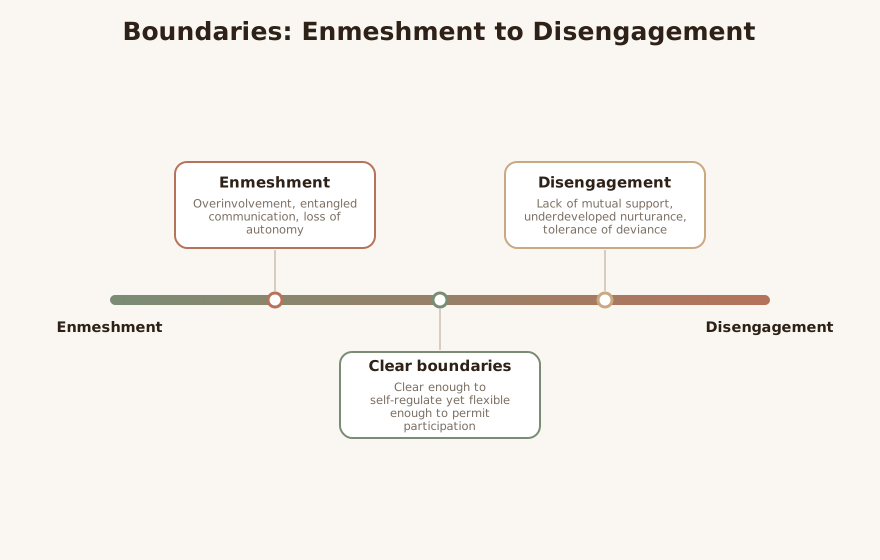
Family structure is the invisible set of functional demands that organizes how family members interact; repeated transactions establish patterns of how, when, and with whom to relate 1. Families operate through subsystems — the spouse, parental, and sibling subsystems, plus alignments by gender or generation — and each member belongs to several at once 2. Boundaries define who participates with whom about what; like a cell membrane, good boundaries are clear enough to let a subsystem self-regulate yet flexible enough to permit participation elsewhere 2. Boundaries fall on a continuum from enmeshment (overinvolvement, entangled communication, loss of autonomy) to disengagement (lack of mutual support, underdeveloped nurturance, tolerance of deviance) 2. Hierarchy reflects differential decision-making power; well-functioning families generally place the parental subsystem “in charge,” not as authoritarianism but as guidance and protection 2. Complementarity describes how members’ positions fit together like puzzle pieces, while the family balances homeostasis (conserving structure) against adaptation (changing to meet developmental and environmental demands) 2. Dysfunction arises when homeostasis trumps adaptation and the family stays “stuck” in a structure that no longer fits its current developmental stage 2.
Interventions & Techniques
SFT relates to families in three intertwined modes — joining, assessing, and changing patterns — that cannot be cleanly separated 2. Joining is the therapist’s stance of respectful curiosity and acceptance that earns temporary insider status and is “the glue that holds the therapeutic system together”; it balances support with enough differentiation to make a difference 2. Assessment proceeds through family mapping — tracking process over content to identify coalitions, alliances, detouring, and who functions as a “switchboard” 2. Enactment is the signature technique: the therapist directs members to interact in session (“Discuss that with your wife, and make sure your daughter doesn’t distract you”) so the family’s actual patterns surface at lifelike intensity and can be revised in the room 2. Boundary making modifies proximity and distance — rearranging chairs, blocking interruptions, having a member observe in silence — to interrupt conflict-avoidance and let underused skills emerge 2. Reframing recasts an individual complaint as a systemic, relational one 4. Intensity and unbalancing (temporarily affiliating with a devalued member) raise the emotional “volume,” and the most intense intervention, crisis induction, deliberately lets an avoided conflict play out and then intervenes forcefully 2. The therapist is the primary instrument of change, not a neutral observer 2.
Evidence Base
SFT’s maturity is best described as established in the sense of being widely taught, durable, and one of the predominant family-counseling theories in the field — but clinicians should be honest about what that does and does not mean for outcome data 4LLM. Its foundational empirical claims come from 1970s work at the Philadelphia Child Guidance Clinic on “psychosomatic families,” where children with diabetes, asthma, and anorexia nervosa whose conditions were poorly controlled were found to show patterns of enmeshment, overprotection, rigidity, and conflict-irresolution, and where family intervention appeared more effective than individual therapy 2. This work was largely uncontrolled clinical research by today’s standards, and the psychosomatic-family model has since been critiqued 2LLM. The most methodologically rigorous descendants of SFT now live in manualized adaptations rather than in “generic” SFT, so a clinician citing an evidence base should generally point to those structured programs rather than to the original studies LLM. In short: the model is conceptually mature and clinically respected, but its modern controlled-trial footprint is thinner than its reputation, and the prudent stance is to use it as a robust assessment-and-intervention framework while remaining candid about the age of its core data LLM.
Populations & Indications
SFT was designed for families and is routinely applied with parents and caregivers, children, adolescents, couples, and blended or single-parent families 24. It originated in work with underorganized, low-income, and minority families and was later extended to a heterogeneous urban population and to families interfacing with child-welfare and human-services systems 2. Psychology Today notes typical applications including adolescent behavioral difficulty, substance use, eating disorders, divorce adjustment, blended-family formation, illness or death in the family, parental mental-health conditions, and major life transitions such as job loss 4. Indications are strongest where the presenting problem is plausibly maintained by family organization — reversed or unclear hierarchy, a parental child, cross-generational coalitions, or boundaries that are too rigid or too diffuse 2. Notably, SFT does not require the whole family to be physically present at every session, but it does require the therapist to “think family” even when meeting an individual parent or child 2.
Problems-for-Work
SFT lends itself to relational and behavioral problems where structure is the lever LLM. Typical problems-for-work include parent-child relational problems, family conflict, enmeshment and disengagement, adolescent behavioral problems, oppositional and conduct difficulties, eating disorders, substance use, and relationship conflict 24. The application logic is consistent across them: identify the structural pattern maintaining the symptom, then use enactment and boundary work to shift it LLM.
- Adolescent oppositionality / parent-child conflict. When a teen “runs the house,” the work targets a weak or split parental hierarchy: get the parents to present a unified executive front and protect the spouse boundary 2LLM.
- Eating disorders. In the classic anorexia “family lunch session,” parents and adolescent stage a three-way fight over eating; the therapist draws a boundary around the spouse subsystem (“You will get out of this boat only by pulling together”), reframing a “mysterious individual disease” as a conflict between an adolescent and her parents 2.
- Substance use and family reorganization. Restructuring supports a parent’s resumption of executive function and reconnection rather than locating the problem solely in the individual’s deficits 2.
LLM-generated illustrative example (not a guideline): A 14-year-old is referred for “defiance.” In session the clinician notices the mother turns to her own mother (the grandmother) every time she sets a limit, who overrides her. The clinician sets up an enactment — mother and son negotiate phone rules directly while the clinician gently blocks the grandmother from intervening — strengthening the parental hierarchy in real time LLM.
Contraindications, Cautions & Cultural Humility
SFT raises the emotional intensity of sessions deliberately, so clinicians should titrate techniques such as unbalancing and crisis induction with care where there is active family violence, untreated severe psychopathology, or safety risk, and should not stage enactments that could expose a member to harm 2LLM. The model has drawn substantive critique that bears directly on cultural humility. Feminist critics argue that the very concept of enmeshment reflects prototypically male standards and can pathologize women’s relational and caregiving preferences 3. SFT has also been criticized for emphasizing intergenerational power dynamics while neglecting spousal issues, extended family, and broader social context 3. There is a live tension worth naming: although SFT originated in work with poor and minority families and was attentive to the disempowerment of families by helping institutions, its norms of “healthy” boundaries and hierarchy are culturally loaded — many cultures organize closeness, multigenerational caregiving, and parental authority in ways that a structural map could mislabel as enmeshment or reversed hierarchy 23LLM. The clinician’s task is to assess against the family’s own cultural and developmental context rather than against a default mid-20th-century nuclear-family template LLM.
Treatment-Plan Suggestions & SMART Objectives
| Goal | SMART objective (example) | Mechanism |
|---|---|---|
| Strengthen parental hierarchy | Within 8 weeks, parents jointly set and hold one house rule across 3 consecutive sessions without a child overriding them | Reinforcing the executive/parental subsystem and clarifying hierarchy 2 |
| Clarify the spouse boundary | Within 6 sessions, the couple completes one in-session discussion of a co-parenting decision without child interruption | Boundary making around the spouse subsystem 2 |
| Reduce enmeshment | Over 10 weeks, the adolescent independently handles 2 age-appropriate tasks formerly done by a parent, reported in session | Increasing differentiation and proximity/distance regulation 2 |
| Reduce disengagement | Within 8 weeks, the family adds one shared daily contact routine, sustained for 2 weeks | Activating underdeveloped nurturance and connection functions 2 |
| Dissolve a cross-generational coalition | Within 6 sessions, parent and grandparent agree to route discipline through the parent, demonstrated in one enactment | Realigning coalitions and detouring patterns 2 |
| Reframe the presenting problem | By session 3, the family describes the problem in relational rather than individual terms | Reframing the unit from identified patient to family system 24 |
| Improve conflict resolution | Over 8 weeks, the family resolves one in-session disagreement to mutual agreement without a third member detouring it | Disrupting conflict-avoidance and building adaptation over homeostasis 2 |
Common Misconceptions
A frequent misconception is that SFT is a toolbox of free-standing techniques; in fact it is a way of thinking and a therapeutic stance, and Minuchin deliberately warned against teaching technique divorced from conceptual framing 2. A second is that the whole family must always be in the room — the model only requires the therapist to “think family,” and can proceed with subsystems or an individual 2. A third is that insight must precede behavioral change; SFT holds the reverse, that change in interaction is a condition of psychological change, not its product, so a parent need not resolve historical roots before becoming effective if the constraining pattern is removed 2. Finally, SFT is sometimes read as anti-individual; in practice it explicitly retains individual assessment and aims for “mutual reliance of the network” rather than rugged self-sufficiency 2.
Training & Certification
SFT competence is developed through structured training rather than a single licensing credential, and is layered onto an existing mental-health license LLM. The Minuchin Center for the Family offers an Introduction to Structural Family Therapy (a 6-week foundational course covering core concepts, assessment, and intervention) and an intermediate-to-advanced Contemporary Applications and Practices course, each delivered online over roughly 12 contact hours and carrying continuing-education credit recognized by multiple state boards and the APA 5. The trainings are aimed at psychologists, counselors, and other mental-health providers working with families and children, including those in child welfare, community mental health, and hospital settings, and the Center also provides on-site agency training and consultation 5. Historically, Minuchin trained practitioners through workshops, summer practica, and year-long externships at the Philadelphia Family Therapy Training Center, a live-supervision tradition that still informs how the model is taught 2.
Key Terms
- Family structure: the invisible set of functional demands organizing recurrent transactions among members 1.
- Subsystem: a functional unit (spouse, parental, sibling) to which members belong simultaneously 2.
- Boundary: the rule defining who participates with whom about what; ranges from rigid to diffuse 2.
- Enmeshment / disengagement: the overinvolved and disengaged poles of the boundary continuum 2.
- Hierarchy: the distribution of decision-making power, ideally with parents “in charge” through guidance 2.
- Coalition / alignment: the grouping of members for or against one another, including cross-generational coalitions 2.
- Complementarity: the way members’ positions fit together as a spatial arrangement 2.
- Homeostasis vs. adaptation: the family’s tendency to conserve structure versus to change with developmental demands 2.
- Enactment: directed in-session interaction that surfaces and revises real patterns 2.
- Joining, unbalancing, intensity, crisis induction: the therapist’s stance and escalating restructuring techniques 2.
Resources & Further Reading
- Minuchin, S. (1974). Families and Family Therapy. Harvard University Press
- Colapinto, J. — Structural Family Therapy (Minuchin Center training chapter, PDF)
- Vetere, A. (2001). Structural Family Therapy. Child Psychology and Psychiatry Review (ResearchGate record)
- The Minuchin Center for the Family — Training
- Structural Family Therapy — Psychology Today
- Structural family therapy — Wikipedia
- Salvador Minuchin on Family Therapy (interview, YouTube)
Reflective / Supervision Questions
- When I map this family, which subsystems are clear, and where are the boundaries too rigid or too diffuse? LLM
- Whose hierarchy is being undermined, and by which coalition or detouring pattern? LLM
- Am I “thinking family” even in the sessions where I meet only one member? LLM
- Where am I tempted to interpret rather than to set up an enactment and let the pattern show itself? LLM
- Can I tolerate the intensity required to sustain a restructuring move, or do I relieve the family too soon? LLM
- Is my judgment of “enmeshment” or “reversed hierarchy” a structural problem, or a cultural difference I am pathologizing? LLM
- Whose latent “slices of the pie” — competence, tenderness, assertiveness — am I trying to help this family recover? LLM