
Strain theory is a sociological account of why people deviate from social norms, not a clinical treatment model — but it gives therapists a sharp, structural lens on the distress that walks into the room when a person’s aspirations have outpaced their realistic options. LLM This article frames Merton’s construct for practicing clinicians: what it claims, where the evidence sits (sociological, not clinical), and how its concepts can be borrowed carefully as case-formulation scaffolding. LLM
Type & Discipline
Merton’s strain theory is a construct drawn from sociology, specifically the structural-functionalist tradition and the sociology of deviance. 1 It is a macro-level theory: it locates the source of deviant and distressed behavior not in the individual psyche but in the structure of society itself, particularly the gap between what a culture tells people to want and the legitimate avenues it actually provides. 4 Because it was built to explain crime rates and social patterns rather than to guide psychotherapy, its relevance to clinical work is analogical — a way of thinking, not a validated intervention. LLM
Creators & Lineage
The theory was developed by American sociologist Robert K. Merton, most influentially in his 1938 paper “Social Structure and Anomie,” reflecting on success-driven American society. 1 5 Merton built directly on Émile Durkheim’s concept of anomie — a state of normative breakdown or “dysregulation” in which the rules that ordinarily govern aspiration and behavior lose their grip. 5 Where Durkheim tied anomie to rapid social change and a breakdown in regulation and integration, Merton relocated it inside the everyday structure of modern society: the routine mismatch between universal goals and unequally distributed means. 4 1
The lineage continues forward. In the late 1970s and beyond, Robert Agnew reformulated the idea as General Strain Theory (GST), shifting from Merton’s macro structural strain to a micro-level, social-psychological account. 5 GST broadened “strain” beyond blocked economic goals to include the loss of valued relationships and exposure to negative or noxious stimuli, and argued that the negative emotions these strains generate (anger, frustration, despair) are what drive maladaptive coping. 5 This emotional-mediation move is what makes the tradition most legible to clinicians. LLM Related constructs in the same family include relative deprivation — distress arising from comparison to others rather than absolute lack. LLM
Core Principles
The engine of the theory is a disjunction between two things every culture transmits. 4 First are culturally prescribed goals — the success symbols a society teaches everyone to pursue, classically material wealth, status, and upward mobility (Merton’s “American Dream”). 5 2 Second are the legitimate or institutionalized means — the approved pathways to those goals, such as education and lawful employment. 3
Strain arises when the culture broadcasts the goals universally but distributes the means unequally, so that large groups are told to want what they have no realistic legitimate route to obtain. 4 2 This is the structural source of anomie: when the gap is wide and chronic, the normative link between goals and means frays, and pressure builds toward deviation. 1 5
Crucially, deviance in this model is normal, not pathological in origin — it is a predictable adaptation to a structural contradiction rather than evidence of individual defect. 4 This is the single most clinically useful reframe the theory offers: behavior that looks like personal failure may be a coherent response to an impossible structural position. LLM
Interventions & Techniques
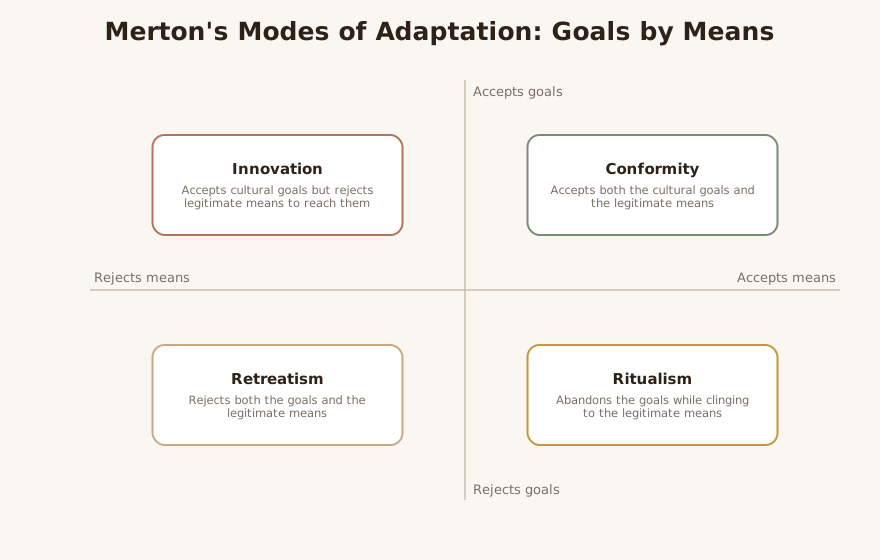
Strain theory has no native “techniques” — it is explanatory, not prescriptive. LLM What it offers the clinician is the modes-of-adaptation typology, which functions as a formulation grid. Merton classified responses by whether a person accepts or rejects the cultural goals and, separately, the legitimate means. 3 6
- Conformity — accepts goals, accepts means. The person keeps pursuing success through education and lawful work despite obstacles; the most common and socially stabilizing response. 2 3
- Innovation — accepts goals, rejects/lacks means. The person still wants success but reaches for illegitimate routes (fraud, theft, dealing) when legitimate ones are blocked. 2 6
- Ritualism — rejects (lowers) goals, accepts means. The person abandons high ambition but rigidly clings to the approved routines, prioritizing security and procedure over advancement. 2 3
- Retreatism — rejects goals, rejects means. The person withdraws from both, a route associated with social disengagement and self-destructive coping such as substance use. 2
- Rebellion — replaces goals and means. The person rejects the prevailing goals and methods and substitutes an alternative vision, seeking systemic change. 2 3
Translated into clinical practice, the grid becomes a non-pathologizing assessment heuristic: where is this client positioned, and at what cost? LLM The therapeutic moves remain those of established modalities — values clarification, behavioral activation, cognitive restructuring of “success” beliefs, grief work around abandoned goals — with the typology supplying the case conceptualization. LLM
LLM-generated illustrative example (not a guideline): A clinician hears a client describe years of grinding at a job he privately finds meaningless, following every rule, hoping for nothing. Reading this as ritualism rather than “low motivation” reorients the work toward grief over a foreclosed ambition and a renegotiation of what “enough” means. LLM
Evidence Base
Be honest with yourself and with supervisees: the evidence here is sociological and analogical, not clinical. LLM Strain theory is an influential and durable account of patterned deviance, but it was never validated as a psychotherapeutic framework, and there are no trials of “strain-theory therapy.” LLM
Even within sociology and criminology the empirical support is contested. Critics note that the original theory lacks consistent empirical confirmation of a direct causal link between strain and criminal behavior, over-emphasizes lower-class crime while failing to explain white-collar offending, and assumes a near-universal materialism that ignores cultural variation. 2 5 Agnew’s General Strain Theory was developed partly to repair these gaps by introducing emotion as the mediating mechanism and broadening the sources of strain. 5
For clinical purposes the takeaway is clear: use the theory to generate hypotheses and language, never to claim an evidence-based mechanism. LLM The validated tools you actually deploy belong to recognized modalities; strain theory is the conceptual scaffolding around them. LLM
Populations & Indications
The construct is most resonant for people whose presenting distress is entangled with blocked opportunity and the goal–means gap. LLM Low-income individuals and those experiencing socioeconomic adversity sit at the theory’s center, since they are most likely to internalize universal success goals while facing constricted legitimate means. 4 2 Adolescents and teens navigating early identity and achievement pressures, justice-involved adults whose histories often track the innovation/retreatism pathways, immigrants straddling competing goal systems, and racial and ethnic minority individuals facing structural barriers to legitimate means are all populations where the lens can illuminate context rather than pathology. 5 LLM
Less obviously, the framework also speaks to high achievers and high-functioning professionals: when culturally idealized success is internalized so completely that it cannot be questioned, conformity and ritualism can curdle into workaholism, perfectionism, and quiet despair. LLM
Problems-for-Work
The following are clinical targets where the strain lens can inform formulation. The theory does not treat these; it helps you frame them. LLM
- Financial strain and material hardship — naming the goal–means gap can externalize self-blame, separating “I failed” from “the legitimate route was structurally narrow.” 4 LLM
- Demoralization and hopelessness — chronic exposure to the gap maps onto the retreatist drift; formulation targets reconnection to attainable, self-chosen goals. 2 LLM
- Resentment — relative deprivation and blocked aspiration are fertile soil for resentment, a workable affect once its structural roots are named. LLM
- Maladaptive perfectionism and workaholism — over-identification with culturally prescribed success (rigid conformity/ritualism) is a useful reframe for compulsive overworking. LLM
- Substance use comorbidity — the retreatism mode explicitly links rejection of goals and means with self-destructive coping such as substance use. 2 LLM
- Loss of meaning or purpose — the ritualist’s abandoned goals and the retreatist’s withdrawal both present clinically as anhedonia and emptiness. LLM
- Adult antisocial behavior — the innovation mode offers a non-moralizing context for rule-breaking pursued in service of otherwise-mainstream goals. 2 LLM
Contraindications, Cautions & Cultural Humility
Strain theory is a blunt instrument if mishandled, and several cautions are non-negotiable. LLM First, it can stereotype: its historical over-focus on lower-class deviance and its assumption of universal materialism risk pathologizing poverty and importing class bias into the consulting room. 5 2 Hold the typology loosely — people move between modes, and labeling a client a “retreatist” is a formulation note, never a diagnosis or a fixed identity. LLM
Second, cultural humility is essential precisely because the theory assumes one dominant goal-set. 2 Many clients operate within plural or alternative value systems — communal, spiritual, or non-materialist — for which the “American Dream” frame is simply wrong; treating their goals as deviant replicates the theory’s central blind spot. 5 LLM
Third, never use the structural frame to minimize agency or risk. Recognizing that innovation or retreatism is a coherent response to blocked opportunity does not license normalizing harmful behavior or skipping standard risk assessment for substance use, antisocial behavior, or hopelessness. LLM The theory contextualizes; it does not excuse, and it does not substitute for evidence-based safety planning. LLM
Treatment-Plan Suggestions & SMART Objectives
The objectives below sit inside established, evidence-based modalities; strain theory supplies only the conceptual framing. LLM
| Goal | SMART objective (example) | Mechanism |
|---|---|---|
| Reduce demoralization from blocked goals | Within 8 weeks, client will identify and act on two self-defined, attainable goals, logging weekly progress | Behavioral activation; reconnects effort to reachable means |
| Decouple self-worth from prescribed “success” | Over 6 sessions, client will articulate 3 personal values distinct from material status and rate weekly alignment | Values clarification; loosens over-identification with cultural goals |
| Soften maladaptive perfectionism | Within 10 weeks, client will reduce self-rated “all-or-nothing success” beliefs by 30% on a tracking scale | Cognitive restructuring of internalized goal standards |
| Process grief over abandoned ambition (ritualism) | Over 5 sessions, client will name and emotionally process one foreclosed goal without self-criticism | Grief/acceptance work; addresses the cost of ritualist adaptation |
| Reduce substance use linked to withdrawal (retreatism) | Within 12 weeks, client will cut use to an agreed target and add two non-use coping skills | Coping-skills training; targets retreatist self-destructive coping |
| Address resentment from relative deprivation | Over 6 sessions, client will identify resentment triggers and practice one reframe or boundary per week | Emotion regulation; works the affect, not the comparison |
| Reframe financial-strain self-blame | Within 4 sessions, client will distinguish structural barriers from personal failure in two stressors | Externalizing/reattribution; reduces shame load |
Common Misconceptions
A few errors recur and are worth naming explicitly. LLM “Strain theory explains individual psychology.” It does not; it is a structural theory about society-wide patterns, and applying it to one person is an analogy, not a mechanism. 4 LLM “It’s an evidence-based therapy.” There is no such thing — the theory has no clinical trials and even its sociological evidence is contested. 5 LLM “The five modes are personality types.” They are responses to a structural condition, situational and changeable, not fixed traits. 3 LLM “Innovation means creativity.” In Merton’s specific sense, innovation denotes pursuing legitimate goals through illegitimate means, a technical term that can mislead. 6 LLM “Strain only affects the poor.” Goal–means gaps also generate distress among high achievers whose internalized success goals become inescapable. LLM
Training & Certification
There is no certification in strain theory and none to seek; it is academic sociology, not a credentialed clinical modality. LLM Clinicians encounter it through undergraduate sociology and criminology coursework and open educational texts. 5 The appropriate “training” for clinical use is competence in the actual evidence-based modalities (e.g., cognitive behavioral, acceptance-based, and motivational approaches) into which the construct’s framing is borrowed, plus grounding in the social determinants of mental health. LLM Treat strain theory as conceptual literacy that enriches formulation, not as a technique to be certified in. LLM
Key Terms
- Anomie — a condition of normlessness or dysregulation in which the rules linking aspiration to behavior break down; Durkheim’s concept, adapted by Merton. 5 1
- Cultural goals — the success aims a society teaches everyone to pursue, classically wealth and status. 4
- Institutionalized / legitimate means — the socially approved pathways to those goals, such as education and lawful work. 3
- Strain — the pressure generated when valued goals outstrip access to legitimate means. 4
- Modes of adaptation — Merton’s five responses to strain: conformity, innovation, ritualism, retreatism, rebellion. 3 6
- General Strain Theory (GST) — Agnew’s micro-level reformulation locating the driver of deviance in negative emotions produced by a broadened range of strains. 5
- Relative deprivation — distress arising from comparison to others rather than from absolute lack. LLM
Resources & Further Reading
▶ Watch — a video introduction to this concept:
- Strain theory (sociology) — Wikipedia
- Merton’s Strain Theory of Deviance in Sociology — Simply Psychology
- Strain Theory and Merton’s Modes of Adaptation — Easy Sociology
- Strain Theory (sociology) — EBSCO Research Starters
- Sociological Theories of Crime: Strain Theories — Griffith University (open text)
- Merton’s Strain Theory: Definition, Typology & Examples — Study.com
Reflective / Supervision Questions
- When a client’s distress maps onto a “mode of adaptation,” am I using that as a hypothesis or quietly converting it into a fixed label? LLM
- Whose “cultural goals” am I assuming this client should hold — and have I checked that against their actual values? LLM
- Where might importing a structural-deviance lens lead me to under-assess clinical risk in the name of “context”? LLM
- How do I hold the structural reality of blocked opportunity alongside the client’s agency without collapsing into either fatalism or victim-blaming? LLM
- For high-functioning clients, am I missing the strain hidden inside their over-identification with success? LLM