
Type & Discipline
Strain theory is an explanatory theory drawn from sociology and criminology, not a model of psychotherapy 2. It belongs to the structural-functionalist tradition, which asks how features of social structure shape rates of deviance across a population rather than locating crime in individual pathology alone 5. Its central claim is that pressure derived from social factors, such as lack of income or limited access to quality education, can drive individuals toward crime and deviance 2. For the practicing clinician, the value of strain theory is conceptual: it offers a vocabulary for the social and situational forces that load onto a client’s distress, and it reframes some “antisocial” behavior as an understandable, if maladaptive, response to blocked goals and accumulating adversity LLM. It is a formulation lens that sits alongside the diagnostic and intervention frameworks you already use, not a substitute for them LLM.
Creators & Lineage
The classic version was developed in the 1930s by sociologist Robert K. Merton and became especially prominent in the 1950s 2. Merton drew on Durkheim’s concept of anomie, a condition of normative breakdown or dysregulation, to argue that the amount of deviance in a society depends on whether that society supplies adequate legitimate means to reach its culturally defined goals 56. The tradition was extended by Albert Cohen on delinquent subcultures and by Richard Cloward and Lloyd Ohlin on differential opportunity 2. Later, Steven Messner and Richard Rosenfeld reformulated the macro-level argument as institutional anomie theory, and Robert Agnew advanced the micro-level, social-psychological version known as General Strain Theory (GST) 25. Agnew’s contribution addressed limitations in the earlier models, particularly their difficulty explaining middle-class delinquency and the gap between aspirations and realistic expectations 2. The strain tradition is conceptually adjacent to social control theory, differential association theory, and social learning theory, each of which offers a competing or complementary account of how deviance is produced and transmitted LLM.
Core Principles
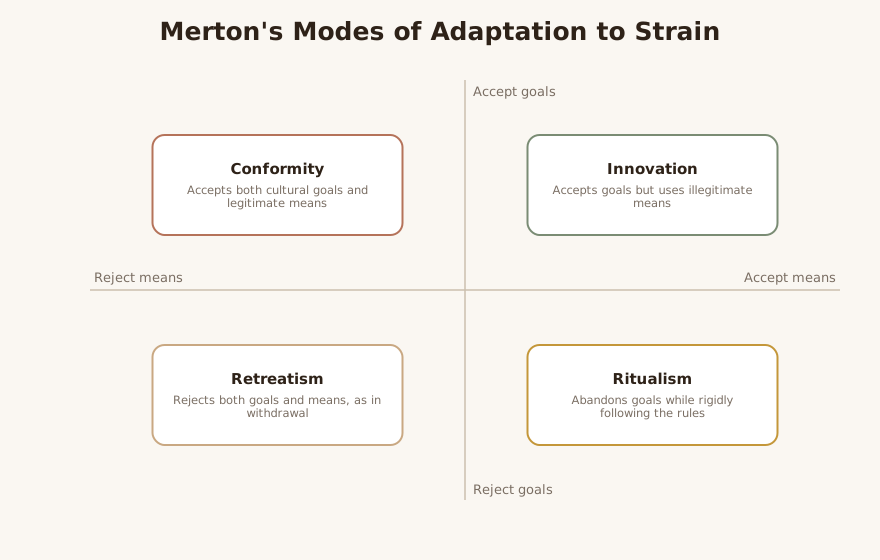
Merton’s classic strain theory rests on a mismatch between two cultural elements: the goals a society holds up as desirable (in the American case, wealth, status, and success) and the legitimate, approved means of attaining them, such as education and stable employment 3. When social inequality blocks access to legitimate pathways, the resulting disjuncture produces strain and a breakdown of the rules, or anomie 35. Merton mapped five modes of adaptation to this strain: conformity (accepting both goals and means), innovation (accepting goals but using illegitimate means), ritualism (abandoning the goals while rigidly following the rules), retreatism (rejecting both goals and means, as in withdrawal or substance use), and rebellion (replacing the existing goals and means with alternatives) 35. This framework deliberately shifts attention from individual moral failing to structural conditions 3.
Agnew’s General Strain Theory broadened the engine of deviance beyond economic failure 2. It identifies three sources of strain: the failure to achieve positively valued goals, the removal or loss of positive stimuli (valued relationships, possessions, or status), and the introduction of negative stimuli (adverse experiences such as discrimination or abuse) 1. Critically, GST inserts an emotional mechanism: strain generates negative emotions, especially anger, and individuals then turn to coping responses that may be constructive or criminal 15. Not all strain is equally criminogenic. Agnew specified that strains most likely to produce crime are those perceived as unjust, high in magnitude, associated with weak social control, and creating some pressure or incentive for criminal coping 1. The intensity, duration, recentness, and centrality of a strain shape its impact, and chronic, severe strain lowers the perceived costs of criminal coping 5.
Interventions & Techniques
Strain theory does not prescribe a set of clinical techniques; it is descriptive and explanatory LLM. Its practical leverage in the consulting room is at the level of case formulation and intervention selection LLM. The theory’s own logic, however, points toward where change is possible: because strain leads to crime largely when individuals lack constructive coping, healthier alternatives such as therapy, cognitive-behavioral coping techniques, and emotional regulation skills are exactly the leverage points the framework recommends for prevention 1.
Translated into clinical practice, a clinician can use the strain lens to do several things LLM. First, conduct a strain inventory during assessment, mapping the client’s blocked goals, recent losses, and ongoing noxious exposures against the three GST sources 1. Second, name and validate the negative emotion, particularly anger and its frequent companions of injustice and humiliation, as a meaningful signal rather than a moral defect 1. Third, target the strain-to-emotion-to-behavior chain with established skills: distress tolerance, cognitive reappraisal of perceived injustice, and problem-solving aimed at restoring legitimate pathways to valued goals LLM. Fourth, where the strain is structural (poverty, discrimination, lack of opportunity), incorporate case management, advocacy, and concrete resource linkage, since GST locates much of the pressure outside the individual 5.
LLM-generated illustrative example (not a guideline): A 17-year-old on probation describes school as “pointless” after being tracked out of the courses that lead to the trades program he wanted. He has begun selling vape cartridges with older peers. Using a strain lens, the clinician maps this as a blocked positively valued goal generating anger and a sense of injustice, with the peer income an “innovation” adaptation. Treatment then targets the anger and injustice appraisal, restores a realistic legitimate pathway (re-enrollment, a mentor), and strengthens constructive coping, rather than treating the selling as a stand-alone moral problem LLM.
Evidence Base
Strain theory is an established and foundational theory within criminology, remaining central to how the field explains deviance through structural and psychological strain rather than individual pathology alone 2. General Strain Theory in particular has generated a large empirical literature and is widely taught as a core sociological theory of crime 56. It is important to be precise about what “established” means here: it describes the theory’s standing as a respected, well-tested explanatory framework in sociology and criminology, not the existence of a manualized, randomized-trial-validated treatment LLM. There is no “strain theory therapy” with an evidence base of its own LLM. When clinicians act on strain-informed formulations, the techniques they deploy (cognitive-behavioral coping, emotion regulation, family and community interventions) carry their own separate evidence, and that is where empirical support for the clinical work actually resides LLM. The theory’s documented limitations also temper how far it should be stretched: critics note it can overemphasize economic success at the expense of diverse aspirations, neglect cultural variation in how goals are defined, offer overly simplistic explanations of deviance, and underexplain white-collar and elite crime while focusing on street crime 5.
Populations & Indications
The theory was originally built around disadvantaged populations unable to achieve socially valued goals through legitimate channels 2. It maps naturally onto clinical work with adolescents and at-risk youth, for whom GST was substantially developed, since Agnew recognized that negative experiences can produce stress even when they are not financially induced, which is often the case for young people 1. It is highly relevant to justice-involved individuals, low-income populations, and marginalized communities, where blocked legitimate opportunity and exposure to noxious environments concentrate 25. Emerging adults / young adults navigating the gap between cultural success scripts and constrained real-world opportunity are another natural fit LLM. The theory has been applied to structurally disadvantaged groups; for example, the Griffith criminology text discusses how colonial policies created strains that disconnected Indigenous (First Nations) cultural goals from available legitimate means, producing unemployment, educational inequity, and criminal-justice overrepresentation, and calls for culturally informed responses 5.
Problems-for-Work
The strain lens speaks most directly to externalizing and stress-linked presentations LLM. Conduct disorder and delinquency can be formulated as innovation or rebellion adaptations to blocked goals, reframing oppositional behavior as goal-directed and context-bound 31. Substance use disorders align with the retreatism adaptation, a withdrawal from both goals and legitimate means 35. Aggression, antisocial behavior, and anger are central, since GST positions anger as the emotional bridge between strain and criminal coping 1. The theory also accounts for internalizing outcomes: depression, chronic stress, and hopelessness can follow the same strains, particularly where the person turns the negative emotion inward rather than outward 1. Anomie, the felt sense that the rules no longer hold or apply, is itself a named problem-for-work that strain theory uniquely illuminates 5.
LLM-generated illustrative example (not a guideline): A 24-year-old client presents with depression and a flat “what’s the point” stance after two years of applying for jobs in her field without success. Rather than reading this only as a mood disorder, the clinician also names it as a strain response: a blocked positively valued goal producing hopelessness and incipient anomie. Treatment combines behavioral activation and cognitive work on the meaning she has assigned to the failure with concrete steps toward an alternative, legitimate pathway LLM.
Contraindications, Cautions & Cultural Humility
Because strain theory is a sociological lens rather than a treatment, the main “contraindication” is over-application: using it to explain away individual responsibility, to pathologize a community, or to substitute social commentary for clinical care LLM. Clinicians should hold the theory’s own critiques in view, especially its tendency to assume a single dominant definition of success and to neglect cultural variation in goals, which can lead to misreading a client whose aspirations differ from the mainstream script 5. A serious caution concerns gender: the framing that men channel anger into criminal behavior through moral outrage while women more often experience depression and guilt, leading to self-directed rather than criminal responses, is a generalization that must not become a stereotype applied to an individual in front of you 1. The structural emphasis of the theory is a strength only if it is matched with cultural humility: with marginalized and colonized communities, the appropriate response is culturally informed intervention developed with the community, not externally imposed assumptions about their goals or deficits 5. Finally, naming structural strain must never slide into fatalism that strips the client of agency; the therapeutic move is to validate the reality of the strain while strengthening the constructive coping and legitimate pathways that remain available LLM.
Treatment-Plan Suggestions & SMART Objectives
The table below illustrates how a strain-informed formulation can be operationalized using established therapeutic skills LLM. Strain theory supplies the formulation; the mechanism column names the actual therapeutic lever LLM.
| Goal | SMART objective (example) | Mechanism |
|---|---|---|
| Reduce reactive aggression linked to perceived injustice | Within 8 weeks, client will use a cognitive reappraisal skill to reframe at least 3 logged “unfair” triggers per week, with self-rated anger dropping 2 points on a 0-10 scale | Targets the strain-anger-behavior chain via cognitive restructuring of injustice appraisals 1 |
| Build constructive (non-criminal) coping repertoire | Within 6 weeks, client will identify and practice 4 distress-tolerance skills and report using at least 2 during a real strain episode | Substitutes constructive coping where criminal coping was the default 1 |
| Restore a legitimate pathway to a blocked goal | Within 90 days, client will complete 3 concrete steps toward re-enrollment or job training and attend 1 supportive resource appointment | Reduces strain magnitude by reopening legitimate means 5 |
| Address retreatism-pattern substance use | Within 12 weeks, client will reduce use to an agreed target and replace 2 weekly “escape” episodes with a values-based activity | Reframes use as a retreatism adaptation and builds alternatives 3 |
| Reduce hopelessness and emerging anomie | Within 8 weeks, client will complete daily behavioral-activation entries and rate sense of meaning weekly, targeting a 2-point rise | Counters the depressive/anomic strain response 1 |
| Strengthen social bonds and informal support | Within 10 weeks, client will re-engage 2 prosocial relationships and attend 1 community or group activity weekly | Raises social control and lowers criminogenic strain pressure 1 |
| Process losses driving removal-of-positive-stimuli strain | Over 12 sessions, client will complete grief/loss-focused processing for a named loss, with reduced intrusion and avoidance scores | Resolves the loss strain source before it fuels acting-out 1 |
Common Misconceptions
A first misconception is that strain theory is a therapy or treatment model; it is an explanatory sociological theory, and any clinical work it informs rests on the evidence of the techniques actually used 2LLM. A second is that it blames poverty for crime in a deterministic way; in fact the theory turns on the gap between goals and means and on how individuals adapt, which is why most people facing strain conform rather than offend 36. A third is that Merton’s and Agnew’s versions are the same; Merton offered a macro, structural account centered on economic goals, while Agnew’s General Strain Theory is a micro, social-psychological account that adds losses, noxious experiences, and the emotional pathway of anger 15. A fourth is that strain inevitably leads to crime; GST is explicit that strain leads to crime mainly when constructive coping is absent, which is precisely the space where therapy operates 1. A fifth is that the theory explains all crime equally well; it is acknowledged to fit street crime better than white-collar or elite deviance 5.
Training & Certification
There is no certification in strain theory, because it is an academic framework rather than a credentialed clinical modality LLM. Clinicians typically encounter it within sociology or criminology coursework, in introductory criminology texts such as the Griffith University materials, and in foundational survey content like Crash Course Sociology 56. To use it well clinically, the relevant training is in the evidence-based methods that carry the actual intervention, including cognitive-behavioral coping and emotion-regulation approaches, alongside cultural-competence training for work with marginalized and justice-involved populations 15. Reading Agnew’s original General Strain Theory writing and the institutional anomie reformulation by Messner and Rosenfeld deepens the formulation, but neither confers a treatment credential 24.
Key Terms
Strain: pressure produced by the gap between goals and legitimate means, or by losses and noxious experiences, that can push toward deviance 21. Anomie: a condition of normative breakdown or dysregulation in which the rules lose their hold 5. Modes of adaptation: Merton’s five responses to strain (conformity, innovation, ritualism, retreatism, rebellion) 3. Innovation: pursuing approved goals through illegitimate means 3. Retreatism: rejecting both goals and means, as in withdrawal or substance use 3. General Strain Theory (GST): Agnew’s micro-level extension adding loss and negative stimuli and an emotional, anger-centered pathway 1. Three sources of strain: failure to achieve valued goals, removal of positive stimuli, introduction of negative stimuli 1. Criminogenic strain characteristics: strains that are unjust, high in magnitude, low in social control, and pressuring toward criminal coping 1. Institutional anomie theory: the Messner and Rosenfeld macro reformulation 2.
Resources & Further Reading
▶ Watch — a video introduction to this concept:
- General strain theory (Wikipedia)
- Strain theory (Encyclopaedia Britannica)
- Merton’s Strain Theory of Deviance (Simply Psychology)
- Anomie and Strain: Context and Consequences of Merton’s Two Theories (ResearchGate)
- Sociological Theories of Crime: Strain Theories (Griffith University)
- Theory & Deviance: Crash Course Sociology #19
Reflective / Supervision Questions
- When you frame a client’s behavior as a strain adaptation, are you using the lens to understand them or to excuse the system from any expectation of their agency LLM?
- Which of your clients are responding to genuinely blocked legitimate pathways, and what concrete steps could reopen even one of those pathways 5?
- How do you hold the difference between validating real structural strain and inadvertently communicating fatalism to the client LLM?
- Where might the theory’s mainstream definition of “success” be causing you to misread a client whose goals are culturally different 5?
- In your work with anger and aggression, are you treating anger as the criminogenic bridge GST describes, and intervening on the appraisal of injustice that precedes it 1?
- Are you avoiding the trap of applying gendered generalizations about anger and depression to the individual in front of you 1?