
Ketamine-assisted psychotherapy (KAP) is a treatment model in which a clinician administers ketamine at sub-anesthetic or dissociative doses inside a structured psychotherapeutic frame of preparation, dosing, and integration sessions 7. It sits at the intersection of psychiatry and psychotherapy: a prescriber manages the pharmacology while a therapist holds the relational and meaning-making work around the medicine sessions 6. This article orients practicing clinicians to what KAP is, what the evidence does and does not support, and how to think about it responsibly in a referral or co-treatment role. LLM
Type & Discipline
KAP is best understood as a pharmacologically augmented psychotherapy, not a pill prescribed in isolation 6. The medicine is ketamine, a dissociative anesthetic that, at low doses, produces a non-ordinary state of consciousness during which psychotherapeutic processing is intended to occur 7. Disciplinarily it spans psychiatry, anesthesiology-adjacent prescribing, and psychotherapy, because legal administration requires a licensed prescriber even when the therapeutic container is held by a non-prescribing therapist 6. Within the broader family of psychedelic-assisted therapies, ketamine occupies a distinctive position: unlike psilocybin or MDMA, ketamine is already an FDA-approved anesthetic that can be used off-label for psychiatric indications, which is why KAP is clinically available today while other psychedelic therapies remain largely investigational 7. LLM
It is important to separate KAP from the simpler, more common practice of ketamine infusion or intranasal esketamine administered with minimal psychological scaffolding 6. KAP specifically adds the deliberate therapeutic process — set, setting, intention, and integration — to the pharmacological intervention 8. LLM
Creators & Lineage
The modern articulation of KAP is closely associated with psychiatrist and psychotherapist Phil Wolfson, who co-edited the foundational anthology The Ketamine Papers: Science, Therapy, and Transformation with Glenn Hartelius in 2016 5. That volume gathered clinical experience, theory, and early science into one of the first sustained treatments of ketamine as a vehicle for psychotherapy rather than purely as an antidepressant agent 5. Wolfson’s work helped frame ketamine within a transpersonal and meaning-centered tradition, emphasizing the therapeutic value of the altered state itself 5.
KAP’s intellectual lineage draws on the broader history of psychedelic-assisted psychotherapy, which similarly structures treatment around preparation, a medicine session, and integration 7. It shares conceptual DNA with MDMA-assisted therapy and with transpersonal psychology’s interest in non-ordinary states as occasions for insight and reorganization of self-experience 7. In practice, many KAP therapists also borrow parts-based and self-relational frameworks such as Internal Family Systems to help patients work with material that surfaces during and after dosing 8. LLM
Core Principles
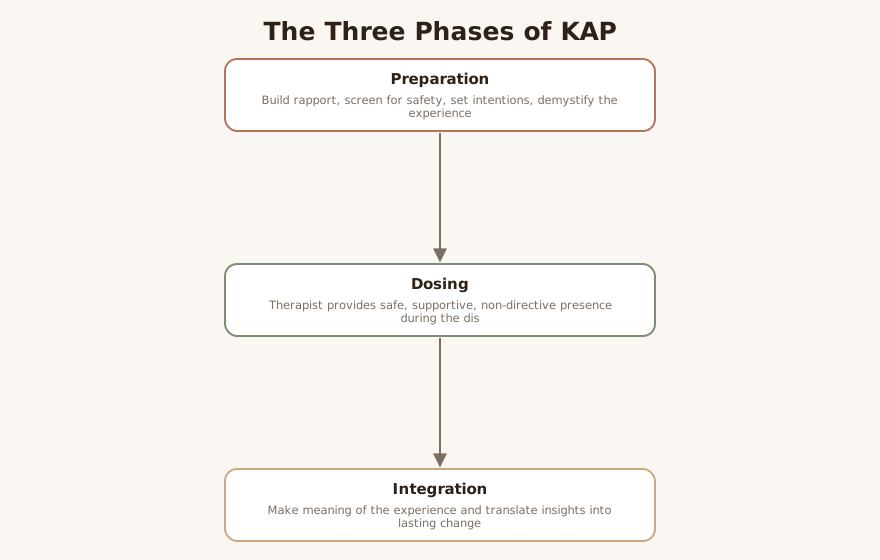
The central premise of KAP is that ketamine opens a temporary window of neuroplasticity and psychological flexibility, and that structured therapy can help the patient use that window productively 8. Three phases organize the work: preparation, dosing, and integration 6. Preparation establishes rapport, screens for safety, sets intentions, and demystifies the experience so the patient can surrender to it rather than fight it 6.
During dosing, the therapist’s role is largely to provide a safe, supportive, non-directive presence while the patient moves through the dissociative state 8. The model assumes that the medicine softens defenses and reduces the affective charge of traumatic or depressive material, allowing it to be approached more openly 8. Integration, the phase many practitioners consider most important, is where the patient and therapist make meaning of the experience and translate insights into behavioral and relational change 6. The guiding logic is that the drug experience is necessary but not sufficient — without integration, the state risks remaining a discrete event rather than producing durable change 6. LLM
Interventions & Techniques
Preparation sessions resemble ordinary psychotherapy: history-taking, alliance-building, psychoeducation about ketamine’s effects, and explicit intention-setting 6. Clinicians attend to set (the patient’s mindset, expectations, and emotional state) and setting (a calm, controlled physical environment), borrowing directly from psychedelic-therapy practice 7. Many programs use eyeshades and curated music during dosing to support an inward, experiential focus 8.
Routes of administration vary and include intramuscular injection, sublingual lozenges or troches, intranasal delivery, and intravenous infusion, with dose calibrated to produce a therapeutic dissociative state rather than full anesthesia 7. The therapist remains present throughout the dosing session, offering grounding and reassurance as needed but generally avoiding heavy interpretation while the patient is in the altered state 8. Integration sessions then use conventional therapeutic techniques — narrative processing, cognitive and emotional consolidation, and behavioral planning — to anchor the experience 6.
LLM-generated illustrative example (not a guideline): A veteran with treatment-resistant depression and combat-related PTSD sets an intention in preparation to “stop bracing against the memory.” During a sublingual dosing session, eyeshades on, he reports a felt sense of distance from the event for the first time. In integration the following week, the therapist helps him put words to that distance and links it to a homework plan for graded re-engagement with avoided activities. LLM
Evidence Base
Clinicians should be candid that KAP’s evidence base is emerging and internally uneven 8. The strongest leg of the evidence concerns ketamine itself, not the psychotherapy wrapper: meta-analytic data show that single and repeated administration of ketamine produces rapid, clinically meaningful antidepressant effects in unipolar and bipolar depression 3. That rapid-acting antidepressant signal is one of the more replicated findings in modern psychiatry 3.
The harder and more honest question is whether adding formal psychotherapy improves on ketamine alone, and here the evidence is weak 2. A 2025 analysis concluded that combined ketamine and psychotherapy provided no additional benefit beyond ketamine alone in treating depression or PTSD 2. This is a sobering finding for the KAP model, because the entire rationale for the labor-intensive therapy structure rests on the assumption that it adds value 2. LLM
A 2026 systematic review of KAP for treatment-resistant depression reflects the same immaturity: while individual studies report benefit, the literature is limited by small samples, heterogeneous protocols, and few rigorous controlled comparisons isolating the psychotherapy component 1. Taken together, the fair summary is that ketamine works as an antidepressant, the optimal psychological scaffolding around it is not yet established, and KAP as a packaged modality should be described to patients as promising but not yet proven 1. LLM
Populations & Indications
KAP has been explored across several adult populations, and the model is generally restricted to adults rather than children or adolescents 6. Treatment-resistant patients — those who have not responded to multiple conventional antidepressants — are the population for whom ketamine’s evidence is strongest and the rationale for an aggressive intervention clearest 1. People at the end of life and those facing existential or death-related distress represent another population of clinical interest, reflecting KAP’s roots in meaning-centered and transpersonal care 5.
Other groups described in the clinical literature include veterans and first responders carrying trauma burdens, and people living with chronic illness or chronic pain in whom depression and demoralization co-occur 8. Across these populations, the common thread is severe, persistent distress that has not yielded to first-line care, making a faster-acting and experientially distinct intervention attractive 8. LLM
Problems-for-Work
The most evidence-supported problem target is treatment-resistant depression, where ketamine’s rapid antidepressant action is best documented 1. Major depressive disorder more broadly is the core indication, and the antidepressant effect extends across unipolar and bipolar presentations 3. Acute suicidal ideation is a problem of particular interest because ketamine can reduce suicidal thinking quickly, which matters in crisis windows even when the longer-term plan relies on other treatment 3.
Posttraumatic stress disorder is a frequently described target, with the model positing that reduced defensive arousal allows trauma material to be approached 8. Other problems clinicians may encounter in KAP referrals include generalized anxiety disorder, obsessive-compulsive disorder, substance use disorders, chronic pain, and end-of-life and existential distress 6. For these latter targets the evidence is thinner than for depression, and KAP should be framed as exploratory rather than established 1.
LLM-generated illustrative example (not a guideline): A first responder with OCD and comorbid depression has plateaued in exposure and response prevention. A KAP referral is considered not to replace ERP but to lift the depressive immobility that has stalled her engagement, with the explicit plan to return to structured ERP once mood and motivation improve. LLM
Contraindications, Cautions & Cultural Humility
The most urgent caution for clinicians and patients is the source of the medicine itself: the FDA has warned about the potential risks of compounded ketamine products used for psychiatric disorders, including products marketed for at-home use without adequate monitoring 4. The agency emphasizes that compounded ketamine has not undergone FDA review for safety, efficacy, or quality, and that use without supervision by a health care provider raises risks including sedation, dissociation, abuse, and serious cardiovascular and respiratory effects 4. Unmonitored at-home dosing falls well outside the supervised KAP model clinicians should endorse 4. LLM
Ketamine carries genuine medical and psychiatric risk: it acutely raises blood pressure and heart rate, produces dissociation that can be frightening or destabilizing, and has recognized potential for misuse and bladder toxicity with repeated use 7. Patients with uncontrolled hypertension, certain cardiac conditions, active psychosis, or histories suggesting elevated abuse liability warrant especially careful prescriber evaluation 7. Because the antidepressant effects can be relatively short-lived, clinicians should guard against framing a single course as a cure and should plan for maintenance and relapse 3. LLM
Cultural humility is essential given KAP’s marketing landscape: the field includes both rigorous clinical programs and aggressively commercial telehealth operations, and patients arrive with widely varying expectations shaped by media enthusiasm 6. Clinicians should respect a patient’s spiritual or meaning-centered framing of the experience while remaining honest that the added value of the psychotherapy is unproven 2. Equitable access is also a concern, as KAP is largely cash-pay and may be inaccessible to many who could benefit 6. LLM
Treatment-Plan Suggestions & SMART Objectives
| Goal | SMART objective (example) | Mechanism |
|---|---|---|
| Reduce acute depressive severity | Patient’s PHQ-9 decreases by at least 50% within 4 weeks of beginning a supervised ketamine course | Rapid antidepressant pharmacology of ketamine 3 |
| Lower acute suicidal ideation | Patient reports reduced frequency and intensity of suicidal thoughts at each session over 2 weeks, with a documented safety plan | Ketamine’s rapid reduction of suicidal ideation 3 |
| Strengthen integration of dosing experiences | Patient completes a written integration reflection and identifies one behavioral change within 72 hours of each dosing session | Integration consolidates insight into durable change 6 |
| Reduce trauma-related avoidance | Patient re-engages 2 previously avoided activities within 6 weeks, tracked weekly | Reduced defensive arousal allows approach to trauma material 8 |
| Build realistic expectations | Patient can state, by end of preparation, that ketamine’s benefits may be time-limited and require maintenance | Psychoeducation prevents over-reliance on a single course 3 |
| Ensure safe sourcing | Patient confirms all ketamine is administered under provider supervision, not via unmonitored compounded at-home products | FDA warning on compounded ketamine risks 4 |
| Support meaning-centered coping (end-of-life) | Patient articulates one shift in relationship to mortality during integration sessions over the treatment course | Transpersonal/meaning-centered framing of the experience 5 |
Common Misconceptions
A frequent misconception is that ketamine and KAP are the same thing; in reality, ketamine infusion with minimal psychological support is distinct from KAP’s deliberate preparation-dosing-integration structure 6. A second misconception is that the psychotherapy component is proven to enhance outcomes, when current evidence suggests combined ketamine and psychotherapy may provide no additional benefit over ketamine alone for depression or PTSD 2. LLM
Patients may also believe a single dosing experience is curative, but the antidepressant effect can be transient and typically requires a course and a maintenance plan 3. Another misconception, fueled by direct-to-consumer marketing, is that at-home compounded ketamine is a safe convenience; the FDA has specifically warned about the risks of such products used without provider supervision 4. Finally, some assume KAP is broadly FDA-approved as a therapy; ketamine is approved as an anesthetic and used off-label for psychiatric indications, and KAP as a packaged modality remains emerging rather than formally established 7. LLM
Training & Certification
There is no single universal license that confers “KAP provider” status, and training currently comes through a patchwork of specialized programs and apprenticeship-style learning 6. Foundational clinical knowledge has been shaped by practitioner-scholars such as Phil Wolfson and the contributors to The Ketamine Papers, which remains a touchstone text for therapists entering the field 5. Legally, administration must be overseen by a prescriber, so most KAP is delivered by a prescriber-therapist or by a therapist working in formal collaboration with a prescribing clinician 6.
Clinicians considering this work should pursue training that covers screening and medical safety, holding non-ordinary states, integration technique, and ethical and consent considerations specific to altered-state work 8. Given the field’s commercial pressures, therapists should be discerning about program quality and grounded in honest communication about the limits of the evidence 2. LLM
Key Terms
Set and setting — the patient’s internal mindset and the external environment, both deliberately shaped to support a safe and productive dosing experience 7.
Integration — the post-dosing phase in which the patient and therapist make meaning of the experience and translate it into behavioral and relational change 6.
Dissociative dose — a sub-anesthetic dose calibrated to produce an altered, dissociative state for therapeutic work rather than full anesthesia 7.
Preparation — pre-dosing sessions that build alliance, set intentions, screen for safety, and demystify the experience 6.
Compounded ketamine — ketamine prepared by a compounding pharmacy outside FDA review, flagged by the FDA for risks when used for psychiatric disorders without supervision 4.
Treatment-resistant depression — depression that has not responded to multiple adequate trials of conventional antidepressants, the population with the strongest rationale for ketamine 1.
Resources & Further Reading
▶ Watch — a video introduction to this concept:
- Effectiveness of ketamine-assisted psychotherapy as a treatment for treatment-resistant depression: a systematic review (Psychopharmacology, 2026)
- Combined ketamine and psychotherapy provide no additional benefit beyond ketamine alone in treating depression or PTSD (Journal of Affective Disorders, 2025)
- Efficacy of single and repeated administration of ketamine in unipolar and bipolar depression: a meta-analysis of RCTs (PMC)
- FDA warns about potential risks of compounded ketamine products for psychiatric disorders
- The Ketamine Papers: Science, Therapy, and Transformation (Wolfson & Hartelius, eds., 2016)
- What to Know About Ketamine-Assisted Psychotherapy (KAP) — Psychology Today
- Ketamine-assisted psychotherapy — Wikipedia
- Ketamine-Assisted Psychotherapy: An Emerging Treatment for Trauma and Depression — Psychiatric Times
Reflective / Supervision Questions
- How do I distinguish, in my own practice and in my communication with patients, between the well-established antidepressant effect of ketamine and the still-unproven added value of the psychotherapy wrapper? 2
- When a patient asks for KAP, how do I assess whether the underlying request is for rapid symptom relief, for a meaning-centered experience, or for an escape from disciplined psychotherapeutic work? LLM
- What is my protocol for verifying that any ketamine a patient is receiving is supervised and not sourced from unmonitored compounded at-home products? 4
- How do I plan for the transient nature of ketamine’s effects, including maintenance and relapse, rather than treating a single course as definitive? 3
- Where am I getting my training and supervision for holding non-ordinary states, and is it rigorous enough to do this work safely and ethically? 8
- How do I hold cultural and economic humility about access, given that KAP is largely cash-pay and shaped by aggressive marketing? 6