
Type & Discipline
The theory of constructed emotion (TCE) is an explanatory theory in affective neuroscience and psychology, not a treatment modality 1. It proposes that an instance of emotion is not triggered by a dedicated brain circuit but is constructed by the brain in the moment, as the brain makes meaning of bodily sensations using past experience and conceptual knowledge 1. For clinicians it functions as a lens — a way of understanding where a feeling comes from — rather than as a protocol you deliver LLM. It sits in the family of predictive-processing and interoception frameworks and is closely allied with allostasis and the brain’s role in regulating the body 1. Its discipline of origin is basic affective science, but it has been translated for public and clinical audiences through Barrett’s book and talks 34. Understood correctly, it changes how a clinician thinks about emotion before it changes any single technique they use LLM.
Creators & Lineage
The theory is most associated with Lisa Feldman Barrett, who developed it as an “active inference” account of interoception and categorization 1. It is the mature form of her earlier conceptual-act model and is often discussed alongside what is broadly called the psychological-construction tradition in emotion science 5. Its principal intellectual rival is the classical or “basic emotion” view — the idea, associated with researchers such as Paul Ekman, that there are a small number of biologically hardwired emotions each with a dedicated fingerprint — which TCE was explicitly written to challenge 5. TCE draws heavily on predictive-processing and active-inference accounts of brain function, in which the brain continuously generates predictions and minimizes prediction error 1. It is conceptually bound to allostasis and “body budgeting,” the brain’s anticipatory regulation of the body’s energy resources, which TCE treats as the metabolic substrate from which affect arises 1. For clinicians, it also has natural affinities with the cognitive-appraisal tradition of emotion and with the emotion-regulation logic that runs through Dialectical Behavior Therapy, even though those lineages are distinct LLM.
Core Principles
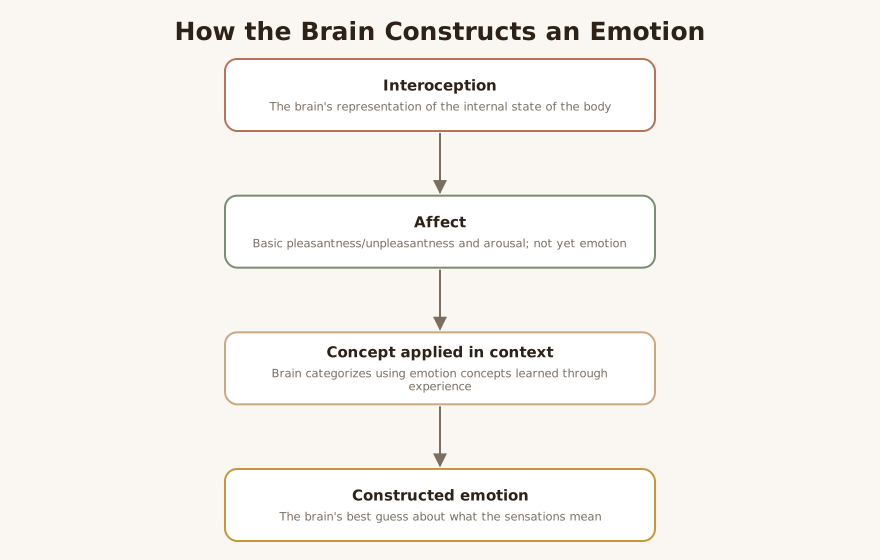
The central claim is that emotions are constructed, not detected: the brain combines signals from inside the body with concepts learned through culture and experience to categorize an affective state as a particular emotion 1. A foundational building block is interoception — the brain’s representation of the internal state of the body — together with affect, the basic, ever-present feeling of pleasantness or unpleasantness and arousal that interoception produces 1. Affect is not yet emotion; it becomes “anger” or “fear” only when the brain applies an emotion concept to make the sensations meaningful in context 1. A second principle is prediction: the brain is not a reactive stimulus-response machine but a predictive organ that anticipates incoming sensations and the body’s needs and then constructs experience accordingly 1. Emotions, on this account, are the brain’s best guesses about what bodily sensations mean and what to do about them 4.
A third principle is concept construction and categorization: the brain uses populations of past experiences, organized as concepts, to categorize the present moment, and emotions are cases of this general categorization process rather than a special kind of event 1. A fourth is degeneracy and variation — many different patterns of brain and body activity can produce the same emotion category, and the same pattern can produce different categories, which is why no single bodily “fingerprint” reliably marks an emotion 5. A practical corollary that Barrett emphasizes for non-specialists is emotional granularity: the more finely a person can construct and distinguish emotion concepts, the more precisely the brain can regulate the body and act, whereas coarse, undifferentiated affect (“I feel bad”) offers fewer options 3.
Interventions & Techniques
There is no “constructed-emotion therapy”; the theory shapes how a clinician frames emotion and selects from existing, evidence-based techniques LLM. The most direct application is psychoeducation that reframes emotions as constructed and, to a degree, malleable rather than fixed reactions one is at the mercy of 4. From the granularity principle, Barrett describes building a larger, more precise emotion vocabulary so the brain has finer concepts to work with — learning and using more specific feeling words 3. The construction frame also motivates recategorization: helping a client notice that a pounding heart and tight stomach are raw affect that could be categorized in more than one way (anxiety, anticipation, excitement) rather than as a single fixed emotion with a single fixed meaning 4. Because the theory roots emotion in interoception and body budgeting, it also points toward attending to the bodily basics — sleep, nutrition, movement — that shape the affective signals the brain has to work with 3.
In practice these moves map onto recognized modalities: granularity and labeling resemble affect-labeling and emotion-differentiation work; recategorization overlaps with cognitive reappraisal; and the underlying skills are kin to the emotion-regulation and mindfulness components of Dialectical Behavior Therapy LLM. The theory supplies the rationale; the host modality supplies the procedure LLM.
LLM-generated illustrative example (not a guideline): A client says “I just feel terrible, I don’t know why.” Working from the granularity idea, the clinician slows down and helps the client parse the global “terrible” into candidate constructions — is this dread about tomorrow, resentment from this morning, or simple hunger and exhaustion? Naming it as “anticipatory anxiety about the meeting” rather than “terrible” gives the client a concept specific enough to act on LLM.
Evidence Base
Maturity here is genuinely emerging, and honesty requires separating two different questions LLM. The first is whether the theory itself is correct. TCE is influential, generative, and widely cited, and it is articulated rigorously as an active-inference account 1. But it is not settled science: it remains actively contested within affective neuroscience, where classical “basic emotion” theories and other models are live competitors, and the debate over whether emotions have biological fingerprints is ongoing 5. A clinician should present TCE as a leading and well-argued theory, not as established fact LLM.
The second question is whether its clinical translations work. Here the evidence is indirect LLM. There is no body of randomized controlled trials testing “constructed-emotion therapy” as a standalone intervention LLM. The behaviors the theory motivates — building emotional granularity, labeling affect, reappraising and recategorizing, and supporting the bodily basis of affect — have their own evidence within established modalities such as cognitive and dialectical-behavioral approaches, but that evidence is not evidence for TCE as a theory LLM. The cleanest clinical posture is to use TCE as a neuroscience-grounded heuristic that motivates evidence-based skills, while being candid with sophisticated clients that the underlying theory is contested LLM.
Populations & Indications
The theory is most useful clinically where the meaning, labeling, and regulation of bodily feeling are central to the presentation LLM. Adults are the natural audience, since the work depends on conceptual reflection and language LLM. People with emotion dysregulation may benefit from the construction frame because it reframes overwhelming feelings as constructed states that can be re-described and, over time, reshaped rather than simply endured 4. People with alexithymia and affect-labeling difficulties are an especially apt fit, because granularity work directly targets the capacity to differentiate and name internal states 3. People with anxiety disorders and panic disorder can use recategorization to reinterpret interoceptive arousal as ambiguous bodily signal rather than certain catastrophe 4. People with chronic pain and prominent somatic symptoms may find value in understanding sensations as constructed and context-dependent — used carefully, and never to imply the pain is imaginary LLM. Trauma survivors and people with mood disorders sometimes carry rigid, overlearned emotion constructions that the frame can help loosen, though this requires care and stabilization LLM. Across all of these, TCE is an adjunct lens, not a diagnosis-specific protocol LLM.
Problems-for-Work
In alexithymia and affect-labeling difficulties, the work is granularity training — expanding the emotion vocabulary and practicing fine distinctions so the client can name states precisely instead of reporting a global “bad” 3. In emotion dysregulation, the work is teaching that a flood of feeling is a construction the brain is making now, then practicing re-description and skill use rather than treating the emotion as an unalterable fact 4. In anxiety and panic disorder, the work is recategorizing interoceptive cues — a racing heart read as arousal that could mean several things, not as proof of imminent disaster 4. In interoceptive dysfunction, the work is improving the accuracy and tolerance of bodily sensing, since affect is built from interoception 1. In chronic pain and somatic symptoms, the work is exploring how context and concepts shape the experience of sensation while preserving validation and appropriate medical workup LLM. In major depressive disorder, the construction frame can support behavioral and cognitive work by recasting low mood as a state the brain is building from a depleted body and narrow concepts, rather than a fixed truth about the self LLM.
LLM-generated illustrative example (not a guideline): A client with panic keeps a brief log: the trigger, the raw sensation (“chest tight, heart fast”), the automatic construction (“I’m having a heart attack”), and at least two alternative constructions (“I’m scared,” “I just ran up the stairs and I’m anxious”). Over weeks, holding more than one possible category loosens the grip of the catastrophic one LLM.
Contraindications, Cautions & Cultural Humility
Because TCE is a theory rather than a procedure, the cautions concern misapplication, not patient selection LLM. The gravest error is using “your brain is just constructing that” to minimize or invalidate real suffering; telling a person in genuine pain or panic that the feeling is “made up by your brain” can land as dismissal and rupture the alliance LLM. The construction frame must never displace appropriate medical evaluation of somatic symptoms or risk assessment of acute distress LLM. Clinicians should also avoid overclaiming: the theory is contested, and presenting it as proven neuroscience misleads clients and overstates what is known 5. Recategorization should not slide into telling clients their valid emotions are “wrong” and should be relabeled away; the goal is more options, not invalidation LLM. Cultural humility is essential because emotion concepts themselves are culturally learned — the categories, display rules, and even which feelings are nameable vary across cultures and languages — so a clinician’s own emotion vocabulary is not a universal standard to impose 1. Granularity work should expand a client’s own conceptual world rather than overwrite it with the therapist’s LLM.
Treatment-Plan Suggestions & SMART Objectives
| Goal | SMART objective (example) | Mechanism |
|---|---|---|
| Build emotional granularity | Client logs daily emotion entries using at least three distinct, specific feeling words per day for 4 weeks | Finer concepts give the brain more precise categories and regulatory options 3 |
| Differentiate affect from emotion | Client completes a sensation-then-label exercise (name the bodily sensation before naming the emotion) on 5 of 7 days for 3 weeks | Separates raw interoceptive affect from the conceptual category applied to it 1 |
| Practice recategorization | Client generates at least two alternative constructions for a distressing feeling in 80% of logged episodes over 4 weeks | Loosens fixed catastrophic categorization of ambiguous bodily signals 4 |
| Reinterpret arousal in anxiety | Client applies a recategorization script to anxious bodily cues during 4 exposure trials over 4 weeks | Reframes interoceptive prediction as ambiguous signal rather than certain threat 4 |
| Support the bodily basis of affect | Client protects a consistent sleep and meal routine on 5 of 7 days for 4 weeks | Stabilizes the interoceptive and body-budget inputs from which affect is constructed 3 |
| Expand emotion vocabulary | Client learns and uses five new specific emotion words in session and at home over 6 weeks | Adds concepts the brain can deploy to construct and regulate experience 3 |
| Reduce identification with emotion | Client reframes “I am anxious” as “my brain is constructing anxiety right now” in daily logs for 3 weeks | Reframes emotion as a constructed, changeable state rather than a fixed fact 4 |
Common Misconceptions
The first misconception is that TCE says “emotions aren’t real” — it does not; constructed emotions are genuine, fully felt experiences, just as a constructed perception of color is genuinely seen 1. A second is that “constructed” means voluntary or easy to change at will; construction happens automatically and below awareness, and reshaping it takes sustained practice 4. A third is that the theory is settled science that has replaced the classical view; in fact it is one contested position in an active scientific debate with serious rivals 5. A fourth is conflating affect with emotion — affect (the basic feeling of pleasantness and arousal) is always present, while emotion is a specific category the brain constructs from it 1. A fifth is reading the theory as denying biology or the body; on the contrary, it is built on interoception and the brain’s regulation of the body 1. Finally, some assume that learning the theory is itself a therapy, when it is a framework that motivates evidence-based skills rather than a tested treatment LLM.
Training & Certification
There is no certification in the theory of constructed emotion and no credentialing body governing its use, because it is a scientific theory rather than a proprietary modality LLM. Clinicians typically encounter it through affective-neuroscience reading, through Barrett’s primary papers and her index of academic work, and through accessible explainers such as her book and TED talk 1634. The practical path is to absorb the framework as background theory and then apply the skills it motivates inside whatever evidence-based modality the clinician is already trained and credentialed in LLM. Using the lens creates no new scope of practice; competence in the host modality — cognitive-behavioral, dialectical-behavioral, or interoceptive and exposure-based work — remains the relevant qualification LLM.
Key Terms
Theory of constructed emotion — the view that emotions are constructed in the moment by the brain making meaning of bodily sensations using concepts and context, rather than triggered by dedicated circuits 1. Interoception — the brain’s representation of the internal state of the body, a core input to affect 1. Affect — the basic, ever-present feeling of pleasantness or unpleasantness and arousal, prior to and distinct from specific emotion 1. Emotion concept — the learned, culturally shaped category the brain applies to affect to construct a specific emotion 1. Prediction / active inference — the principle that the brain anticipates sensations and the body’s needs and constructs experience to minimize prediction error 1. Categorization — the general process, applied to emotion, by which the brain uses past experience to make the present meaningful 1. Emotional granularity — the capacity to construct and distinguish many precise emotion categories, associated with better regulation 3. Body budgeting / allostasis — the brain’s anticipatory regulation of the body’s energy resources, the metabolic basis of affect 1.
Resources & Further Reading
▶ Watch — a video introduction to this concept:
- The theory of constructed emotion: an active inference account of interoception and categorization (Barrett, 2017) — SCAN
- The theory of constructed emotion (full text on PMC)
- How Emotions Are Made: The Secret Life of the Brain (Lisa Feldman Barrett)
- You aren’t at the mercy of your emotions — your brain creates them (TED Talk)
- Theory of constructed emotion (Wikipedia)
- Research papers by Lisa Feldman Barrett
Reflective / Supervision Questions
- When you introduce the construction frame, how do you confirm the client experiences it as empowering rather than as “your feelings aren’t real”? LLM
- How do you decide when a presentation calls for granularity and recategorization work versus stabilization, validation, or medical workup first? LLM
- Are you presenting the theory as a contested-but-useful heuristic, or have you let it drift into overclaimed certainty? LLM
- Whose emotion concepts are in the room — and how do you expand a client’s own vocabulary rather than impose yours across cultural and linguistic difference? LLM
- In which of your cases is “just relabel it” likely to feel invalidating, and how do you adapt? LLM
- What would tell you the frame is not helping this particular client, and what would you switch to? LLM