
Type & Discipline
Accelerated Resolution Therapy (ART) is a brief, manualized psychotherapy situated within clinical psychology and belonging to the family of eye-movement, trauma-focused treatments 1. Its defining procedural signature is the pairing of therapist-guided sets of smooth-pursuit lateral eye movements with a directed image-rescripting technique, delivered within a short, protocol-driven course of treatment 1. Practitioners and reviewers most often position it as a time-efficient intervention for the symptoms of posttraumatic stress disorder, although it has been described as addressing a wider range of presentations 1.
Conceptually, ART is best understood as a procedural cousin of Eye Movement Desensitization and Reprocessing (EMDR) that has been deliberately standardized and made more directive 3. It draws on cognitive-behavioral and psychodynamic elements and shares the eye-movement and exposure heritage of trauma-focused work, but it diverges in actively transforming the distressing mental image rather than primarily desensitizing it 3. For clinicians, the most accurate framing is that ART is an emerging, brief eye-movement therapy whose procedure is well specified but whose controlled-trial evidence base is still small 1.
Creators & Lineage
ART was developed in 2008 by Laney Rosenzweig, a Licensed Marriage and Family Therapist who has worked in the mental health field for more than three decades 7. Rosenzweig had trained in multiple modalities and came to appreciate the therapeutic value of eye movements, but she concluded that the way they were being used needed modification, which led her to construct standardized, directive treatment protocols by combining elements from several therapeutic traditions 7. The intellectual-property rights to ART are held by Rosenzweig and her entity, the Rosenzweig Center for Rapid Recovery, LLC, which is relevant context when weighing program claims about the method 7.
The clearest lineage is to EMDR, the eye-movement trauma therapy from which ART’s bilateral-stimulation element is adapted 5. ART also sits downstream of the broader exposure and cognitive-behavioral traditions and incorporates an imagery-rescripting component in which clients deliberately revise the content of a distressing image 3. The method’s developer has characterized ART as more directive, easier to learn, and often delivered in a shorter time than EMDR, a positioning that has shaped how it is marketed and trained 5. Beyond the academic literature, ART has received lay and broadcast attention, including a public-television segment profiling the therapy 8.
Core Principles
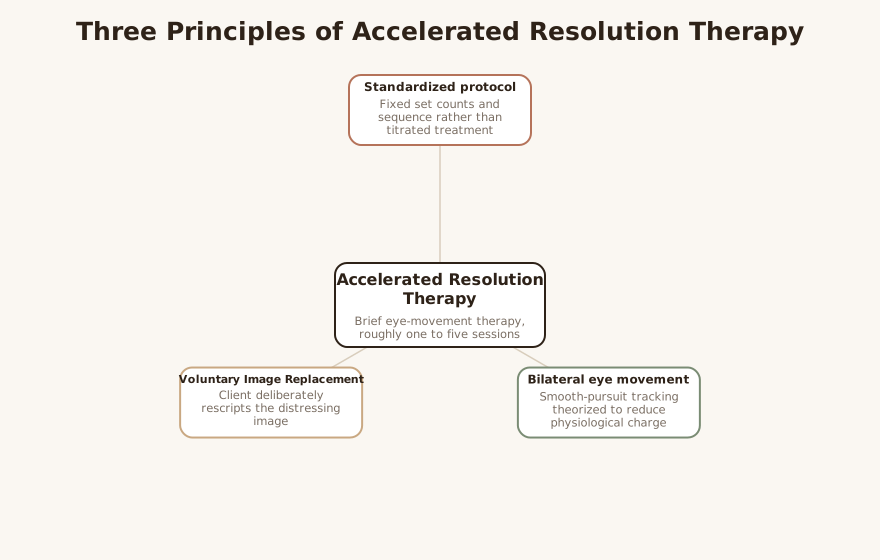
The first organizing principle is that traumatic material can be processed rapidly through a fixed, repeatable procedure rather than through an extended, individualized course 1. ART therefore standardizes the dose and structure of treatment, using set counts of eye movements and a defined sequence of interventions in place of the more flexible, clinically titrated approach used in EMDR 3. The intent is a time-efficient protocol that can be delivered in roughly one to five sessions 1.
The second principle is bilateral eye movement as a processing aid: the client tracks the therapist’s hand moving side to side while holding the distressing experience in mind, a maneuver theorized to reduce the physiological charge of the recalled memory 3. The mechanism by which this helps is not established, and lay summaries appropriately describe it only as something that “may” help shift traumatic memories toward long-term storage 5. Clinicians should hold this mechanistic claim loosely and present it to clients as a working hypothesis rather than settled science LLM.
The third and most distinctive principle is Voluntary Image Replacement (VIR): the client deliberately transforms the distressing mental image into a different, more tolerable one, so that the felt experience of the memory is changed rather than merely habituated 3. ART also devotes substantially more time to the physical sensations associated with a memory than EMDR typically does, treating somatic processing as a core target 3. Together, these principles frame ART less as pure desensitization and more as a structured rescripting of how a trauma is internally represented 3.
Interventions & Techniques
In session, the therapist moves a hand from side to side while the client thinks about or describes the traumatic event and follows the hand with their eyes, generating the bilateral stimulation that anchors the procedure 5. The eye movements are delivered in standardized sets, commonly described as sets of forty, intended to reduce physiological reactivity during recall 3. This fixed dosing, rather than a clinically improvised number of passes, is part of what makes the protocol reproducible across therapists 3.
After reactivity to the scene has been reduced, the client is guided to imagine what they wish had happened in the situation instead of what actually occurred, replacing the distressing image with a preferred one through Voluntary Image Replacement 5. The original factual memory is understood to remain intact while the intrusive sensory image loses its grip, which is the change the protocol is designed to produce 5. Particular attention is paid throughout to the bodily sensations that accompany the memory, consistent with ART’s emphasis on somatic processing 3. A typical course is brief, with studies describing relief within roughly one to five hour-long sessions and an average of about 3.7 sessions to see results 5. Clinician-facing explainers summarize the same arc — guided eye movements paired with directed image work delivered over a short course — as the practical “how it works” of the method 4.
LLM-generated illustrative example (not a guideline): A clinician treating a survivor of an assault has the client hold the freeze-frame image of the attacker’s face while tracking the therapist’s hand through standardized sets of eye movements until the racing heartbeat and chest tightness settle. The client is then guided to rescript the scene — picturing themselves safe and the threat gone — and to notice how the body responds to the new image, repeating sets until the original picture no longer intrudes. LLM
Evidence Base
The evidence base for ART is best characterized as emerging and promising rather than established 1. A 2024 systematic review located only five primary studies (337 participants enrolled, 250 completing), comprising two randomized controlled trials with crossover designs, two prospective observational cohort studies, and one feasibility study 1. Every included study reported a significant reduction in PTSD symptoms from pre- to post-intervention, with effect sizes spanning d = 1.12 to 3.28, alongside secondary improvements in depression, anxiety, distress, and sleep 1.
Honesty about maturity requires several caveats. The review judged risk of bias as good in one study, fair in two, and poor in two, and only two studies included any control condition, an attention control and a waitlist 1. The authors could not conduct a meta-analysis because of heterogeneity in study designs and an insufficient number of low-risk-of-bias studies, and they concluded plainly that ART “shows some promise as a time-efficient clinical treatment for symptoms of PTSD in adults; however, more high-quality studies are needed” 1. The frequently cited single-arm cohort study illustrates both the appeal and the limits of this literature: among 80 adults receiving one to five sessions, PTSD scores on the PCL-C fell from 54.5 to 31.2 with effect sizes of 1.72 to 1.98, and the proportion meeting symptom criteria dropped from 80% to 17%, yet the design had no control group and relied on self-report measures rather than formal diagnosis 3. Reported safety has been favorable, with no serious adverse events judged related to ART in that study, though minor headaches and transient mood changes occurred and lay sources note possible nightmares or heightened anxiety 3 5. ART has been surveyed in the psychiatric review literature as a method whose research base, while encouraging, remains early-stage 2.
Populations & Indications
The population in which ART has been most studied is adults with PTSD symptoms, including active-duty military, housed and homeless veterans, female veterans with military sexual trauma, civilians, and informal hospice caregivers 1. The trauma exposures represented in the cohort literature include violent or abusive crime, loss of a loved one, divorce, and acute or chronic illness, reflecting a mixed civilian and military caseload 3. First responders and other occupationally trauma-exposed groups are a clinically natural extension of this same indication, though they are less directly represented in the controlled studies LLM.
Beyond core PTSD, ART is described by clinical explainers as being applied to depression, anxiety, grief and complicated grief, substance use, and chronic pain, but the supporting research is limited for most conditions beyond PTSD 5. The cohort data do show concurrent improvement in depressive and anxiety symptoms when trauma is treated, which is consistent with the comorbidity common in trauma-exposed clients 3. Clinicians should treat phobias, panic, generalized anxiety, and grief as plausible but under-evidenced applications and weight them as extrapolation from the PTSD work rather than independently established indications LLM.
Problems-for-Work
The clearest problem-for-work is PTSD organized around a discrete, identifiable traumatic scene, where the eye-movement sets and image-rescripting steps map directly onto a circumscribed memory 3. Acute stress disorder and recent-event reactions are reasonable extensions of the same brief, image-focused logic, with the caveat that the controlled evidence concerns established PTSD rather than the acute window 1 LLM. Intrusive memories and flashbacks are a natural target because Voluntary Image Replacement is aimed precisely at the intrusive sensory image rather than the factual recollection 5.
For depression and anxiety occurring alongside trauma, the documented concurrent symptom reductions support treating the underlying trauma image rather than addressing mood and worry in isolation 3. Specific phobia and panic can be conceptualized as disturbances anchored to a vivid threat image that the rescripting procedure is designed to revise, and grief can be approached by targeting the distressing images bound up with a loss 5 LLM. Across all of these, the honest framing for a client is that PTSD is where the evidence is strongest and the rest is promising but preliminary 1 LLM.
LLM-generated illustrative example (not a guideline): A bereaved client cannot stop seeing the image of a loved one in the hospital at the moment of death, and that intrusive picture dominates every attempt to remember the person warmly. Using ART, the clinician reduces the physiological reactivity to the scene with eye-movement sets, then helps the client rescript the dominant image toward a chosen memory of the person well and at peace, while tracking the bodily shift that accompanies the new picture. LLM
Contraindications, Cautions & Cultural Humility
ART deliberately reactivates distressing material, so the standard cautions for any activating trauma work apply: acute suicidality, severe dissociation, unmanaged substance use, and unstable living circumstances generally call for stabilization before image-focused processing LLM. Reported adverse effects are typically minor, but clinicians should anticipate and normalize possible nightmares or a transient rise in anxiety and build in containment and follow-up 5. Because the controlled evidence base is small and concentrated in PTSD, ART should not be presented to clients as an established treatment for conditions where the data are sparse 1.
A specific caution concerns the commercial structure and marketing of the method: ART’s intellectual property is held by its developer’s company, and even the program’s own materials acknowledge that the therapy “sounds too good to be true,” so clinicians should be skeptical of claims of near-universal rapid cure and avoid overselling speed to clients 7 6. Where an established, guideline-supported trauma therapy is available and better matched to the client, there is no obligation to choose ART 1 LLM. Cultural humility extends to the rescripting step in particular: the clinician should not impose a preferred “corrected” image but follow the client’s own meaning, values, and wishes for how a scene might have gone, since the replaced image must be the client’s, not the therapist’s LLM.
Treatment-Plan Suggestions & SMART Objectives
| Goal | SMART objective (example) | Mechanism |
|---|---|---|
| Reduce PTSD symptom severity | Within 5 sessions, reduce client’s self-reported PTSD score (e.g., PCL) by a clinically meaningful margin | Brief, standardized eye-movement processing of the target scene 1 |
| Lower physiological reactivity to the memory | Reduce client-rated bodily distress on recall from high to mild across eye-movement sets in session | Sets of smooth-pursuit eye movements reducing physiological response during recall 3 |
| Replace the intrusive image | By end of treatment, client reports the distressing image no longer intrudes when the event is recalled | Voluntary Image Replacement revising the intrusive sensory image 5 |
| Reduce comorbid depressive symptoms | Achieve a meaningful drop on a depression measure over the treatment course | Concurrent symptom improvement documented alongside PTSD reduction 3 |
| Process somatic distress | Client identifies and reports resolution of the body sensations tied to the memory by end of treatment | ART’s emphasis on processing physical sensations associated with the memory 3 |
| Reduce intrusive grief imagery | Within agreed sessions, shift the dominant image of a loss from distressing to a chosen tolerable memory | Image rescripting applied to loss-related imagery 5 |
| Confirm and consolidate gains | Re-administer the symptom measure at follow-up and confirm maintenance of reductions | Re-evaluation of treated targets and durability check 1 |
Common Misconceptions
A first misconception is that the eye movements are a proven active ingredient; the supporting literature and lay summaries describe their effect only as something that may aid processing, with the mechanism unclear, so they should be presented as the procedural hallmark rather than an established cause of benefit 5 LLM. A second is that ART is interchangeable with EMDR; it is a deliberately standardized, more directive variant that actively replaces the distressing image and spends more time on somatic processing than EMDR typically does 3. A third is that rescripting erases or falsifies the memory, whereas the factual recollection is understood to remain intact while the intrusive image loses its charge 5.
A fourth misconception is that ART’s strong reported effect sizes settle the question of efficacy; the systematic review found too few low-bias studies to pool and concluded that more high-quality research is needed, so large single-arm gains should be read with that caveat 1. A fifth is that the brevity of ART means no preparation or clinical judgment is required; activating trauma work still demands assessment, stabilization where indicated, and attention to risk 1 LLM. Finally, the impression that ART is established for depression, phobias, grief, or pain outruns the evidence, which is concentrated in PTSD 5 1.
Training & Certification
ART is delivered by licensed mental health professionals who have completed the method’s standardized training, and its developer offers and oversees that training as the holder of the protocol’s intellectual property 7. The method was explicitly built to be standardized and, in its developer’s framing, easier to learn and more directive than EMDR, which is part of its training appeal 5. Clinical explainers point clients toward locating ART-trained therapists through an ART provider search tool, though they offer little public detail on certification standards 5.
Because the protocol nonetheless involves activating distressing material and guiding image rescripting, supervised consultation on early cases is the prudent standard, particularly with complex trauma, dissociation, or high-risk presentations LLM. Clinicians considering training should evaluate it as they would any proprietary, commercially held method: confirm what the credential actually authorizes, weigh the cost against the still-emerging evidence base, and avoid adopting promotional claims of rapid universal cure into their own informed-consent language 7 1 LLM.
Key Terms
- Smooth-pursuit eye movements: Therapist-guided lateral eye movements, delivered in standardized sets, that the client performs while holding a distressing memory in mind 3.
- Sets of forty: The standardized count of eye movements used per set, reflecting ART’s fixed dosing rather than improvised passes 3.
- Voluntary Image Replacement (VIR): The core rescripting technique in which the client deliberately transforms a distressing mental image into a more tolerable, preferred one 3.
- Image rescripting: Revising the content of a distressing internal image so the intrusive picture changes while the factual memory remains 5.
- Bilateral stimulation: Side-to-side stimulation, here via eye movements, paired with attention to the target experience 5.
- Somatic processing: Deliberate attention to and resolution of the physical sensations tied to a memory, emphasized more in ART than in EMDR 3.
- Time-efficient protocol: ART’s framing as a brief treatment delivered in roughly one to five sessions 1.
Resources & Further Reading
- ART for PTSD in adults: A systematic review (PLOS Mental Health, 2024)
- Accelerated Resolution Therapy (ART): a Review and Research to Date (Current Psychiatry Reports, 2017)
- Brief Treatment of Symptoms of PTSD by Use of Accelerated Resolution Therapy (PMC)
- Accelerated Resolution Therapy: Benefits, Techniques & How It Works (GoodTherapy)
- Accelerated Resolution Therapy (ART): What to Know (Psych Central)
- Accelerated Resolution Therapy — official program site
- About Laney — Accelerated Resolution Therapy
- WEDU Quest 206: Accelerated Resolution Therapy (PBS)
Reflective / Supervision Questions
- For a given client, can I justify choosing ART over an established, guideline-supported trauma therapy on grounds beyond brevity or my own familiarity with the method? 1 LLM
- How do I describe the eye-movement component to clients honestly, given that its mechanism is unclear and described only as something that may help? 5 LLM
- In the Voluntary Image Replacement step, how do I ensure the replacement image reflects the client’s own meaning and wishes rather than my preferred resolution? 3 LLM
- Given that the evidence is concentrated in PTSD, how am I framing applications to depression, grief, phobias, or pain in my informed consent? 5 1
- Have I adequately assessed risk and stabilization before beginning activating, image-focused processing with this client? 1 LLM
- How am I keeping the method’s promotional and commercial claims out of my own clinical judgment about what ART can realistically deliver? 7 1