
Type & Discipline
The Theory of Planned Behavior (TPB) is an explanatory and predictive theory in social and health psychology, belonging to the family of attitude-behavior (expectancy-value) models 1. It is not a therapy and was never proposed as one; it is a conceptual framework for understanding why people do or do not perform a specific behavior, and for designing interventions to change that behavior 3. Its predecessor, the Theory of Reasoned Action (TRA), is the same model minus the control construct, so the two are usually discussed together 3. For clinicians, the value of TPB is diagnostic: it tells you which psychological levers stand between a client and a target behavior, so that an intervention can be aimed rather than diffuse LLM.
The theory has been applied across an unusually wide range of behaviors — physical activity, drug use, recycling, travel choice, safer sex, and technology adoption among them — and is frequently described as the most widely used model in health psychology 34. Well over 2,000 empirical studies have used it 3.
Creators & Lineage
TPB was developed by Icek Ajzen, building on the Theory of Reasoned Action that he created with Martin Fishbein in the 1970s and 1980s 34. The TRA assumed that the behaviors of interest to social scientists were largely under volitional control, so behavior could be predicted directly from intention, and intention from attitude and subjective norm alone 3. After working with the TRA, Ajzen recognized that this assumption of perfect volitional control severely limited the model for behaviors that are difficult to execute — a person can fully intend to attend a concert and still be stopped by a broken-down car or sold-out tickets 3. He therefore added a control construct and renamed the model the Theory of Planned Behavior, formalized in his 1985 work and the influential 1991 paper 34. The TRA is thus a special case of TPB: when control is complete, the control terms drop out and TPB reduces to the TRA 3.
The perceived-control construct was explicitly built on Albert Bandura’s concept of self-efficacy from social cognitive theory 37. TPB is one of several overlapping change frameworks clinicians will recognize alongside the Health Belief Model, the Transtheoretical (Stages of Change) Model, and motivational interviewing, all of which share an interest in beliefs, readiness, and confidence as antecedents of action LLM.
Core Principles
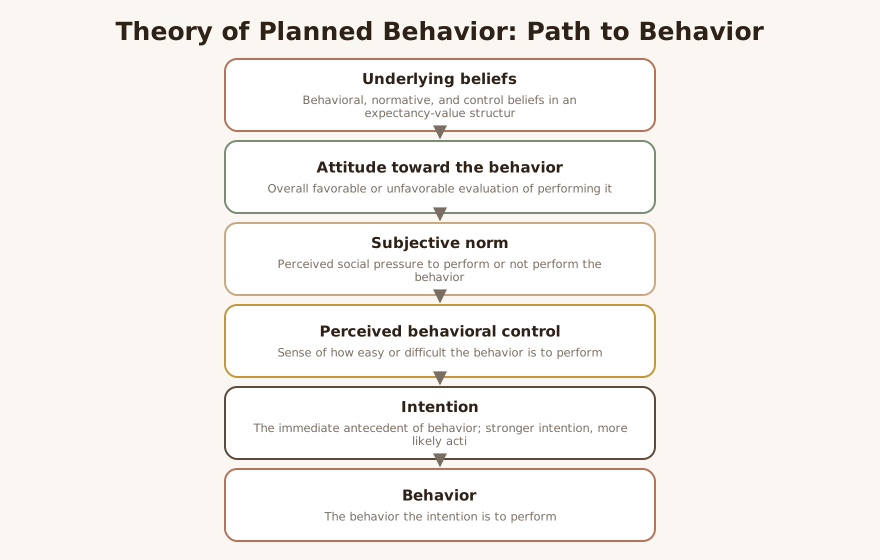
The central proposition is that the immediate antecedent of behavior is the intention to perform it — the stronger the intention, the more likely the behavior follows 3. Intention, in turn, is determined by three conceptually independent predictors 12:
- Attitude toward the behavior — the person’s overall favorable or unfavorable evaluation of performing it, built from behavioral beliefs about the likely consequences and experiences of the behavior 3.
- Subjective norm — perceived social pressure to perform or not perform the behavior, built from normative beliefs. Ajzen distinguishes injunctive norms (whether important others approve) from descriptive norms (whether important others themselves do it) 3.
- Perceived behavioral control (PBC) — the person’s sense of how easy or difficult the behavior is, built from control beliefs about facilitating and impeding factors such as skills, time, money, and the cooperation of others 3.
Each construct rests on an expectancy-value structure: belief strength multiplied by an associated value (outcome evaluation, importance of the referent, or power of the control factor), summed across accessible beliefs 3. Two further principles matter clinically. First, actual behavioral control moderates the path from intention to behavior — people carry out intentions only to the degree they actually can, and PBC serves as a usable proxy when actual control is hard to measure 3. Second, the principle of compatibility: the behavior must be defined by its target, action, context, and time frame, and every construct must be measured at the same level of specificity, or prediction degrades 3.
TPB also describes feedback effects: performing a behavior generates new information that revises beliefs and so reshapes future intentions, meaning the model is not strictly one-directional in practice 3.
Interventions & Techniques
Because each construct rests on identifiable beliefs, TPB points to concrete intervention targets 5. An ASCN faculty-development example illustrates the logic: recruit people with favorable attitudes, build self-efficacy through guided practice, and strengthen subjective norms through cohorts and ongoing mentoring 5. Translated to clinical work, the operational steps are LLM:
- Elicit accessible beliefs first. Ajzen recommends a free-response elicitation in which the person lists the outcomes, social referents, and barriers that come spontaneously to mind for the specific behavior 3. Clinically, this is a structured interview, not a generic checklist LLM.
- Target attitudes by examining and re-weighting behavioral beliefs — the perceived costs, benefits, and felt experiences of the behavior 3.
- Target subjective norms by surfacing who matters to the client and what those referents are believed to approve of and to do themselves 3.
- Target perceived control by reducing real barriers and building confidence and skills, since a favorable attitude and supportive norm only translate into intention when control is felt to be sufficient 3.
- Close the intention-behavior gap with implementation intentions — having the client specify when, where, and how they will act once an intention is formed, which reliably increases follow-through 34.
LLM-generated illustrative example (not a guideline): A client in early recovery says he intends to attend three support meetings a week. A TPB-informed session would map his behavioral beliefs (meetings help vs. they are boring), his normative beliefs (his sponsor expects it; his old friends mock it), and his control beliefs (no ride after 8pm), then convert the intention into an implementation intention: “After my Tuesday shift ends at 6, I’ll take the 6:40 bus to the 7pm meeting.” LLM
Evidence Base
The evidence base is mature and established: thousands of studies and numerous meta-analyses support TPB’s predictive validity across health and behavioral domains, and it predicts health-related intentions better than the TRA alone 37. Be honest with clients and supervisees about the ceiling, though. Meta-analytic syntheses find that intentions account for, on average, only about 25% of the variance in behavior — the well-documented intention-behavior gap 3. Much of the supporting research is correlational rather than experimental, and critics note the model gives limited room to emotion, habit, and impulsive or spontaneous action 47.
A theoretical nuance with practical force: La Barbera and Ajzen (2021) showed that PBC moderates the other predictors. Attitude predicts intention more strongly when perceived control is high, while subjective norm predicts intention more strongly when perceived control is low 6. The authors argue that the routinely “weak” norm effects in TPB studies may partly reflect overlooked moderation rather than genuine unimportance 6. Clinically, this suggests that for clients who feel little control, social support and normative messaging may carry more weight than attitude work LLM.
Populations & Indications
TPB is behavior-specific rather than population-specific, so it applies wherever a discrete, definable behavior is at stake 3. It has been used extensively with adults, adolescents, people managing chronic illness, individuals making health behavior changes, and people in addiction treatment 34. It is well suited to clients with substance use disorders, where attitudes, norms, and especially perceived control over abstinence or attendance are central 4. It is indicated whenever you can specify a target behavior — quitting smoking, taking medication, exercising, using condoms — and want to understand which of the three levers is blocking action 3.
Problems-for-Work
- Smoking cessation: all three constructs correlate with quit intentions, and past failed attempts lower perceived control and reduce future quit attempts — a direct cue to rebuild PBC 4.
- Substance use disorders and relapse prevention: map attitudes toward use vs. abstinence, the norms of the client’s social circle, and control beliefs about high-risk situations 4.
- Medication adherence and treatment nonadherence: a low intention-behavior correlation may signal a control deficit (cost, side effects, complexity), implying you must supply means to act, not just strengthen motivation 3.
- Physical inactivity and obesity/weight management: define the behavior compatibly (e.g., “30+ minutes of vigorous exercise three times a week”) and use implementation intentions to convert intention into routine 34.
- Risky sexual behavior: Ajzen notes that intentions to use condoms substantially overstate actual use, so plan for hypothetical bias 3.
- Ambivalence about change: ambivalent attitudes are expected, since accessible beliefs may link a behavior to both positive and negative outcomes; this overlaps directly with the territory of motivational interviewing 3LLM.
Contraindications, Cautions & Cultural Humility
TPB is a measurement and analysis framework, so there are no “contraindications” in the clinical-safety sense; the cautions are about misapplication LLM. The model under-weights emotion, habit, and impulsive behavior, so it fits poorly with behaviors that are automatic or strongly affect-driven and should not be the sole lens for them 47. Most validating research is correlational, so causal confidence should be modest 7.
The most important caution is cultural. Critics note that TPB centers individual autonomy and rational sense-making, reflecting Western assumptions that may not transfer to collectivist contexts 4. Practically, this means subjective norm is not a fixed-weight variable: for many clients, the expectations of family or community are not “social pressure” to be overridden but a legitimate organizing value LLM. Because accessible beliefs vary by population and over time, clinicians must elicit each client’s actual beliefs rather than import beliefs from another group, and they should be aware that descriptive norms (what one’s community does) and injunctive norms (what it expects) can pull in different directions 3.
Treatment-Plan Suggestions & SMART Objectives
| Goal | SMART objective (example) | Mechanism |
|---|---|---|
| Strengthen intention to change a target behavior | Within 4 sessions, client states a specific intention defined by target, action, context, and time frame, rated >= 5/7 on a likelihood scale | Compatible behavioral definition raises intention’s predictive link to behavior 3 |
| Shift attitude toward the behavior | Over 3 weeks, client identifies and re-weights at least 3 behavioral beliefs (costs/benefits), shifting self-rated attitude toward favorable | Attitude is a function of behavioral beliefs about consequences 3 |
| Recruit supportive subjective norms | By session 6, client names 2 supportive referents and arranges one concrete support contact per week | Normative beliefs (injunctive and descriptive) feed subjective norm 3 |
| Build perceived behavioral control | Within 4 weeks, client reduces 2 identified barriers and rates control over the behavior >= 5/7 | PBC rests on control beliefs and moderates the attitude/norm path to intention 36 |
| Close the intention-behavior gap | At each session, client converts the week’s intention into a written implementation intention specifying when/where/how | Implementation intentions increase action on intentions 34 |
| Reduce relapse via barrier planning | Over 6 weeks, client maps 3 high-risk situations and a coping plan for each, completing >= 80% as logged | Low intention-behavior correlation signals control deficits requiring means to act 3 |
| Sustain change through feedback review | Monthly, client and clinician review outcomes and update beliefs and the next intention | Feedback from performance revises beliefs and future intentions 3 |
Common Misconceptions
- “TPB assumes people are rational.” Ajzen states this directly: people are not assumed to be rational. Beliefs may be incomplete, biased, paranoid, or otherwise irrational; the theory only claims that intentions and behavior follow reasonably from whatever beliefs the person holds 3. Factual accuracy of the beliefs is immaterial 3.
- “PBC is the same as locus of control.” It is not. Locus of control is a general internal/external attribution about life events; PBC is behavior-specific and indifferent to whether the controlling factors are internal or external 3. Perceived lack of ability is internal yet produces low PBC, so internal locus does not equal high PBC 3.
- “PBC and self-efficacy are different constructs.” Conceptually there is no difference — both refer to belief in one’s capability to perform a behavior; they merely tend to be measured differently 3.
- “You should add predictors like emotion or past behavior to improve the model.” TPB rests on an assumption of sufficiency — attitude, norm, and PBC are held to be the only predictors of intention needed 3. Additions such as self-identity, anticipated affect, or past behavior are possible but should be made cautiously and only when they are behavior-specific, causal, conceptually independent, and broadly applicable 3.
- “Demographics and personality directly drive behavior.” In TPB these are background factors whose effects are mediated through behavioral, normative, and control beliefs 3.
- “There is a standard TPB questionnaire.” There is not, and there cannot be a universal one, because accessible beliefs differ by behavior, population, and time, requiring fresh formative elicitation each time 3.
Training & Certification
There is no certification in TPB, because it is a theory rather than a treatment protocol LLM. The authoritative primary materials are freely available from Ajzen’s University of Massachusetts pages, including the construct diagram, the FAQ paper, and sample measurement and questionnaire documents that the FAQ references for guidance on building behavior-specific instruments 23. Clinicians typically encounter TPB within graduate training in health and social psychology and apply it under the umbrella of an evidence-based modality such as CBT or motivational interviewing LLM. Competent application depends less on a credential than on disciplined behavioral definition, valid elicitation of the client’s own beliefs, and attention to the principle of compatibility 3.
Key Terms
- Behavioral intention — readiness to perform a behavior; the most proximal determinant of behavior 3.
- Attitude toward the behavior — favorable/unfavorable evaluation, derived from behavioral beliefs 3.
- Subjective norm — perceived social pressure, derived from injunctive and descriptive normative beliefs 3.
- Perceived behavioral control (PBC) — perceived ease/difficulty of the behavior, derived from control beliefs; equivalent to self-efficacy 3.
- Actual behavioral control — real capacity and resources; moderates the intention-to-behavior path 3.
- Principle of compatibility — all constructs must match the behavior’s target, action, context, and time frame 3.
- Assumption of sufficiency — the three predictors are held sufficient to predict intention 3.
- Background factors — traits, values, demographics that act only indirectly, through beliefs 3.
- Implementation intention — a when/where/how plan that links a formed intention to action 3.
Resources & Further Reading
▶ Watch — a video introduction to this concept:
- Ajzen, I. (1991). The theory of planned behavior (Semantic Scholar)
- Theory of Planned Behavior Diagram — Ajzen’s official page (UMass)
- The Theory of Planned Behavior: Frequently Asked Questions (Ajzen, UMass PDF)
- Theory of Planned Behavior (Simply Psychology)
- Theory of Planned Behavior — ASCN Higher Education change-theory collection
- Control Interactions in the Theory of Planned Behavior (PMC)
- Theory of planned behavior — Wikipedia
Reflective / Supervision Questions
- For my current client, have I defined the target behavior precisely by its target, action, context, and time frame — or am I working with a vague goal that violates the principle of compatibility? 3
- Which of the three levers — attitude, subjective norm, or perceived control — is actually blocking this client’s intention, and is my intervention aimed there or scattered? 13
- When a client’s stated intention is not translating into behavior, am I treating it as a motivation problem when it may be a control deficit that requires supplying real means to act? 3
- Have I elicited this client’s own accessible beliefs, or have I imported assumptions from another population or from my own values? 3
- For a client who feels little control, am I leaning on social support and normative resources, given that norms predict intention more strongly when perceived control is low? 6
- Where might emotion, habit, or impulse be driving the behavior in ways TPB does not capture, and what complementary framework should I bring in? 47
- Am I respecting the client’s cultural relationship to family and community expectations rather than reflexively framing them as pressure to overcome? 4LLM