
Type & Discipline
Health and Wellness Coaching (HWC) is a patient-centered, partnership-based modality for supporting sustained health behavior change, situated at the intersection of behavioral medicine, coaching, and lifestyle medicine 4. It is delivered as a structured, ongoing relationship in which a trained coach helps a client clarify goals, mobilize their own motivation, and build the self-management skills needed to change health behaviors over time 2. Rather than prescribing or instructing, the coach works from the premise that the client is the expert on their own life and is resourceful and capable of self-directed change 4.
The discipline has matured substantially through formal standardization: the National Board for Health & Wellness Coaching (NBHWC) defines training, scope, and competency standards, and partners with the National Board of Medical Examiners (NBME) to administer a national certifying examination 2. This certification infrastructure distinguishes contemporary HWC from informal “health coaching” and anchors it as a recognized allied role within chronic-disease and lifestyle-medicine care 3. HWC is frequently embedded in primary care, integrative medicine, and lifestyle-medicine programs, where it complements rather than replaces medical and psychotherapeutic treatment 4.
Creators & Lineage
HWC did not emerge from a single founder but coalesced in the early 2000s as practitioners imported coaching methods into health care and married them to evidence-based behavior-change science 4. A central figure is Margaret Moore, who founded Wellcoaches, an early and influential coach-training school that helped professionalize the field and shape national certification standards 6. The field’s intellectual lineage draws heavily on motivational interviewing, on goal-setting theory, and on self-determination and self-efficacy traditions, all of which supply the mechanisms coaches use to evoke and sustain change 7.
Other key figures associated with the field’s growth include Ruth Wolever and Karen Lawson, whose work is part of the broader effort to define competencies and an evidence base for integrative and medical coaching 2. The defining lineage move was methodological: HWC deliberately fused the relational, evocative style of motivational interviewing with the structured goal-architecture of goal-setting theory, rather than relying on advice-giving or education alone 7. More recent scholarship has worked to integrate mind-body processes with this MI-grounded coaching stance, extending the model toward stress physiology and self-regulation 7.
Core Principles
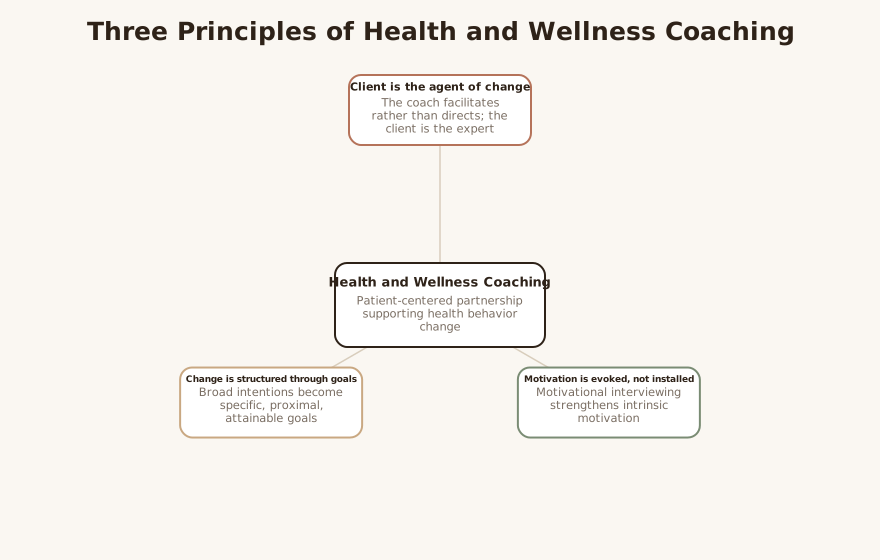
The foundational principle is that the client is the agent of change, and the coach’s role is to facilitate rather than direct 4. Coaching presumes the client is whole, capable, and the expert on their own circumstances, so the work centers on eliciting the client’s own reasons, resources, and plans rather than imposing the clinician’s 4. This stance is operationalized through a patient-centered, collaborative partnership in which agenda and goals are set by the client 2.
A second principle is that motivation is evoked, not installed, which is why motivational interviewing is so central to the model 7. The coach uses open questions, reflective listening, affirmation, and the strategic elicitation of change talk to strengthen the client’s intrinsic motivation, on the theory that internally generated reasons drive more durable change than external pressure 7. This aligns HWC with self-determination principles emphasizing autonomy, competence, and relatedness 7.
A third principle is that change is structured through goals 7. Drawing on goal-setting theory, coaches help clients translate broad intentions into specific, proximal, attainable goals with clear feedback, building self-efficacy through accumulating small successes 7. Coaching is therefore both relational and architectural: it supplies the motivational climate and the concrete scaffolding for behavior change 4.
LLM-generated illustrative example (not a guideline): A client with prediabetes says, “I know I should eat better, but I never stick with it.” Rather than supplying a diet, the coach reflects the ambivalence, asks what has worked before, and helps the client design one specific, attainable weekly goal they themselves chose, so the plan and the motivation both originate with the client LLM.
Interventions & Techniques
The procedural core of HWC blends motivational-interviewing microskills with goal-architecture and self-management tools 7. Sessions typically open with a collaborative agenda-setting step in which the client, not the coach, names the focus, followed by open-ended exploration that uses reflective listening and affirmations to surface the client’s own values and motivations 7. The coach actively listens for and reinforces change talk while avoiding the “righting reflex” of correcting or persuading 7.
From this motivational base, the coach helps the client convert intention into a concrete plan, often using SMART-style goals that are specific, measurable, and proximal, paired with explicit planning of when, where, and how the behavior will occur 7. Between-session action steps, self-monitoring, and structured review of progress provide the feedback loop that goal-setting theory predicts will build self-efficacy 7. Coaches commonly use a strengths and vision orientation, helping clients articulate a compelling future “best self” and connect daily behaviors to it 4.
A distinguishing contemporary development is the integration of mind-body techniques, such as breathing, relaxation, and stress-regulation practices, into the coaching frame, used to support the physiological and emotional self-regulation that behavior change often requires 7. Throughout, accountability is collaborative rather than enforced: the coach holds the client to their own stated goals while preserving autonomy 4.
LLM-generated illustrative example (not a guideline): A client with hypertension wants to “be more active.” The coach helps them shrink this to a proximal, measurable target, walking ten minutes after dinner on four specified evenings, plans the cue and location with them, sets up a simple log, and schedules a brief progress review the following session LLM.
Evidence Base
HWC’s evidence base is best described as established but still consolidating: there is a growing body of randomized controlled trials and at least one systematic review and meta-analysis examining its effect on patient-important outcomes in chronic illness care 1. That review found that health and wellness coaching can improve a range of outcomes relevant to patients living with chronic conditions, supporting its use as a behavior-change intervention in chronic-disease management 1. Individual randomized trials reinforce this, including a randomized-controlled trial in diabetes that reported improvements in glycemic control and lifestyle measures with coaching relative to usual care 5.
Honest appraisal requires naming the field’s limitations 1. A persistent challenge is heterogeneity: “health coaching” is defined and delivered inconsistently across studies, with variation in coach training, session number and frequency, and the specific techniques used, which complicates pooled estimates and direct comparison 1. The diabetes trial, while positive, is a single study in a specific population and should not be generalized uncountably 5. The recent push to standardize training and certification through NBHWC is partly a response to this variability and may strengthen the comparability of future research 2. Clinicians should therefore present HWC as a well-supported, increasingly standardized approach for chronic-illness behavior change, while acknowledging that effect sizes and active ingredients are still being clarified 1.
Populations & Indications
HWC is most established in the management of chronic disease and in lifestyle-medicine contexts, where sustained behavior change is the therapeutic target 4. The systematic-review evidence specifically concerns patients living with chronic illness, making chronic-disease self-management a core indication 1. Trial evidence supports use with people who have type 2 diabetes, where coaching has been linked to better glycemic control and lifestyle improvement 5.
By extension and by the logic of lifestyle medicine, HWC is applied to adults managing cardiovascular risk, hypertension, obesity and prediabetes, and the broad family of behaviorally mediated conditions in which diet, physical activity, sleep, stress, and tobacco use drive outcomes 4. It is particularly suited to clients who are ambivalent or have struggled with adherence, because its motivational core is designed precisely to engage that ambivalence rather than override it 7. HWC functions best as an adjunct within a broader medical and, where relevant, psychotherapeutic plan, not as a stand-alone treatment for psychiatric disorders 4.
Problems-for-Work
HWC targets the behavioral and motivational machinery of chronic-illness self-management, which makes it a strong fit for several presenting problems 4. Medication and regimen nonadherence is addressed by exploring the client’s own ambivalence and barriers and co-designing sustainable routines, rather than reissuing instructions 7. Sedentary behavior is worked through proximal, specific activity goals with planning and self-monitoring, building self-efficacy from small wins 7.
Suboptimal glycemic control and weight management are supported through coaching on diet and activity behaviors, with trial evidence in diabetes indicating such coaching can move clinical and lifestyle measures 5. Tobacco use and other entrenched habits are engaged through change talk and autonomy-supportive planning rather than confrontation 7. Low self-efficacy for change is itself a target: the goal-setting architecture is explicitly designed to rebuild a client’s belief that change is possible through accumulating successes 7. Stress and dysregulation that undermine self-management can be addressed through the integration of mind-body and self-regulation practices into the coaching frame 7.
LLM-generated illustrative example (not a guideline): A client with type 2 diabetes repeatedly skips their evening medication. Instead of restating its importance, the coach explores the client’s daily routine and ambivalence, learns the dose collides with an inconsistent dinner, and helps the client anchor it to a stable existing habit they selected, then reviews adherence collaboratively the next session LLM.
Contraindications, Cautions & Cultural Humility
HWC has few absolute contraindications, but important scope cautions apply 4. Coaching is not psychotherapy and is not designed to treat psychiatric disorders, acute crises, eating disorders, or suicidality; coaches should recognize these limits and refer to appropriate clinical care, and clinicians who also coach must keep the roles distinct 2. Similarly, coaching does not replace medical management of chronic disease; behavior-change support sits alongside, not instead of, evidence-based medical treatment 4.
Because HWC centers the client’s own goals and reasons, it carries a built-in disposition toward respecting autonomy, but cultural humility must still be deliberate 4. What counts as a “healthy” behavior, a desirable body, or a feasible routine is shaped by culture, food environment, work and caregiving demands, and material resources, so coaches must elicit goals from the client’s world rather than impose a generic lifestyle template 4. The coach should attend to structural barriers, such as food access, neighborhood safety, cost, and time, that can make behavior change far harder than motivation alone would predict, and avoid framing nonadherence as mere lack of will LLM. Practiced honestly, the patient-centered, evocative stance of HWC is itself a vehicle for humility, because it grounds every plan in the client’s stated values and constraints 4.
Treatment-Plan Suggestions & SMART Objectives
The following table offers example goals, SMART-formatted objectives, and the behavior-change mechanism each targets; all are illustrative and must be individualized to the client’s own goals and context LLM.
| Goal | SMART objective (example) | Mechanism |
|---|---|---|
| Increase physical activity | Walk 10 minutes after dinner on 4 specified evenings per week for 4 weeks, logged each time | Proximal, specific goal builds self-efficacy through accumulating success 7 |
| Improve medication adherence | Take evening medication anchored to an existing daily habit on at least 6 of 7 days, reviewed weekly | Habit anchoring plus collaborative accountability supports adherence 7 |
| Strengthen intrinsic motivation | Articulate 3 personal reasons for change and revisit them at the start of each session for 4 weeks | Eliciting and reinforcing change talk raises intrinsic motivation 7 |
| Support glycemic self-management | Self-monitor one diabetes-related behavior daily and review the pattern with the coach biweekly | Self-monitoring and feedback support behavioral self-management in diabetes 5 |
| Build a sustainable dietary change | Replace one sugar-sweetened beverage per day with water on 5 of 7 days for 4 weeks | Small, attainable proximal goals reduce overwhelm and build momentum 7 |
| Regulate stress to protect routines | Practice a chosen 5-minute breathing or relaxation skill on 4 days per week for 3 weeks | Mind-body self-regulation supports the capacity to sustain change 7 |
| Clarify a values-based vision | Define a concrete “best self” vision and link each weekly action step to it for 4 weeks | Vision and strengths orientation connects daily behavior to durable meaning 4 |
Common Misconceptions
A frequent misconception is that health coaching is simply giving advice or education about healthy living 4. In fact, the defining feature of HWC is that it is patient-centered and evocative: the coach draws out the client’s own motivation and plans rather than dispensing information, and over-relying on advice undercuts the model’s mechanism 4. A second misconception is that “anyone can call themselves a health coach,” which, while historically true of informal practice, ignores the now-formal national training and certification standards set by NBHWC and examined by NBME 2.
A third misconception conflates coaching with therapy 2. HWC is bounded in scope, oriented to present-focused behavior change and self-management rather than the treatment of mental disorders, and competent coaches refer out when issues exceed that scope 2. Finally, some assume the evidence is either nonexistent or definitively settled; the honest picture is a growing, positive, but heterogeneous evidence base still working toward standardization 1.
Training & Certification
Contemporary HWC has a defined credentialing pathway 2. The NBHWC sets standards for what a qualifying training program must cover and maintains a directory of approved programs; graduates of an approved program who meet experience requirements may sit for the national certifying examination 2. That examination is administered through a partnership with the National Board of Medical Examiners and confers the NBC-HWC (National Board Certified Health & Wellness Coach) credential, which is the field’s principal mark of standardized competency 3.
Approved training programs, such as the Wellcoaches school founded by Margaret Moore, provide the coach-skills curriculum, supervised practice, and competency assessment that prepare candidates for certification 6. For clinicians, the practical path is to complete an NBHWC-approved program, accrue the required coaching experience, and pass the national exam, while continuing to build skill through supervised practice and the underlying motivational-interviewing and goal-setting literature 2. Many lifestyle-medicine and integrative-medicine programs treat this certification as a marker of readiness to deliver coaching within team-based care 4.
Key Terms
- Health and Wellness Coaching (HWC) — a patient-centered, partnership-based modality supporting sustained health behavior change in chronic disease and lifestyle medicine 4.
- Patient-centered partnership — a collaborative relationship in which the client sets the agenda and is treated as the expert on their own life 4.
- Motivational interviewing — the evocative, autonomy-supportive communication style at the heart of HWC, used to elicit and strengthen change talk 7.
- Change talk — client speech favoring change, which the coach selectively reflects and reinforces to build motivation 7.
- Goal-setting architecture — the use of specific, proximal, attainable goals with feedback to scaffold behavior change and self-efficacy 7.
- Self-efficacy — a client’s belief in their capacity to perform a behavior, built through accumulating small successes 7.
- Mind-body integration — incorporation of breathing, relaxation, and self-regulation practices to support the physiological side of change 7.
- NBC-HWC — National Board Certified Health & Wellness Coach, the credential conferred via the NBHWC/NBME certifying exam 3.
Resources & Further Reading
▶ Watch — a video introduction to this concept:
- The impact of health and wellness coaching on patient-important outcomes in chronic illness care: a systematic review and meta-analysis (Patient Education and Counseling)
- National Board for Health & Wellness Coaching (NBHWC)
- Health & Wellness Coach Certifying Examination (NBME)
- Health Coaching: The Science and Art of Behavior Change (American College of Lifestyle Medicine)
- Effectiveness of Health Coaching in Diabetes Control and Lifestyle Improvement: A Randomized-Controlled Trial (PMC)
- Wellcoaches School of Coaching — National Certification
- Integrating mind-body processes and motivational interviewing in health coaching (Frontiers in Psychology, 2025)
Reflective / Supervision Questions
- For a current client, are you evoking their reasons and plans for change, or have you slipped into advice-giving and the righting reflex? 7
- How do you keep the boundary between coaching and psychotherapy clear, and what is your threshold for referring a client out of scope? 2
- When a client struggles to change a behavior, how do you distinguish genuine ambivalence from structural barriers like cost, access, or time, and how does that change your plan? LLM
- Are you translating broad client intentions into specific, proximal, measurable goals with real feedback, as goal-setting theory predicts works best? 7
- How honestly are you presenting the evidence for coaching, well supported and growing, but heterogeneous and still consolidating, to clients and referrers? 1
- Where could integrating a mind-body or self-regulation element better support a client whose stress is undermining their self-management? 7