
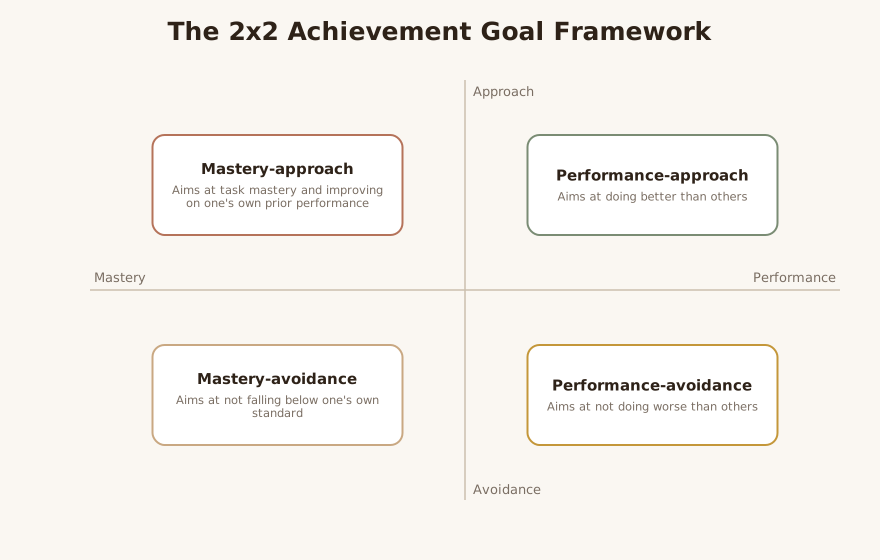
Achievement Goal Theory (AGT) is one of the most-studied frameworks in motivation science, and it offers therapists a precise vocabulary for a problem they see constantly: the gap between what a client wants to achieve and why they are pursuing it. LLM Two clients can carry identical academic or athletic goals, yet one experiences them as energizing growth and the other as a high-stakes referendum on their worth. LLM AGT explains that difference through the type of goal orientation a person adopts, and that distinction maps directly onto the perfectionism, performance anxiety, and fear of failure that fill clinical caseloads. LLM
Type & Discipline
AGT is a theory rather than a treatment package; it is a descriptive and explanatory model of why and how people pursue competence in achievement settings. 4 It originates in educational and motivational psychology and belongs to the broader family of motivation theory. 4 Its central object of study is the goal orientation—the cognitive-affective stance a person takes toward demonstrating or developing competence in a domain such as school, sport, or work. 4 Because it is a theory and not a manualized therapy, clinicians use AGT as a conceptual lens to inform case formulation and to guide interventions delivered within established treatment modalities, not as a billable therapy in its own right. LLM
Creators & Lineage
The modern theory grew out of John Nicholls’s foundational analysis of how people conceive of ability and experience achievement. 1 Nicholls argued that subjective experience, task choice, and performance hinge on whether a person construes ability in a task-referenced way (am I improving? did I understand it?) or a normatively referenced way (did I beat others?). 13 This task-versus-ego distinction became the seed of what is now called mastery versus performance goals. 5
Carol Dweck contributed the parallel insight that beliefs about the nature of ability—whether intelligence is fixed or malleable—shape the goals people set, linking AGT to implicit theories of intelligence and the growth-mindset literature. LLM Andrew Elliot then reorganized the field by crossing the mastery/performance dimension with an approach/avoidance dimension, producing the influential 2x2 achievement goal framework. 2 Across these contributors, AGT sits alongside and borrows from Self-Determination Theory, self-efficacy theory, and attribution theory, all of which address the conditions under which motivation flourishes or collapses. LLM The theory has matured through decades of refinement, and recent retrospectives describe an arc of early promise, subsequent theoretical disputes, and ongoing revision. 5
Core Principles
The first principle is that competence is the conceptual core of achievement motivation, and goals are the standards by which people define and evaluate it. 4 The second is the foundational contrast between two orientations. A mastery goal (also called a task or learning goal) defines success as developing competence, mastering material, and improving relative to one’s own prior performance. 4 A performance goal (also called an ego goal) defines success as demonstrating competence relative to others—outperforming peers or avoiding looking incompetent. 4
The third principle, introduced by Elliot and McGregor, is that each orientation splits along a valence dimension into approach and avoidance forms, yielding a 2x2 framework: mastery-approach, mastery-avoidance, performance-approach, and performance-avoidance. 2 Mastery-approach aims at task mastery and improvement; mastery-avoidance aims at not failing to master a task or not falling below one’s own standard; performance-approach aims at doing better than others; performance-avoidance aims at not doing worse than others. 2 This crossing matters clinically because the avoidance goals—organized around not failing rather than succeeding—are the ones most consistently tied to distress. LLM
A fourth principle is that goal orientations are not pure traits; they are influenced by the achievement context and by the person’s underlying conception of ability, so the same individual may adopt different goals in different settings. 14 Finally, the field has continued to debate how best to model these goals, with later work comparing the original dichotomous model, the 2x2 model, and newer multi-component models to see which best predicts outcomes. 6
Interventions & Techniques
AGT does not prescribe a fixed set of techniques, but its principles translate into recognizable clinical moves. LLM The first is goal-orientation assessment: eliciting how a client defines success in a given domain and listening for normative (“I have to be the best in my cohort”) versus self-referenced (“I want to understand this better than I did last month”) framing. LLM Because Nicholls showed that task choice and subjective experience follow from these conceptions, the framing itself is a leverage point. 1
The second move is reframing toward mastery: helping clients restate goals in terms of learning, improvement, and process rather than comparison and outcome. LLM The third is valence work: noticing when a client is organized around avoidance—working to not fail rather than to grow—and surfacing the cost of that stance, since the 2x2 framework identifies avoidance goals as a distinct and clinically relevant category. 2 A fourth move is shaping the motivational climate: with clients who have agency over their environment (parents, coaches, managers, or self-structured study), encouraging task-involving conditions that reward effort and improvement over normative ranking. 4
LLM-generated illustrative example (not a guideline): A graduate student presents with paralysis before exams. On assessment, her goal is “not to be the one who fails out”—a performance-avoidance orientation. The therapist helps her articulate a parallel mastery-approach goal (“I want to actually understand statistics so I can use it in my research”), then tracks weekly which goal she is operating from. As the mastery framing becomes more available, her pre-exam avoidance and procrastination decrease. LLM
Evidence Base
AGT is an established and heavily researched framework; the maturity of the theory is not in question, even as specific models within it remain debated. 5 Nicholls’s original formulation has been foundational for four decades and continues to anchor the construct. 13 Elliot and McGregor’s 2x2 framework is among the most-cited papers in motivation science and provided the empirical scaffolding for distinguishing approach from avoidance goals. 2
The evidence base is largest on the correlational side: goal orientations reliably predict patterns of affect, persistence, task choice, and performance, and the field has invested heavily in comparing competing models of how the goals are structured. 16 A 2016 comparison of three models of achievement goals tested the dichotomous, 2x2, and more recent multi-component formulations against educational outcomes, reflecting the field’s continued effort to refine measurement. 6 Honest appraisal, however, requires acknowledging the discords: retrospective reviews document genuine theoretical disagreement about definitions, the proliferation of goal constructs, and unresolved questions about which model is correct. 5 For the clinician, the practical takeaway is that the broad distinction between learning-oriented and other-referenced (especially avoidance) goals is robust and useful, while the finer taxonomies remain contested. LLM AGT is also not, by itself, an outcome-validated psychotherapy; its clinical value is as a formulation tool inside evidence-based modalities. LLM
Populations & Indications
AGT was developed in achievement contexts, so its most natural fit is with people whose distress is organized around performance domains. 4 Students and adolescents are the populations in which the theory was originally elaborated, given the salience of grades, comparison, and ability beliefs in school settings. 14 Athletes are a second core population, where task-involving versus ego-involving climates strongly shape experience. 4 High-achieving professionals and perfectionists round out the clinically relevant groups, because their symptoms frequently trace to an entrenched normative or avoidance goal orientation. LLM Indications for using the lens include presentations where a client’s suffering is tied less to the achievement domain itself and more to how they construe success and failure within it. LLM
Problems-for-Work
AGT gives traction on several presenting problems. With perfectionism, the lens distinguishes adaptive striving (mastery-approach) from the rigid, self-evaluative standard-setting that often reflects performance or mastery-avoidance goals. 2 With fear of failure, AGT names the underlying structure directly: failure-avoidance is the organizing motive of avoidance goals, making the dynamic explicit and workable. 2 For performance anxiety, the theory connects acute distress to ego-involving, normatively referenced construals of the task. 1
For procrastination, avoidance goals offer a parsimonious account—delay protects against the feared demonstration of incompetence. LLM In academic burnout, chronic performance and avoidance orientations help explain the depletion that follows sustained comparison-based striving. LLM With low self-esteem, the normative basis of performance goals ties self-worth to outranking others, a fragile foundation the clinician can name and loosen. LLM And in motivation deficits, AGT helps differentiate a client who lacks any competence goal from one whose mastery motivation is being suppressed by avoidance. LLM
LLM-generated illustrative example (not a guideline): A mid-career attorney describes burnout and dread before every filing. Formulation reveals a near-total performance-approach orientation—worth contingent on being ranked above peers. Work focuses on reintroducing self-referenced markers of competence and meaning, reducing the burnout fueled by perpetual comparison. LLM
Contraindications, Cautions & Cultural Humility
AGT is a conceptual lens, so there are no procedural contraindications; the cautions concern misuse. LLM The most important is the temptation to moralize—to treat mastery goals as “healthy” and performance goals as “pathological.” LLM The literature is more nuanced: performance-approach goals can support strong performance in some contexts, and the clinically concerning patterns cluster around the avoidance forms. 2 Imposing a mastery frame on a client whose context genuinely rewards normative comparison (competitive admissions, elite sport, up-or-out workplaces) can feel invalidating and ignore real contingencies. LLM
Cultural humility is essential because the theory was built largely in Western, individualistic educational settings, and conceptions of ability, the meaning of comparison, and the value placed on collective versus individual achievement vary across cultures. 1 The therapist should treat the client’s own definition of success as data to be understood, not corrected, and should hold the theory’s specific taxonomies lightly given the unresolved debates within the field. 5
Treatment-Plan Suggestions & SMART Objectives
| Goal | SMART objective (example) | Mechanism |
|---|---|---|
| Increase awareness of goal orientation | Within 4 sessions, client will name, for two achievement domains, whether their goal is mastery- or performance-based, in session, 100% of prompts | Self-referenced vs. normative conception of ability 1 |
| Reframe a normative goal toward mastery | Within 6 weeks, client will restate one core academic/work goal in improvement terms and log it weekly for 3 consecutive weeks | Shift from ego- to task-involvement 4 |
| Reduce avoidance-driven procrastination | Over 8 weeks, client will begin one previously avoided task within 24 hours of scheduling it, on at least 4 of 5 occasions | Targeting performance/mastery-avoidance valence 2 |
| Loosen contingent self-worth | Within 8 sessions, client will record 3 weekly instances of self-referenced progress independent of comparison to others | Decoupling worth from normative ranking LLM |
| Lower performance anxiety in evaluated settings | Before next 2 evaluated events, client will rehearse a mastery-framed pre-task statement and rate anxiety pre/post (target reduction of 2+ points on 0-10) | Reconstrual of evaluative task as learning task 1 |
| Build adaptive striving (reduce perfectionism) | Over 6 weeks, client will set one “good-enough/learning” standard per project and complete it without revision-checking, weekly | Replacing avoidance standards with mastery-approach 2 |
| Shape motivational climate (parent/coach/self) | Within 4 weeks, client will identify and implement 2 changes that reward effort/improvement over ranking in their environment | Task-involving climate 4 |
Common Misconceptions
A first misconception is that performance goals are simply bad and mastery goals are simply good; the more accurate picture distinguishes approach from avoidance, with the avoidance forms carrying most of the clinical risk and performance-approach goals sometimes supporting achievement. 2 A second is that goal orientations are fixed personality traits; Nicholls’s work emphasized that they depend on how ability is conceived in a given context, so they are at least partly situational and modifiable. 1 A third misconception is that AGT is a settled, monolithic theory; in fact it comprises competing models, and researchers continue to dispute which structure best fits the data. 56 A fourth is that AGT is itself a therapy—it is a theory of motivation that informs treatment, not a treatment protocol. LLM
Training & Certification
There is no certification in Achievement Goal Theory, because it is an academic theory of motivation rather than a credentialed clinical method. LLM Clinicians develop competence by reading the primary literature—Nicholls’s foundational paper on conceptions of ability and Elliot and McGregor’s 2x2 framework are the anchor texts—and by following the broader reviews that trace the theory’s evolution and current disputes. 125 Practical clinical skill comes from integrating the lens into modalities the therapist is already trained and credentialed in, such as CBT or ACT, rather than from any AGT-specific credential. LLM
Key Terms
- Mastery goal (task/learning goal): Defining success as developing competence and improving relative to one’s own standard. 4
- Performance goal (ego goal): Defining success as demonstrating competence relative to others. 4
- Approach vs. avoidance: The valence dimension; approach goals move toward success, avoidance goals move away from failure. 2
- 2x2 framework: Crossing mastery/performance with approach/avoidance to yield four goal types. 2
- Conception of ability: Whether ability is judged in task-referenced or normatively referenced terms—the cognitive basis of goal orientation. 1
- Motivational climate: The achievement environment as task-involving (rewarding improvement) or ego-involving (rewarding ranking). 4
Resources & Further Reading
▶ Watch — a video introduction to this concept:
- Nicholls, J.G. (1984). Achievement motivation: Conceptions of ability, subjective experience, task choice, and performance (PsycNET)
- Nicholls, J.G. (1984), ERIC record EJ305998
- Elliot, A.J., & McGregor, H.A. (2001). A 2x2 achievement goal framework (Semantic Scholar)
- Achievement Goal Theory — an overview (ScienceDirect Topics)
- Achievement Goal Theory: A Story of Early Promises, Eventual Discords, and Future Possibilities (ResearchGate)
- Comparing Three Models of Achievement Goals (ERIC EJ1119099, 2016)
Reflective / Supervision Questions
- For this client, do I actually know how they define success in the relevant domain—self-referenced improvement or normative ranking—or am I assuming? LLM
- Am I subtly moralizing mastery goals as “healthy” and performance goals as “unhealthy,” and is that costing me accuracy or alliance? LLM
- Where is the client’s distress organized around avoidance (not failing) rather than approach (succeeding), and how does that change the formulation? 2
- Does the client’s context genuinely reward normative comparison, such that a pure mastery reframe would be invalidating or impractical? LLM
- Whose conception of ability shaped this client’s goals—family, culture, institution—and am I attending to that lineage with humility? 1
- Which billable modality am I delivering this within, and is my documentation reflecting the clinical intervention rather than the theory itself? LLM