
Type & Discipline
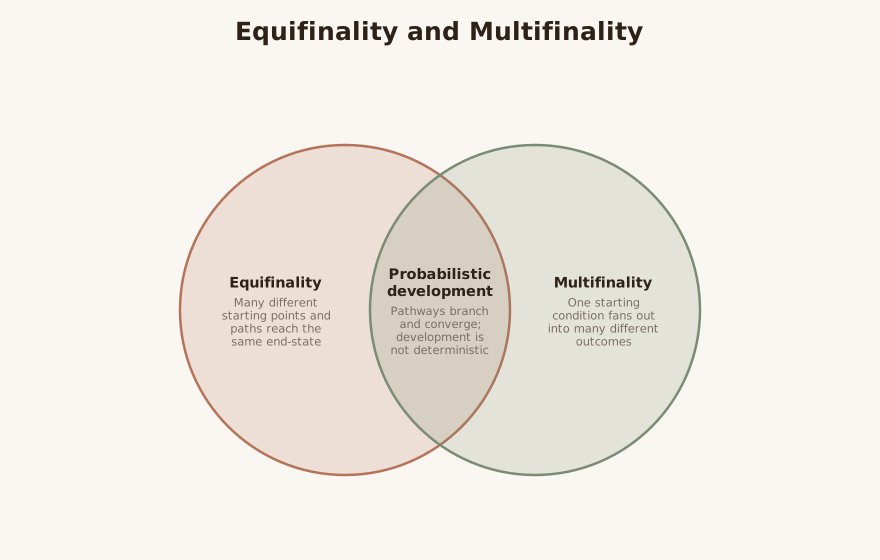
Equifinality and multifinality are paired principles drawn from general systems theory and carried into the clinical sciences through developmental psychopathology. 1 Equifinality is the property of an open system whereby the same end-state can be reached from a variety of different initial conditions and through a variety of different pathways. 4 Its counterpart, multifinality, holds that a single starting component or risk factor may function differently depending on the system it is embedded in, so that the same beginning can yield many divergent outcomes. 4 Neither principle is a therapy, a technique, or a manualized protocol; both are explanatory propositions about how complex, living systems develop over time. LLM
For practicing therapists, the pair functions as a case-formulation lens rather than an intervention. LLM It supplies the formal vocabulary for two clinical intuitions every experienced clinician already holds: that the same diagnosis can arise from radically different histories, and that the same history does not predetermine a single fate. 1 Understanding the pair helps a clinician resist both the etiological oversimplification of “one cause, one disorder” and the prognostic fatalism of “this history guarantees that outcome.” LLM
Creators & Lineage
The concept of equifinality originates with the biologist Ludwig von Bertalanffy, the founder of general systems theory, who used it to distinguish open biological systems from closed physical ones. 4 In a closed system, the final state is fixed by the initial conditions; in an open system that exchanges matter and energy with its environment, the same final state can be reached from different starting points and by different routes. 4 This was the property that, for Bertalanffy, made living systems irreducible to simple mechanistic causation. LLM
The translation of these ideas into clinical science is most closely associated with Dante Cicchetti and Fred Rogosch, whose 1996 editorial in Development and Psychopathology made equifinality and multifinality organizing principles of the field. 1 Cicchetti and Rogosch argued that developmental psychopathology must abandon linear, single-cause models in favor of a systems view in which multiple pathways lead to similar disorders and similar risks diverge into different outcomes. 1 The lineage thus runs from von Bertalanffy’s general systems theory and the broader cybernetics and systems-science tradition, through developmental psychopathology, and into family systems thinking, all of which model individuals as open systems nested within larger systems. 3 The principles remain in active use; a 2025 study in the Journal of Affective Disorders explicitly applied multifinality and equifinality to the effects of family risks on adolescent mental health. 5
Core Principles
The first principle is the definition of equifinality: in an open system, a given end-state can be reached from many different initial conditions and along many different developmental trajectories. 4 Applied to psychopathology, this means a single disorder rarely has a single cause; instead, diverse combinations of risk and protective factors converge on a common clinical presentation. 1 Two children arriving at the same depressive presentation may have traveled entirely different developmental roads. LLM
The second principle is the definition of multifinality: a particular adverse experience or risk factor does not lead inexorably to one outcome, because its effect depends on the organization of the whole system in which it operates. 4 The same component may carry different meaning and produce different results in different systems, so one starting point fans out into many possible end-states. 4 Children exposed to similar maltreatment can develop along markedly different lines, some toward disorder and some toward resilience. 1
The third principle is probabilistic, not deterministic, development. LLM Because pathways branch and converge, the relation between any single risk factor and any single outcome is one of probability rather than certainty, and prediction must be made across developmental time rather than at a single point. 1 This is the formal basis for the field’s insistence that risk is not destiny and that resilience is a genuine developmental outcome, not a statistical anomaly. 5
A practical corollary follows directly: assessment should map patterns and processes across a person’s history rather than searching for a single proximal cause, and prognosis should be framed as a distribution of possibilities shaped by ongoing context. LLM
Interventions & Techniques
Because equifinality and multifinality are explanatory principles rather than a therapy, they generate orienting heuristics and formulation moves rather than scripted techniques. LLM Three follow directly from the pair.
First, multi-pathway case formulation. Equifinality instructs the clinician to hold open several candidate developmental routes to a presenting problem rather than committing prematurely to one etiological story. 1 In practice this means building a formulation that names the particular combination of risks, contexts, and protective factors that produced this client’s version of a shared diagnosis, rather than treating the diagnostic label as the explanation. LLM
Second, idiographic over nomothetic matching. Because the same end-state arises by different paths, two clients with identical diagnoses may require different interventions targeted to their distinct underlying processes. 1 The principles thus give a theoretical rationale for treatment matching and for resisting one-size-fits-all protocol assignment by diagnosis alone. LLM
Third, a resilience and prevention stance. Multifinality implies that the same risk can be deflected toward an adaptive outcome, which locates leverage in the protective factors and contextual moderators that shape which pathway a child or family follows. 5 Preventive work can therefore target the moderators that bend a risky trajectory rather than only the risk itself. LLM
LLM-generated illustrative example (not a guideline): Two adolescents both meet criteria for major depression. The clinician, working from equifinality, declines to assume a shared mechanism. For one, the formulation centers on early loss and an avoidant attachment pattern; for the other, on chronic peer victimization and a perfectionistic cognitive style. Each receives an intervention emphasis fitted to the pathway that produced the shared end-state, rather than the same manualized package assigned by diagnosis alone. LLM
Evidence Base
The maturity of equifinality and multifinality is best described as established — but established as a conceptual and meta-theoretical framework within developmental psychopathology and general systems theory, not as an empirically validated treatment. 1 As organizing principles they are foundational and widely taught, and the Cicchetti and Rogosch 1996 statement is treated as a seminal articulation of the field’s stance. 1 There is no body of randomized controlled trials testing an “equifinality therapy,” because no such standalone therapy exists. LLM
The empirical support that does exist is observational and developmental: longitudinal and cohort research repeatedly documents that multiple pathways converge on similar disorders and that similar risks diverge into different outcomes, which is precisely what the principles predict. 1 More recent work continues to test the framework directly — for example, the 2025 analysis of family risks and adolescent mental health was explicitly organized around multifinality and equifinality and examined how clusters of family risk relate to divergent and convergent mental-health outcomes. 5 This is genuine, accumulating evidence for the descriptive validity of the principles. LLM It does not, however, license efficacy claims about any particular intervention: the principles explain and predict the shape of developmental data, but they do not by themselves demonstrate that a given technique works. LLM
Populations & Indications
The lens is population-agnostic because it describes how developmental pathways branch and converge rather than any single diagnosis. LLM It is most clarifying with children at developmental risk, where the question of which trajectory a given risk will follow is central. 1 It scales naturally to families and to families with diverse developmental histories, where the “system” is the family unit and the same family-level risk may produce different outcomes across siblings. 5
It is especially useful with trauma-exposed populations, where it formalizes the clinical observation that similar traumatic exposures yield strikingly varied results. 1 It is equally indicated with people with comorbid conditions, where multiple overlapping pathways help explain why diagnoses cluster, and across clinical research and case-formulation populations broadly, where it serves as a meta-model for thinking about etiology and prognosis. 1 The principles are indicated wherever the central puzzle is heterogeneity — why a single label covers many different stories, or why a single exposure produces many different fates. LLM
Problems-for-Work
- Heterogeneity of symptom etiology. Equifinality reframes a single diagnosis as a common end-state reachable by many routes. 1 Application: build a formulation that specifies this client’s particular pathway rather than treating the diagnosis as the cause. LLM
- Comorbidity. Overlapping and branching pathways help explain why conditions co-occur rather than treating each as an isolated entity. 1 Application: look for shared upstream processes that feed several presenting problems at once. LLM
- Varied outcomes from similar trauma. Multifinality predicts that similar exposures diverge, so two clients with comparable histories need not share a prognosis. 1 Application: assess the moderators and protective factors that distinguish their trajectories. LLM
- Resilience despite adversity. The framework treats adaptive outcomes after risk as a genuine developmental pathway, not noise. 5 Application: identify and reinforce the protective processes that are bending the trajectory. LLM
- Differential pathways to disorder. Different combinations of risk converge on similar disorders. 1 Application: avoid assuming that clients with the same diagnosis arrived by the same route. LLM
- Treatment matching difficulties. Because shared diagnoses mask distinct mechanisms, intervention can be fitted to pathway rather than label. 1 Application: let the formulated mechanism, not the diagnostic code, drive the choice of emphasis. LLM
- Diagnostic overshadowing. Holding multiple pathways in mind guards against letting a single salient label foreclose inquiry into other contributing processes. LLM Application: keep alternative etiological hypotheses live until the data adjudicate. LLM
Contraindications, Cautions & Cultural Humility
The chief caution is misuse as an excuse for vagueness: because “many pathways are possible” is always true, the principles can be invoked to avoid the hard work of specifying this client’s actual pathway. LLM The clinical value lies in disciplined, idiographic formulation, not in an open-ended shrug at complexity. 1
A second caution concerns prognostic balance. Multifinality is genuinely hopeful — similar risk can yield resilient outcomes — but it must not be used to minimize real harm or to imply that adverse outcomes are simply a matter of the client choosing a different path. 5 Equally, equifinality should not become deterministic in reverse, as if a presenting disorder proves that some specific trauma “must” have occurred. LLM
On cultural humility, what counts as a “risk factor,” an “adaptive outcome,” or a “protective process” is culturally and contextually defined, and the clinician does not get to decide unilaterally which developmental endpoints are healthy and which are pathological. LLM A pathway that looks maladaptive from outside may be a finely tuned adaptation to an environment the clinician has not seen, and the moderators that bend a trajectory toward resilience in one cultural context may differ in another. 5 Finally, the principles are a model, not the territory; human development is not a literal finite-state system, and presenting systems formalism as the truth about a person’s life is reductive and should be avoided. LLM
Treatment-Plan Suggestions & SMART Objectives
| Goal | SMART objective (example) | Mechanism |
|---|---|---|
| Build a multi-pathway formulation | Within 3 sessions, clinician and client co-construct a written developmental timeline naming at least 2 candidate pathways to the presenting problem | Operationalizes equifinality by holding open multiple routes to the same end-state 1 |
| Identify protective/moderating factors | Over 4 sessions, client names 3 protective relationships or strengths that have shaped their trajectory, reviewed in session | Targets the moderators that determine which outcome a risk produces (multifinality) 5 |
| Match intervention to pathway, not label | By session 6, clinician documents how the chosen treatment emphasis maps onto the formulated mechanism rather than the diagnostic code | Uses equifinality to justify idiographic treatment matching 1 |
| Reframe prognosis as a distribution | Within 2 sessions, client can state in their own words that their history makes several outcomes possible rather than one fixed fate | Translates probabilistic, non-deterministic development into hope and agency 1 |
| Distinguish shared trauma from shared outcome | Over 4 weeks, client and clinician compare the client’s outcome with a similarly exposed peer to identify what differed | Illustrates multifinality and surfaces the client’s specific moderators 5 |
| Map comorbid problems to shared roots | Within 5 sessions, clinician charts how 2 or more presenting problems may share upstream developmental processes | Applies converging-pathways logic to comorbidity 1 |
| Monitor trajectory over developmental time | Across 6 months, client completes a brief monthly review of changes in risk and protective factors and their effects | Embeds the probabilistic, across-time stance of the framework 1 |
Common Misconceptions
A frequent misconception is that equifinality and multifinality are the same idea, or are easily interchangeable. LLM They are mirror opposites: equifinality runs from many starting points to one end-state, while multifinality runs from one starting point to many end-states. 4 Conflating them, or inverting the definitions, defeats their purpose. LLM
A second misconception is that the principles constitute a deliverable therapy with outcome data. LLM They are explanatory propositions established within developmental psychopathology and general systems theory; they inform formulation but do not by themselves validate any technique. 1 A third error is reading equifinality as license for etiological agnosticism — “anything could have caused this, so we cannot say” — when the principle in fact demands a specific account of which pathway operated for this client. 1 Finally, people sometimes treat multifinality as proof that outcomes are arbitrary; the principle says outcomes are conditional on the system’s organization and moderators, which is a claim about lawful contingency, not randomness. 4
Training & Certification
There is no certification in equifinality or multifinality, because they are scientific principles rather than a credentialed practice. LLM Clinicians typically encounter them through training in developmental psychopathology, general systems theory, and the family-systems literature. 1 The primary route to genuine fluency is reading the source material: the Cicchetti and Rogosch 1996 statement lays out both principles and their implications for the field. 1 Accessible secondary treatments, such as the entry in the SAGE Encyclopedia of Lifespan Human Development and explainer summaries, offer concise orientations for clinicians newer to the concepts. 4 Following contemporary applications, such as the 2025 work on family risks and adolescent mental health, shows how the principles are operationalized in current research. 5 Certification, where relevant, belongs to the parent clinical modality — trauma-focused or family therapy, for instance — not to the principles themselves. LLM
Key Terms
- Equifinality: The property by which an open system can reach the same end-state from different initial conditions and along different pathways. 4
- Multifinality: The property by which the same initial component or risk factor can lead to different outcomes depending on the system in which it operates. 4
- Open system: A system that exchanges matter and energy with its environment, in which final states are not fixed by initial conditions. 4
- Developmental pathway: A probabilistic trajectory across time along which risk and protective factors shape an individual’s adaptation. 1
- Probabilistic (non-deterministic) development: The principle that risk relates to outcome by probability rather than certainty, requiring prediction across developmental time. 1
- Protective / moderating factor: A variable that conditions which outcome a given risk produces, central to the multifinality of trajectories. 5
- Resilience: An adaptive developmental outcome reached despite significant adversity, treated by the framework as a genuine pathway rather than an anomaly. 5
Resources & Further Reading
▶ Watch — a video introduction to this concept:
- Cicchetti, D., & Rogosch, F. A. (1996). Equifinality and multifinality in developmental psychopathology — Development and Psychopathology
- Cicchetti & Rogosch (1996) — full-text PDF (Cambridge Core)
- Equifinality — an overview (ScienceDirect Topics)
- Equifinality Versus Multifinality — The SAGE Encyclopedia of Lifespan Human Development
- Multifinality and equifinality in the effects of family risks on adolescent mental health — Journal of Affective Disorders (2025)
- Cicchetti & Rogosch (1996) — full text (ResearchGate)
Reflective / Supervision Questions
- For a client with a familiar diagnosis, can I articulate the specific developmental pathway that produced this presentation, or am I letting the label stand in for an explanation? 1
- Where am I assuming that a difficult history determines a fixed outcome, and how would multifinality reframe that prognosis? 5
- If two of my clients share a diagnosis, am I assigning the same intervention by label, or matching emphasis to their distinct underlying processes? 1
- What protective and moderating factors are already bending this client’s trajectory, and am I doing anything to reinforce them? 5
- Am I using “many pathways are possible” as a disciplined formulation tool, or as a way to avoid committing to a specific account? LLM
- Whose definition of a “healthy outcome” am I using, and does it impose cultural assumptions on this client’s developmental context? LLM