
Type & Discipline
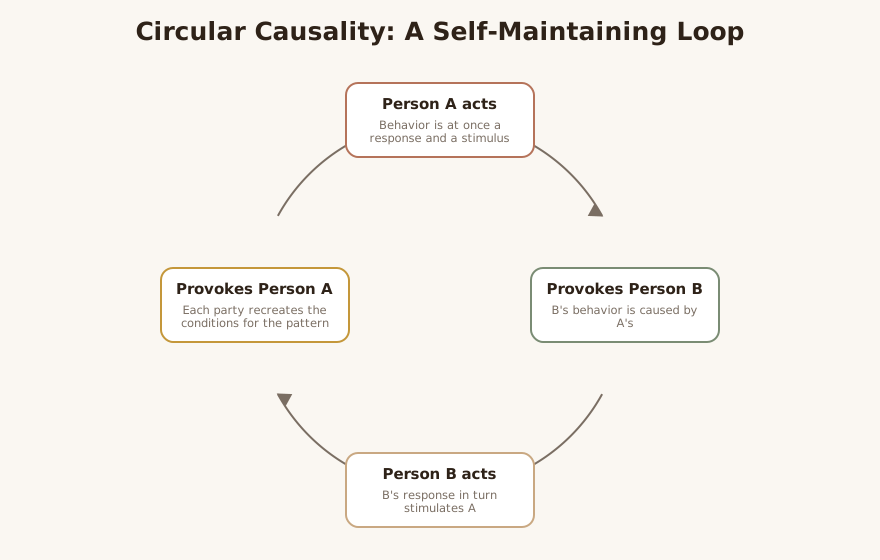
Circular (or recursive) causality is not a therapy, a manual, or a technique—it is a foundational construct and an epistemological stance within systemic family therapy 1. It names a way of understanding how problems arise and persist in relationships: cause and effect are mutual and reciprocal, so that A influences B while B simultaneously influences A, the two looping back on each other rather than running in one direction 1. LLM
The construct belongs to the discipline of systemic family therapy and draws its conceptual machinery from general systems theory and cybernetics, the mid-twentieth-century sciences of feedback, regulation, and communication in self-correcting systems 5. Its clinical force comes from the contrast it draws with linear causality—the everyday, billiard-ball assumption that one event simply causes another in a straight line, and that a problem therefore has a single locatable cause and, often, a culprit 2. Systemic practice deliberately substitutes a circular reading for this linear one 2. LLM
Because it is a construct rather than a packaged treatment, circular causality functions less like a tool you apply and more like a lens you look through—it reorganizes how a clinician perceives the presenting complaint before any specific intervention is chosen 3. LLM
Creators & Lineage
The intellectual headwaters are in cybernetics and general systems theory, where the anthropologist and theorist Gregory Bateson translated ideas about feedback loops and recursive regulation into the study of human communication, relationship, and “mind” as a patterned, self-maintaining process 5. Bateson’s collected essays in Steps to an Ecology of Mind are the canonical bridge between the cybernetic notion of circular feedback and its application to families, communication, and pathology 5. His thinking reframed symptoms as moves within an ongoing interactional pattern rather than as properties lodged inside a single person 5. LLM
The construct was then sharpened into clinical method by the Milan team—Mara Selvini Palazzoli, Luigi Boscolo, Gianfranco Cecchin, and Giuliana Prata—whose 1980 paper Hypothesizing—Circularity—Neutrality elevated “circularity” to one of three explicit guidelines for conducting a systemic session 6. For the Milan group, circularity meant the therapist’s capacity to investigate the family on the basis of feedback, asking each member about the relationship and behavior of others, and thereby surfacing the recursive connections the family itself could not see 6. This move connected the abstract systems idea to a concrete in-session practice 6.
The lineage runs from general systems theory and cybernetics, through Bateson’s ecology of mind, into the broader field of systemic family therapy, and specifically into the strategic and Milan systemic traditions that built whole treatment models on the premise that symptoms are sustained by circular patterns 1. Encyclopedic treatments of the field now present circular causality as a settled organizing idea of family systems theory 1. LLM
Core Principles
The first principle is mutual causation: in any sustained relationship, behavior is both a response and a stimulus at once, so it is artificial to ask which party “started” a pattern 1. Each person’s action is simultaneously caused by and a cause of the other’s, and the interaction is best described as a loop rather than a line 1. LLM
The second principle is the self-maintaining feedback loop. A pattern persists not because of an original cause that keeps firing, but because the parties continually recreate the conditions for it: A’s behavior maintains B’s behavior, which in turn maintains A’s, in an ongoing recursive cycle 3. The construct borrows directly from the cybernetic idea that systems regulate themselves through feedback, holding patterns stable over time 5. LLM
The third principle is the dethroning of linear blame. Where linear thinking locates a problem in one person and asks “who is at fault,” circular thinking asks how the parts of a system fit together to keep a pattern alive 2. Punctuation—where one chooses to start and stop the story—becomes arbitrary, because every “cause” is also an “effect” of what came before it in the loop 2. This is not a denial of responsibility but a redescription of the unit of analysis from the individual to the relationship 2. LLM
The fourth principle is context and relationship as the proper level of explanation. The symptom is understood in terms of its place in the pattern of connection among family members, not as a free-standing trait, so the relevant data are differences, comparisons, and relationships rather than isolated facts about one member 6. LLM
Interventions & Techniques
Although circular causality is a construct, it is operationalized clinically through a signature technique: circular questioning 4. Circular questions are designed to elicit information about relationships and differences rather than about static, individual attributes, and in doing so they make the recursive pattern visible to the family and the therapist alike 4.
Common forms include difference questions (“Who worries most about your brother—your mother or your father?”), ranking questions (“If you put the family in order of who gets most upset when Dad drinks, what would the order be?”), before-and-after questions (“Was the arguing worse before or after your daughter moved out?”), and gossip-in-the-presence-of questions, in which one member is asked to describe the relationship between two others 4. Each turns the conversation toward connection, sequence, and reciprocal effect 4. LLM
The Milan formulation embeds this within a session-level discipline: the therapist forms a hypothesis about the systemic meaning of the symptom, pursues circularity by interrogating the family on the basis of feedback about relationships, and maintains neutrality—a stance of not allying with any one member or position—so the loop, rather than any single villain, stays in view 6. Circularity in this sense is the active engine of information-gathering: the clinician’s questions follow the feedback the family supplies 6. LLM
A further technical move is reframing the punctuation of the presenting story. Because cause and effect loop, the clinician can offer the family a different starting point that recasts a blamed individual’s behavior as one move in a shared cycle 3. LLM
LLM-generated illustrative example (not a guideline): A couple presents with the complaint that “he withdraws.” Linearly, his withdrawal is the cause and her distress the effect. A circular reading asks: she pursues and criticizes because he withdraws; he withdraws because she pursues and criticizes. A circular question—“When he goes quiet, what do you do next, and what does he do after that?”—maps the loop. Neither partner is the cause; the pursue-withdraw cycle maintains itself. LLM
Evidence Base
The evidence status of circular causality is best stated precisely: it is an established, foundational construct of systemic family therapy, but it is a theory of how patterns work, not a discrete treatment with its own randomized-trial outcome literature 1. Its “establishment” lies in its near-universal adoption across the systemic field and its codification in encyclopedias and core texts, not in effect sizes 1. LLM
Its conceptual pedigree is strong and traceable: it derives rigorously from cybernetics and systems theory as articulated by Bateson, and it was formalized into clinical guidelines by the Milan team in a paper that remains a seminal reference for systemic practice 56. The construct’s operational arm, circular questioning, has a descriptive and theoretical literature mapping its types and clinical functions 4. LLM
Honest appraisal: clinicians should not overstate the empirical case. Much of the support is theoretical, descriptive, and consensus-based rather than experimental, and the original cybernetic framing has itself been critiqued and revised within the field over the decades 4. The construct’s value is heuristic and organizing—it reliably generates useful clinical hypotheses and questions—rather than something demonstrated to outperform a comparator in controlled trials, because it is not the kind of object that is tested that way 1. Treat it as a well-established conceptual foundation underpinning evidence-informed systemic models, not as a standalone evidence-based intervention 1. LLM
Populations & Indications
Circular causality applies wherever the relevant clinical unit is a relationship system rather than an isolated individual 1. It is most directly indicated for couples and families, where reciprocal patterns are the substance of the presenting problem 1. LLM
It is especially clarifying with family systems organized around a “symptomatic” member, because the construct reframes the so-called identified patient’s behavior as one element sustaining (and sustained by) the wider pattern, rather than as the sole locus of pathology 6. It is apt for parents and children in conflict, where escalating cycles of demand and refusal are easily read as loops 4. It extends to blended and multigenerational families, where multiple overlapping loops and coalitions operate at once 1. LLM
Because the underlying ideas come from general systems theory, the construct also generalizes beyond the household to groups and organizations, any human system in which feedback maintains stable patterns of interaction 5. LLM
Problems-for-Work
The construct earns its keep on relational presentations, and clinicians can translate complaints into loops:
- Relationship conflict and marital distress: the recurring fight is reframed from “whose fault” to “what cycle,” exposing the reciprocal moves each partner contributes 2. Application: use difference and sequence questions to chart the escalation loop. LLM
- Repetitive negative interaction patterns: these are the paradigm case—self-maintaining feedback loops where A maintains B which maintains A 3. LLM
- Communication problems: circular questioning surfaces how each message is both a reply and a provocation, dissolving the “who started it” stalemate 4. LLM
- Scapegoating and blame cycles: circular causality directly counters scapegoating by redistributing a linear, one-person attribution across the relational pattern that sustains it 2. LLM
- Parent-child conflict: demand-and-refusal or nag-and-stonewall sequences are mapped as loops rather than as a child’s or parent’s standalone defect 4. LLM
- Enmeshment and disengagement: these structural positions are read as products of, and contributors to, ongoing feedback among members rather than fixed traits 1. LLM
LLM-generated illustrative example (not a guideline): In a family where a teenager is “the angry one,” circular questioning reveals that the more the parents confer privately about him, the more excluded and provocative he becomes; the more provocative he becomes, the more they confer. The “anger problem” is relocated from the boy to the loop that keeps the family organized around it. LLM
Contraindications, Cautions & Cultural Humility
The chief caution is misusing circularity to dilute accountability. A circular reading must never be used to imply that a victim of abuse, violence, or coercion “co-creates” or shares responsibility for harm done to them; in contexts of power imbalance, abuse, or safety risk, responsibility is not symmetrical, and the clinician should not flatten it into a neutral loop 2. LLM Systemic neutrality is a stance toward not scapegoating, not a refusal to name harm or to protect safety 6. LLM
A second caution concerns clinical applicability: circular causality is a way of thinking, not a complete treatment plan, and it does not by itself address crisis, risk, or individual psychopathology that requires direct intervention 1. It is best paired with a fuller systemic model and with appropriate individual assessment 1. LLM
Cultural humility is integral. What counts as a “pattern,” a healthy boundary, an appropriate level of parental authority, or acceptable emotional expression varies markedly across cultures and family structures, and the loops a clinician perceives are shaped by their own cultural assumptions 3. LLM In multigenerational and collectivist family systems, the very unit of analysis—where the relevant “system” begins and ends—may differ from a clinician’s default, and circular hypotheses should be offered tentatively and checked against the family’s own meanings rather than imposed 6. LLM
Treatment-Plan Suggestions & SMART Objectives
| Goal | SMART objective (example) | Mechanism |
|---|---|---|
| Shift the family from linear blame to a circular view | Within 1-2 sessions, family will describe the presenting problem as a reciprocal pattern rather than naming a single person at fault | Reframing punctuation from linear to circular causality 2 |
| Map the maintaining feedback loop | Within 2-3 sessions, couple will jointly articulate the step-by-step sequence of one recurring conflict cycle | Circular/sequence questioning makes the loop explicit 4 |
| Reduce scapegoating of the identified patient | Within 3-4 sessions, family will offer at least two relational (non-individual) explanations for the symptom | Circularity redistributes attribution across the system 6 |
| Improve relational communication | Over treatment, partners will report fewer “who started it” deadlocks and more recognition of mutual contribution | Difference questions surface reciprocal influence 4 |
| Interrupt a repetitive negative pattern | Within 4-6 sessions, family will identify one point in the loop where a different response is possible and attempt it | Altering one move in a self-maintaining loop changes the cycle 3 |
| Maintain therapist neutrality / multipartiality | Each session, clinician will elicit each member’s perspective on the relationships among others without allying with one position | Neutrality keeps the systemic pattern, not a villain, in focus 6 |
| Generate and test systemic hypotheses | Within the first 2 sessions, clinician will form and revise at least one hypothesis about the symptom’s function in the system | Hypothesizing organizes circular inquiry 6 |
Common Misconceptions
“Circular causality means no one is responsible.” It relocates the unit of analysis to the relationship; it does not erase accountability, and it explicitly must not be used to excuse abuse or coercion 2. LLM
“It denies that anything ever causes anything.” It does not reject causation; it replaces a one-directional, single-cause model with a model of mutual, recursive influence among parts of a system 1. LLM
“Circular causality and circular questioning are the same thing.” The first is the underlying construct about how patterns are maintained; the second is the clinical technique used to reveal those patterns in session 4. LLM
“Neutrality means the therapist is passive or has no view.” Milan neutrality is an active stance of not scapegoating and of holding multiple perspectives, deployed precisely so the circular pattern stays visible 6. LLM
“It is an outdated 1980s idea.” Although the original cybernetic framing has been critiqued and revised, circular causality remains a core, encyclopedically codified organizing construct of contemporary systemic practice 1. LLM
Training & Certification
Circular causality is a construct, not a credential, so there is no certification in it; clinicians absorb it as part of broader training in systemic and family therapy 1. LLM The foundational sources for self-study are Bateson’s Steps to an Ecology of Mind, which grounds the cybernetic logic, and the Milan team’s Hypothesizing—Circularity—Neutrality, which translates that logic into session conduct 56. Encyclopedic entries on circular causality and on circularity-versus-linearity provide accessible orientation for trainees 12. LLM Practical command of the associated technique—circular questioning—is best developed through supervised systemic practice, supported by the descriptive literature cataloguing question types and functions 4. LLM
Key Terms
- Circular (recursive) causality: the principle that cause and effect are mutual and loop back, so that A maintains B which maintains A, replacing single-direction explanation with reciprocal pattern 1.
- Linear causality: the contrasting assumption that one event causes another in a straight line, locating a problem in a single cause and often a single person 2.
- Feedback loop: the cybernetic mechanism by which a system regulates itself and holds patterns stable, the engine behind self-maintaining interaction cycles 5.
- Punctuation: the (arbitrary) point at which a participant or observer starts and stops the story of an interaction, determining who appears to be “the cause” 2.
- Circular questioning: the clinical technique of asking about differences, rankings, and relationships among members to reveal the recursive pattern 4.
- Hypothesizing–Circularity–Neutrality: the Milan team’s three guidelines for conducting a systemic session, in which circularity is the feedback-driven mode of inquiry 6.
Resources & Further Reading
▶ Watch — a video introduction to this concept:
- Circular Causality in Family Systems Theory — Encyclopedia of Couple and Family Therapy (Springer)
- Circularity and Linearity — The SAGE Encyclopedia of Marriage, Family, and Couples Counseling
- Linear vs. Circular Causality: Systemic Therapy Series — Family Therapy Basics
- Theoretic Overview of Circular Questions in Family and Systemic Therapy (Knowledge International Journal, PDF)
- Gregory Bateson, Steps to an Ecology of Mind (Google Books)
- Selvini Palazzoli et al., Hypothesizing—Circularity—Neutrality (PubMed)
Reflective / Supervision Questions
- In your most recent couple or family case, where did you instinctively punctuate the story—who did you treat as the cause—and how would the formulation change if you mapped the full loop instead? LLM
- When you use a circular reading, how do you guard against the slide into false symmetry that could minimize abuse, coercion, or a genuine power imbalance? LLM
- How comfortable are you holding neutrality—eliciting each member’s view of the others’ relationships—without subtly allying with the member you find most sympathetic? LLM
- Which of your “individual” case formulations might actually be descriptions of a maintaining feedback loop, and what circular question would test that hypothesis? LLM
- How do your own cultural assumptions shape where you draw the boundary of “the system” and which patterns you notice, and how do you check those hypotheses against the family’s own meanings? LLM