
Type & Discipline
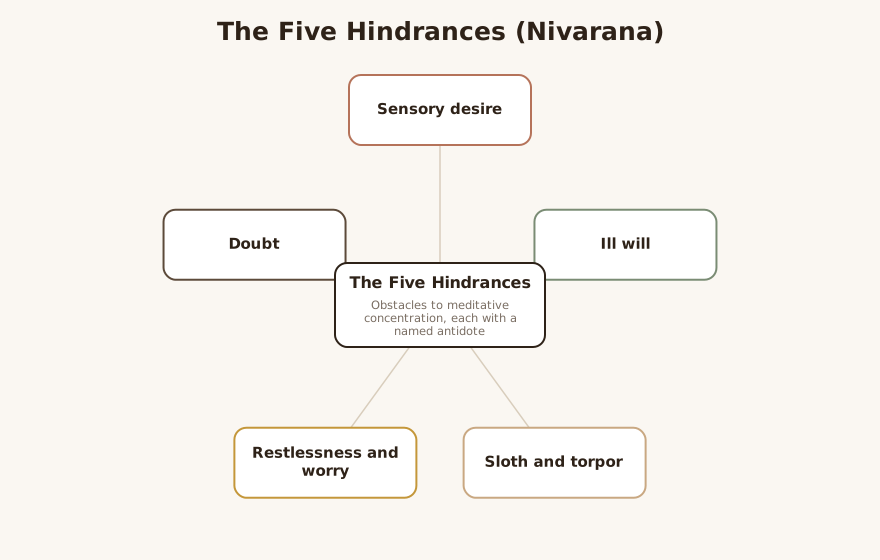
The Five Hindrances (Pali: nivarana) are a construct — a taxonomy of mental states rather than a treatment modality — drawn from Buddhist psychology and the contemplative tradition of insight (vipassana) meditation 2. The framework names five recurring obstacles that obstruct concentration and clarity during meditation: sensory desire, ill will, sloth-and-torpor, restlessness-and-worry, and doubt 2. The Buddha is recorded as calling them “obstructions, hindrances, corruptions of the mind, weakeners of wisdom” 2. For the practicing clinician, the value of the taxonomy is not doctrinal; it is that it supplies a shared, granular vocabulary for the specific ways a client’s attention comes apart during mindfulness practice LLM.
The construct sits within the broader family of Buddhist contemplative practice and has been carried into secular clinical settings through mindfulness-based programs, where it functions as a troubleshooting map rather than a religious teaching LLM. It is descriptive psychology of attention, and that is largely why it has survived translation into Western therapeutic contexts LLM.
Creators & Lineage
The taxonomy is canonical and anonymous in origin, appearing across the Pali Canon — notably in the Samyutta Nikaya and the Satipatthana Sutta — as a settled list rather than the invention of a single author 2. Its systematic elaboration belongs to the commentarial tradition: the fifth-century scholar-monk Buddhaghosa, in his commentary to the Samyutta Nikaya, distinguished temporary suppression of the hindrances (through meditative absorption or insight) from their permanent eradication across the stages of awakening 2. The classic “five similes of water” — comparing each hindrance to a different way water can be unfit to see one’s reflection in — derives from the Sangarava Sutta (SN 46.55) 2.
In the twentieth century, the German-born monk Nyanaponika Thera compiled the canonical and commentarial material on the hindrances and their antidotes into a single accessible text, The Five Mental Hindrances and Their Conquest, which became a standard reference for practitioners and teachers 1. The contemporary Western insight-meditation lineage has continued this work: Gil Fronsdal, through the Insight Meditation Center, teaches the hindrances as a recurring series paired with guided meditations and modern mnemonic techniques 3, and Jack Kornfield has reframed them for lay practitioners as material to be worked with — “part of the path” rather than enemies to be eliminated 4.
Core Principles
First, the hindrances are understood as universal and impersonal — states that arise in every meditator, not signs of personal failure 4. This framing matters clinically: a client who reads sleepiness or boredom as evidence they are “bad at meditation” benefits from learning these are named, expected obstacles LLM.
Second, each hindrance has identifiable nutriments (what feeds it) and antidotes (what starves or counters it) 1. According to the canonical analysis Nyanaponika compiles, what gives rise to a hindrance is “unwise attention” to a provocative object, and what abandons it is a specific set of countering conditions 1. The framework is thus not merely diagnostic but prescriptive — it pairs each problem with a response 1.
Third, the hindrances are obstacles to concentration specifically. In the Theravada absorption (jhana) scheme, five mental factors are held to counteract them, each factor opposing a particular hindrance 2. This gives the construct a built-in theory of mechanism: a hindrance is not just unpleasant, it actively blocks the stability of attention that practice is trying to build 2.
Fourth, complete freedom from the hindrances is framed as a graduated, long-term attainment, not a single technique’s result — in the canonical scheme, different hindrances are fully eradicated at different stages of spiritual development 1. The practical takeaway for ordinary practice is more modest: hindrances are recognized, weakened, and temporarily suppressed, again and again, rather than permanently removed 1.
Interventions & Techniques
The contemplative literature describes both a general working method and hindrance-specific antidotes LLM.
The general method, emphasized in the modern teaching lineage, is recognition and naming: noticing that a hindrance is present, naming it (e.g., silently noting “wanting,” “aversion,” “sleepiness,” “restlessness,” “doubt”), and meeting it with investigation rather than suppression or self-criticism 4. Kornfield frames this as making the hindrance itself an object of mindful attention — turning the obstacle into the meditation 4. Fronsdal’s teaching pairs each hindrance with a structured mnemonic and a corresponding guided meditation 3.
The hindrance-specific antidotes, as Nyanaponika compiles them from canonical and commentarial sources, include a recurring set of “six things” leading to abandonment, several of which (noble friendship, suitable conversation) are shared across all five 1:
- Sensory desire is countered by contemplation of the unattractive or impermanent aspects of the desired object, guarding the sense doors, moderation in eating, good friendship, and suitable conversation 1.
- Ill will is countered chiefly by cultivating loving-kindness (metta) and by reflecting on the ownership of one’s own action — that anger, like an unaccepted gift, returns to the one who throws it 1.
- Sloth-and-torpor is countered by avoiding overeating, changing posture, attending to the perception of light, fresh air, recollection of death, and walking meditation, among other “stirring” practices 1.
- Restlessness-and-worry is countered by knowledge of the teachings and discipline, asking questions, and associating with calm, settled practitioners 1.
- Doubt is countered by study, inquiry, and developing firm conviction in the practice and its guides 1.
In the absorption scheme, the corresponding counteracting factors are applied thought against sloth-torpor, sustained thought against doubt, rapture against ill will, non-sensual pleasure against restlessness-worry, and one-pointedness against sensory desire — a distinct mapping from the “six things,” and worth keeping separate 2.
LLM-generated illustrative example (not a guideline): A client reports that ten minutes into a home practice she “gives up” because her mind floods with her to-do list. The clinician helps her name this as restlessness-worry, normalizes it as one of the five expected hindrances, and introduces a settling anchor (lengthening the exhale, feeling the feet) before returning attention to the breath. The client later reports that naming the state — “oh, this is the restless one” — reduced the sense of failure that had been ending her sessions early LLM.
Evidence Base
Honesty about maturity is important here. The Five Hindrances framework is established in the sense that it is canonical, internally coherent, and standard pedagogy in mindfulness-based teaching — it has been taught and refined for well over a millennium and is a fixture of contemporary insight-meditation instruction 123. It is not established in the sense of being an independently trialed clinical intervention LLM.
There is, to be clear, no body of randomized controlled trials testing “the Five Hindrances” as a standalone treatment, and this article does not claim one LLM. Its empirical support is indirect: it is embedded within the broader mindfulness literature, surfacing in clinical settings as a component of how mindfulness practice is taught and troubleshot, rather than as a discrete manualized protocol LLM. Clinicians should therefore present it to clients as a practice heuristic and a teaching model, not as an evidence-based intervention in its own right LLM. Where the framework adds value is descriptive and motivational — giving language to common practice difficulties — and that value does not depend on a trial literature it does not have LLM.
Populations & Indications
The framework is best suited to adults engaged in or beginning a meditation or mindfulness practice, including clients enrolled in mindfulness-based programs where formal sitting practice is a component 3. It is especially useful for clients whose practice keeps stalling for an identifiable reason — those who fall asleep, get bored, get agitated, get flooded with planning, or quietly conclude that meditation “doesn’t work for me” 4.
It indicates well for anxiety- and rumination-prone clients, for whom restlessness-worry and doubt are frequently the operative obstacles, and for clients with motivational or attentional difficulties in practice, where sloth-torpor predominates LLM. Because the taxonomy normalizes these states as universal, it is also indicated whenever a client’s self-criticism about practice has become an obstacle in itself 4.
It is not a diagnostic instrument and maps onto no DSM category; it describes states of attention, not disorders LLM.
Problems-for-Work
The construct translates cleanly into concrete problems-for-work, each with its own application LLM:
- Meditative restlessness and agitation — the client who cannot sit still or whose mind races. Application: naming “restlessness,” shortening sits, and adding a grounding anchor before lengthening practice 14.
- Drowsiness and low motivation in practice — the client who reliably falls asleep or “can’t be bothered.” Application: posture change, practicing with eyes open, attending to light, or walking meditation 1.
- Aversion and irritability during practice — the client who meets discomfort or distraction with anger. Application: loving-kindness phrases and reframing the aversion itself as the object of attention 14.
- Craving and distractibility — the client pulled toward pleasant thoughts, plans, or fantasies. Application: noting “wanting,” guarding the senses, and returning to the anchor 1.
- Doubt and treatment non-adherence — the client who concludes practice is pointless and disengages. Application: inquiry, psychoeducation about the universality of doubt, and re-contracting realistic expectations 14.
LLM-generated illustrative example (not a guideline): A client who has stopped his home practice tells the clinician “I just don’t think this is for me.” Rather than persuading him, the clinician names doubt as one of the five recognized hindrances — a predictable visitor, not a verdict — and they investigate together what specifically triggered it (a single restless session). Reframing the doubt as a known obstacle, rather than evidence about his suitability, restores his willingness to experiment with a shorter practice LLM.
Contraindications, Cautions & Cultural Humility
The framework carries real risks when transplanted carelessly LLM. The most clinically significant is that for clients with trauma histories, sustained attention to internal experience can intensify distress, dissociation, or intrusions — the “just sit with it” stance implied by some hindrance teaching can be harmful, and clinicians should titrate practice, prioritize grounding and choice, and never frame avoidance of overwhelming material as a hindrance to be overcome LLM. Sloth-torpor in particular should not be reflexively treated as a meditative obstacle; it can mask depression, fatigue, a medical condition, or trauma-related shutdown, all of which warrant assessment rather than a posture change LLM.
There is also a spiritual-bypass risk: the language of “overcoming” desire, ill will, or doubt can be misused to pathologize ordinary, valid emotion, or to pressure a client past anger that is signaling a real boundary violation LLM. The corrective is Kornfield’s framing — working with these states with acceptance, not suppressing them — which is the safer clinical stance 4.
On cultural humility: this is a sacred framework from living Buddhist traditions, not a neutral psychological tool LLM. Clinicians should be transparent that it has religious origins, avoid presenting it as their own innovation, and be mindful that secularized “antidotes” strip context from a soteriological system 1. For clients of Buddhist heritage, the clinician should defer to the client’s own relationship to the teaching; for others, presenting it as one optional lens — never as required belief — respects both the tradition and the client LLM.
Treatment-Plan Suggestions & SMART Objectives
| Goal | SMART objective (example) | Mechanism |
|---|---|---|
| Reduce practice-ending restlessness | Within 4 weeks, client will name “restlessness” when it arises and complete 3 of 5 weekly home sits without stopping early | Labeling/decentering; recognition of an impersonal state 4 |
| Decrease aversion during practice | Within 6 weeks, client will apply a loving-kindness phrase in response to in-session irritation on 4 of 5 practice days | Substituting goodwill for ill will; metta antidote 1 |
| Counter drowsiness/low engagement | Over 3 weeks, client will use one alertness antidote (posture change, eyes open, or walking) whenever sloth-torpor is noticed, logged in a practice journal | Energizing antidotes for sloth-torpor 1 |
| Work with craving/distractibility | Within 4 weeks, client will silently note “wanting” and return attention to the breath anchor, reporting reduced self-judgment | Sense-door guarding; noting as decentering 14 |
| Reduce doubt-driven disengagement | Within 8 weeks, client will distinguish “doubt the hindrance” from “evidence practice is failing” and maintain a contracted minimum practice | Reframing doubt as universal; inquiry antidote 14 |
| Build a stable attentional anchor | Within 6 weeks, client will sustain attention on a chosen anchor for 5 minutes, troubleshooting interruptions by naming the active hindrance | Concentration as counter to the hindrances 2 |
| Reduce shame about “failing” at meditation | Within 4 weeks, client will reframe at least one stalled session per week as an expected hindrance rather than personal deficit | Normalization; impersonal framing 4 |
Common Misconceptions
“The goal is to get rid of the hindrances.” The lived practice goal is recognizing, weakening, and temporarily suppressing them — not permanent removal, which the tradition frames as a long-term graduated attainment, not a session outcome 1. Clinically, the working stance is relating to the hindrance, not eliminating it 4.
“A hindrance means I’m doing it wrong.” The hindrances are universal and impersonal; their arising is expected, and naming them is itself the practice 4.
“It’s just a list of distractions.” Each hindrance has a distinct phenomenology, a distinct nutriment, and a distinct antidote — sleepiness and agitation call for opposite responses, which is precisely why the granular taxonomy is useful 1.
“The two antidote schemes are one system.” The “six things” antidotes (Nyanaponika’s compilation) and the absorption-factor mapping (the jhana counteractants) are two different analyses; clinicians should not blend them into a single invented correspondence 12.
Training & Certification
There is no certification in “the Five Hindrances”; competence comes from training in mindfulness practice and instruction more broadly LLM. Clinicians typically encounter the framework through mindfulness teacher training, insight-meditation retreats, and structured study programs such as those offered through the Insight Meditation Center, where the hindrances are taught as a recurring series alongside guided practice 3. Nyanaponika Thera’s compilation remains the standard textual reference for the canonical antidotes 1, and contemporary teachers including Fronsdal and Kornfield offer accessible expositions oriented to lay and clinical practitioners 34. For clinical use, the relevant credentialing is in the delivering modality (e.g., mindfulness-based program facilitation) rather than the construct itself LLM.
Key Terms
- Nivarana — Pali term for “hindrance”; the obstacles that obstruct concentration and weaken wisdom 2.
- Kamacchanda — sensory/sensual desire 2.
- Vyapada (byapada) — ill will, aversion, hostility 2.
- Thina-middha — sloth-and-torpor; dullness and drowsiness of mind and body 2.
- Uddhacca-kukkucca — restlessness-and-worry (agitation and remorse) 2.
- Vicikiccha — skeptical doubt 2.
- Nutriment — in this framework, what feeds or gives rise to a hindrance, classically “unwise attention” to a provocative object 1.
- Metta — loving-kindness; the canonical antidote to ill will 1.
- Jhana — meditative absorption; the hindrances are the obstacles its counteracting factors overcome 2.
Resources & Further Reading
▶ Watch — a video introduction to this concept:
- The Five Mental Hindrances and Their Conquest — Nyanaponika Thera (Access to Insight)
- Five hindrances (Wikipedia)
- The Five Hindrances — Dharma talk series, Gil Fronsdal (AudioDharma)
- Making the Hindrances Part of the Path — Jack Kornfield
- The Five Hindrances — Spirit Rock Meditation Center practice guide
- The Five Hindrances (Nivarana) — Ajahn Brahmavamso (PDF, Buddhist Society of Western Australia)
Reflective / Supervision Questions
- When a client’s mindfulness practice stalls, do I help them identify which hindrance is operating, or do I treat all practice difficulty as a single undifferentiated problem? LLM
- Am I distinguishing sloth-torpor as a meditative obstacle from depression, fatigue, or trauma-related shutdown that needs assessment rather than an “antidote”? LLM
- How do I hold the tension between “working with” a hindrance and inadvertently pressuring a client past emotion (anger, doubt) that is carrying valid information? LLM
- For trauma-affected clients, where is my threshold for titrating or pausing internally focused practice rather than framing distress as an obstacle to overcome? LLM
- Am I transparent with clients about the Buddhist origins of this framework, and do I present it as one optional lens rather than a required belief? LLM
- When I introduce the normalizing idea that hindrances are universal, am I also tracking whether that reframe is genuinely reducing a client’s shame or simply being absorbed as another way to “do it right”? LLM