
Type & Discipline
Expressed Emotion (EE) is a construct and a measurement, not a therapy. It quantifies the emotional climate that a key relative or caregiver directs toward an ill family member, and it has its home in social psychiatry and family research 5. The term refers to a set of attitudes — chiefly criticism, hostility, and emotional over-involvement — that a relative voices about a patient, rated from a structured interview or speech sample and used to classify families as “high-EE” or “low-EE” 1. LLM
What makes EE clinically important is its predictive function: the level of emotion a relative expresses shortly after a patient is admitted is strongly associated with symptomatic relapse over the following months 1. For practicing therapists, this matters because EE is one of the most reliable family-level predictors of course and outcome in serious mental illness, and because the family interventions built to lower EE are themselves evidence-based treatments 2. LLM
It is worth holding the distinction firmly: EE is the thermometer, not the cure. The construct tells you something about relapse risk; the interventions derived from it — psychoeducation, communication training, behavioral family work — are what change outcomes 2. LLM
Creators & Lineage
EE grew out of British social psychiatry in the 1960s and 1970s, originating with George Brown and colleagues, who noticed that discharged psychiatric patients fared differently depending on the household they returned to 5. Brown and Rutter developed the Camberwell Family Interview (CFI) as the foundational instrument for capturing relatives’ attitudes in a standardized way 6. LLM
Christine Vaughn and Julian Leff then refined and shortened the measure, producing the abbreviated CFI and demonstrating that the level of emotion expressed by relatives shortly after a schizophrenic patient’s admission strongly predicted relapse in the nine months after discharge 1. Their 1976 paper established critical remarks as the single most important measure contributing to the overall EE index, and it shaped the scales clinicians still reference today 1. LLM
The lineage runs from this social-psychiatric measurement tradition directly into the family-therapy and psychoeducation movements 5. Once EE was shown to predict relapse, the obvious next step was to design family interventions that reduce it — behavioral family management, family psychoeducation, and family-focused therapy all carry EE forward as a target and a rationale 2. LLM
Core Principles
The first principle is that the family emotional environment is a measurable, modifiable risk factor. High-EE households are characterized by frequent critical comments, overt hostility, or marked emotional over-involvement, and patients returning to these environments relapse at higher rates 1. LLM
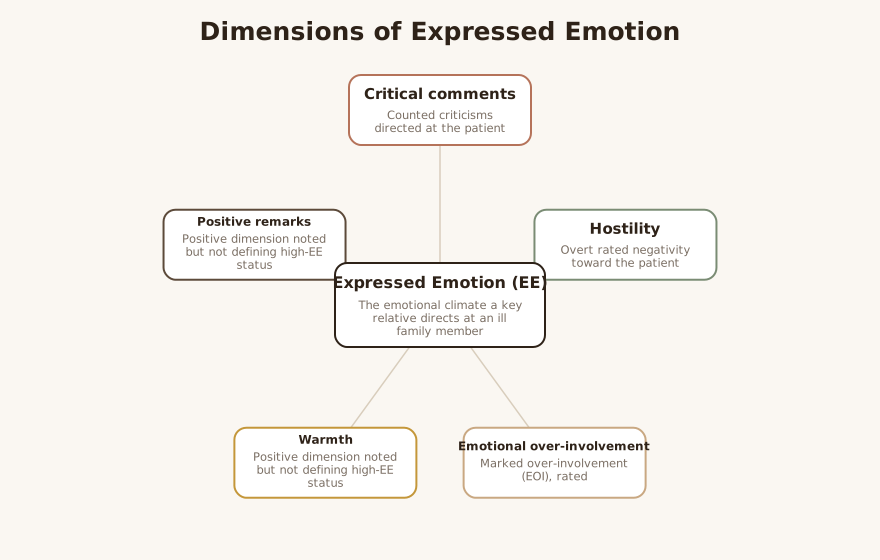
The second principle is that EE is composed of distinct dimensions rather than a single global “negativity.” The classic components are critical comments, hostility, emotional over-involvement (EOI), and — on the positive side — warmth and positive remarks 6. Criticism is counted; hostility and EOI are rated; warmth and positive remarks are noted but do not define high-EE status 6. LLM
The third principle is a stress-vulnerability logic: a person with a biologically vulnerable disorder is more reactive to ambient interpersonal stress, so a critical or over-involved home environment functions as a chronic stressor that pushes a vulnerable patient toward relapse 2. Family interventions are proposed to work by reducing that stress, improving relatives’ understanding and coping, and lowering EE 2. LLM
The fourth principle is that EE is bidirectional and not a verdict on a “bad” family. High EE often reflects relatives who are overwhelmed, frightened, and under-supported, frequently emerging from genuine care that has curdled into over-involvement or frustration 2. Framing it as blame is both clinically counterproductive and conceptually wrong. LLM
Interventions & Techniques
Because EE is a construct, the “techniques” fall into two groups: how you assess it, and how you lower it.
Assessment. The gold-standard instrument is the Camberwell Family Interview, a semi-structured interview with the relative that is audio-recorded and later rated for EE components 6. From the CFI, raters count critical comments, judge hostility, and rate emotional over-involvement, while also noting warmth and positive remarks 6. Vaughn and Leff’s abbreviated version concentrated on the interview areas most likely to elicit criticism, since critical comments cluster early in the interview and carry the most predictive weight 1. Briefer proxies — such as speech-sample methods — were later developed because the full CFI is time-intensive and requires trained, certified raters, which limits routine clinical use 5. LLM
Reducing EE. The interventions designed to lower EE are family-based and broadly share a common toolkit 2:
- Psychoeducation about the disorder, to replace blaming or “willful misbehavior” attributions with an illness model, reducing criticism 2. LLM
- Communication training, to help relatives express needs and concerns without escalation 2. LLM
- Problem-solving and coping support, to reduce caregiver burden and the over-involvement that springs from anxiety 2. LLM
These ingredients are delivered within structured family treatment, and systematic review evidence supports family intervention over standard care for people with schizophrenia, including reductions in relapse and readmission 3. LLM
LLM-generated illustrative example (not a guideline): A mother of a young man with schizophrenia repeatedly says, “He’s just lazy — he could get up if he wanted to.” On a CFI this would register as critical comments rooted in a misattribution. A psychoeducation module reframing avolition as a negative symptom of the illness, paired with communication coaching, aims to lower the criticism count and the household tension it generates. LLM
Evidence Base
The evidence here is established, and you can say so with more confidence than for most family constructs 1. The EE-to-relapse association is one of the more robust and replicated findings in social psychiatry: Vaughn and Leff demonstrated the predictive link in schizophrenia, and the construct has since been studied across many disorders 1. LLM
The mechanistic and intervention literature is also supportive. Kuipers and colleagues summarize the evidence for the efficacy of family interventions in schizophrenia and propose that lowering EE — by improving relatives’ understanding, coping, and communication — is a key mechanism of change 2. A systematic review comparing family-based interventions to standard care for people with schizophrenia found benefits including reduced relapse and hospital readmission, consistent with the EE rationale 3. LLM
Two honest caveats. First, EE is a predictor and correlate of relapse, not a demonstrated sole cause; the relationship is genuinely bidirectional and embedded in a stress-vulnerability system 2. Second, the strength of the EE-relapse association and the meaning of the cutoffs vary by population and culture, so the construct does not transfer cleanly everywhere it has been measured 4. Within those limits, EE remains a well-validated, clinically useful index, and the family interventions built on it are evidence-based 3. LLM
Populations & Indications
EE was developed and is best validated in families of people with schizophrenia, where high EE predicts relapse and family intervention reduces it 1. The construct has been extended to caregivers of people with serious mental illness more broadly, where caregiver burden, criticism, and over-involvement track with course of illness 2. LLM
EE has also been applied to families of people with mood disorders, where it is relevant to relapse in both bipolar disorder and major depressive disorder, and to families of people with eating disorders, where criticism and over-involvement bear on the course of anorexia and bulimia 5. It has been studied in couples and in families of people with substance use disorders, reflecting its general usefulness as an index of an emotionally charged relational climate 5. LLM
The practical indication for measuring or addressing EE is any case where a vulnerable patient lives with, or is in frequent contact with, key relatives, and where relapse risk, treatment nonadherence, or persistent family conflict is part of the clinical picture 2. LLM
Problems-for-Work
- Schizophrenia relapse: the original and best-supported target; high household EE predicts relapse, and family psychoeducation that lowers criticism and over-involvement reduces it 1. Application: assess EE early after discharge and route high-EE families into structured psychoeducation 3. LLM
- Bipolar disorder relapse and major depressive disorder relapse: EE in the household is relevant to mood-disorder course, making relatives’ criticism and over-involvement legitimate treatment targets within family-focused work 5. LLM
- Eating disorders (anorexia/bulimia): criticism and emotional over-involvement around eating can maintain symptoms, so lowering EE is a plausible focus alongside the primary eating-disorder treatment 5. LLM
- Caregiver burden and high family stress/hostility: EE is partly a marker of overwhelmed caregivers; supporting relatives’ coping reduces both burden and the EE it generates 2. LLM
- Family conflict and criticism: the critical-comment dimension directly indexes conflict; communication training targets it 2. LLM
- Treatment nonadherence: a high-EE, low-understanding home environment undermines adherence, which psychoeducation can improve 3. LLM
LLM-generated illustrative example (not a guideline): A young woman with bipolar disorder relapses each time she moves home with a parent who monitors her sleep, mood, and medication minute-to-minute. The pattern reads as emotional over-involvement; the work is helping the parent step back into supportive distance rather than anxious surveillance. LLM
Contraindications, Cautions & Cultural Humility
EE is an assessment construct, so the main cautions concern how it is used rather than physical risk. The central caution is never to weaponize EE as blame: labeling a family “high-EE” to their faces, or treating the rating as a character judgment, can rupture the alliance and worsen the very criticism you are trying to reduce 2. The clinical frame is that high EE usually reflects frightened, overburdened relatives, and the intervention is supportive, not corrective of “bad” families 2. LLM
Cultural humility is essential and is not optional, because EE components are culturally patterned 4. Emotional over-involvement that looks pathological in one setting is normative care in another — in Indian contexts, for instance, a relative who does not show emotional over-involvement may be seen as uncaring 4. Critical comments also vary: in some cultures criticism is an accepted, even caring, part of interpersonal relations, and norms around expressing anger differ widely, which can inflate or deflate EE ratings 4. LLM
Base rates of high EE differ sharply across cultures and ethnic groups, and conventional EE measures applied across groups are “fraught with difficulties,” so cutoffs validated in one population should not be assumed to transfer 4. The Cambridge review stresses establishing baseline normative data before accepting cross-cultural findings or building family interventions on them 4. Practically, this means rating EE against the family’s own cultural baseline, not a Western default, before drawing relapse-risk conclusions. LLM
Treatment-Plan Suggestions & SMART Objectives
| Goal | SMART objective (example) | Mechanism |
|---|---|---|
| Reduce critical comments at home | Over 8 weeks, relative will reduce critical statements about the patient’s symptoms in session-based role-plays, replacing them with illness-informed language | Psychoeducation reframes symptoms as illness, not willfulness, lowering criticism 2 |
| Reduce emotional over-involvement | Within 6-8 sessions, caregiver will identify and practice 2 ways to provide support without intrusive monitoring | Coping support reduces the anxiety driving over-involvement 2 |
| Increase warmth and positive remarks | By treatment end, relative will report and demonstrate increased expressed warmth toward the patient | Positive relational climate buffers stress-vulnerability 1 |
| Improve relatives’ understanding of the disorder | Within 4 sessions, family will accurately describe the patient’s diagnosis, course, and negative symptoms | Psychoeducation corrects blaming attributions 2 |
| Improve family communication | Over treatment, family will use a structured communication skill (e.g., direct, non-escalating requests) in session | Communication training reduces conflict and criticism 2 |
| Reduce caregiver burden | Within 8 weeks, caregiver will report measurable reduction in burden on a standardized caregiver measure | Support and problem-solving offload caregiver stress 2 |
| Lower relapse / readmission risk | Over the treatment course, patient will avoid psychiatric readmission and sustain adherence | Family intervention reduces relapse versus standard care 3 |
| Strengthen treatment adherence | Within 6 weeks, patient and family will establish a shared, agreed medication and follow-up routine | Lower-EE, better-informed home supports adherence 3 |
Common Misconceptions
“EE is a treatment.” It is a measure and a predictor; the treatments are the family interventions that lower it 2. LLM
“High EE means a bad or dysfunctional family.” High EE typically reflects overwhelmed, frightened, under-supported relatives, and is frequently rooted in genuine care, not malice 2. LLM
“All EE is criticism.” Criticism is the most weighted component, but EE also includes hostility and emotional over-involvement, and the over-involvement dimension can be present with little overt criticism 1. LLM
“The cutoffs are universal.” The base rates and meaning of high-EE thresholds vary substantially across cultures, so the standard cutoffs do not transfer cleanly between populations 4. LLM
“EE causes relapse.” EE robustly predicts relapse within a stress-vulnerability model, but it is a correlate and risk factor embedded in a bidirectional system, not a demonstrated sole cause 2. LLM
Training & Certification
There is no clinician “certification in EE” in the way one trains in a therapy model; rather, formal training is required to rate EE reliably from the Camberwell Family Interview, which is a specialized instrument with established rating conventions 6. Reliable CFI rating requires training because the interview must be conducted and then coded for critical comments, hostility, over-involvement, warmth, and positive remarks 6. LLM
For clinical application, the relevant training is in the family interventions that lower EE — family psychoeducation, behavioral family management, and family-focused therapy — which are taught as structured, manualized programs 2. The full CFI’s length and rater-training demands are precisely why briefer proxy measures were developed for research and applied settings 5. LLM
Key Terms
- Expressed Emotion (EE): a measured index of the emotional attitudes a key relative directs toward an ill family member, used to classify families as high- or low-EE 1.
- Critical comments: statements expressing dislike, disapproval, or resentment of the patient’s behavior; the most heavily weighted, and predictive, EE component 1.
- Hostility: generalized criticism or rejection of the patient as a person rather than of specific behaviors 1.
- Emotional over-involvement (EOI): exaggerated emotional response, over-protectiveness, intrusiveness, or self-sacrifice by the relative 6.
- Warmth and positive remarks: the positive EE dimensions — affection, empathy, and praise — noted in rating but not used to define high-EE status 6.
- Camberwell Family Interview (CFI): the semi-structured, audio-recorded interview that is the original and gold-standard method for rating EE 6.
Resources & Further Reading
▶ Watch — a video introduction to this concept:
- Vaughn & Leff (1976), The measurement of expressed emotion in the families of psychiatric patients (PubMed)
- Kuipers et al. (2006), Family interventions in schizophrenia: evidence for efficacy and proposed mechanisms of change (Wiley)
- Family-based interventions versus standard care for people with schizophrenia (PMC)
- Expressed emotion across cultures (Advances in Psychiatric Treatment, Cambridge Core)
- Camberwell Interview for Assessing Expressed Emotion in Families (Springer)
- Expressed emotion (Wikipedia)
Reflective / Supervision Questions
- In your cases where a vulnerable patient lives with key relatives, do you routinely think about the household emotional climate as a measurable, modifiable relapse risk — and what would change if you did? LLM
- When you notice a relative being highly critical, how do you distinguish hostility from frightened over-involvement, and how does that distinction change your intervention? LLM
- How do you raise the issue of family criticism or over-involvement without the family hearing blame, given that high EE usually reflects overwhelmed caregivers? LLM
- Whose cultural baseline are you using when you judge a relative as “over-involved” or “critical,” and how might that judgment differ if you used the family’s own cultural norms? LLM
- Given that EE predicts but does not simply cause relapse, how do you communicate relapse risk to families in a way that is honest about the construct’s limits and avoids fatalism? LLM