
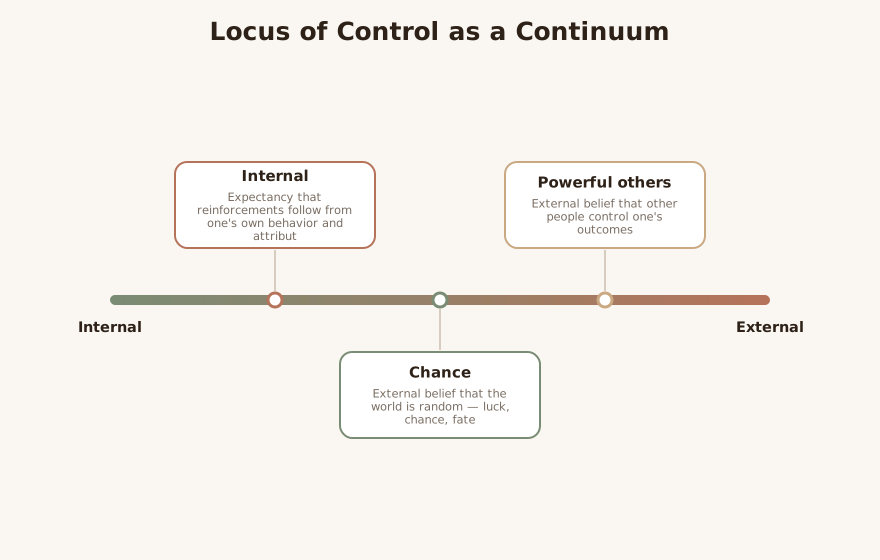
Locus of control is one of the most widely cited constructs in personality and social psychology, and it is also one of the most frequently misused in clinical conversation LLM. It names a single, specific idea: a person’s generalized expectancy about whether the outcomes of their behavior are determined by their own actions or by forces outside them 1. People who believe outcomes follow from their own effort, skill, and decisions are described as having an internal locus of control; people who attribute outcomes to luck, fate, chance, or powerful others are described as having an external locus of control 1. For a clinician, the construct is valuable precisely because so much presenting distress is organized around the question of whether the client believes their situation can be changed by anything they do LLM. The cautions matter as much as the applications, and they are addressed directly below, because “more internal is always better” is a clinically dangerous oversimplification of what the research actually shows LLM.
Type & Discipline
Locus of control is a construct, not a therapy, a diagnosis, or a treatment protocol 1. It belongs to personality and social-learning psychology, where it is defined as a relatively stable, generalized expectancy that operates across many situations 2. Rotter conceived of it as a dimension of personality measured along a continuum from highly internal to highly external, rather than as a binary type, even though it is often discussed loosely as if people fell into two camps 2. The construct is “generalized” in a precise technical sense: it is the expectancy a person carries into novel or ambiguous situations where they have no specific prior experience to draw on, which is exactly when a broad belief about control does the most work 3.
The discipline of origin shapes how a clinician should hold the idea. Locus of control emerged from social-learning theory as a way of predicting behavior, not as a model of psychopathology 3. Its clinical relevance is therefore inferential and formulation-level: it helps explain why a client engages or disengages from goal-directed action, adheres or fails to adhere to treatment, and feels agentic or helpless, but it does not by itself tell you what to do LLM. It is a lens that sharpens case conceptualization and can be a target of change within an established modality, rather than a stand-alone intervention package LLM.
Creators & Lineage
The construct was developed by Julian B. Rotter, an American psychologist whose 1954 book Social Learning and Clinical Psychology laid out the social-learning theory from which locus of control is derived 6. Rotter formalized the specific concept and an instrument to measure it in his influential 1966 monograph, introducing the Internal-External (I-E) Scale that drove decades of subsequent research 6. Rotter was one of the most eminent and most-cited psychologists of his era, and locus of control became one of the most studied variables in the field 6.
Within Rotter’s own framework, locus of control is not a free-floating trait but one element of a tightly specified theory of behavior 3. Social-learning theory holds that the likelihood of a behavior is a function of expectancy (the person’s belief that the behavior will lead to a given outcome) and reinforcement value (how much the person wants that outcome) operating within a specific psychological situation 3. Locus of control is the generalized form of expectancy, the part that carries across situations when situation-specific expectancies are weak 3. This places it in clear lineage with adjacent constructs that clinicians often conflate with it: Bandura’s self-efficacy theory, which concerns belief in one’s capability to perform an action rather than belief about what controls outcomes; attribution theory, which concerns how people explain causes after the fact; and Seligman’s learned helplessness, which describes the helpless, externalized state that can develop when actions repeatedly fail to influence outcomes LLM. Rotter’s construct predates and overlaps with these, and keeping the distinctions clear is part of using it well 3LLM.
Core Principles
The first principle is that locus of control is a generalized expectancy, meaning it predicts behavior most strongly in unfamiliar or ambiguous situations and matters less where the person already has strong situation-specific experience 3. A seasoned clinician may have a very high specific expectancy that their next session will go well, regardless of where their generalized locus of control sits; the generalized belief shows its hand in the new, the unstructured, and the uncertain 3LLM.
The second principle is dimensionality and direction. Internal locus of control is the expectancy that reinforcements follow from one’s own behavior and attributes; external locus of control is the expectancy that reinforcements are controlled by luck, chance, fate, or powerful others 1. These sit on a continuum, and most people are neither purely internal nor purely external but somewhere along it 2.
The third principle, frequently missed, is that external is not a single thing. Later work, notably Levenson’s, split the external pole into distinct beliefs in chance versus powerful others, recognizing that “the world is random” and “other people control my outcomes” are psychologically different stances with different behavioral consequences 2. This multidimensional refinement carries directly into health psychology through the Multidimensional Health Locus of Control (MHLC) Scales, which measure internality, chance externality, and powerful-others externality as separate dimensions of health-related control beliefs 4.
The fourth principle is that locus of control is relatively stable but not immutable 2. It is treated as a trait-like generalized expectancy, yet it can shift with development, with major life experience, and, importantly for clinicians, as a result of intervention 5. The construct would be of little therapeutic interest if it were fixed; the contemporary literature explicitly frames it as something with antecedents, consequences, and interventions 5.
Interventions & Techniques
Locus of control does not come with a proprietary technique catalogue; instead, it organizes and gives a rationale to moves drawn from established therapies LLM. The general therapeutic aim, where indicated, is to help a client recognize the domains of their life over which they genuinely do have influence, and to act on that recognition, which tends to shift a maladaptively external expectancy toward a more internal and agentic one 5. The editorial literature treating locus of control as a target frames it explicitly as something amenable to intervention rather than merely measured 5.
In practice this work is recognizable as cognitive and behavioral LLM. Cognitive restructuring addresses the appraisals that sustain an external stance, examining beliefs such as “nothing I do makes a difference” against evidence of times the client’s actions did matter LLM. Behavioral experiments and graded activity test those beliefs in vivo, generating direct experience of contingency between effort and outcome, which is the most credible source of a more internal expectancy LLM. Attributional work, drawn from the attribution-theory lineage, helps a client re-examine how they assign causes for successes and failures, since habitually crediting outcomes to luck or powerful others maintains externality LLM. Skills training and problem-solving raise actual competence so that the client’s increasingly internal beliefs are matched by real capability, which guards against the failure that follows from believing one controls outcomes one cannot yet manage LLM. Using a measure such as the MHLC can make the client’s specific pattern of control beliefs visible and discussable, and can track change over a course of treatment 4.
LLM-generated illustrative example (not a guideline): A clinician treating a client with health-behavior nonadherence administers a health locus of control measure and finds high powerful-others and chance externality with low internality. Rather than lecturing about adherence, the clinician uses behavioral experiments around one small, fully controllable health action, then reviews the result, so the client accumulates direct evidence that some health outcomes do follow from their own behavior, gradually loosening the “it’s all up to the doctors and luck” stance LLM.
Evidence Base
The honest label is established construct, not established therapy LLM. Locus of control has one of the deepest measurement and correlational literatures in personality psychology, accumulated over more than half a century since Rotter’s 1966 scale, and it is a well-validated, extensively replicated individual-difference variable 6. As a construct, its associations are robust: internality is broadly associated with better psychological adjustment, more active coping, and more health-promoting behavior, while externality, particularly chance externality, is associated with poorer outcomes across many domains 57. The summary clinical reference describes locus of control as a meaningful predictor in mental and physical health contexts and explicitly relevant to clinical work 7.
What the evidence does not establish is a tested “locus of control therapy,” because no such free-standing modality exists LLM. The construct’s clinical value is downstream: it is a formulation tool and a change target embedded inside cognitive-behavioral therapy, rehabilitation programs, health-behavior interventions, and similar approaches, where shifting control beliefs is one mechanism among several rather than a packaged treatment with its own randomized-trial base 5LLM. The contemporary literature treats antecedents, consequences, and interventions together, which signals both that the construct is taken seriously as a target and that the intervention evidence is an active, still-maturing area rather than a closed, definitive one 5.
Two further caveats temper enthusiasm. First, most of the foundational literature is correlational, so the direction of causation between an external locus of control and outcomes such as depression is genuinely ambiguous: a more external stance may contribute to depression, result from it, or both LLM. Second, the original unidimensional I-E measurement has been substantially criticized and refined into multidimensional models precisely because lumping “chance” and “powerful others” together obscured real distinctions, so older findings based on a single internal-external score should be read with that limitation in mind 24.
Populations & Indications
The construct has been applied across an unusually wide range of populations 7. It is studied extensively in adults and adolescents as a general individual-difference variable, and in students, where locus of control relates to academic motivation and achievement 17. It is especially salient for people with chronic illness and patients in rehabilitation, where beliefs about who or what controls one’s health and recovery directly shape engagement, adherence, and coping, and where the Multidimensional Health Locus of Control Scales were specifically designed to capture those beliefs 4. It is relevant to employees, given the construct’s long history in organizational psychology around job satisfaction, stress, and performance 2. And it bears on trauma survivors, for whom experiences of overwhelming, uncontrollable events can powerfully reshape generalized expectancies about control, sometimes toward an adaptive realism and sometimes toward an externality that resembles helplessness 5LLM.
The clearest indication for bringing the construct into a formulation is a presentation organized around control, agency, and helplessness: a client who is stuck because they do not believe their actions can change anything, who shows learned-helplessness-like disengagement, or whose health, academic, or occupational behavior is undermined by a belief that outcomes rest entirely with luck or with powerful others 5LLM. It is not indicated as a primary lens where distress is better explained by acute external constraint, oppression, or genuine lack of resources, a boundary that the cautions below treat as central LLM.
Problems-for-Work
Locus of control supplies clinicians with precise language for a cluster of agency-related problems LLM.
- Learned helplessness. The helpless pattern, in which a person stops trying because past actions failed to influence outcomes, maps onto an externalized, chance-dominated expectancy, and the implied lever is rebuilding experienced contingency between effort and result 5LLM.
- Depression and hopelessness. External locus of control, especially chance externality, is associated with depressive presentations and with hopelessness, though the correlational nature of the evidence means causation runs in uncertain directions and should not be over-claimed 57LLM.
- Anxiety and stress. Beliefs that important outcomes are controlled by unpredictable external forces are linked with higher stress and anxiety, since uncontrollability is itself a potent stressor 7LLM.
- Low self-efficacy. While distinct from self-efficacy, an external locus of control often co-travels with low confidence in one’s own capability, and the two can be worked on together, with care to keep the constructs separate in formulation 1LLM.
- Health-behavior nonadherence. The MHLC framework links high powerful-others and chance beliefs, with low internality, to weaker engagement in self-directed health behavior, identifying a concrete target for health-focused work 4.
- Academic underachievement. In students, a more external locus of control is associated with lower academic motivation and achievement, suggesting attributional and effort-contingency work as a focus 1LLM.
- Externalizing problems. A pattern of attributing one’s behavior and its consequences entirely to outside forces can feature in externalizing presentations, where building ownership of controllable behavior is part of the work 2LLM.
LLM-generated illustrative example (not a guideline): An adolescent referred for academic underachievement insists that grades are “just luck” and that teachers decide outcomes regardless of effort. The clinician works attributionally, helping the student notice the one subject where consistent study did move the grade, using that single domain of demonstrated contingency to begin loosening a globally external stance, while staying alert to whether real, unfair barriers are also at play LLM.
Contraindications, Cautions & Cultural Humility
The single most important caution is that internal is not uniformly “healthy” and external is not uniformly “pathological” LLM. Treating a more internal locus of control as the universal therapeutic goal is a serious oversimplification, because a strong internal stance can become maladaptive when a person blames themselves for outcomes they genuinely cannot control, producing guilt, self-criticism, and burnout 1LLM. Conversely, an external attribution is sometimes accurate and protective: when outcomes really are controlled by other people or by chance, recognizing that fact is realism, not a deficit to be corrected 2LLM.
This connects to the deepest cultural and ethical caution. Locus of control was developed largely within an individualistic frame, and its implicit valorization of internality can pathologize people whose lives are shaped by structural realities, discrimination, poverty, illness, or oppression, in which power genuinely does rest with external forces LLM. For a client facing real systemic barriers, an “external” locus of control may be an accurate appraisal of their situation, and pushing them toward internality risks blaming them for conditions they did not create and cannot individually fix LLM. Cultural humility also requires recognizing that beliefs about control are not culturally neutral: collectivist and faith-based worldviews may locate control in family, community, or the divine in ways that are adaptive and meaningful rather than dysfunctional, and reading such beliefs as a maladaptive externality would be an ethnocentric clinical error 2LLM.
A further caution concerns measurement and trauma. The construct is best understood multidimensionally; a single internal-external score can mask whether a client’s externality is about chance or about powerful others, distinctions with very different clinical implications 24. And with trauma survivors in particular, a shift toward externality after uncontrollable events may be a comprehensible response to real loss of control rather than a thinking error, and should be approached with that understanding 5LLM.
Treatment-Plan Suggestions & SMART Objectives
| Goal | SMART objective (example) | Mechanism |
|---|---|---|
| Build experienced contingency between effort and outcome | Over 6 weeks, client will complete one self-chosen, fully controllable action per week and log whether it produced the intended result | Direct experience of action-outcome contingency moves a maladaptively external expectancy toward internal 5 |
| Re-examine attributions for success and failure | By week 4, client will record, for two events per week, an alternative explanation that credits their own controllable contribution | Attributional change loosens habitual crediting of outcomes to luck or powerful others 5LLM |
| Clarify the client’s health-control belief profile | Within the first 2 sessions, client completes a health locus of control measure and reviews the internal, chance, and powerful-others pattern with the clinician | Makes the multidimensional belief pattern visible and targetable 4 |
| Reduce maladaptive self-blame in an over-internal client | Over 8 weeks, client will identify, for one distressing event weekly, which parts were and were not within their control | Counters the burnout and guilt that follow from internalizing uncontrollable outcomes 1LLM |
| Distinguish realistic external constraint from helplessness | By week 6, client will name one genuine external barrier and one domain where they retain real influence each week | Preserves accurate appraisal while restoring agency where agency exists 2LLM |
| Increase health-behavior engagement | Over 8 weeks, client will perform one self-directed health behavior on schedule and rate their sense of personal influence over it | Strengthens internality and reduces chance/powerful-others dominance in health behavior 4 |
| Address academic disengagement in a student | Within 5 weeks, student will track effort and outcome in one target subject and review the relationship weekly | Builds demonstrated effort-outcome contingency against an “it’s just luck” belief 1LLM |
Common Misconceptions
The most consequential misconception is that internal locus of control is always better and is the goal of therapy 1. The construct does not support this: an excessively internal stance fuels self-blame for uncontrollable events, and a measured external appraisal is sometimes simply accurate 1LLM. A second misconception is that locus of control is the same as self-efficacy; it is not, because self-efficacy concerns belief in one’s capability to perform a behavior, while locus of control concerns belief about what controls the outcomes of behavior, and a person can be high on one and low on the other LLM. A third is that people are simply “internals” or “externals”, when the construct is a continuum and the external pole itself fractures into distinct chance and powerful-others beliefs 2. A fourth is that locus of control is a fixed trait that cannot change; it is relatively stable yet demonstrably movable through development, experience, and intervention, which is what makes it clinically interesting 5. A fifth is that the construct is culturally universal and value-neutral, when its individualistic framing can pathologize culturally normative beliefs about communal, familial, or divine control 2LLM. A final misconception is that an external locus of control causes depression in any simple way; the relationship is correlational and the causal direction is genuinely uncertain 57.
Training & Certification
There is no certification in locus of control, and none would be appropriate, because it is a construct rather than a credentialed treatment LLM. Clinicians typically encounter it within graduate coursework in personality and social-learning psychology, where Rotter’s social-learning theory and the internal-external distinction are standard material 36. Working competence comes not from a standalone course but from training in the modalities where the construct is actually applied, principally cognitive-behavioral therapy, rehabilitation psychology, and health psychology, alongside familiarity with the adjacent constructs of self-efficacy, attribution, and learned helplessness so the distinctions are not blurred 1LLM. Clinicians who intend to use a formal measure such as the Multidimensional Health Locus of Control Scales should consult the original scale literature for proper administration and interpretation of its separate dimensions 4.
Key Terms
- Locus of control: a generalized expectancy about whether outcomes are controlled by one’s own actions (internal) or by external forces such as luck, fate, and powerful others (external) 1.
- Internal locus of control: the expectancy that reinforcements follow from one’s own behavior, effort, and attributes 1.
- External locus of control: the expectancy that reinforcements are controlled by luck, chance, fate, or powerful others 1.
- Generalized expectancy: the broad, cross-situational belief that operates most strongly in novel or ambiguous situations where specific experience is lacking 3.
- Expectancy and reinforcement value: in Rotter’s social-learning theory, the belief that a behavior leads to an outcome, and the desirability of that outcome, which jointly predict behavior in a given situation 3.
- Chance vs. powerful-others externality: the two distinct components of the external pole, separating belief in randomness from belief in control by other people 2.
- Multidimensional Health Locus of Control (MHLC) Scales: instruments measuring internal, chance, and powerful-others control beliefs specifically in the health domain 4.
- Internal-External (I-E) Scale: Rotter’s original 1966 self-report measure of generalized locus of control 6.
Resources & Further Reading
▶ Watch — a video introduction to this concept:
- Locus of Control Theory in Psychology: Internal vs External — Simply Psychology
- Locus of control — Wikipedia
- The Social Learning Theory of Julian B. Rotter — J. Mearns, California State University, Fullerton
- Development of the Multidimensional Health Locus of Control (MHLC) Scales — Wallston, Wallston & DeVellis (1978)
- Editorial: Locus of Control: Antecedents, Consequences and Interventions Using Rotter’s Definition — PMC
- Julian Rotter — Wikipedia
- Locus of Control — StatPearls (PubMed)
Reflective / Supervision Questions
- When this client attributes their situation to outside forces, am I distinguishing a maladaptive helpless expectancy from an accurate appraisal of real external constraint, discrimination, or lack of resources? 2LLM
- Am I implicitly treating “more internal” as the goal, and if so, could that be loading this client with self-blame for outcomes they genuinely cannot control? 1LLM
- Have I kept locus of control distinct from self-efficacy in my formulation, or am I collapsing belief about control of outcomes into belief about personal capability? LLM
- Is this client’s externality about chance, about powerful others, or both, and how does that distinction change what I would target? 24
- For a client whose beliefs about control are rooted in collectivist, familial, or faith-based worldviews, am I respecting those as potentially adaptive rather than reading them as a deficit? 2LLM
- With a trauma survivor, am I treating a shift toward externality as a comprehensible response to real uncontrollability rather than as a thinking error to be corrected? 5LLM