
Type & Discipline
Bronfenbrenner’s ecological systems theory is a developmental theory rather than a treatment protocol, originating in developmental psychology 1. It conceptualizes human development as occurring within a set of nested, interacting environmental structures that surround and influence the developing person 1. The framework is descriptive and explanatory — it accounts for how environments shape development — rather than prescriptive about specific clinical techniques LLM. In its mature form Bronfenbrenner renamed the framework the “bioecological model,” adding explicit attention to the biological and psychological characteristics of the individual and to the processes through which person and environment interact over time 6. For practicing therapists it functions most usefully as a case-formulation and assessment lens layered onto whatever evidence-based modality you are delivering, not as a stand-alone therapy LLM.
Creators & Lineage
The theory was developed by Urie Bronfenbrenner, a Russian-born American developmental psychologist, who first articulated the ecological model in the 1970s and crystallized it in his 1979 book The Ecology of Human Development 2. Bronfenbrenner was a co-founder of the U.S. Head Start program, and his work was motivated in part by concern that developmental research overemphasized laboratory study at the expense of the real-world contexts in which children actually grow 4. Over subsequent decades he revised the model, shifting emphasis from the environment alone toward the dynamic interplay between person, process, context, and time — the formulation often summarized as the Process-Person-Context-Time (PPCT) model 6. The framework sits within a broader family of context-oriented approaches and is closely related to family systems theory, the social ecological model used in public health and prevention science, and attachment theory’s emphasis on the relational environment of early development 4. Bronfenbrenner explicitly drew on and reacted against earlier developmental traditions, positioning his work as a corrective to context-stripped models of the child 1.
Core Principles
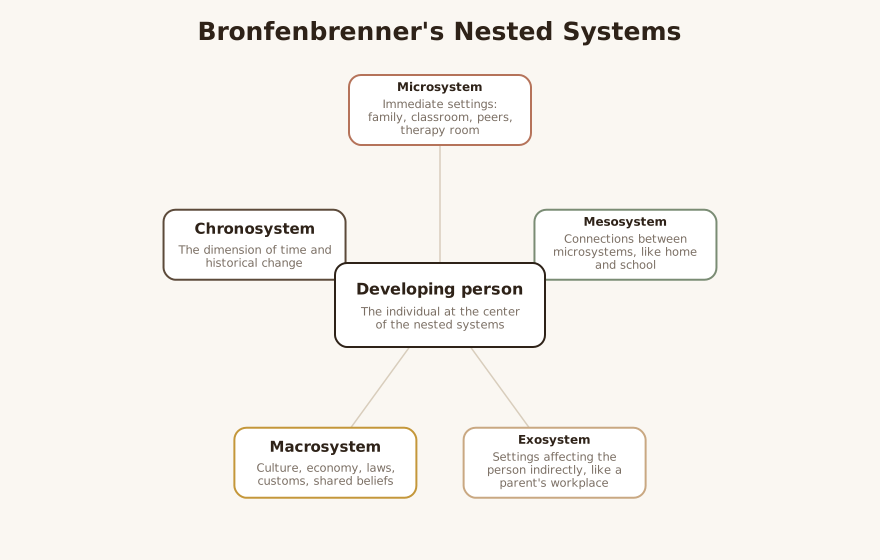
The central claim is that development cannot be understood apart from the environment in which it occurs, and that this environment is organized as a series of nested systems, often pictured as concentric circles around the individual 1. The microsystem is the innermost layer: the immediate settings the person directly participates in, such as family, classroom, peer group, or therapy room, and the face-to-face relationships within them 1. The mesosystem is the set of connections and interactions between microsystems — for example, how a child’s home and school communicate, or whether parents and teachers are aligned 1. The exosystem comprises settings the person does not directly inhabit but which nonetheless affect them, such as a parent’s workplace, a parent’s social network, or local government and school board decisions 3. The macrosystem is the overarching layer of culture, economic conditions, laws, customs, and shared belief systems that pattern all the inner systems 3. Bronfenbrenner later added the chronosystem, which captures the dimension of time — both developmental transitions in the person’s life and historical changes in the surrounding environment, such as a divorce, a move, or a societal upheaval 3.
A defining principle is bidirectionality: the person is not a passive recipient of environmental influence but actively shapes and is shaped by their settings through reciprocal interaction 1. In the bioecological elaboration, Bronfenbrenner emphasized proximal processes — the recurring, increasingly complex reciprocal interactions between the developing person and the people, objects, and symbols in their immediate environment — as the primary engines of development 6. These proximal processes are moderated by the characteristics of the person, the context, and time, which is why the same intervention can produce different outcomes across individuals and settings 6.
Interventions & Techniques
Because the theory is not itself a therapy, “interventions” here means how clinicians operationalize the framework within their practice LLM. The foundational technique is ecological assessment: systematically mapping a client’s microsystems, the quality of mesosystem linkages, relevant exosystem pressures, and macrosystem influences, then locating the presenting problem within that map 1. A practical tool is an eco-map or systems diagram drawn collaboratively with the client or family, depicting each system layer and the strength or strain of the connections between them LLM. The framework directs clinicians toward multi-level intervention — addressing not only individual symptoms but also the relationships between settings and the supports available in the wider environment 5.
LLM-generated illustrative example (not a guideline): A clinician seeing a 9-year-old for escalating classroom outbursts maps the microsystems (home, classroom, after-school care), notices that no one has connected the teacher’s behavior log with the parents’ account of disrupted sleep (a weak mesosystem link), learns a parent recently lost shift work (an exosystem stressor), and reframes the treatment plan to include a parent-teacher communication routine alongside the child’s emotion-regulation work LLM.
Mesosystem-strengthening techniques include facilitating coordination across a child’s settings, such as releases of information to align home and school, family-school meetings, and warm handoffs between providers LLM. Exosystem-level work often means connecting families to concrete resources and case management to buffer environmental pressures the client cannot directly control 5. Macrosystem awareness shapes how the clinician attends to cultural values, immigration context, and systemic inequities that frame the client’s experience 5.
Evidence Base
The maturity of this framework is best described as established as a conceptual and research model, not as an evidence-based treatment LLM. Bronfenbrenner’s theory is one of the most widely cited and durable frameworks in developmental psychology and has been applied extensively across education, social work, public health, and prevention research 5. A review of studies applying the bioecological theory in international and intercultural education research found the framework broadly used to structure investigations of how nested contexts shape outcomes, while also noting that applications are uneven — many studies invoke the microsystem and macrosystem but underutilize the mesosystem, exosystem, and especially the chronosystem and proximal-process components 5. That same review observed that the theory is frequently cited in its early “systems” form while neglecting Bronfenbrenner’s later, more demanding PPCT formulation, which can lead to shallow or partial applications 5.
Clinicians should hold two honest points in mind LLM. First, the theory’s strength is heuristic and organizing: it reliably improves the breadth and contextual accuracy of case formulation LLM. Second, because it is a meta-framework rather than a manualized intervention, it does not carry the kind of randomized-controlled-trial efficacy data that supports specific therapies; outcome claims must come from the evidence-based modality you deliver, with Bronfenbrenner’s model serving as the contextual scaffolding LLM.
Populations & Indications
The framework is most directly indicated for children and adolescents, whose development is especially visibly governed by the family, school, and peer systems the model foregrounds 1. It is highly applicable to families seen in family or systemic work, where the unit of attention is already relational and cross-setting 4. It is particularly valuable with at-risk youth and children in foster care, whose lives are characterized by disrupted microsystems, fragmented mesosystem linkages, and powerful exosystem and chronosystem forces such as placement changes and child-welfare policy LLM. At the community level, the model informs prevention and population-health framing by directing attention to the macrosystem and exosystem conditions that pattern risk 5. Although the theory was developed around child development, its logic extends across the lifespan, since adults likewise live within nested systems of relationship, institution, and culture LLM.
Problems-for-Work
The model is suited to presenting problems whose origins or maintenance clearly involve context LLM.
- Behavioral problems and conduct disorder: mapping the consistency (or inconsistency) of expectations across home, school, and peer microsystems often reveals the contingencies maintaining the behavior 1.
- School-related problems: the mesosystem lens makes home-school misalignment an explicit target, and exosystem factors such as school resourcing become visible 3.
- Family conflict and parent-child relational problems: the bidirectional, reciprocal-interaction principle reframes conflict as a system property rather than one party’s pathology 1.
- Childhood adversity and trauma exposure: layering microsystem safety, exosystem stressors, and macrosystem inequities clarifies cumulative risk and points to buffering supports 5.
- Adjustment disorder and developmental delays: the chronosystem foregrounds transitions — a move, a divorce, a new placement — as the timing variable around which symptoms emerged 3.
- Social environment problems: the framework names environmental disadvantage as a legitimate clinical focus rather than treating it as background noise 5.
LLM-generated illustrative example (not a guideline): For an adolescent in foster care presenting with conduct symptoms, the clinician charts three placement changes in two years (chronosystem), no stable school microsystem, and a caseworker turnover that severed the mesosystem link between therapy and the home; the formulation reframes “oppositional” behavior as an adaptive response to environmental instability and prioritizes stabilizing the systems before targeting the behavior in isolation LLM.
Contraindications, Cautions & Cultural Humility
There are no “contraindications” in the pharmacological sense for a conceptual framework, but there are meaningful cautions LLM. The most common misuse is breadth without depth — gesturing at “context” while neglecting the proximal processes and mesosystem and chronosystem components that give the model its analytic power 5. A second caution is that the framework can expand a formulation to include factors well outside the clinician’s scope or the treatment’s reach; identifying an exosystem or macrosystem driver does not obligate or enable the therapist to fix it, and clinicians should distinguish what they assess from what they can treat LLM. Used carelessly, the model can also slide toward determinism, implying the environment fully dictates outcomes and discounting the person’s agency that Bronfenbrenner himself emphasized through bidirectionality and proximal processes 6.
Cultural humility is intrinsic to the macrosystem concept: the framework explicitly locates culture, values, and societal structures as active developmental forces, which obligates clinicians to examine how their own cultural assumptions and the dominant macrosystem may differ from the client’s 5. The review of intercultural applications cautions that the model has often been applied across cultures without sufficient attention to how the systems themselves are culturally constituted, so what counts as a “microsystem” or a healthy mesosystem cannot be assumed to be universal 5.
Treatment-Plan Suggestions & SMART Objectives
| Goal | SMART objective (example) | Mechanism |
|---|---|---|
| Strengthen home-school mesosystem link | Within 6 weeks, parent and teacher will establish a weekly shared communication log reviewed in session, documented in 4 of 6 weeks | Improves mesosystem coherence so expectations are consistent across microsystems 1 |
| Stabilize a disrupted microsystem | Within 8 weeks, identify and maintain one consistent supportive adult relationship, tracked weekly on a contact log | Re-establishes proximal processes that drive development 6 |
| Buffer exosystem stressors | Within 4 weeks, connect family to two concrete community resources and confirm uptake of at least one | Reduces environmental pressure transmitted from settings the client cannot control 5 |
| Build caregiver reflective capacity | Over 10 sessions, caregiver will identify the child’s contribution to 3 recurring interaction cycles, rated on a session checklist | Operationalizes bidirectionality and reciprocal interaction 1 |
| Process a chronosystem transition | Within 6 sessions, client will construct a timeline linking symptom onset to a specific life transition, completed and reviewed | Names timing as a causal variable to organize coping 3 |
| Increase cross-system coordination of care | Within 30 days, obtain releases and hold one coordinated meeting with two outside providers, documented | Repairs fragmented mesosystem linkages around the client LLM |
| Enhance cultural-context attunement | Over 4 sessions, elicit and document the family’s macrosystem values relevant to the presenting problem and integrate into the plan | Aligns treatment with the client’s culturally constituted systems 5 |
Common Misconceptions
A frequent misconception is that the five systems are static physical places rather than dynamic, interacting structures defined by relationships and processes 6. Another is that the model is exclusively about children; while child development was its original domain, the nested-systems logic applies across the lifespan LLM. Clinicians sometimes treat the layers as one-directional, assuming the environment acts on a passive individual, whereas Bronfenbrenner insisted on bidirectional, reciprocal influence 1. A subtle but important error is conflating the early “ecological systems” version with the mature “bioecological” model; the latter centers proximal processes and person characteristics and is more demanding to apply faithfully 6. Finally, many users equate the macrosystem narrowly with “culture” while omitting economic conditions, laws, and historical period that the macrosystem and chronosystem are meant to capture 3.
Training & Certification
There is no certification or credential in “Bronfenbrenner’s theory,” because it is a conceptual framework taught as foundational content rather than a proprietary clinical method LLM. It is standard curriculum in developmental psychology, social work, counseling, and education training programs and is typically encountered in coursework, textbooks, and continuing-education material rather than through a licensing pathway 1. Clinicians deepen their command of it primarily by reading Bronfenbrenner’s primary work and by studying applied reviews that model rigorous use of all components, including the often-neglected mesosystem, exosystem, and chronosystem 25. Practical competence is built through supervised case formulation, where a supervisor checks that ecological mapping is being used to sharpen, not merely broaden, the conceptualization LLM.
Key Terms
- Microsystem: the immediate settings and direct relationships the person participates in, such as family, school, and peer group 1.
- Mesosystem: the interconnections and interactions between two or more microsystems, such as the home-school relationship 1.
- Exosystem: settings the person does not directly inhabit but that affect them, such as a parent’s workplace or local policy 3.
- Macrosystem: the overarching culture, economic conditions, laws, and belief systems that shape all inner layers 3.
- Chronosystem: the temporal dimension, encompassing both life transitions and historical change over time 3.
- Proximal processes: the recurring, increasingly complex reciprocal interactions between the person and their immediate environment, identified in the bioecological model as the primary drivers of development 6.
- Bioecological model (PPCT): the mature formulation organizing development around Process, Person, Context, and Time 6.
- Bidirectionality: the principle that the person and environment influence each other reciprocally rather than in one direction 1.
Resources & Further Reading
▶ Watch — a video introduction to this concept:
- Bronfenbrenner, U. (1979). The Ecology of Human Development: Experiments by Nature and Design. Harvard University Press. — the primary source 2
- Bronfenbrenner’s Ecological Systems Theory (Simply Psychology) — accessible overview of the systems 1
- The Bronfenbrenner Ecological Model and Its 5 Systems (Verywell Mind) — clear breakdown of each layer 3
- Urie Bronfenbrenner: Ecological Systems Theory and the Bioecological Model (EarlyYears.tv) — covers the later PPCT/bioecological revision 6
- Ecological systems theory (Wikipedia) — reference overview with lineage and history 4
- Review of studies applying Bronfenbrenner’s bioecological theory in international and intercultural education research (PMC) — examines how faithfully the model is applied and its cross-cultural cautions 5
Reflective / Supervision Questions
- For your current case, have you mapped all five systems, or have you defaulted to the microsystem and macrosystem while neglecting the mesosystem, exosystem, and chronosystem? 5
- Where is the most clinically actionable leverage point in your client’s ecological map, and does it fall inside or outside the reach of your treatment? LLM
- Are you treating the client’s environment as acting on a passive individual, or are you accounting for how the client actively shapes their settings? 1
- Which macrosystem assumptions — your own and the dominant culture’s — might differ from your client’s, and how would that change your formulation? 5
- What chronosystem transition coincided with symptom onset, and have you integrated that timing into the treatment plan? 3