
Type & Discipline
The Interpersonal Theory of Psychiatry is a foundational theory of personality and psychopathology rather than a manualized treatment protocol LLM. Its central claim is that psychiatry is most accurately understood as “the study of processes that involve or go on between people” — that personality cannot be isolated from the interpersonal field in which it occurs 2. Where classical psychoanalysis located the engine of mental life in intrapsychic instinctual drives, Sullivan relocated it to the observable transactions between a person and the significant others around them 1. He defined personality itself as “a relatively enduring pattern of recurrent interpersonal situations which characterize a human life” 2.
This positions the theory at the boundary of psychiatry and psychoanalysis, and it founded the family known as interpersonal psychoanalysis 1. Clinically, it is less a set of techniques than a lens: it asks the therapist to attend continuously to what is happening between people — including between client and clinician — as the primary data of treatment LLM. Its descendants, including interpersonal psychotherapy and object relations theory, inherit this relational emphasis LLM.
Creators & Lineage
The theory is the work of Harry Stack Sullivan (1892-1949), an American psychiatrist whose clinical reputation was built largely on his work with severely disturbed patients, particularly young men with schizophrenia 1. Sullivan trained within the psychoanalytic tradition but came to reject its drive-centered, intrapsychic emphasis in favor of a social and interpersonal account of mind 1.
Sullivan was a notably oral teacher who published relatively little in finished form during his lifetime; much of the canonical theory was reconstructed from lecture transcripts and posthumous editing by colleagues and students 1. His circle and intellectual heirs carried the framework forward into several streams LLM. Frieda Fromm-Reichmann and Clara Thompson were close collaborators in the development of interpersonal psychoanalysis LLM. The nurse-theorist Hildegard Peplau adapted Sullivan’s interpersonal concepts directly into psychiatric nursing, building therapeutic-relationship models for work with psychiatric patients 4.
The lineage runs from psychoanalysis, through Sullivan’s interpersonal psychoanalysis, and forward into both interpersonal psychotherapy and object relations theory, each of which retains the premise that the relationship is where the clinical action lives LLM.
Core Principles
Anxiety is interpersonal and primary. For Sullivan, anxiety is “the main disruptive force” in relationships and arises from interpersonal failures rather than from instinctual conflict 42. Crucially, anxiety is contagious: it is first transmitted from the anxious caregiver to the infant, and the avoidance of anxiety becomes the organizing motive of personality development 4.
Two streams of motivation: satisfaction and security. Sullivan distinguished needs for satisfaction (biological — hunger, sleep, contact) from needs for security (interpersonal — conforming to and being accepted within the social world) 4. Mental disorder, in his view, follows from the disruption of these needs, especially the security needs that govern self-esteem and belonging 4.
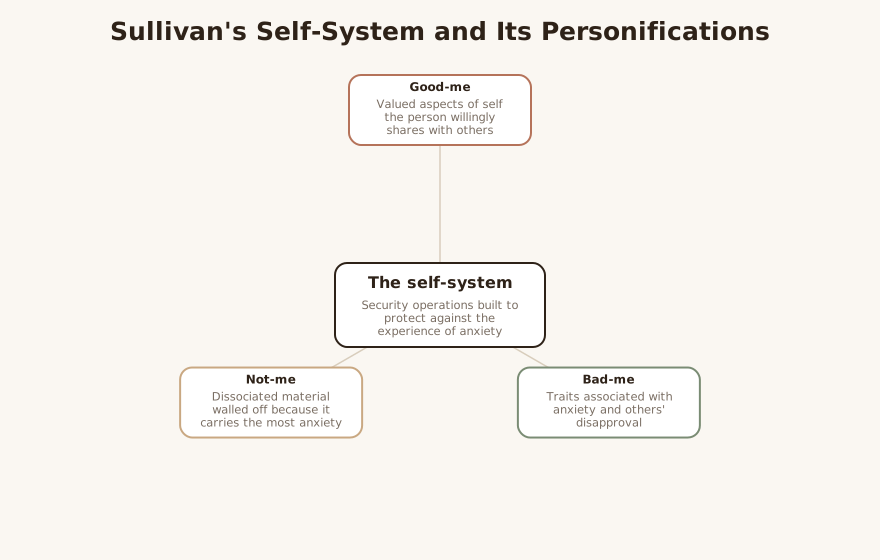
The self-system. To manage anxiety, the developing person builds a self-system — a set of security operations that protect against the experience of anxiety 2. The self-system organizes self-experience into personifications: the good-me (valued aspects the person willingly shares), the bad-me (traits associated with anxiety and disapproval), and the not-me (dissociated material so anxiety-laden it is split off, carrying “feelings of horror, dread”) 4. The not-me is the seed of the most severe psychopathology LLM.
Personifications and dynamisms. Personifications are the images we form of self and others through interpersonal experience; when widely shared they harden into stereotypes 2. Dynamisms are the relatively stable, recurrent patterns of energy transformation — habitual units of interpersonal behavior — that constitute a personality 2.
Three modes of experience. Sullivan described a developmental progression in how experience is organized: the prototaxic (the undifferentiated, momentary flow of sensation in infancy), the parataxic (the assumption of causal connection between events that are merely contiguous — magical, illogical linkage), and the syntaxic (consensually validated, logical, language-based thought) 2. These modes are not fully outgrown; the parataxic in particular persists into adult relating LLM.
Parataxic distortion. When a person responds to another based on a personification carried from an earlier relationship rather than on who the person actually is, Sullivan called it parataxic distortion — a concept closely allied with, and broadening, the psychoanalytic notion of transference 5. It is one of his most clinically useful contributions and is visible in everyday treatment LLM.
Interventions & Techniques
Sullivan’s theory generates a distinctive clinical stance rather than a scripted technique set LLM.
The participant observer. The therapist is not a detached mirror but a participant observer — actively engaged in the interpersonal field while simultaneously observing it 2. Sullivan explicitly rejected both classical analytic detachment and a purely Rogerian friendliness, positioning the clinician as someone whose own participation is itself data 2. The clinician cannot study an interpersonal situation from outside it; observing inevitably means participating LLM.
The psychiatric interview. Sullivan structured the interview into four phases: the formal inception, the reconnaissance (a broad social and developmental history), the detailed inquiry, and the termination, sometimes with between-session tasks 2. The interview is treated as a real interpersonal event whose process — tension, avoidance, security operations — is as informative as its content LLM.
Tracking anxiety and security operations. Because anxiety drives avoidance, the clinician watches for the moments where the client’s self-system mobilizes to fend off anxiety — sudden topic changes, vagueness, selective inattention — and treats these as windows into the structure of the self-system LLM.
Working with parataxic distortion in the room. The therapeutic relationship becomes a live sample of the client’s maladaptive interpersonal patterns; the clinician can notice, and gently make consensual (syntaxic), the distortions the client imports into the relationship 5.
LLM-generated illustrative example (not a guideline): A client repeatedly interprets the therapist’s neutral silence as cold disapproval and begins to over-explain and placate. The clinician, as participant observer, names the pattern: “I notice that when I pause, you seem to expect criticism and start to defend yourself — I wonder where that expectation comes from.” This reframes a here-and-now parataxic distortion into shared, examinable material LLM.
Evidence Base
The maturity of this concept is best described as established but foundational rather than empirically validated in its own right LLM. Sullivan’s interpersonal theory is one of the field-shaping frameworks of twentieth-century American psychiatry, and its conceptual influence is broad and durable 1. However, it predates the modern randomized-controlled-trial paradigm, and the theory itself has not been tested as a discrete, manualized treatment LLM.
The honest framing for clinicians is this: the evidence lives mainly in the descendants. Interpersonal psychotherapy, which inherits Sullivan’s relational emphasis, became one of the more rigorously studied talking therapies for depression and related conditions LLM. Object relations and contemporary interpersonal psychoanalysis carry the lineage forward in psychodynamic practice LLM. Sullivan’s direct empirical contribution was clinical and observational — his reported success engaging young men with schizophrenia in relationship, at a time when such patients were widely considered unreachable, was influential 1.
Clinicians should therefore use the theory as an explanatory and organizing framework, and look to its evidence-based descendants when a specific, validated protocol is required LLM.
Populations & Indications
The theory was forged in work with people with schizophrenia and psychosis, and Sullivan’s relational, non-institutional approach to these patients was central to his reputation 1. He argued against the standard practice of institutionalization, believing custodial settings produced artificial, counterproductive environments 2.
Beyond psychosis, the framework applies naturally to adults presenting with anxiety disorders, given that anxiety is the theory’s organizing construct 2. It is well suited to people with personality disorders and entrenched maladaptive interpersonal patterns, where recurrent relational situations — the very definition of personality in Sullivan’s terms — are the clinical target 2. Its developmental scheme gives it specific traction with adolescents, particularly around the preadolescent and adolescent epochs Sullivan saw as decisive for the capacity for intimacy 2. It is broadly applicable to psychotherapy clients whose presenting concerns are relational at root LLM.
Problems-for-Work
- Anxiety and social anxiety disorder: Because anxiety is interpersonal in origin, the work targets the relational situations that generate it and the security operations that perpetuate avoidance 24.
- Interpersonal difficulties and relationship conflict: The recurrent-situations model gives a vocabulary for the patterns a client re-creates across relationships 2.
- Maladaptive interpersonal patterns and personality disorders: Personality is the pattern of recurrent interpersonal situations, so these become both the formulation and the treatment focus 2.
- Low self-esteem and self-concept disturbance: The good-me / bad-me / not-me structure maps directly onto disturbances in self-experience and the anxiety that distorts them 4.
- Schizophrenia and psychosis: The theory’s original clinical home, emphasizing relationship and meaning over custodial management 12.
- Depression: Approached through its interpersonal context — losses, role disputes, and disrupted security needs — a thread that interpersonal psychotherapy later developed systematically LLM.
LLM-generated illustrative example (not a guideline): An adult client with longstanding low self-esteem describes a “harsh inner voice” that activates whenever they receive feedback. Formulated in Sullivan’s terms, the voice expresses a bad-me personification consolidated through early disapproving interactions; treatment works to bring that personification into syntaxic, shared awareness and to test it against present-day relationships LLM.
Contraindications, Cautions & Cultural Humility
The theory carries no direct “contraindication” in the medical sense, but several cautions apply LLM.
First, it is a theory, not an evidence-based protocol; for acute psychosis, severe depression with risk, or other conditions with established first-line treatments, the interpersonal lens should complement — not replace — guideline-concordant care LLM. Second, the participant-observer stance demands disciplined self-monitoring; a clinician who participates without observing risks enacting the client’s parataxic distortions rather than illuminating them LLM.
On cultural humility: Sullivan held a sociogenic rather than purely biogenic view, arguing that cultural forces caused much of what was labeled mental illness 2. This is a strength — it builds attention to context into the theory’s foundations — but it also obligates the clinician to ask whose social norms define “security” and consensual validation LLM. What reads as a security operation or a distortion in one cultural frame may be an adaptive, normative response in another; the consensual (syntaxic) standard is itself culturally situated LLM. The developmental epochs, drawn from a particular mid-century North American context, should be held loosely rather than applied as universal milestones LLM.
Treatment-Plan Suggestions & SMART Objectives
| Goal | SMART objective (example) | Mechanism |
|---|---|---|
| Reduce interpersonally driven anxiety | Within 8 weeks, client will identify 3 recurring interpersonal situations that trigger anxiety and name the avoidance behavior used in each, in 3 of 4 sessions | Mapping security operations to interrupt avoidance 24 |
| Recognize parataxic distortion | Within 10 weeks, client will catch and label 2 instances of reacting to a present person “as if” they were someone from the past, per week | Bringing parataxic experience into syntaxic awareness 5 |
| Strengthen self-concept | Within 12 weeks, client will articulate 3 good-me qualities and reframe 1 bad-me self-statement, documented weekly | Rebalancing personifications within the self-system 4 |
| Improve relational repair | Within 6 weeks, client will use 1 direct repair statement after a relationship conflict, twice, and report the outcome | Replacing avoidance-based security operations with engagement 2 |
| Increase tolerance of interpersonal anxiety | Within 8 weeks, client will remain in 2 mildly anxiety-provoking social situations without escape behavior, weekly | Reducing reliance on the self-system’s protective avoidance 4 |
| Clarify developmental relational patterns | By session 6, client will complete an interpersonal reconnaissance identifying 2 formative relationships shaping current patterns | Reconstructing recurrent interpersonal situations 2 |
| Build consensual validation in key relationship | Within 10 weeks, client will check 1 assumption per week against the other person’s actual stated intent | Shifting from parataxic to syntaxic relating 25 |
Common Misconceptions
“It’s just transference under a different name.” Parataxic distortion overlaps with transference but is broader: it applies to all relationships, not only the therapeutic one, and is rooted in Sullivan’s general theory of how the parataxic mode misattributes causality 5. “Sullivan ignored the inner world.” He did not deny inner experience; he reframed it as fundamentally constituted within interpersonal situations rather than as a sealed intrapsychic system 2. “It’s the same as humanistic, Rogerian warmth.” Sullivan explicitly rejected the model of therapist-as-friend; the participant observer is engaged but disciplined, using the relationship as data, not as a substitute for analysis 2. “It has no developmental theory.” Sullivan proposed a full sequence of developmental epochs organized around interpersonal tasks rather than psychosexual stages 2. “It’s a manualized therapy.” It is a theory and a clinical stance; the manualized, trial-tested work belongs to its descendants LLM.
Training & Certification
There is no certifying body for “Sullivanian therapy” as a discrete credential LLM. The theory is transmitted primarily through psychodynamic and psychoanalytic training in the interpersonal tradition, and through the broad psychiatric and psychiatric-nursing literature it influenced 14. Clinicians typically encounter it within graduate coursework on personality theory and within supervision in relationally oriented programs 6. Those seeking applied, credentialed pathways generally pursue training in the evidence-based descendants — interpersonal psychotherapy or psychodynamic/object-relations training — where Sullivan’s concepts are operationalized LLM. Primary engagement with Sullivan’s own work (largely posthumously edited lectures) remains the deepest route into the source material 1.
Key Terms
- Anxiety: The central disruptive interpersonal force, transmitted from caregiver to infant and organizing personality development 24.
- Self-system: The set of security operations built to ward off anxiety 2.
- Good-me / bad-me / not-me: Personifications of self organized by their associated anxiety, from valued, to disapproved, to dissociated 4.
- Personification: An image of self or other formed through interpersonal experience 2.
- Dynamism: A stable, recurrent pattern of interpersonal behavior; a unit of personality 2.
- Prototaxic / parataxic / syntaxic modes: The developmental sequence of how experience is organized, from raw sensation, to magical/illogical linkage, to consensually validated logic 2.
- Parataxic distortion: Reacting to a person based on a carried-over personification rather than present reality; a broadened cousin of transference 5.
- Participant observer: The clinician’s stance of engaged participation plus simultaneous observation 2.
- Security operations: Behaviors deployed to minimize anxiety and protect self-esteem 4.
- Sociogenic: Sullivan’s view that much mental illness is socially/culturally caused rather than biologically determined 2.
Resources & Further Reading
▶ Watch — a video introduction to this concept:
- Harry Stack Sullivan: Interpersonal Theory and Psychotherapy — American Journal of Psychiatry
- The Interpersonal Psychotherapy of Harry Stack Sullivan: Remembering the Legacy — Longdom (open access)
- Harry Stack Sullivan’s Interpersonal Theory of Personality — Psychology Town
- Sullivan’s Interpersonal Theory — PSYCH Mental Health Hub
- Parataxic distortion — Grokipedia
- Theories of Personality — Sullivan chapter (PDF)
Reflective / Supervision Questions
- Where in my current caseload am I participating in an interpersonal pattern without observing it — and how would I know? LLM
- When a client reacts to me in a way that feels disproportionate, do I treat it as parataxic distortion to be understood, or as a problem to be corrected? 5
- How do I distinguish a client’s anxiety-driven security operation from a culturally adaptive, normative response? LLM
- Whose standard of “consensual validation” am I using when I judge a client’s thinking as distorted? LLM
- For this client, does an interpersonal formulation complement the evidence-based protocol I am also responsible for, or am I substituting theory for guideline-concordant care? LLM
- What recurrent interpersonal situation does this client re-create across relationships, and is it showing up between us? 2