
Type & Discipline
Dual-process theory is a theory of reasoning and judgment drawn from cognitive psychology and behavioral economics rather than from clinical science 3. It proposes that human thought arises from two qualitatively different kinds of processing: an implicit, automatic, unconscious mode and an explicit, controlled, conscious mode 3. In its most familiar form, popularized by Daniel Kahneman, these are labeled System 1 and System 2 4. For clinicians, the value of the framework is not that it is a treatment but that it gives a shared vocabulary for something we observe daily: clients react before they reflect, and the reaction and the reflection do not always agree LLM.
It is worth stating the boundary plainly at the outset. Dual-process theory is an established and influential account of how cognition works; it is not an evidence-based psychotherapy and confers no clinical credential of its own LLM. Its place in therapy is as a conceptual lens that maps cleanly onto mechanisms already targeted by recognized modalities LLM.
Creators & Lineage
The earliest dual-process proposals in reasoning research came from Peter Wason and Jonathan Evans in the 1970s, who distinguished heuristic from analytic processes in studies of how people handle logic problems 3. Steven Sloman later contrasted associative versus rule-based reasoning, and Keith Stanovich and Richard West introduced the now-ubiquitous “System 1 / System 2” terminology 3. Daniel Kahneman, building on decades of work with Amos Tversky on heuristics and biases, brought the distinction to a mass audience with Thinking, Fast and Slow (2011) 4.
Within clinical lineage, the framework resonates with several traditions even though none of the provided cognitive-science sources address therapy directly LLM. Kahneman’s behavioral economics supplies the heuristics-and-biases vocabulary; cognitive behavioral therapy (CBT) already trades in automatic thoughts and deliberate restructuring; dialectical behavior therapy (DBT) names a “wise mind” that integrates emotion and reason; and mindfulness-based interventions cultivate the pause between stimulus and response LLM. Clinicians frequently borrow dual-process language to explain these mechanisms, but the borrowing is interpretive synthesis, not a claim the original theorists made LLM.
Core Principles
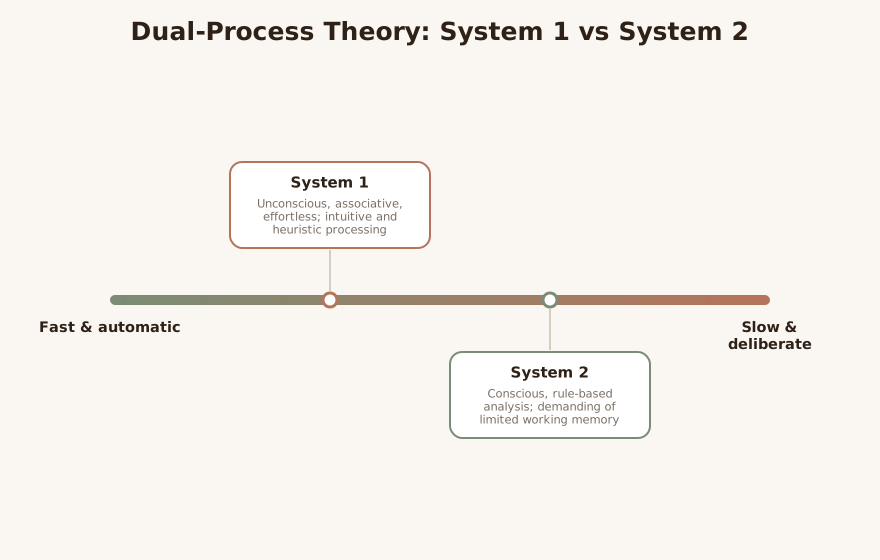
System 1 is fast, automatic, and effortless 2. It operates unconsciously and with minimal cognitive load, draws on formed habits, runs on associative and contextual principles, and is “usually with strong emotional bonds included” 3. It is evolutionarily ancient — what Evans calls the “old mind” 2. It is responsible for intuitive judgments and for heuristic processing 3.
System 2 is slow, effortful, and deliberate 2. It is conscious and controlled, applies rules and systematic analysis, and is “demanding of cognitive capacity” because it relies on central working memory, which has limited capacity 3. It is evolutionarily recent and possibly human-specific — the “new mind” 23. Individual differences in cognitive ability and working-memory capacity strongly predict performance on tasks that require System 2 engagement 2.
A crucial principle for clinical work is the relationship between the systems. In the default-interventionist model, System 1 generates a default response automatically, and System 2 may or may not intervene to correct it 3. In parallel-competitive accounts, both systems operate simultaneously and interact 3. Either way, the practical implication is the same: even when people believe they are reasoning carefully, “System 1 beliefs and biases still drive many of our choices,” operating underneath the deliberate process 5.
Evans and Stanovich’s later work reframed the debate around what defines the two types of processing rather than merely what typically correlates with them, advancing the position that surface features like speed and emotion are characteristic but not definitional 1. The deeper proposed signature of Type 2 processing is its reliance on working memory and the capacity to hold hypothetical scenarios in mind 12.
Interventions & Techniques
Dual-process theory does not prescribe techniques; clinicians translate it into intervention by mapping it onto methods that already exist LLM. The general logic is: help clients notice the fast, automatic response, create a deliberate pause, and bring System 2 online to evaluate or override it LLM. The Decision Lab frames this awareness-to-intervention pathway as the practical payoff of the model — recognizing when intuition misleads is the first lever of change 5.
In CBT terms, “automatic thoughts” are System 1 outputs, and cognitive restructuring is the deliberate System 2 work of catching, examining, and testing them LLM. In DBT, the “wise mind” can be described as the integration that emerges when neither raw emotional reactivity (System 1) nor cold reasoning alone (System 2) dominates, and skills like STOP and urge surfing insert a deliberate gap before an automatic urge is acted on LLM. Mindfulness practices train the metacognitive noticing that lets a client observe a System 1 reaction without immediately enacting it LLM. Motivational interviewing’s evocation of ambivalence can be read as surfacing the gap between an automatic appetitive pull and a reflectively endorsed value LLM.
LLM-generated illustrative example (not a guideline): A client with panic notices her heart racing on a crowded train and the instantaneous appraisal “I’m about to collapse.” A clinician using dual-process language might name that appraisal as a fast, automatic System 1 alarm, then coach a deliberate System 2 check — “What has actually happened the last twenty times this thought fired?” — so the override becomes a rehearsed skill rather than a one-off argument LLM.
Evidence Base
Honesty about maturity requires a careful distinction. As a theory, dual-process accounts are established, decades old, and highly influential across reasoning, social cognition, and decision research 31. As a treatment, dual-process theory has no evidence base, because it is not a treatment — there are no trials of “dual-process therapy” to report LLM. Its clinical credibility is borrowed entirely from the modalities (CBT, DBT, mindfulness-based interventions) into which it is embedded LLM.
Even the theory itself carries important caveats that clinicians should know. Kahneman himself described System 1 and System 2 as useful characters — a narrative device rather than literal, anatomically distinct brain modules 4. He also publicly acknowledged having “placed too much faith in underpowered studies,” especially priming research, several of which faced replication problems 4. Attempts to locate a neural foundation — for example, proposing the brain’s Default Mode Network as the substrate for fast System 1 thinking — remain explicitly speculative and exploratory, with the authors themselves calling for “deeper and more systematic investigation” rather than claiming established findings 6. Single-system and continuum alternatives have been proposed that question whether two discrete systems exist at all 3. In short: a powerful organizing metaphor, well established as a framework, but not a settled map of the brain LLM.
Populations & Indications
Because dual-process theory is a general account of cognition, it is broadly applicable to adults across presentations, and its clinical relevance is greatest where an automatic reaction reliably outpaces reflective control LLM. The populations where clinicians most often invoke it include people with anxiety disorders (where threat appraisals fire automatically), people with impulse-control problems and those with substance use disorders (where appetitive urges precede deliberation), clients already in CBT (whose work centers on automatic thoughts), and people with eating disorders such as binge eating (where the urge-to-act loop is fast and habitual) LLM. None of the provided cognitive-science sources studied these populations, so these are reasoned applications, not citable findings LLM.
The framework is best suited to clients who have at least some capacity to engage System 2 — to observe, label, and deliberate LLM. Where that capacity is acutely compromised (intoxication, acute crisis, significant cognitive impairment), the “pause and reflect” logic has limited traction in the moment and is better deferred LLM.
Problems-for-Work
- Generalized anxiety and rumination. Worry can be framed as System 1 threat-detection that recruits System 2 into unproductive verbal problem-solving; the work is to redirect deliberate capacity toward defusion or scheduled-worry containment rather than feeding the loop LLM.
- Impulsivity and reactive aggression. These are paradigmatic System 1 dominance — action before appraisal; interventions insert a structured delay so System 2 can come online before the behavior LLM.
- Substance use and binge eating. The automatic appetitive cue-response can be named explicitly, and urge-surfing or delay strategies give the slower system time to reassert chosen values LLM.
- Cognitive distortions and emotional reasoning. “I feel it, therefore it’s true” is System 1 substitution — answering a hard question (is this true?) with an easy one (how does this feel?), mirroring Kahneman’s substitution heuristic 4; restructuring is the System 2 correction LLM.
- Decision-making difficulties. Naming when a choice is being driven by an anchor or by availability — both System 1 phenomena 4 — helps clients slow down high-stakes decisions LLM.
Contraindications, Cautions & Cultural Humility
The chief caution is conceptual overreach. Evans catalogued several “fallacies” clinicians can easily fall into: that System 1 always produces error and System 2 always produces the correct answer (both systems can do either), that fast processing is always System 1 (experience can make expert System 2 fast), and that there are only ever two systems (the evidence points to multiple sub-processes) 3. A therapist who tells a client “your emotional brain is wrong and your rational brain is right” is misusing the model and may pathologize intuition that is, in fact, adaptive expertise LLM3.
There is also a values caution. The framing of System 1 as primitive and System 2 as rational carries a cultural bias toward Western, individualist ideals of detached deliberation, and can implicitly devalue intuitive, relational, or culturally embedded ways of knowing LLM. Cultural humility means not treating “more deliberation” as universally superior, and not assuming a client’s fast, emotion-laden response is a defect to be corrected rather than information to be understood LLM. Finally, because the popular framework rests partly on studies that did not replicate 4, clinicians should hold the metaphor lightly and avoid presenting it to clients as established neuroscience LLM.
Treatment-Plan Suggestions & SMART Objectives
| Goal | SMART objective (example) | Mechanism |
|---|---|---|
| Increase awareness of automatic reactions | Within 4 weeks, client logs at least 3 instances/week of an automatic thought or urge, naming it as a “fast” reaction in a thought record | Metacognitive noticing of System 1 output LLM5 |
| Build a deliberate pause before impulsive action | Within 6 weeks, client applies a STOP/delay skill before acting on an identified urge in 70% of logged episodes | Inserting a gap so System 2 can engage LLM |
| Reduce emotional reasoning | By session 8, client distinguishes “feeling” from “fact” in 4 of 5 reviewed situations | Correcting System 1 question-substitution via deliberate restructuring 4LLM |
| Decrease reactive aggression | Over 8 weeks, client reports a measurable drop (e.g., on a self-rating) in acting on anger before pausing | Strengthening deliberate override of automatic reactivity LLM |
| Improve high-stakes decision-making | Within 5 weeks, client uses a written pros/cons or delay protocol for 2 significant decisions | Recruiting System 2 to check System 1 anchors/availability 4LLM |
| Interrupt binge or substance urge cycles | Within 6 weeks, client uses urge-surfing on 60% of logged urges, recording outcome | Allowing the slower system to reassert chosen values LLM |
| Reduce rumination | By week 8, client redirects from worry to a defusion skill within 10 minutes of noticing onset, 4x/week | Withdrawing deliberate capacity from the System 1 worry loop LLM |
Common Misconceptions
- “System 1 is bad / irrational; System 2 is good / rational.” Both systems can produce correct or incorrect responses depending on the task; System 1 intuition is often fast and right 3.
- “Anything fast is System 1.” Experience and expertise can make genuine analytic (System 2) processing fast, so speed alone does not identify the system in use 31.
- “They are two literal brain regions.” Kahneman explicitly treated them as useful characters in a story, not anatomical modules, and neural mapping (e.g., to the Default Mode Network) remains speculative 46.
- “There are exactly two systems.” Evidence suggests multiple interacting sub-processes rather than a clean binary, and continuum models challenge the dichotomy entirely 3.
- “It’s settled neuroscience.” Parts of the popular account rest on studies that failed to replicate, a limitation Kahneman acknowledged himself 4.
Training & Certification
There is no “dual-process theory” certification, and clinicians should not present or seek one LLM. Competence comes from two directions: first, fluency with the source ideas, most accessibly through Kahneman’s Thinking, Fast and Slow and the Evans and Evans-and-Stanovich reviews 421; second, formal training in the modalities that actually operationalize the concept — CBT, DBT, mindfulness-based interventions, or motivational interviewing — through their respective recognized training and supervision pathways LLM. The dual-process frame is then used as case-conceptualization scaffolding within those competencies, not as a credential in its own right LLM.
Key Terms
- System 1 / Type 1 processing — fast, automatic, unconscious, associative, low-effort processing tied to habit and emotion 23.
- System 2 / Type 2 processing — slow, deliberate, conscious, rule-based processing that depends on limited-capacity working memory 23.
- Default-interventionist model — System 1 supplies a default; System 2 intervenes (or fails to) to correct it 3.
- Parallel-competitive model — both systems run simultaneously and interact 3.
- Old mind / new mind — Evans’ evolutionary framing of ancient (System 1) versus recent (System 2) cognition 2.
- Heuristics — mental shortcuts (e.g., anchoring, availability, substitution) characteristic of System 1, which can yield systematic biases 4.
- WYSIATI (“What You See Is All There Is”) — the tendency to build judgments only from available information while ignoring what is unknown 4.
- Cognitive ease — the felt fluency under which System 1 operates spontaneously 46.
Resources & Further Reading
▶ Watch — a video introduction to this concept:
- Evans & Stanovich (2013), Dual-Process Theories of Higher Cognition: Advancing the Debate
- Evans (2003), In two minds: dual-process accounts of reasoning (PDF)
- Dual process theory — Wikipedia
- Thinking, Fast and Slow (Daniel Kahneman, 2011) — Wikipedia
- System 1 and System 2 Thinking — The Decision Lab
- Dual Process Theory and the Default Mode Network — PMC
- Kahneman Gave Us System 1 and 2 — Here’s What’s Next — YouTube
Reflective / Supervision Questions
- When I describe a client’s reaction as “System 1,” am I using it to understand them, or to subtly imply their intuition is wrong?
- Where in my caseload am I treating “more deliberation” as the goal, and is that a value I should examine for cultural bias?
- Can I name the recognized modality that actually carries each dual-process intervention I use, and am I documenting it as such?
- How do I hold this framework as a useful metaphor rather than presenting it to clients as established brain science?
- For a given client, is the deficit really a failure to engage System 2 — or is it that the automatic response is adaptive and I have misread the situation?