
Type & Discipline
Dispositional optimism is a personality construct, not a treatment modality or a school of therapy 1. It names a trait-level, relatively stable individual difference: the generalized expectancy that good things, rather than bad things, will happen across the broad domains of one’s life 1. The construct sits within personality and health psychology, in the family of trait theory, and is studied primarily through self-report rather than delivered as an intervention 4. For the clinician, dispositional optimism functions as an explanatory and assessment lens — a way to understand why two clients facing the same stressor cope and recover so differently — rather than as something you administer LLM. Its distinctive feature is that it is defined by expectancies about outcomes, not by mood, attributional style, or self-talk; optimism here means “I expect this to turn out well,” not “I feel cheerful” or “I explain setbacks charitably” 1. That precision is what makes it measurable and predictive, and it is also the source of the most common clinical confusions, addressed below LLM.
Creators & Lineage
The construct in its modern, measurable form was developed by Charles Carver and Michael Scheier, who introduced it in the mid-1980s and refined it over the following decades, often in collaboration with Suzanne (Lawrence) Segerstrom 1. Their work grew directly out of expectancy-value models of motivation and out of their own self-regulation theory of behavior, in which goal-directed action depends on a person’s confidence or doubt about reaching valued goals 1. In that framework, optimism is simply this confidence generalized across the whole of life rather than tied to one specific goal 1. Scheier and Carver’s 2018 retrospective traces three decades of accumulating health research built on this foundation 3.
The wider lineage includes the positive psychology movement, within which optimism became one of the central studied strengths, and Martin Seligman’s learned optimism, a related but distinct tradition that grew out of the reformulated learned-helplessness and cognitive theories of depression 7. It is worth stating early that dispositional optimism (a generalized expectancy, measured by the Life Orientation Test) and learned optimism (an explanatory or attributional style, measured by the Attributional Style Questionnaire) are different constructs with different measures, even though they are frequently conflated 7. Adjacent ideas include hope theory and self-efficacy, which also concern positive expectations but locate them differently — in pathways and agency, or in beliefs about one’s own capabilities LLM.
Core Principles
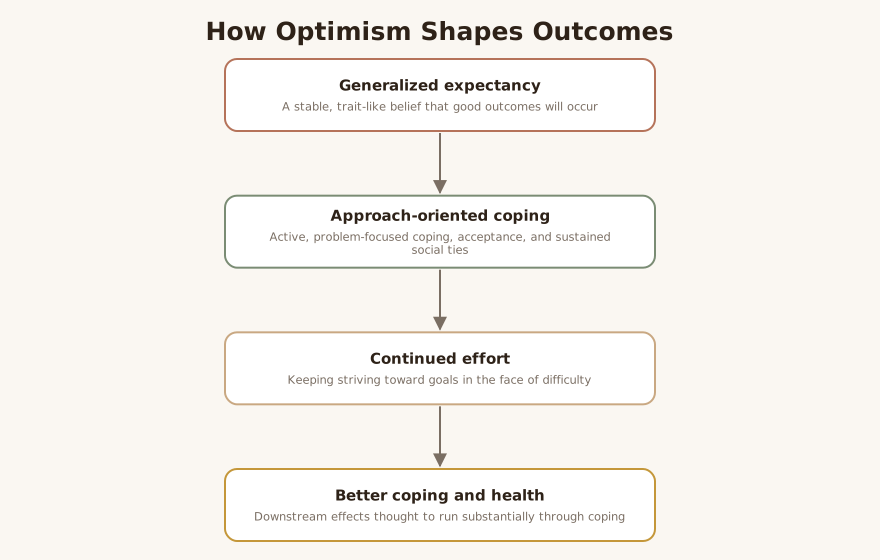
The first principle is that optimism is an expectancy: a belief about the likelihood of good versus bad outcomes in the future 1. Because Carver and Scheier root it in self-regulation theory, the mechanism is straightforward — people who expect good outcomes keep striving toward their goals, while people who expect bad outcomes tend to disengage, give up, or avoid 1. Optimism is thus not passive cheerfulness but a motivational stance with behavioral consequences: it predicts continued effort in the face of difficulty 4.
The second principle is that this expectancy is generalized and trait-like — relatively stable over time and across situations — which distinguishes it from situation-specific confidence and gives it the durability of a personality variable 1. The third principle concerns mechanism: optimism’s downstream effects are thought to run substantially through coping behavior 1. Optimists are more likely to use active, problem-focused, and approach-oriented coping, to use acceptance when a situation is uncontrollable, and to sustain social ties, while pessimists more often use avoidance, denial, and disengagement 1. A fourth and contested principle is dimensionality: although optimism is treated as a single bipolar dimension running from optimism to pessimism, the items measuring positive and negative expectancies sometimes behave as two correlated-but-separable factors, leaving open whether optimism and pessimism are genuinely opposite ends of one continuum or partly independent tendencies 1.
Interventions & Techniques
There is no “dispositional optimism therapy”; because the construct is a trait, it informs assessment and case formulation more than it prescribes a technique LLM. The most direct clinical use is measurement. The standard instrument is the Life Orientation Test–Revised (LOT-R), a brief self-report scale in which respondents rate agreement with statements about expecting good or bad outcomes 5. The LOT-R contains ten items, of which six are scored — three worded in an optimistic direction and three in a pessimistic (reverse-scored) direction — and four are unscored filler items included to obscure the scale’s intent 56. Higher totals indicate greater dispositional optimism, and the measure takes only a few minutes, making it practical for intake or progress monitoring 6.
Beyond assessment, the construct points toward expectancy- and coping-focused work LLM. Because optimism operates through continued goal engagement and adaptive coping, interventions that plausibly shift the relevant behaviors — reducing avoidance, building active and acceptance-based coping, sustaining social support, and setting reachable goals — align with what the construct predicts, even where they do not change the trait itself 1. The Best Possible Self exercise, in which a person writes in detail about a future in which things have gone well, is the most commonly cited brief practice associated with experimentally raising optimism, though it is drawn from the positive-psychology literature rather than from Carver and Scheier’s own program 6.
LLM-generated illustrative example (not a guideline): A clinician notices that a client recovering from a cardiac event keeps “not getting around to” cardiac-rehab appointments. Administering the LOT-R surfaces marked pessimism — the client expects rehab to fail regardless of effort. Rather than debating the future, the clinician targets the behavioral pathway: shrinking the first step to one short walk, scheduling it, and reviewing the disconfirming evidence afterward. The aim is to interrupt expectancy-driven disengagement, not to argue the client into feeling optimistic LLM.
Evidence Base
The maturity of dispositional optimism as a construct is best described as established 1. It has decades of accumulated research, a widely used and psychometrically studied measure, and reasonably consistent associations with both psychological adjustment and physical health 3. Optimism reliably predicts lower distress and better subjective well-being, more adaptive coping, and a range of health-relevant outcomes, including findings in cardiac, cancer, and other medically ill samples 14. The 2018 Scheier and Carver review summarizes evidence linking higher optimism to better cardiovascular outcomes, immune and inflammatory markers, recovery, and even mortality in some cohorts 3.
Honesty about that evidence requires three caveats, all drawn from the construct’s own literature rather than from speculation LLM. First, the great majority of the health findings are prospective-observational, not experimental: optimism is measured and outcomes are tracked, which establishes prediction but not causation, and leaves room for confounding by socioeconomic status, baseline health, and related traits 3. Second, optimism overlaps with neuroticism and trait negative affectivity, raising the question of how much of its predictive power is unique versus shared with general distress-proneness; the literature has worked to show incremental validity beyond these, but the confound is real and persistent 1. Third, the LOT-R’s factor structure is debated, with positive and negative items sometimes separating, which complicates the assumption that a single optimism–pessimism score captures one thing 1. The construct is solid and useful; it is not a proven causal lever, and clinicians should describe it as a predictor and formulation aid rather than as a treatment target with established outcome trials LLM.
Populations & Indications
Dispositional optimism is most informative wherever expectancies about the future shape coping and behavior, which is to say nearly everywhere, but it has been studied most heavily in specific groups 4. The general adult population is the baseline context, where optimism predicts well-being and life satisfaction 4. People with chronic illness are a central population: optimism has been examined as a predictor of adjustment, adherence, and outcome in long-term conditions 4. Cardiac patients are among the most studied, with optimism linked to recovery and cardiovascular outcomes after events and procedures 3. Cancer patients likewise show associations between optimism and psychological adjustment, and in some studies course of illness, though here especially the construct must be handled without implying that attitude controls disease 4. Older adults are studied for links between optimism, resilience, and longevity 3. Across these groups, optimism is an indicator and a moderator — a variable that helps predict who will struggle and who will cope — rather than a diagnosis or an indication for a specific protocol LLM.
Problems-for-Work
As a formulation lens, dispositional optimism maps onto several presenting problems LLM. In depression and especially hopelessness, low optimism and high pessimism describe the negative future expectancies that drive withdrawal and inertia, and naming the expectancy — “you expect effort to be wasted” — can make the cognitive target concrete 1. In anxiety, pessimistic outcome expectancies feed avoidance and anticipatory dread, and the optimism construct frames why approach behavior is therapeutic 1. In poor coping and stress management, the construct directly predicts the coping repertoire: low optimism correlates with avoidance and disengagement, pointing the work toward active, problem-focused, and acceptance-based coping 1.
In health-related distress and adjustment difficulties around illness, optimism helps explain who disengages from treatment and self-care, making it a useful screen and a rationale for behavioral activation around medical regimens 4. In low resilience, optimism is one of the better-studied trait correlates of bouncing back from adversity, and tracking it can mark progress 3. In pessimistic explanatory style, the clinician must take care to distinguish the related-but-different learned-optimism construct, while recognizing that low dispositional optimism and a pessimistic style often co-occur and reinforce each other 7.
LLM-generated illustrative example (not a guideline): A client with generalized anxiety reports that they decline social invitations because “it’ll just be awkward and go badly.” Reframed through expectancy, this is a pessimistic outcome belief driving avoidance. The clinician sets a small approach experiment — attending one short gathering and recording what actually happened — to gather disconfirming evidence and interrupt the expectancy-avoidance loop, while monitoring LOT-R-style expectancy ratings over weeks LLM.
Contraindications, Cautions & Cultural Humility
Because dispositional optimism is a construct, the cautions concern interpretation and misuse, not patient selection LLM. The gravest risk is sliding from “optimism predicts better outcomes” into “the client should just be more positive,” which can become victim-blaming — particularly in serious illness, where implying that pessimism worsens disease adds guilt to suffering and overstates a largely correlational literature 3. Optimism is not a cure, and a low LOT-R score is not a moral failing or a cause of cancer LLM. Clinicians should also resist treating optimism as wholly fixed; while trait-like and stable, it is not immutable, and framing it as destiny is unwarranted 1. A further caution is the neuroticism overlap: a low optimism score may partly reflect general distress, so it should be interpreted alongside, not instead of, mood and anxiety assessment 1.
Cultural humility matters because the construct, its measure, and its underlying value on positive future expectancy are products of largely Western research traditions LLM. What counts as adaptive expectancy varies: in some contexts, “defensive pessimism” or cautious, realistic appraisal is protective rather than maladaptive, and cultural and religious frameworks differ in how they value optimism versus acceptance or equanimity LLM. Structural realities also shape expectancies legitimately — people facing discrimination, poverty, or genuine danger may hold “pessimistic” expectations that are accurate readings of their circumstances, and no expectancy work substitutes for changing those conditions LLM. The LOT-R should be used as one data point within a culturally informed formulation, not as a verdict on a client’s outlook LLM.
Treatment-Plan Suggestions & SMART Objectives
| Goal | SMART objective (example) | Mechanism |
|---|---|---|
| Establish a baseline of expectancy | Client completes the LOT-R at intake and at 6 weeks, reviewing results with the clinician | Measures dispositional optimism to anchor formulation and track change 5 |
| Reduce expectancy-driven avoidance | Client completes 1 small, scheduled approach task per week for 6 weeks despite predicting a poor outcome, then logs the actual result | Gathers disconfirming evidence to weaken pessimistic outcome expectancies 1 |
| Build active coping | Client applies a problem-focused or acceptance-based coping step to 70% of logged stressors over 4 weeks | Shifts coping repertoire toward the active style associated with optimism 1 |
| Sustain goal engagement | Client breaks one stalled valued goal into weekly sub-steps and completes ≥1 per week for 6 weeks | Counters disengagement predicted by low expectancy within self-regulation 1 |
| Strengthen future orientation | Client writes a detailed “best possible self” entry weekly for 4 weeks | Brief practice associated with raising optimistic expectancy 6 |
| Maintain social support | Client initiates one supportive contact weekly for 6 weeks, logged | Preserves the social ties optimists tend to sustain under stress 1 |
| Support adjustment to illness | Client identifies and completes 2 self-care or adherence actions weekly for 6 weeks | Targets engagement that low optimism otherwise erodes in medical regimens 4 |
Common Misconceptions
The first and most important misconception is that dispositional optimism is the same as Seligman’s learned optimism; in fact dispositional optimism is a generalized outcome expectancy measured by the Life Orientation Test, whereas learned optimism is an explanatory or attributional style measured by the Attributional Style Questionnaire, and the two are related but distinct 7. A second is that optimism means positive thinking, affirmations, or cheerful mood; the construct is specifically about expecting good outcomes, and its effects run through coping and goal engagement, not through self-talk or affect 1. A third is that optimism is simply the absence of pessimism; the dimensionality debate around the LOT-R suggests positive and negative expectancies can behave as partly separable, so a person can hold both to some degree 1. A fourth is that optimism causes better health; the strongest claim the evidence supports is robust prediction in prospective-observational designs, not established causation 3. A fifth is that it is a fixed and unchangeable trait; it is stable and trait-like but not immutable 1. Finally, some assume more optimism is always better, when realistic or defensively pessimistic appraisal is sometimes the more adaptive response to genuine threat LLM.
Training & Certification
There is no certification in dispositional optimism, because it is a research construct rather than a proprietary therapy LLM. Clinicians typically encounter it through personality and health-psychology coursework and through Carver and Scheier’s primary papers and reviews 13. The practical competency is twofold: knowing how to administer, score, and interpret the LOT-R — including its filler and reverse-scored items — and knowing how to fold the resulting expectancy information into a case formulation without overclaiming causation 5. Using the construct creates no new scope of practice; the relevant qualification remains competence in whatever established modality the clinician already delivers, such as cognitive behavioral therapy or acceptance and commitment therapy, within which expectancy- and coping-focused work is carried out LLM. Familiarity with the adjacent learned-optimism and hope literatures helps the clinician keep the constructs distinct and use the right measure for the right question LLM.
Key Terms
Dispositional optimism — the trait-level, generalized expectancy that good rather than bad outcomes will occur across life 1. Generalized expectancy — a belief about the likely outcome of events that is broad rather than tied to a single situation or goal 1. Self-regulation theory — Carver and Scheier’s framework in which goal-directed behavior depends on confidence or doubt about reaching valued goals, the basis from which optimism is derived 1. Life Orientation Test–Revised (LOT-R) — the standard brief self-report measure of dispositional optimism, with six scored items (three optimistic, three reverse-scored) plus four filler items 56. Pessimism — the expectancy that bad outcomes will occur, treated as the opposing pole of optimism though sometimes measured as a partly separable factor 1. Learned optimism — Seligman’s distinct construct concerning explanatory or attributional style, measured by the Attributional Style Questionnaire, not by the LOT-R 7. Active coping — problem-focused, approach-oriented coping associated with higher optimism, as opposed to avoidance and disengagement 1.
Resources & Further Reading
▶ Watch — a video introduction to this concept:
- Optimism (Carver, Scheier & Segerstrom, 2010, Clinical Psychology Review) — ScienceDirect
- Dispositional Optimism (Carver & Scheier) — PMC
- Dispositional Optimism and Physical Health: A Long Look Back, a Quick Look Forward (Scheier & Carver, 2018) — PDF
- Dispositional Optimism — National Cancer Institute, Division of Cancer Control and Population Sciences
- Life Orientation Test Revised (LOT-R) — NovoPsych
- What is the Life Orientation Test and How to Use It? (LOT-R) — PositivePsychology.com
- Optimism — Wikipedia
Reflective / Supervision Questions
- When a client scores low on optimism, how do you distinguish a pessimistic expectancy from accurate appraisal of genuinely difficult circumstances, and does that distinction change your plan? LLM
- How do you talk about optimism and health with a medically ill client without implying that their attitude caused or controls their disease? LLM
- In your formulation, how much of a low optimism score might be capturing general neuroticism or distress rather than expectancy specifically, and how would you tell? LLM
- Where in your caseload have you conflated dispositional optimism with learned optimism, and would using the right measure for the right question change anything? LLM
- When is encouraging a more optimistic outlook genuinely helpful, and when does it risk becoming pressure or invalidation? LLM
- How would cultural or religious values around acceptance, equanimity, or realistic caution reshape how you interpret a client’s expectancies? LLM