
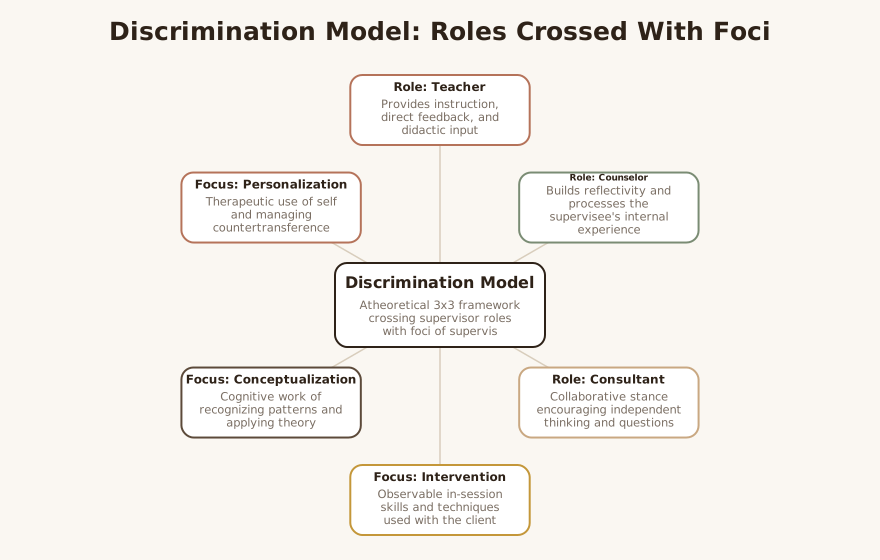
The Discrimination Model is one of the most recognizable scaffolds in clinical supervision: a compact 3x3 grid that helps a supervisor decide, moment to moment, what in the supervisee’s work to attend to and how to respond. It is deliberately simple, and that simplicity is the point — it gives a structure that supervisors can hold in their heads in real time while watching a session tape or listening to a case presentation. LLM This article orients practicing therapists to the model’s logic, its evidence, its honest limits, and how to translate it into supervision plans.
Type & Discipline
The Discrimination Model is a process model of clinical supervision rather than a theory of how people change. Bernard explicitly framed it as an “atheoretical” framework — one designed to help supervisors organize their efforts systematically regardless of the therapeutic orientation the supervisee practices. 3 It sits within counselor education and the broader discipline of clinical supervision, alongside developmental models, integrated models, and orientation-specific (psychoanalytic, behavioral, person-centered, cognitive-behavioral) models. 3 Because roughly three-quarters of psychotherapists identify as eclectic, the field has needed supervision frameworks that transcend a single school of therapy, and the Discrimination Model was built to be that kind of cross-cutting tool. 3
What distinguishes it from a developmental model such as the Integrated Developmental Model (IDM) is that it does not stage the supervisee as a beginner, intermediate, or advanced learner moving through fixed phases. 3 Instead, it gives the supervisor a situational decision grid that can be applied to any moment of any supervisee’s work, which is part of why it is described as accessible and adaptable in complexity depending on the supervisor’s own readiness. 4
Creators & Lineage
The model was developed by Janine Bernard in 1979, with refinements published in 1997. 4 It has since been carried forward and elaborated in Fundamentals of Clinical Supervision, the field-standard text Bernard co-authored with Rodney K. Goodyear. 1 Over time the model became a backbone of supervisor training precisely because it is widely used by practicing supervisors and is concerned with the process of supervision — specifically, tailoring supervisory interventions to the needs of the individual supervisee. 4
Its lineage runs in two directions. Looking back, it shares conceptual neighbors in microskills training, person-centered supervision, and the developmental tradition. 3 Looking forward, it has been extended and re-applied. Lanning (1986) proposed adding a fourth focus — assessment of the supervisee’s professional behaviors, including legal and ethical conduct. 4 The model has been adapted into the School Counseling Supervision Model, an extension tailored to the distinct demands of school-based practice. 5 It has been re-applied as a scaffold for helping supervisees build a preferred counselor identity in supervision. 2 And it forms the structural core of the Common Factors Discrimination Model (CFDM), which grafts relationship variables onto Bernard’s grid. 4
Core Principles
The model is built from two crossed dimensions. The first is the three roles the supervisor can occupy:
- Teacher — assumed when the supervisee needs instruction, direct feedback, or didactic input. 4
- Counselor — used to increase the supervisee’s reflectivity and to help them process internal experiences tied to their professional development, such as blind spots, anxiety, or countertransference. 4
- Consultant — a collaborative, more collegial stance that encourages the supervisee to think and act independently and to bring their own questions. 4
The second dimension is the three foci — the domain of the supervisee’s work being examined:
- Intervention — observable, in-session behaviors: the actual skills and techniques the supervisee uses with the client. 4
- Conceptualization — the supervisee’s cognitive work: recognizing client patterns, applying theory, and understanding session dynamics. 4
- Personalization — the supervisee’s therapeutic use of self: self-awareness, maintaining one’s own counseling style, and managing countertransference so that the clinician stays congruent and present. 34
Crossing three roles with three foci yields a 3x3 matrix of nine possible supervisor responses (for example, teacher x conceptualization, or counselor x personalization). 3 A foundational principle is that the supervisor does not adopt a single fixed role but shifts roles situationally — within a single session and across sessions — depending on what the supervisee needs at that instant. 4 An equally important corollary is corrective: the model assumes supervisors naturally gravitate toward certain roles and foci, so it deliberately pushes for a broader range of response than the supervisor would default to on their own. 3
Interventions & Techniques
In practice, the model is used to name and choose the supervisor’s next move. The supervisor first identifies the focus — is the issue the supervisee’s actual technique (intervention), their understanding of the case (conceptualization), or their internal reactions (personalization)? — and then selects the most fitting role for that moment. 34
Concretely, the same clinical situation can be supervised through different cells of the grid:
- A supervisee mishandling a silence might be addressed in teacher x intervention (“Here is how to sit with and then label a silence”) or in counselor x personalization (“What came up in you when the room went quiet?”). LLM
- A muddled formulation invites teacher x conceptualization (offering a framework) or consultant x conceptualization (“How do you make sense of the pattern across these three sessions?”). LLM
The model also functions as a self-audit for supervisors. Mapping a supervision session onto the grid afterward reveals over-used cells — for instance, a supervisor who lives in teacher x intervention and rarely enters counselor x personalization — and prompts a wider repertoire. 3
LLM-generated illustrative example (not a guideline): A supervisor reviews tape of a trainee whose anxious over-talking crowds out the client. In real time the supervisor first names the focus as personalization, adopts the counselor role to ask what the trainee feared the silence would mean, and only then shifts to the teacher role to rehearse a slowed-down reflection. Naming the grid cell out loud (“I want to slow down and work on what’s happening in you here”) makes the role shift transparent to the supervisee. LLM
Evidence Base
The maturity of this model is best described as established rather than extensively outcome-validated. It is widely used by practicing supervisors and is regarded as an accessible, empirically validated framework that can be adapted in complexity to the supervisor’s level of readiness. 4
The empirical record is real but partial. Ellis and Dell (1986) used multidimensional scaling to test the model’s structure and found support for the teacher and counselor roles as distinct — but the consultant role did not emerge as a distinct role, instead blurring into teaching and counseling, a finding that subsequent studies confirmed. 4 This is an important honesty point: a core element of the model has repeatedly failed to differentiate cleanly in measurement. 4
The other major, well-documented limitation is that the model itself does not thoroughly address the supervisory relationship (Beinart, 2004). 4 The Discrimination Model tells a supervisor what to focus on and which role to adopt, but it says comparatively little about the working alliance, the real relationship, or the emotional bond that research on supervision increasingly treats as central. 4 The Common Factors Discrimination Model was developed specifically to fill this gap, retaining Bernard’s structure while layering in the working alliance, the real relationship, and hope/expectancy factors. 4 In short: the model is mature and trusted as an organizing heuristic, but it is not a strongly outcome-validated treatment of the relational dimension of supervision, and one of its three roles is empirically shaky. 4
Cross-Model Comparison and the Outcome Question
Extending the IDM contrast drawn above: because the Discrimination Model is usually the first framework a new supervisor meets, it is worth being explicit about what it does not attempt — and which other models were built to do those things. Three model families dominate contemporary supervisor training, and the cleanest way to hold them apart is that each answers a different question. LLM
- The Discrimination Model answers a situational question: given what is in front of me right now, what should I attend to, and how should I respond? Its unit of analysis is the supervisory moment, and it is deliberately atheoretical, which is what lets it sit on top of any therapy orientation. 134
- Stoltenberg and McNeill’s Integrated (Integrative) Developmental Model (IDM) answers a trajectory question: where is this supervisee in their development, and what supervisory environment matches that level? Its unit of analysis is the supervisee across time, described in terms of self- and other-awareness, motivation, and autonomy. 9
- Competency-based clinical supervision (Falender and Shafranske) answers an accountability question: which specific knowledge, skills, and values must this supervisee demonstrate, and against what explicit criteria will that be assessed? Its unit of analysis is the named competency, and it is criterion-referenced rather than situational or stage-based. 10
| Model family | Question it answers | Unit of analysis | What it hands the supervisor | What it underspecifies |
|---|---|---|---|---|
| Discrimination Model (Bernard) | What do I address, and in which role, right now? | The supervisory moment | A 3x3 situational grid usable in real time across orientations 14 | Developmental sequence, assessment criteria, and the supervisory relationship itself 4 |
| IDM (Stoltenberg & McNeill) | Where is this supervisee developmentally, and what environment fits? | The supervisee over time | Levels with matched supervisory environments and structure/autonomy calibration 9 | The moment-to-moment choice of response; formal competency criteria LLM |
| Competency-based (Falender & Shafranske) | What must be demonstrated, and how is it evaluated? | The named competency | Explicit domains, criterion-referenced assessment, and documentation for gatekeeping 10 | In-session supervisory technique; developmental pacing LLM |
Framed this way, the three are layers rather than rivals, and most experienced supervisors run all three at once without labeling them: competency-based criteria set the semester’s objectives and the evaluation form, IDM calibrates how much structure versus autonomy this particular supervisee can currently metabolize, and the Discrimination grid decides what is actually said in Tuesday’s meeting. LLM Milne and Reiser’s manualized evidence-based CBT supervision sits at the most operationalized end of the same continuum, specifying supervisory methods and fidelity in the way a treatment manual specifies therapy. 12 Choosing a “primary” model is therefore less a commitment than a decision about which question a given supervision program most needs answered first. LLM
Does supervision demonstrably improve client outcomes?
The honest answer, at the level of the whole field rather than any one model, is that we do not know. Watkins (2011) reviewed thirty years of research and located only 18 supervision-outcome studies published between 1981 and 2011 — and concluded that the field could say nothing more confidently about supervision’s contribution to patient outcomes than it could three decades earlier, because the available studies were too few and too methodologically weak to settle the question. 11 The finding is frequently misread, so the direction matters: this is a verdict on the evidence base, not on supervision. Watkins did not conclude that supervision fails to help clients; he concluded that the research has not been designed well enough to show whether it does, while noting that a handful of newer studies assess the supervision-to-outcome link more directly and are more promising. 11
This bears directly on how the Discrimination Model’s established rating above should be read. “Established” here means widely adopted, taught as core supervisor-training content, and structurally examined — not demonstrated to improve client outcomes. 4 LLM The same constraint applies to the alternatives rather than favoring any of them: IDM’s signature matching prediction rests largely on descriptive and construct-validation evidence, and competency-based supervision’s own guidelines concede that supervisor competence still requires further empirical study (each is discussed in its own article). LLM The practical implication for a supervisor choosing among models is that the choice should be made on fit — the supervisee’s needs, the program’s accountability requirements, the supervisor’s own training — and never defended as outcome superiority, because no supervision model currently has grounds for that claim. LLM
Populations & Indications
The model is designed for supervising counselors-in-training and pre-licensure clinicians, and more broadly for any practicing therapist receiving clinical supervision across orientations. 34 It is equally a tool for supervisors and supervisors-in-training, who use it to structure and audit their own practice. 4 Because it is atheoretical, it is indicated wherever a supervisee’s orientation differs from the supervisor’s, or where caseloads are eclectic. 3 Its school-based extension makes it applicable to school counselors, whose role spans direct intervention, systems work, and consultation. 5
It is well indicated when a supervisor wants a shared vocabulary for feedback, when supervision feels stuck in one register (all teaching, or all processing), or when a supervisee needs help seeing the difference between doing the skill, understanding the case, and being affected by the work. LLM
Problems-for-Work
The grid maps neatly onto the kinds of problems supervision exists to address. Each cell suggests where to aim:
- Skill gaps in intervention — a supervisee who reflects content but never affect; addressed in the intervention focus, often via the teacher role. 4 LLM
- Weak or inaccurate conceptualization — a supervisee who cannot articulate a formulation or misses cross-session patterns; addressed in the conceptualization focus. 4 LLM
- Countertransference and use-of-self difficulties — a supervisee whose own reactions distort the work; addressed in the personalization focus, typically through the counselor role. 34 LLM
- Reduced reflectivity / anxiety — a frozen or defensive supervisee; the counselor role exists to increase reflectivity. 4 LLM
- Over-dependence — a supervisee who wants to be told what to do; the consultant role exists to build independent thinking. 4 LLM
- Ethical / professional-behavior concerns — addressed via Lanning’s proposed professional-behaviors focus, covering legal and ethical conduct. 4 LLM
Contraindications, Cautions & Cultural Humility
The model carries a built-in ethical caution around the counselor role. When the supervisor steps into counselor-like work to address a supervisee’s blind spots or countertransference, there is a genuine risk of drifting into therapy with the supervisee — a dual relationship. The model’s own guidance is that if a personal issue requires ongoing therapeutic work, the supervisee should be referred elsewhere rather than treated by the supervisor. 3 The counselor role addresses personal material as it bears on the clinical work, not as open-ended treatment. 3 LLM
A second caution is the consultant role’s empirical weakness: because it does not differentiate cleanly from teaching and counseling, a supervisor who believes they are “consulting” may simply be teaching in a softer voice, and should not assume the stance is automatically more collaborative. 4 LLM
A third, structural caution is what the model omits. It underspecifies the supervisory relationship, so a supervisor who relies on the grid alone may neglect the alliance, the bond, and the cultural and power dimensions of the dyad. 4 Cultural humility is not a labeled cell in the model, which means the supervisor must supply it: attending to how culture, identity, and power shape both the supervisee’s work and the supervision relationship belongs inside every focus — most explicitly within personalization and conceptualization — and the grid should never be used in a way that treats those issues as out of scope. LLM
Treatment-Plan Suggestions & SMART Objectives
The following objectives illustrate how a supervisor might translate the model into a supervision plan. (These describe supervision goals; clinical treatment goals for clients are formulated separately.) LLM
| Goal | SMART objective (example) | Mechanism |
|---|---|---|
| Broaden the supervisee’s intervention repertoire | Within 4 sessions, supervisee will demonstrate 3 new reflective-listening skills on reviewed tape, rated competent by supervisor | Teacher x intervention: instruction plus feedback on observable behavior 4 |
| Strengthen case conceptualization | By session 6, supervisee will present a written formulation linking theory to client patterns for 2 cases | Conceptualization focus; consultant role prompts independent synthesis 4 |
| Improve use of self / manage countertransference | Over 6 weeks, supervisee will identify and verbalize 1 personal reaction per session and a plan to contain it | Counselor x personalization: increased reflectivity 34 |
| Increase reflectivity in an anxious supervisee | Within 1 month, supervisee will initiate self-review of 2 session moments without prompting | Counselor role used to lower anxiety and raise reflection 4 |
| Build independent clinical judgment | By midterm, supervisee will bring 2 self-generated case questions per session rather than requesting directives | Consultant role fosters autonomous thinking 4 |
| Widen the supervisor’s own range | Supervisor will map each supervision session to the 3x3 grid for 8 weeks and confirm use of at least 5 distinct cells | Self-audit corrects natural role/focus bias 3 |
| Address professional/ethical behavior | Within 3 sessions, supervisee will review 1 ethical decision against the applicable code and document reasoning | Professional-behaviors focus (Lanning extension) 4 |
Common Misconceptions
“The supervisor picks one role and stays in it.” The model’s central claim is the opposite: roles shift situationally within and across sessions, and supervisors draw on the knowledge and skills of all three rather than occupying a single fixed role. 4
“It’s a theory of therapy.” It is an atheoretical process model of supervision, not a theory of client change, which is precisely why it works across orientations. 3
“The consultant role is the most advanced or most collaborative, and clearly distinct.” Empirically, the consultant role has repeatedly failed to emerge as a distinct dimension, blending into teaching and counseling. 4
“The model covers the supervisory relationship.” A documented criticism is that it does not thoroughly address the supervisory relationship — extensions like the Common Factors Discrimination Model were created to add that. 4
“The counselor role means doing therapy with your supervisee.” It targets personal material only as it affects the clinical work; ongoing personal therapy should be referred out. 3 LLM
Training & Certification
There is no standalone “Discrimination Model certification.” The model is taught as core content in graduate supervision courses and supervisor-training programs, and its canonical reference is Bernard and Goodyear’s Fundamentals of Clinical Supervision. 1 Its accessibility is a deliberate training feature: it can be adapted in complexity to match the supervisor’s level of readiness, making it a common entry point for new supervisors before they layer in relational and developmental frameworks. 4 Formal authorization to supervise is governed not by the model but by jurisdictional licensure boards and professional bodies; clinicians should follow their own state or national requirements for supervisor designation. LLM
Key Terms
- Atheoretical model — a framework usable across therapeutic orientations because it organizes supervision rather than prescribing a theory of change. 3
- Teacher / Counselor / Consultant — the three supervisor roles. 4
- Intervention / Conceptualization / Personalization — the three foci of supervisee skill. 34
- 3x3 matrix — the nine role-by-focus combinations available to the supervisor. 3
- Reflectivity — the supervisee’s capacity to process internal experience, increased through the counselor role. 4
- Professional-behaviors focus — Lanning’s proposed fourth focus covering legal/ethical conduct. 4
- Common Factors Discrimination Model (CFDM) — an extension adding working alliance, real relationship, and hope/expectancy to Bernard’s grid. 4
Resources & Further Reading
▶ Watch — a video introduction to this concept:
- Fundamentals of Clinical Supervision — Bernard & Goodyear
- The Common Factors Discrimination Model: An Integrated Approach to Counselor Supervision — The Professional Counselor (NBCC)
- Theories and Models of Supervision — Australian Institute of Professional Counsellors
- The School Counseling Supervision Model: An Extension of the Discrimination Model — Butler University (PDF)
- Creating a Preferred Counselor Identity in Supervision: A New Application of Bernard’s Discrimination Model — ResearchGate
- Does Psychotherapy Supervision Contribute to Patient Outcomes? Considering Thirty Years of Research — Watkins (2011), The Clinical Supervisor
- IDM Supervision: An Integrative Developmental Model for Supervising Counselors and Therapists (3rd ed.) — Stoltenberg & McNeill
- Clinical Supervision: A Competency-Based Approach — Falender & Shafranske (APA Books)
- A Manual for Evidence-Based CBT Supervision — Milne & Reiser (Wiley)
Reflective / Supervision Questions
- When I review my last three supervision sessions against the 3x3 grid, which cells do I overuse, and which do I avoid? 3 LLM
- Am I confident the consultant stance I think I’m taking is genuinely collaborative, given that the role does not differentiate cleanly in research? 4 LLM
- When I move into the counselor role, where is my boundary between addressing personal material that affects the work and drifting into therapy? 3 LLM
- How am I attending to the supervisory relationship, culture, and power — dimensions the model itself does not name? 4 LLM
- For this particular supervisee, which focus (intervention, conceptualization, personalization) is the real growth edge right now, and am I matching my role to it? 4 LLM
- Am I using this model because it answers the question this supervisee’s situation actually poses, or because it is the one I was trained in — and would a developmental or competency-based frame answer it better? 910 LLM
- Given that thirty years of research has not established that supervision improves client outcomes, what am I doing to check that my supervision is reaching the clients, rather than assuming it does? 11 LLM