
Type & Discipline
Competency-based clinical supervision is a framework, not a treatment modality, and it belongs to professional psychology and the broader supervision literature rather than to any school of therapy 7LLM. The American Psychological Association defines it as “a meta-theoretical approach that explicitly identifies the knowledge, skills and attitudes that comprise clinical competencies” and that employs “criterion-referenced competence standards” to develop and evaluate them 7. The word metatheoretical is load-bearing: the framework is deliberately agnostic about which therapy a supervisee practices, so it can structure supervision of a psychodynamic, cognitive-behavioral, or family-systems clinician alike 7LLM. Its central reorientation is to treat supervision itself as “a distinct professional competence” that must be trained, rather than a skill that accrues automatically from clinical experience or seniority 27. For the practicing therapist who supervises, this means the object of the work is the supervisee’s developing competencies, with the welfare of the supervisee’s clients held as the supervisor’s “primary ethical and legal obligation” 7.
Creators & Lineage
The competency-based approach is most closely associated with Carol Falender and Edward Shafranske, whose volume Clinical Supervision: A Competency-Based Approach (now in its second edition, 2021) operationalizes the framework around essential knowledge, practical skills, and the attitudes and values implicit in supervisor competence 3. Falender chaired the APA task force that produced the field-defining policy document, the Guidelines for Clinical Supervision in Health Service Psychology, adopted by the Board of Educational Affairs in 2014 and published in American Psychologist in 2015 72. That task force drew members from clinical, counseling, and school psychology, reflecting the framework’s intent to span the health service psychology specialties rather than a single tradition 7. The guidelines align tightly with the Falender and Shafranske model, and the two are usually read together: the book supplies the conceptual and practical apparatus while the guidelines supply the profession’s normative standard 37. The lineage of the framework runs through the broader “competency movement” in psychology training, which shifted assessment away from seat-time and toward demonstrable knowledge, skills, and attitudes 7LLM.
Core Principles
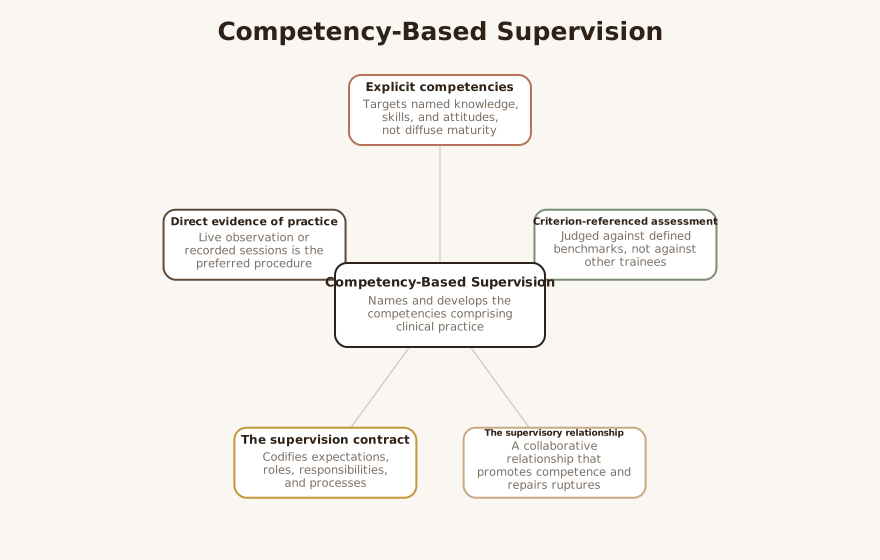
The first principle is explicit competencies: supervision targets named knowledge, skills, and attitudes rather than diffuse “clinical maturity,” and supervisor competence itself “requires knowledge, skills, and attitudes” that must be attained “through formal education and training” 7. The second is criterion-referenced assessment: competencies are judged against defined benchmarks, not against other trainees or the supervisor’s idiosyncratic preferences 7. The third is the supervisory relationship as the vehicle, described in the guidelines as “essential to supervision”; the supervisor’s task is to create “a collaborative relationship that promotes the supervisees’ competence” and to repair the “inevitable” ruptures that arise 7.
A fourth principle is the supervision contract, which the guidelines call “a valuable tool for codifying the supervisory relationship” and which should elaborate “expectations, roles, responsibilities and processes” — an element the guidelines note is “often given too little attention” 7. A fifth is direct evidence of practice: “live observation or review of recorded sessions is the preferred procedure,” displacing exclusive reliance on the supervisee’s self-report of what happened in the room 7. A sixth is structured feedback and dual-purpose evaluation: feedback should be “direct, clear, and timely, behaviorally anchored, responsive to supervisees’ reactions,” and both formative (ongoing, developmental) and summative (cumulative, decisional) evaluation are treated as essential supervisor competencies 7. A seventh principle is diversity as an ethical imperative: supervisors must “develop and maintain self-awareness regarding their diversity competence” and “enhance their diversity competence to establish a respectful supervisory relationship” 7. Finally, the framework holds the supervisor accountable as a gatekeeper to the profession, obligated to “address performance problems directly” and to be “competent in developing and implementing plans to remediate performance problems” 7.
Interventions & Techniques
The framework’s signature technique is the collaboratively negotiated supervision contract, which translates the abstract relationship into written expectations, goals, methods, and evaluation criteria at the outset 7LLM. A second is direct observation — live or recorded session review — which supplies the behavioral evidence that competency claims require and which the guidelines name the preferred method 7. A third is behaviorally anchored feedback delivered on an ongoing basis, so that the supervisee is never surprised by a summative evaluation 7. The framework also organizes work around competency self-assessment: in the public-sector training study, supervisors completed the Clinical Supervisor Self-Assessment Scale (CSSAS) before and after training to locate their own competence gaps, and participants reported that the course “helped me understand skill areas I need to strengthen” 5.
Other techniques the literature foregrounds include attending to the working alliance and its ruptures, helping supervisees “identify and manage countertransference and reactivity,” working with parallel process, and incorporating client feedback into supervision where setting and policy permit 57. In community and public-sector settings the framework is increasingly delivered through telesupervision, where supervisors must also build technological competence — the area showing the largest gains in the public-sector curriculum 5.
LLM-generated illustrative example (not a guideline): In the first supervision meeting, a supervisor and a new associate co-author a one-page agreement naming three competency goals (risk assessment, diversity-responsive case formulation, documentation), the cadence of recorded-session review (one tape every two weeks), and how formative feedback will be given (a brief behaviorally anchored note after each tape). When a later tape shows a missed safety-planning step, the supervisor names the specific behavior, links it to the contracted competency, and revises the plan — rather than delivering a global judgment about the associate’s “readiness” at the year-end review LLM.
Evidence Base
The maturity of competency-based clinical supervision as a framework is established: it is the explicitly endorsed, field-standard approach for health service psychology, codified in APA policy and operationalized in a major textbook now in its second edition 73. The guidelines articulate a coherent, criterion-referenced model with named domains, and the approach has generated training curricula and a validated self-assessment instrument (the CSSAS) used to measure supervisor competence 75. This represents a deliberate shift, as the guidelines put it, from learning supervision through personal experience to “a more systematic, competency-based framework” 7.
Honesty requires a sharp distinction between framework consensus and outcome proof LLM. The guidelines themselves concede that supervisor competence “remains an area requiring additional empirical study” 7. The most directly relevant training study is a single, uncontrolled pre-post evaluation of public-sector clinicians: it found a medium overall effect on supervisor self-efficacy (mean CSSAS scores rising from 80.15 to 87.32, Cohen’s d ≈ 0.46), with the largest gains in technology use (d ≈ 1.15) and multicultural competencies (d ≈ 0.72) 5. Those are self-efficacy gains, not demonstrated improvements in supervisee competence or, further downstream, in client outcomes 5LLM. Notably, self-efficacy for direct observation actually decreased after training (change of −3.90), which the authors read as growing awareness of organizational barriers rather than declining skill 5. The current evidentiary position is therefore: a well-specified, professionally sanctioned framework whose proximal training effects are modest and whose distal effects on client care await controlled study 57LLM.
Populations & Indications
The “population” served by this framework is the supervisee, and the framework spans supervisees across career stages and settings 7LLM. It is built for pre-licensure trainees and interns in health service psychology education and training programs, the explicit scope of the guidelines 2. It applies equally to practicing clinicians entering supervised hours toward independent licensure, and to seasoned clinicians whose supervisory competence the framework treats as a skill in its own right 7LLM. The public-sector literature extends it concretely to community and public-sector mental health clinicians, a group the training study notes differs from graduate students in that they “especially value immediate, practical, applications of supervision strategies” with “minimal requirements for outside reading” 5. The same literature establishes its use with telesupervision and telehealth clinicians, where technological competence becomes part of the supervisor’s required skill set 5. Across these groups the framework indicates a need to assess the supervisee’s competencies against benchmarks and to tailor the supervision contract, observation cadence, and feedback to the supervisee’s developmental level and setting constraints 7LLM.
Problems-for-Work
Because the recipient is the supervisee, the framework’s “problems-for-work” are drawn from the guidelines’ domain of Problems of Professional Competence and adjacent supervisory challenges 7LLM. Competence problems and the need for remediation are the central case: the supervisor must “address performance problems directly” and be “competent in developing and implementing plans to remediate performance problems,” for instance when recorded sessions reveal a persistent gap in risk assessment 7LLM. Diversity-competence gaps are a designated focus, requiring the supervisor to build the supervisee’s — and their own — self-awareness as “an ethical imperative in supervision” 7. Supervisory alliance ruptures are an expected problem the framework asks supervisors to name and repair rather than avoid 7. Countertransference and reactivity in the supervisee are explicitly worked, as the public-sector curriculum’s emphasis on “helping supervisees identify and manage countertransference and reactivity” shows 5. Documentation and ethical-legal lapses surfaced as frequent themes in supervisor case presentations, alongside the tension of balancing clinical and administrative roles when supervisors hold both 5. Gatekeeping decisions — whether a supervisee can be advanced or must be held back — are the framework’s most consequential problem-for-work, and one the public-sector study found especially “difficult for participants because of workplace policies and a unionized work culture” 57.
LLM-generated illustrative example (not a guideline): A supervisor reviews three consecutive recorded intakes and observes that the supervisee consistently omits collaborative goal-setting with clients from minoritized backgrounds, defaulting to a fixed protocol. Rather than waiting for the summative review, the supervisor names the specific behavior, links it to the contracted diversity-competence goal, and builds a brief remediation step (role-play plus reading) into the next two sessions — a formative, criterion-referenced response rather than a global verdict LLM.
Contraindications, Cautions & Cultural Humility
The framework is a structure for supervision, not a substitute for clinical care of the supervisee’s clients, and the supervisor’s “primary ethical and legal obligation to protect the welfare of the client/patient” always supersedes the developmental agenda for the supervisee 7. A central caution is setting fit: the public-sector study documents that competency-based methods can collide with organizational reality — the term “contract” itself had to be replaced with “supervision agreements” in some counties “because of its legal implications,” direct observation was constrained by agencies where most supervisors “had never been observed themselves,” and gatekeeping was complicated by unionized employment 5. Implementing the framework rigidly without addressing these structural barriers risks performative compliance rather than genuine competence development 5LLM. A second caution concerns dual roles: in the public-sector cohort, roughly 52% simultaneously held clinical and administrative supervisor positions, creating “complexity… including issues related to disclosure… relationship strains… power dynamics, and evaluation” that the supervisor must manage transparently 5.
Cultural humility is not optional but constitutive: the guidelines make diversity self-awareness “an ethical imperative” and require the supervisor to “enhance their diversity competence to establish a respectful supervisory relationship” 7. The supervisor’s power to evaluate and to gatekeep amplifies the stakes of any cultural misattunement, since the supervisee cannot freely contest a biased assessment 7LLM. Humility therefore extends to the supervisor’s own competence: the framework’s reliance on the supervisor as benchmark-setter means an under-trained or culturally unreflective supervisor can encode their blind spots into a supervisee’s formation, which is precisely why the guidelines insist supervisor competence be formally trained rather than assumed 7LLM.
Treatment-Plan Suggestions & SMART Objectives
These objectives target the supervisee’s competency development; the “client” of this framework is the supervisee, and the goals are framed accordingly 7LLM.
| Goal | SMART objective (example) | Mechanism |
|---|---|---|
| Establish a shared supervision contract | Within the first 2 supervision sessions, supervisor and supervisee will co-author a written agreement naming at least 3 competency goals, the observation cadence, and the evaluation criteria 7LLM | Codifying expectations, roles, and processes in a supervision contract 7 |
| Build diversity self-awareness | Over 8 weeks, supervisee will complete a structured diversity self-assessment and identify 2 specific competence gaps to target, reviewed in supervision 7LLM | Diversity competence as an ethical imperative; self-awareness development 7 |
| Institute direct observation | Within 30 days, supervisee will submit 1 recorded or live-observed session every 2 weeks for behaviorally anchored review 7LLM | Direct evidence of practice via live observation or recorded sessions 7 |
| Strengthen response to corrective feedback | Across 6 sessions, supervisee will receive timely behaviorally anchored feedback after each observed session and document 1 concrete change applied in the next session, in 5 of 6 instances 7LLM | Formative, behaviorally anchored feedback responsive to supervisee reactions 7 |
| Develop a named clinical competency to benchmark | Within 12 weeks, supervisee will demonstrate the contracted skill (e.g., collaborative safety planning) to criterion on 2 consecutive observed sessions 7LLM | Criterion-referenced competence standards 7 |
| Manage countertransference and reactivity | Over 8 weeks, supervisee will identify in supervision at least 3 instances of reactivity affecting the clinical work and a corresponding regulation strategy for each 5LLM | Identifying and managing supervisee countertransference and reactivity 5 |
| Use a competency self-assessment to guide growth | At intake and at 6 months, supervisee will complete a structured supervisor/clinician self-assessment and set 2 development targets from the lowest-rated competencies 5LLM | Self-assessment of competencies to locate and close gaps 5 |
| Repair supervisory alliance ruptures | When a rupture is identified, supervisor and supervisee will name it within 1 session and agree on a repair step, documented in supervision notes 7LLM | Addressing inevitable ruptures through repair processes 7 |
Common Misconceptions
A frequent error is treating supervision competence as an automatic byproduct of clinical seniority; the framework’s whole premise is that supervision is “a distinct professional competence” requiring its own formal training 27. A second misconception is that “competency-based” means a rigid checklist that crowds out the relationship — yet the guidelines name the supervisory relationship “essential to supervision” and make the alliance the vehicle through which competencies are developed 7. A third is conflating formative and summative evaluation, or skipping the formative layer so that the supervisee meets a high-stakes summative judgment without prior warning; the framework treats both as essential and insists feedback be “direct, clear, and timely” 7. A fourth misconception is that self-report of sessions is sufficient evidence; the framework prefers “live observation or review of recorded sessions” precisely because narrated accounts can omit the behaviors that matter 7. Finally, some assume the framework imports cleanly into any agency; the public-sector experience shows that contracting language, observation, and gatekeeping all required adaptation to local policy and culture 5.
Training & Certification
There is no single credential that confers “competency-based supervisor” status; rather, the framework is the standard against which supervisor training in health service psychology is increasingly built 7LLM. The APA guidelines explicitly direct supervisors to “attain and maintain competence in the practice of supervision through formal education and training,” establishing formal preparation — not experience alone — as the route to competence 7. Many U.S. licensing jurisdictions require supervision-specific coursework for those who supervise toward licensure, and the Falender and Shafranske textbook is a primary training resource for that coursework 3LLM. The public-sector study offers one concrete model: an 18-session, nine-month online curriculum spanning competency-based foundations, multicultural supervision, working alliances, ruptures, parallel process, ethics, countertransference, direct observation, gatekeeping, reflective and deliberate practice, developmental models, telehealth, and self-assessment, delivered with expert-interview videos and standardized case presentations, and built around a train-the-trainer sustainability model 5. Clinicians developing supervisory competence should ground themselves in the guidelines and the primary text, complete jurisdiction-required training, and use a structured self-assessment to identify and close their own gaps 375.
Key Terms
- Metatheoretical approach — a supervision framework independent of any single therapy orientation, applicable across modalities 7.
- Competency — an explicitly named cluster of knowledge, skills, and attitudes that can be developed and assessed 7.
- Criterion-referenced standards — benchmarks against which competence is judged, rather than comparison to peers 7.
- Supervision contract — a written codification of expectations, roles, responsibilities, and processes in the supervisory relationship 7.
- Supervisory alliance — the collaborative relationship “essential to supervision,” through which competencies develop and whose ruptures are repaired 7.
- Direct observation — live or recorded session review, the preferred source of evidence about supervisee practice 7.
- Formative vs. summative evaluation — ongoing developmental feedback versus cumulative decisional assessment; both are essential supervisor competencies 7.
- Gatekeeping — the supervisor’s professional obligation to address competence problems and decide who advances toward independent practice 7.
- Problems of professional competence — the guidelines’ domain covering performance problems and their remediation 7.
- CSSAS — the Clinical Supervisor Self-Assessment Scale, used to measure supervisor competencies pre- and post-training 5.
Resources & Further Reading
▶ Watch — a video introduction to this concept:
- APA Guidelines for Clinical Supervision in Health Service Psychology (full policy)
- Guidelines for Clinical Supervision in Health Service Psychology (American Psychologist, PubMed)
- Clinical Supervision: A Competency-Based Approach, 2nd ed. (Falender & Shafranske, APA Books)
- Competency-Based Supervision (APA streaming video, Shafranske & Falender, 2016)
- Training Public Sector Clinicians in Competency-Based Clinical Supervision (PMC)
- APA Guidelines for Clinical Supervision: Competency-Based Implications for Supervisees (Sage)
- Guidelines for Clinical Supervision in Health Service Psychology (Society for the Advancement of Psychotherapy explainer)
Reflective / Supervision Questions
- Have I co-created an explicit supervision contract with each supervisee, or am I relying on an implicit understanding of goals, methods, and evaluation criteria? 7LLM
- What direct evidence — live or recorded — do I actually have of each supervisee’s practice, versus what I infer from their self-report? 7
- Is my feedback behaviorally anchored, timely, and formative, so that no summative evaluation will surprise the supervisee? 7LLM
- How am I attending to my own diversity competence as a supervisor, given that my evaluative power makes my blind spots costly for the supervisee? 7LLM
- When a supervisee shows a competence problem, do I move to direct, criterion-referenced remediation, or do I avoid the conversation until it becomes a gatekeeping crisis? 7LLM
- What structural barriers in my setting — policy, dual roles, observation constraints — are quietly shaping how I can implement this framework, and how am I addressing them? 5LLM
- Where am I treating my own supervisory competence as a trained skill to be assessed and developed, rather than as something my clinical seniority already guarantees? 27LLM