
Type & Discipline
Executive-coaching GROW elaborations are not a single therapy; they are a family of structured conversation frameworks drawn from the coaching and organizational-psychology tradition rather than from clinical psychotherapy LLM. The anchor of the family is the GROW model — Goal, Reality, Options, Will (or Way Forward) — a four-stage scaffold for goal-directed coaching dialogue 1. The “elaborations” are the many variants that reshuffle, rename, or extend those stages for a particular context: adding a topic-framing step, front-loading current reality, or building in formal review and accountability 24.
For a clinician, the most useful framing is this: GROW and its cousins are content-free process maps. They tell you the sequence of a productive change conversation but say nothing about the content of the client’s problem LLM. This makes them portable across settings — leadership development, performance review, career transition — but also means the rigor of any session depends almost entirely on the practitioner’s questioning skill, not on the mnemonic itself 2. The discipline of origin is coaching and organizational psychology, sitting alongside, and partly overlapping with, solution-focused and cognitive-behavioral coaching traditions LLM.
Creators & Lineage
GROW emerged from British executive coaching in the late 1980s and early 1990s, developed by Sir John Whitmore together with colleagues and popularized through his book Coaching for Performance 1. Graham Alexander is credited within the coaching community as a co-originator of the framework, and Whitmore became its most visible champion LLM. The model grew out of early coaching programs that blended performance psychology, goal-setting, and ideas about human potential 1.
The lineage threads into several therapeutic and applied traditions. Its emphasis on the client generating their own options and committing to action echoes solution-focused brief therapy’s resource orientation and its assumption that clients hold the keys to their own change LLM. The “Options” and strengths-oriented questioning connect naturally to positive psychology — practitioners routinely layer in self-determination theory, character-strengths work, and unconditional positive regard to deepen the four stages 2. The structured, action-oriented spine also overlaps with cognitive-behavioral coaching, which shares GROW’s bias toward measurable behavior change LLM.
Peter Hawkins, a prominent figure in systemic and team coaching, sits in the broader lineage of practitioners who extended GROW-style thinking into supervision and team contexts LLM. Among the named elaborations, CIGAR — Current reality, Ideal, Gaps, Action, Review — was developed by Anthony Grant and Suzy Green in 2003, reordering the conversation to begin with present reality before defining the ideal 4.
Core Principles
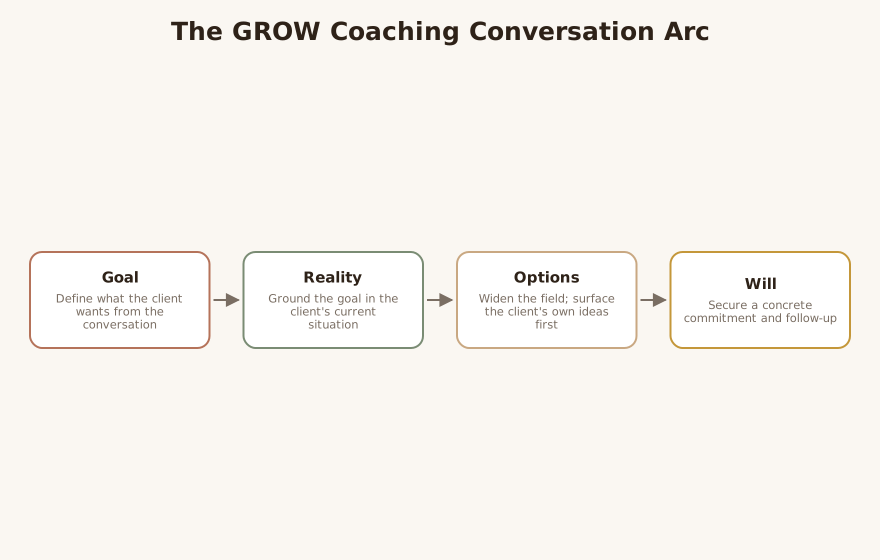
The first principle is sequence over content: a good change conversation moves from defining what the client wants, to grounding it in current reality, to widening the field of options, to securing concrete commitment 1. The mnemonic exists to keep both parties oriented within that arc rather than collapsing prematurely into advice LLM.
Second is client agency. GROW assumes the client is resourceful and capable of generating their own solutions; the coach’s job is to ask, not to prescribe 2. The “Options” stage in particular is meant to surface the client’s own ideas before any external input 2.
Third is goal primacy with reality-testing. Classic GROW begins with the goal, then deliberately tests it against current reality so that aspiration is anchored rather than fantasized 1. Several elaborations argue the opposite ordering is better for some clients — CIGAR starts with current reality and only then defines the ideal, which can reduce defensiveness when the gap is large 4.
Fourth is commitment and accountability. The closing stage — Will, Way Forward, or CIGAR’s explicit Review — converts insight into a specific next action and a follow-up mechanism 14. The elaborations that add a Review stage formalize what GROW leaves implicit: that change requires tracking and adjustment over time 4.
Interventions & Techniques
The core technique across the family is staged open questioning. PositivePsychology.com catalogs roughly ten questions per GROW stage, moving from “What would you like to focus on today?” at the Goal stage to “How will you celebrate when you’ve achieved your goal?” at the Way Forward stage 2. The practitioner’s craft lies in pacing — staying in each stage long enough to do real work before advancing LLM.
TGROW adds a Topic stage before Goal, giving space to explore the broad area of concern before narrowing to a specific, sessionable goal — useful when a client arrives diffuse or overwhelmed 2. GROWTH extends the model with Tactics and Habits, pushing past the single next step toward an implementation plan and the routines needed to sustain it 2.
CIGAR reorders the conversation to Current reality, Ideal, Gaps, Action, Review — explicitly naming the gap between present and desired states as its own working object, and closing with a built-in accountability check-in 4. Practitioners also draw on adjacent scaffolds such as CLEAR and OSKAR depending on client need, choosing the structure that fits the presenting situation rather than forcing one model 1.
LLM-generated illustrative example (not a guideline): A mid-level manager arrives saying “I’m just stressed about work.” Rather than jumping to solutions, the coach spends the Topic stage mapping the territory — workload, a difficult peer, an upcoming reorg — and only then helps the client choose one as the Goal for the session: “preparing for the reorg conversation.” Reality, Options, and Will follow on that single thread. LLM
A recurring technique across elaborations is scaling and review: asking the client to rate confidence or commitment, and formally scheduling a check-back, so the framework becomes a loop rather than a one-off 4.
Evidence Base
The honest summary is that GROW and its elaborations are established in practice but thin in direct outcome evidence LLM. GROW is among the most widely taught and used coaching frameworks worldwide, with extensive practitioner literature and reference coverage describing its structure and application 16. That ubiquity reflects practical utility and ease of teaching, not a deep randomized-trial base LLM.
Much of the empirical support is indirect, borrowed from the components GROW operationalizes: goal-setting, self-efficacy, and self-determination constructs that practitioners graft onto the stages 2. The variants — TGROW, GROWTH, CIGAR, CLEAR, OSKAR — are largely described in practitioner and explanatory sources rather than validated head-to-head against one another 24. CIGAR’s developers come from the coaching-psychology research tradition, which lends the model conceptual credibility, but the explanatory material emphasizes its simplicity and clarity rather than citing comparative trials 4.
For a clinician, the practical implication is to treat these frameworks as structured process tools, not evidence-based treatments. They organize a conversation reliably; they do not carry the empirical warrant of a manualized psychotherapy LLM. When working with genuinely clinical presentations, the framework should sit inside, not replace, an evidence-based modality LLM.
Populations & Indications
The natural population is executives, leaders, managers, and working professionals pursuing performance, leadership, or development goals 1. The frameworks are designed for goal-directed, future-oriented conversations with people who are functioning but seeking change — not for acute clinical distress LLM.
They fit well with teams, where shared goal-and-reality language helps groups align, and with people in career transition, where the staged arc from topic to action maps cleanly onto an exploratory-to-committed trajectory LLM. CIGAR is explicitly positioned for high-stress professionals — executives and entrepreneurs — who benefit from a structured process that keeps goals attainable and feedback consistent 4.
In a therapy or integrated behavioral-health setting, these structures are most apt for the coaching-adjacent strand of work: a client who is psychologically stable but stuck on a concrete life or work goal, where a brief, structured, action-oriented frame accelerates movement LLM.
Problems-for-Work
- Goal-setting difficulties. The Goal stage forces specificity, converting “I want things to be better” into a defined, testable target 1.
- Procrastination. The Will / Way Forward and GROWTH’s Habits stages turn intention into a scheduled first action and a supporting routine 2.
- Career indecision. TGROW’s Topic stage and CIGAR’s Ideal stage give structured space to clarify direction before committing 24.
- Performance issues. Reality-testing a goal against current performance surfaces the actual gap to be closed 14.
- Low motivation. Options-stage strengths questioning and positive-psychology overlays reconnect the client to autonomous reasons for change 2.
- Decision-making difficulties. The Options stage deliberately widens the field of choices before narrowing, countering premature closure 2.
- Work-related stress and work-life balance. Topic-framing helps a diffuse stress complaint become a workable, bounded goal LLM.
LLM-generated illustrative example (not a guideline): A client in career transition keeps oscillating between two job offers. Using CIGAR, the coach maps Current reality (financial runway, energy, values), then the Ideal (what a good year looks like), names the Gaps each option leaves, builds an Action (one informational interview per role), and sets a Review for two weeks out. LLM
Contraindications, Cautions & Cultural Humility
The central caution is scope: GROW elaborations are coaching frameworks, not treatments for clinical conditions LLM. When a presentation involves significant depression, trauma, suicidality, or another diagnosable disorder, a goal-and-action conversation can feel invalidating or can paper over distress that needs clinical attention; the appropriate move is to recognize the boundary and shift to, or refer for, evidence-based care LLM. The frameworks assume a client with the regulatory and cognitive capacity to set goals and generate options — an assumption that does not hold during acute crisis LLM.
A second caution is premature solution-focus. Because the structure pulls toward action, an unskilled practitioner can rush a client through Reality into Options before the problem is adequately understood, producing brittle commitments 2. The remedy is disciplined pacing within each stage LLM.
On cultural humility: GROW carries embedded Western, individualist assumptions — that the individual is the locus of change, that explicit goal-setting is desirable, and that direct articulation of aspirations is comfortable LLM. For clients from more collectivist or hierarchical contexts, framing a “Goal” in purely individual terms, or expecting candor about workplace “Reality” with a power differential present, may not fit LLM. The practitioner should hold the mnemonic loosely, adapt its language, and check whether the very premise of self-directed goal-setting resonates for the client LLM.
Treatment-Plan Suggestions & SMART Objectives
| Goal | SMART objective (example) | Mechanism |
|---|---|---|
| Clarify a vague work concern into a workable focus | Within 2 sessions, client will name one specific, bounded work goal using a Topic-then-Goal structure | Topic-framing reduces overwhelm and enables specificity 2 |
| Reduce procrastination on a stalled project | Over 3 weeks, client will complete one pre-defined next action per week and log it | Will/Habits stages convert intention into scheduled behavior 2 |
| Resolve career indecision | Within 4 weeks, client will articulate an “ideal” criterion set and test two options against it | Ideal-and-Gaps reasoning structures comparison 4 |
| Improve a defined performance metric | Within 6 weeks, client will close one identified reality-vs-goal gap with a tracked action plan | Reality-testing surfaces the actual gap to close 1 |
| Rebuild motivation for a chosen goal | Each session, client will identify one strength or autonomous reason supporting the goal | Strengths/self-determination questioning restores autonomous motivation 2 |
| Counter premature decisions | Before deciding, client will generate at least four distinct options | Options stage widens the field before narrowing 2 |
| Sustain change between sessions | Client will complete a scheduled self-rated review of progress at each check-in | Built-in Review formalizes accountability 4 |
Common Misconceptions
“GROW is a therapy.” It is a coaching conversation structure, not a clinical treatment, and lacks the outcome evidence base of a manualized psychotherapy LLM6.
“The mnemonic does the work.” The framework only sequences the conversation; effectiveness depends on the quality of questioning and pacing the practitioner brings to each stage 2.
“There is one correct order.” Several elaborations deliberately reorder the stages — CIGAR starts with current reality, TGROW adds a topic step first — precisely because the canonical Goal-first sequence does not fit every client 24.
“More letters means more rigor.” The proliferation of variants (TGROW, GROWTH, CIGAR, CLEAR, OSKAR) reflects context-specific packaging and branding, not a tested hierarchy of effectiveness 14.
“It works for any presenting problem.” The frameworks assume a stable, goal-capable client; they are not designed for acute clinical distress and can be misapplied there LLM.
Training & Certification
There is no single credential that owns GROW; it is taught across the coaching field and embedded in most foundational coach-training curricula LLM. Practitioners typically encounter it through coaching-skills programs and the practitioner literature, including Whitmore’s Coaching for Performance and provider resources that walk through each stage with sample questions 12.
Formal professional grounding in coaching generally comes through accredited coach-training and credentialing bodies, where GROW-style models are one component of a broader competency framework rather than a standalone certification LLM. For clinicians wanting to integrate these tools, the realistic pathway is structured coaching-skills training layered onto existing clinical licensure, with clear attention to scope-of-practice boundaries between coaching and therapy LLM. The variants are usually learned informally from explanatory resources rather than through dedicated certification tracks 24.
Key Terms
- GROW — Goal, Reality, Options, Will (or Way Forward); the four-stage anchor model 1.
- TGROW — GROW with a preceding Topic stage to explore the broad area before setting a goal 2.
- GROWTH — GROW extended with Tactics and Habits for implementation and sustainability 2.
- CIGAR — Current reality, Ideal, Gaps, Action, Review; a reordered variant beginning with present reality 4.
- Will / Way Forward — the commitment stage converting insight into a concrete next action 1.
- Reality-testing — anchoring an aspirational goal against the client’s current situation 1.
- Review — a scheduled accountability check-in to track and adjust progress over time 4.
Resources & Further Reading
▶ Watch — a video introduction to this concept:
- The GROW Model: A Complete Guide to Goals, Reality, Options & Will — Performance Consultants
- What Is the GROW Coaching Model? (Incl. Examples) — PositivePsychology.com
- An Overview of Coaching Models — Biró (International Coach Academy)
- Exploring the CIGAR Coaching Model — Paperbell
- The GROW Coaching Model EXPLAINED! — YouTube
- GROW model — EBSCO Research Starters (Business & Management)
Reflective / Supervision Questions
- When I reach for a GROW elaboration, am I choosing it because it fits this client’s situation, or because it is the structure I default to? LLM
- How do I know when a “coaching” goal conversation is actually masking a clinical presentation that needs a different frame or a referral? LLM
- Where do I tend to rush — do I leave the Reality stage too early to get to Options and action? LLM
- How well does my version of “set a goal” travel across clients from different cultural and organizational contexts? LLM
- For this client, would starting with current reality (CIGAR) lower defensiveness more than starting with the goal? 4
- Am I being honest with the client about the difference between coaching scaffolds and evidence-based treatment? LLM