
Type & Discipline
The supervisory working alliance is a relational construct within clinical supervision and psychotherapy-process research, not a freestanding treatment modality LLM. It names the collaborative relationship between supervisor and supervisee, theorized as the vehicle through which supervision produces change in the trainee 6. It belongs to the family of “common factors” thought to operate across supervision models — relationship elements that matter regardless of whether a supervisor works from a developmental, psychodynamic, or competency-based frame 6. Because it is a construct rather than an intervention, it is something a supervisor cultivates and measures rather than a protocol delivered; its practical value lies in directing attention to how supervision is being conducted, not only what content is covered LLM.
The construct is methodologically mature: it is operationalized by validated self-report instruments and has generated three decades of empirical study, which is why it appears in this wiki as an “established” construct 6. Its lineage is explicitly borrowed — it is the therapeutic working alliance, a pantheoretical mechanism of change in psychotherapy, transplanted into the supervisory dyad 6.
Creators & Lineage
The construct originates with Edward Bordin, who in 1983 proposed a working-alliance-based model of supervision 1. Bordin had earlier reframed the psychotherapeutic alliance as a pantheoretical change mechanism, and his 1983 contribution extended that same architecture to the supervisor–supervisee relationship, reasoning that if the alliance drives change in therapy, an analogous alliance should drive learning and development in supervision 6. At the time the extension was theoretical: Bordin predicted that a favorable supervisory alliance would be associated with positive supervisory outcomes, but that prediction had not yet been empirically tested 6.
The measurement lineage runs through James Efstation and colleagues, who in 1990 built one of the first instruments for the supervisory alliance, the Supervisory Working Alliance Inventory (SWAI), and reported a positive association between alliance strength and trainee self-efficacy 6. Nicholas Ladany and colleagues then conducted an early longitudinal test of Bordin’s model, deliberately using an alliance measure derived directly from Bordin’s three-factor structure (a trainee version of the Working Alliance Inventory) to ask whether changes in the alliance over time tracked changes in supervisory outcomes 6. This Bordin → Efstation → Ladany progression — theory, then measurement, then longitudinal test — is the backbone of the construct’s empirical history 6.
Core Principles
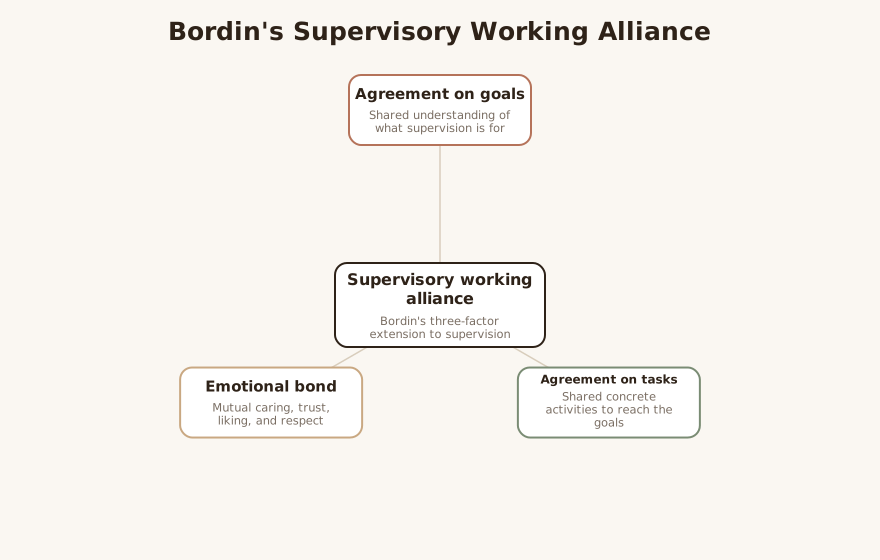
Bordin conceptualized the supervisory working alliance as a multidimensional construct with three interrelated factors 6. The first is mutual agreement on the goals of supervision — for example, mastery of counseling skills — meaning supervisor and supervisee share an understanding of what the supervision is for 6. The second is mutual agreement on the tasks of supervision — the concrete activities, such as observation of therapy sessions, that are expected to move the trainee toward those goals 6. The third is the emotional bond between the two parties: feelings of mutual caring, trust, liking, and respect 6.
A defining principle is that the alliance is dynamic, not static. Bordin described its “building and repair” — the positive and negative experiences that accumulate across the course of supervision, strengthening the alliance when the trainee’s thoughts, feelings, and actions are more positive and weakening it when they are more negative 6. This means the alliance can fray and be repaired, and that a single snapshot understates what is really a moving relationship 6.
A further principle is that the alliance is theorized as a common factor that cuts across supervision models — no single supervision model has been shown to explain change better than another, and the relationship is one of the candidate elements that may carry change regardless of model 6. Finally, the alliance is held to be collaborative: it is a partnership for change in the supervisee grounded in shared understanding, not a one-directional transmission of expertise 6.
Interventions & Techniques
Although the alliance is a construct rather than a technique, it implies concrete supervisor behaviors LLM. Goal consensus work — explicitly negotiating and periodically revisiting what the trainee wants to develop — operationalizes the goals factor LLM. Task transparency — making the structure of supervision legible so the trainee is clear on their responsibilities, as captured by SWAI items like “I am clear on what my responsibilities are in supervision” — operationalizes the tasks factor 6.
The bond is cultivated through the supervisor’s interpersonal stance. Empirically, supervisor cultural humility and a collaborative supervisory style both strengthen the working alliance, and the alliance in turn is what reduces trainee withholding 3. Supervisory style matters: an interpersonally sensitive, “attractive” style explains substantial variance in alliance strength, and the benefit of an interpersonally sensitive style is stronger for less-experienced supervisees 5. Rupture repair is a technique implied directly by Bordin’s “building and repair” language — noticing strain, naming it, and re-establishing agreement and trust 6.
LLM-generated illustrative example (not a guideline): A supervisor notices a supervisee has gone quiet about a difficult case. Rather than pressing for content, she names the process — “I want to make sure supervision feels safe enough to bring me the hard ones; have I done anything that made that harder?” — modeling repair of the bond before returning to the clinical material LLM.
Evidence Base
The honest summary is that the supervisory working alliance is a well-established and well-measured construct whose links to specific outcomes are mixed LLM. As a measurement target it is mature: instruments derived from Bordin’s three-factor model show strong internal consistency, with subscale reliabilities exceeding .90 in trainee samples 6.
The outcome picture is more nuanced than the popular framing of “strongest predictor of supervision outcomes” suggests LLM. In Ladany and colleagues’ longitudinal test (107 trainees rated at two time points), changes in the supervisory working alliance were significantly related to changes in trainee satisfaction with supervision — supporting Bordin’s model — but were not related to changes in trainee self-efficacy over time 6. Notably, trainees increased in self-efficacy as a group regardless of whether their alliance strengthened or weakened, which the authors attributed partly to maturation and partly to the alliance factors being too global to detect skill-specific effects 6.
The strongest contemporary evidence is for disclosure. In a study of 214 supervisees, the supervisory working alliance fully mediated the inverse relationships between (a) supervisor cultural humility and trainee nondisclosure, and (b) collaborative supervision and trainee nondisclosure — when the alliance was entered, cultural humility and collaboration lost their unique predictive power 3. That study also documented how common withholding is: roughly 62% of supervisees had withheld negative reactions about supervisor competence and about 46% had withheld feeling unsafe, though most still disclosed important client information 3. Other findings are flatly negative for specific outcomes: in counselors-in-training, the supervisory working alliance did not significantly predict compassion fatigue 5. The defensible claim is therefore: the alliance is a robust, foundational relationship variable with strong ties to satisfaction and disclosure, but it is not a uniform predictor of every supervision outcome LLM.
Populations & Indications
The construct was developed in and is most validated for counselors- and psychologists-in-training — beginning practicum students through interns — who are the populations sampled across the foundational studies 6. It is directly relevant to early-career clinicians in licensure or post-degree supervision, where the same goals/tasks/bond dynamics apply LLM.
It is especially indicated for cross-racial and cross-cultural supervisory dyads: in the cultural-humility study, roughly 36% of dyads were cross-racial, and the alliance was the pathway through which a supervisor’s cultural humility translated into reduced trainee withholding — making attention to the alliance a concrete equity lever, not only a comfort measure 3. It is also indicated when developmental level is in play, since the value of an interpersonally sensitive supervisory style for the alliance is greater for less-advanced supervisees 5.
Problems-for-Work
Trainee nondisclosure. A supervisee who withholds clinical errors, doubts, or negative reactions to the supervisor undermines both client safety and their own learning; strengthening the alliance — via cultural humility and collaboration — is the empirically supported route to more disclosure 3.
LLM-generated illustrative example (not a guideline): A practicum student stops mentioning a client’s worsening suicidal ideation because she fears looking incompetent. The supervisor’s task-for-work is to rebuild the bond and explicitly normalize bringing risk material, so disclosure resumes LLM.
Supervisory ruptures. When goal disagreement, task confusion, or relational strain weakens the alliance, the indicated work is Bordin’s “repair” — re-negotiating goals and tasks and restoring trust 6.
Evaluation anxiety. Trainee fear of negative evaluation drives withholding; an alliance characterized by a strong bond and clear, transparent tasks reduces the threat the evaluative relationship poses LLM.
Low trainee self-efficacy. While the alliance does not reliably cause self-efficacy gains over time, a favorable alliance creates the conditions — clarity on goals/tasks and a trusting bond — under which targeted skill development can proceed 6.
Contraindications, Cautions & Cultural Humility
There are no “contraindications” to a strong alliance, but several cautions apply LLM. First, the alliance is not a substitute for the evaluative and gatekeeping functions of supervision; a warm bond cannot license avoidance of corrective feedback or competence concerns, and over-prioritizing comfort can collude with a trainee’s avoidance LLM. Second, the alliance is not a reliable lever for every outcome — supervisors should not assume that improving rapport will, by itself, raise self-efficacy or prevent compassion fatigue, given the negative findings on both 65.
On cultural humility: the evidence is specific and actionable. Supervisor cultural humility strengthens the alliance, which in turn reduces trainee withholding — so a supervisor’s stance toward the trainee’s cultural identity is a working-alliance issue, particularly in cross-racial dyads 3. Cultural ruptures (microaggressions, unexamined assumptions) are alliance ruptures and warrant the same naming-and-repair attention LLM. A caution about the evidence base itself: foundational samples skew White, cisgender, and female, so generalization to other supervisee and supervisor identities should be made carefully 3.
Treatment-Plan Suggestions & SMART Objectives
The table below frames supervision-side objectives; because this is a supervisory construct, the goals concern the trainee’s development and the supervisor’s alliance-building behaviors LLM.
| Goal | SMART objective (example) | Mechanism |
|---|---|---|
| Establish goal consensus | Within the first two sessions, supervisor and supervisee co-write three measurable learning goals reviewed monthly | Goals-agreement factor of the alliance 6 |
| Clarify supervision tasks | Supervisee can, by session 3, state their supervision responsibilities and the session structure without prompting | Tasks-agreement factor 6 |
| Strengthen the emotional bond | Over 6 weeks, supervisee’s bond-subscale rating increases by a meaningful margin on a brief alliance check-in | Bond factor; trust and respect 6 |
| Reduce trainee nondisclosure | Within one quarter, supervisee discloses at least one clinical error or doubt per month previously withheld | Alliance as mediator of disclosure 3 |
| Build alliance via cultural humility | Supervisor invites and acts on feedback about cultural fit at least twice per quarter | Cultural humility → alliance → disclosure 3 |
| Repair ruptures promptly | Any identified alliance strain is named and a repair plan agreed within one session | Bordin’s “building and repair” 6 |
| Tailor style to developmental level | Supervisor adopts a more interpersonally sensitive style with the early-stage supervisee, reviewed at midpoint | Style × development interaction 5 |
| Monitor satisfaction | Supervisee completes a brief satisfaction check each quarter; declines trigger a goals/tasks review | Alliance–satisfaction link 6 |
Common Misconceptions
“The alliance is the same as liking each other.” The bond is only one of three factors; an alliance can feel warm yet be weak if goals and tasks are not agreed, and a robust alliance includes hard, clear work 6. “A strong alliance predicts all good supervision outcomes.” It reliably tracks satisfaction and disclosure but did not predict self-efficacy change or compassion fatigue in the cited studies — outcome prediction is selective, not universal 65. “The alliance is fixed once established.” Bordin explicitly framed it as dynamic, subject to building and repair across the supervision 6. “Prioritizing the alliance means going easy on evaluation.” A clear, trusting alliance is precisely what makes honest evaluation and disclosure of errors possible; the two are complementary, not opposed 3. “Cultural humility is separate from the alliance.” Empirically it works through the alliance, so it is a core alliance-building behavior, not an add-on 3.
Training & Certification
There is no certification in “the supervisory working alliance” itself; it is a construct trained within broader clinical supervision education LLM. Supervisors typically encounter it through graduate supervision coursework, profession-specific supervisor credentials (such as a board-approved clinical supervisor designation), and continuing-education on supervision LLM. Practical competence is built by learning to assess the alliance with validated instruments derived from Bordin’s three-factor model and to act on goals/tasks/bond and rupture-repair deliberately 6. Given the cultural-humility evidence, supervisor training increasingly pairs alliance skills with multicultural and cultural-humility training, since the two are empirically linked 3.
Key Terms
Working alliance — the collaborative, change-oriented relationship; Bordin’s pantheoretical mechanism extended from therapy to supervision 6. Goals (agreement on) — shared understanding of what supervision is meant to achieve 6. Tasks (agreement on) — shared understanding of the activities expected to reach those goals 6. Bond — mutual caring, trust, liking, and respect between supervisor and supervisee 6. Building and repair — Bordin’s term for the dynamic strengthening and mending of the alliance over time 6. SWAI — Supervisory Working Alliance Inventory, an early measure (Efstation et al., 1990) 6. Nondisclosure — supervisee withholding of clinical or supervision-related information, reduced by a stronger alliance 3. Cultural humility — an other-oriented supervisor stance that strengthens the alliance and reduces withholding 3.
Resources & Further Reading
▶ Watch — a video introduction to this concept:
- Bordin (1983), A Working Alliance Based Model of Supervision, The Counseling Psychologist
- Ladany, Ellis, Friedlander & Stern (1992), The Supervisory Working Alliance: Its Relation to Trainee Self-Efficacy and Satisfaction with Supervision (ERIC ED362798)
- Supervisor Cultural Humility and Supervisee Nondisclosure: The Supervisory Working Alliance Matters (PMC)
- Supervisory Working Alliance — articles in The Professional Counselor (NBCC)
Reflective / Supervision Questions
- When did I last explicitly renegotiate goals and tasks with my supervisee, rather than assuming they still hold LLM?
- What is my supervisee most likely withholding from me right now, and what about our bond makes that withholding feel necessary to them 3?
- Can I distinguish a genuinely strong alliance from a merely comfortable one in which evaluation and error-disclosure have quietly stopped LLM?
- How would my supervisee, especially in a cross-cultural dyad, rate my cultural humility — and have I created a real channel for that feedback 3?
- Where in our recent work was there an unrepaired rupture, and what would naming it directly cost and gain 6?
- Am I tailoring my interpersonal style to this supervisee’s developmental level, or applying one stance to everyone 5?