
Type & Discipline
Mindfulness-Oriented Recovery Enhancement (MORE) is a manualized, integrative behavioral intervention developed within clinical psychology and clinical social work, typically delivered as an eight-week group therapy program 7. It is best understood as a stand-alone treatment modality rather than a single technique, combining three families of skill — mindfulness training, “third-wave” cognitive-behavioral reappraisal, and positive-psychology savoring — into one sequenced protocol 7. Mechanistically and conceptually, MORE is grounded in affective neuroscience: its explicit aim is to remediate dysregulated reward processing that the model holds common to addiction, chronic pain, and psychiatric distress 2. Within the broader addiction-treatment family, it sits alongside other mindfulness-based interventions but is distinguished by making reward valuation itself an explicit therapeutic target 2.
Creators & Lineage
MORE was created by Eric Garland, a clinical researcher and licensed clinical social worker, who translated discoveries in affective and cognitive neuroscience into a structured therapeutic protocol 5. Initial clinical trials of the program began around 2010 7. The intervention draws on three lineages that Garland integrates deliberately: mindfulness training, third-wave cognitive-behavioral therapy with its emphasis on psychological flexibility and emotion regulation, and principles from positive psychology 7. Although MORE incorporates mindfulness as a core element, the model is grounded primarily in affective neuroscience rather than descending directly from Mindfulness-Based Stress Reduction or Mindfulness-Based Cognitive Therapy 7. The mechanism literature also situates MORE within Buddhist contemplative traditions — including Tibetan mind-training practices oriented toward “transforming adversity into the path” — and within dual-process models of cognition that address both bottom-up reward salience and top-down executive control 2. The intervention is described in detail in Garland’s Guilford Press treatment manual, which presents it as an evidence-based treatment for chronic pain and opioid use 4.
Core Principles
The organizing construct of MORE is hedonic dysregulation: the disruption of the brain’s capacity to appropriately value rewards 2. The model draws on an allostatic framework in which addiction involves a downward shift in the hedonic set point, as drug rewards progressively overshadow natural rewards through neuroplastic changes in stress and reward circuits 2. Garland frames this as a disorder of salience dysregulation and learning processes “gone awry,” in which individuals become decreasingly sensitive to natural rewards while becoming hypersensitized to drug cues and to withdrawal-related stress 2. The same dysregulation of reward and stress circuitry is proposed to link addiction, chronic pain, and psychiatric distress, which is why one protocol is offered across these presentations 2.
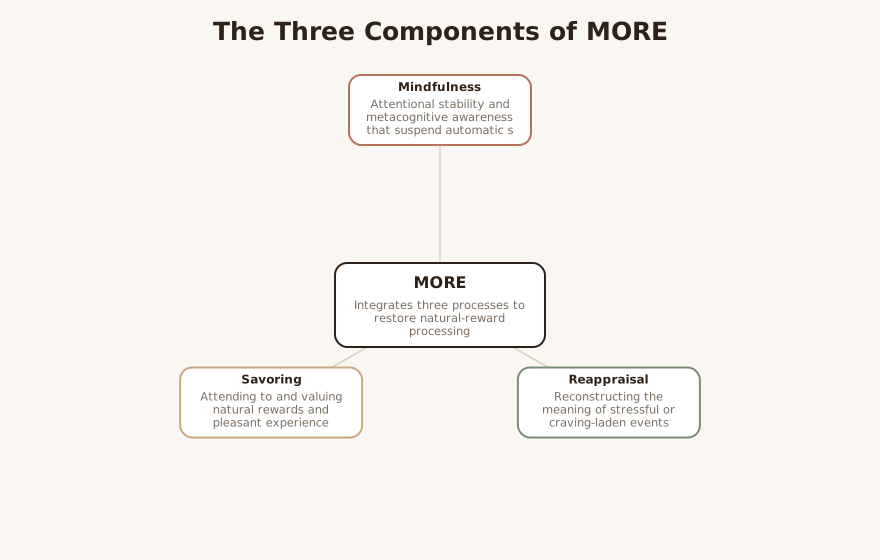
MORE’s three principles map onto this model. Mindfulness provides attentional stability and metacognitive awareness, suspending automatic drug-use or pain schemas and opening space for the revaluation of experience 2. Reappraisal reconstructs the meaning of stressful or craving-laden events, using a stabilized attention to hold affectively charged mental simulations of consequences 2. Savoring intentionally orients attention to the sensory and emotional dimensions of natural rewards, directly countering their relative devaluation 2. A defining innovation is that MORE makes valuation processes an explicit target rather than only attempting to suspend them, which differentiates it from traditional mindfulness-based approaches 2.
Interventions & Techniques
In session, mindfulness practice in MORE trains clients to notice attentional fixation on pain, stress, or craving and then to deconstruct those experiences into their component sensations, dampening their automatic grip 7. Reappraisal practice teaches clients to interrupt negative thought patterns and reframe stressful events to find meaning, building on the attentional control developed through mindfulness 7. Savoring practice asks clients to focus on the pleasant sensory features of positive experiences — for example the warmth of sunlight or a loved one’s touch — to amplify positive emotion and cultivate appreciation without clinging 27. The standard format delivers these skills across roughly eight weeks of group sessions, supported by home practice 7. Training of clinicians emphasizes experiential practice of these mind-body techniques, live supervision of delivery, and education in the underlying conceptual frameworks 5.
LLM-generated illustrative example (not a guideline): A clinician guides a client on long-term opioid therapy through a mindful body scan toward an aching lower back, helping them parse “pain” into discrete sensations of heat, tightness, and pulsing; the client later reappraises a flare as a signal to pace activity rather than catastrophize, and closes the session savoring a cup of tea — practicing the reorientation from drug-driven to natural reward that the protocol targets LLM.
Evidence Base
The evidence base for MORE is established. A multilevel meta-analysis synthesized 16 manuscripts reporting data from eight randomized controlled trials (N = 816) across addictive behavior, psychiatric distress, and chronic pain 1. It reported moderate-to-small standardized effects: reductions in addictive behavior (SMC = −0.54, p = 0.007), craving (SMC = −0.42, p = 0.010), opioid dose (mean change −17.95, p < 0.001), chronic pain (SMC = −0.60, p < 0.001), and psychiatric symptoms (SMC = −0.34, p < 0.001) 1. Notably, benefits were consistent regardless of participant race, gender, age, or income, and the authors recommended broader dissemination across healthcare systems 1. The program’s own summary cites trial findings of a 45% reduction in opioid misuse, a 42% reduction in drug relapse, and a 24% reduction in chronic pain 5.
Beyond outcomes, MORE has been studied for mechanistic target engagement. A study of opioid users provided neural and affective evidence that MORE remediates hedonic dysregulation, supporting the claim that the intervention acts on the reward processes it targets 3. Mechanistic work documents that MORE increases parasympathetic heart-rate variability during stress recovery, enhances late positive potential (an EEG marker) to natural-reward cues, and increases striatal and anterior cingulate responses during positive emotion regulation; increases in these savoring-related neural responses predicted increases in positive affect 2. Two caveats temper this picture: the cumulative randomized sample remains modest at 816 participants, and much of the trial and mechanistic work originates from the developer’s own research group, so independent replication strengthens, but does not yet dominate, the literature 12.
Populations & Indications
MORE was developed for and tested in adults with opioid misuse and chronic pain, and the developer positions it for opioid use disorder, addiction more broadly, chronic pain, depression, and PTSD 5. The condition list reported across trials and reference sources includes alcohol use disorder, opioid use disorder, smoking cessation, chronic pain, PTSD, and substance use disorders with comorbid psychiatric conditions 7. Because the meta-analysis pooled trials across addictive behavior, psychiatric distress, and chronic pain and found benefit across all three domains, the indication is broad within these reward-and-stress–related presentations 1. The finding that effects held across demographic groups supports use with diverse adult populations rather than a narrow subgroup 1.
Problems-for-Work
MORE is most directly indicated when the clinical problem is anchored in dysregulated reward and stress processing 2. Representative problems-for-work include opioid misuse and craving, where reappraisal and savoring aim to reduce the relative pull of the drug and restore natural reward 25. Anhedonia and blunted positive affect — the experiential face of hedonic dysregulation — are addressed through savoring practice that amplifies responses to natural rewards 2. Chronic pain and pain-related distress are worked through mindful deconstruction of pain into sensory components and reappraisal of pain meaning 7. Substance craving and cue-reactivity are targeted by mindfulness that suspends automatic use schemas 2.
LLM-generated illustrative example (not a guideline): For a client whose problem-for-work is “craving and emotion-driven relapse,” the clinician tracks weekly craving intensity and notes whether the client can apply a mindful “urge surfing” pause before acting, pairing it with a savoring exercise to rebuild a sense of reward from sober activities LLM.
Contraindications, Cautions & Cultural Humility
The provided sources do not specify formal contraindications for MORE, so clinicians should apply standard cautions for mindfulness-based and group interventions using clinical judgment LLM. Because MORE is frequently delivered to clients on long-term opioid therapy and reduces opioid dose in trials, any medication tapering should remain under the prescribing clinician’s management rather than being driven by the behavioral protocol alone 1. As an experiential, group-delivered intervention, MORE assumes a degree of tolerance for interoceptive attention to pain, craving, and emotion, which warrants pacing and individualized framing for clients with significant trauma histories LLM. On cultural humility, the meta-analytic finding that benefits were consistent across race, gender, age, and income is reassuring for equitable application, but consistency of average effect does not replace attentiveness to each client’s relationship to contemplative practice and to pain or substance use within their cultural context 1.
Treatment-Plan Suggestions & SMART Objectives
| Goal | SMART objective (example) | Mechanism |
|---|---|---|
| Reduce opioid misuse | Over 8 weeks, client reduces self-reported opioid misuse behaviors, supported by weekly self-monitoring logs reviewed each session 5 | Reappraisal and mindfulness reduce the relative salience of drug reward 2 |
| Restore natural reward / reduce anhedonia | Within 8 weeks, client completes a daily savoring practice at least 5 days/week and reports increased positive affect on a brief weekly measure 2 | Savoring amplifies neural and affective responses to natural rewards 2 |
| Lower craving intensity | Over the protocol, client reports a measurable decrease in peak weekly craving ratings 1 | Mindfulness suspends automatic use schemas and supports urge tolerance 2 |
| Reduce chronic pain interference | Within 8 weeks, client demonstrates use of mindful deconstruction of pain during at least 2 flares/week and reports reduced pain interference 7 | Mindful parsing of pain into sensory components reduces its automatic affective grip 7 |
| Improve emotion regulation under stress | By session 8, client applies reappraisal to at least one stressful event weekly and reports improved coping 7 | Reappraisal reconstructs meaning of stressors using stabilized attention 2 |
| Reduce psychiatric distress | Over 8 weeks, client shows a decrease on a standardized depression or anxiety self-report measure 1 | Combined reward-restoration and emotion-regulation skills reduce distress 1 |
| Build sustainable home practice | Client establishes a daily 10–15 minute formal mindfulness practice maintained ≥5 days/week by week 6 7 | Repeated practice consolidates attentional and metacognitive skill 2 |
Common Misconceptions
A frequent misconception is that MORE is simply a mindfulness or relaxation program; in fact mindfulness is only one of three integrated components, alongside reappraisal and savoring, and the protocol’s distinctive aim is to restructure reward valuation rather than to induce calm 27. A second misconception is that MORE descends directly from Mindfulness-Based Stress Reduction or Mindfulness-Based Cognitive Therapy; it is instead grounded primarily in affective neuroscience and integrates third-wave cognitive-behavioral and positive-psychology elements 7. A third is that mindfulness in MORE is meant to suspend all evaluation of experience; on the contrary, the model deliberately makes valuation an explicit target, which is its principal departure from earlier mindfulness-based interventions 2. Finally, the framing that MORE is purely an addiction treatment understates its tested scope, since trials and the meta-analysis also address chronic pain and psychiatric distress 1.
Training & Certification
Training in MORE is delivered to healthcare professionals, psychotherapists, and graduate students through multiple formats, including in-person and online options 5. The training model combines experiential skill practice in mind-body techniques, live supervision of intervention delivery, and education in the underlying conceptual frameworks 5. Certification requires completion of basic and advanced training plus demonstrated competence assessed with the MORE Fidelity Measure 5. According to the developer’s summary, more than 1,100 clinicians across medical centers, military systems, and community clinics have been trained, and at least one health system began offering MORE as a reimbursable service in 2021 5. Garland’s Guilford Press manual serves as the primary written reference supporting training and fidelity 4.
Key Terms
- Hedonic dysregulation — disruption of the brain’s capacity to appropriately value rewards, the central target of MORE 2.
- Allostatic framework — the model in which addiction reflects a downward shift in the hedonic set point as drug reward overshadows natural reward 2.
- Savoring — intentional attention to the sensory and emotional features of natural rewards to amplify positive emotion and restore their value 2.
- Reappraisal — reconstructing the meaning of stressful or craving-laden events using stabilized, mindful attention 2.
- Metacognitive awareness — the mindfulness-derived capacity to observe mental states, which suspends automatic schemas and enables revaluation 2.
- Target engagement — demonstration, via neural and affective measures, that the intervention acts on the reward processes it is designed to change 3.
- MORE Fidelity Measure — the instrument used to assess clinician competence for certification 5.
Resources & Further Reading
▶ Watch — a video introduction to this concept:
- Multilevel meta-analysis of MORE randomized controlled trials (PubMed)
- Restructuring reward processing with MORE: therapeutic mechanisms (PMC)
- MORE remediates hedonic dysregulation in opioid users: target engagement (Science Advances)
- Mindfulness-Oriented Recovery Enhancement (Guilford Press treatment manual)
- Dr. Eric Garland — About M.O.R.E. (official site)
- MORE for Opioid Misuse and Chronic Pain — Dr. Eric Garland (video)
- Mindfulness-Oriented Recovery Enhancement (Wikipedia)
Reflective / Supervision Questions
- For a given client, can you articulate how their presenting problem maps onto the hedonic-dysregulation model, and is that model a good fit or a forced one? 2
- When you teach savoring, are you tracking whether the client’s positive affect actually shifts, or only whether they complete the exercise? 2
- How do you hold the boundary between behavioral pain and craving work in MORE and the medical management of opioid dose, and who owns each decision? 1
- Given that much of the evidence comes from the developer’s group, how does that influence the confidence and framing you offer clients about expected benefit? 1
- For clients with trauma histories, how are you pacing interoceptive attention to pain and craving so the practice supports rather than overwhelms? LLM