
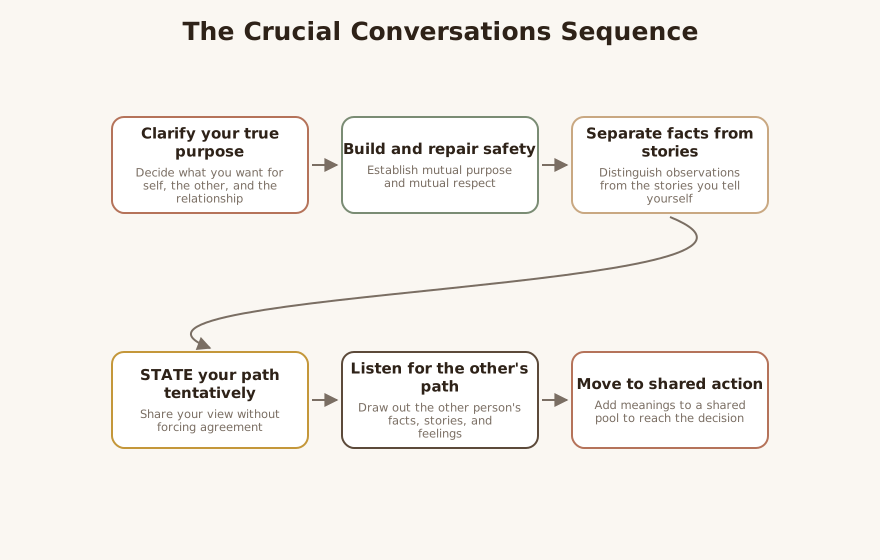
A “crucial conversation” is defined narrowly and usefully: it is any everyday interaction in which the stakes are high, opinions differ, and emotions run strong 2. These are not formal meetings or scheduled mediations; they are the ordinary moments — a feedback talk, a boundary with a partner, a disagreement on a care team — that disproportionately shape relationships and outcomes 2. For clinicians, the model is valuable precisely because so much of what we treat (relationship conflict, conflict avoidance, defensiveness, reactive anger) lives inside exactly these moments LLM.
Type & Discipline
Crucial Conversations is a structured communication framework drawn from organizational development and management research rather than from clinical psychotherapy 2. Its authors are organizational-development practitioners, and the model was disseminated primarily through corporate training rather than through randomized clinical trials 2. As such, it sits in the family of communication-skills models — alongside assertiveness training and Nonviolent Communication — and is best understood by therapists as a teachable skill set rather than a diagnosis-specific treatment LLM. The framework’s stated aim is to transform emotionally charged disagreement into collaborative problem-solving by keeping dialogue open under stress 5.
Creators & Lineage
The book was authored by Kerry Patterson, Joseph Grenny, Ron McMillan, and Al Switzler, organizational-development experts who founded the training company Crucial Learning (formerly VitalSmarts) 2. The first edition was published in 2002 1. The authors report having translated their work across dozens of countries and languages and trained hundreds of large organizations, which accounts for the model’s heavy footprint in corporate and healthcare-team settings 2.
The framework is not a clinical descendant of any single therapy, but its conceptual cousins are easy to see LLM. Its emphasis on stating your own perspective directly yet respectfully overlaps with assertiveness training, and its discipline around language (“I don’t… I do…”) echoes the request-and-observation structure of Nonviolent Communication LLM. Its central cognitive move — recognizing that you create your own emotions through the “story” you tell yourself about events — is structurally identical to the cognitive model used in cognitive behavioral therapy, where interpretations mediate between events and feelings 2. Its insistence on managing physiological arousal so that the thinking brain stays online parallels the distress-tolerance and emotion-regulation aims of dialectical behavior therapy LLM.
Core Principles
The model rests on the idea that meaning is pooled, not won 3. The authors reframe a high-stakes talk away from a “must-win” contest and toward “a process in which people add meanings to a shared pool of information,” and they argue the size of that shared pool predicts the quality of the eventual decision 3. The first principle, Start with Heart, asks the speaker to clarify what they genuinely want — for themselves, for the other person, and for the relationship — before engaging 3. This is paired with rejecting the Fool’s Choice, the false either/or belief that one must choose between honesty and the relationship 2.
The second principle is that safety is the precondition for honesty 5. People do not retreat into either silence (withdrawing, masking, avoiding) or “violence” (controlling, labeling, attacking) because the content is too hard; they do it because they no longer feel safe 2. Safety, in this model, rests on two pillars: mutual purpose (the other person believes you care about their goals, not only your own) and mutual respect (the other person believes you regard them as a worthy human) 4. When either pillar cracks, dialogue stops and defensiveness begins LLM.
The third principle is that emotions follow stories, not events 2. Between something happening and our feeling about it, we construct an interpretation, and it is the interpretation — not the raw event — that generates the emotion and drives the behavior 4. The fourth principle, drawn from the review literature, is physiological: under threat the limbic system can hijack the prefrontal cortex, so the practical work of the model is keeping arousal low enough that rational processing remains available 5.
Interventions & Techniques
The model operationalizes its principles into a sequence of named, teachable tools — which is precisely what makes it adaptable to a therapy room or a skills group LLM.
Learn to Look trains the person to notice, in real time, when a conversation has turned crucial and when they or the other have slipped into silence or violence 5. Make It Safe offers repair moves for when safety breaks, the most portable of which is Contrasting, a “don’t/do” statement that first names the misunderstanding you want to prevent and then states your real intent (“I don’t want you to think I’m questioning your competence; I do want us to solve this missed handoff”) 4. For situations where purposes genuinely diverge, the authors offer CRIB — Commit to seek mutual purpose, Recognize the purpose behind the strategy, Invent a mutual purpose, and Brainstorm new strategies 4.
Master My Stories uses a four-step retracing of one’s own reaction — the Path to Action — moving from what I saw or heard, to the story I told, to what I felt, to how I acted 4. The clinical payoff is that one can intervene at the story step, replacing “clever stories” — victim, villain, and helpless narratives — with a more complete and balanced account 4.
For speaking, the model offers the STATE skills: Share your facts (the least controversial, safest starting point), Tell your story, Ask for others’ paths, Talk tentatively, and Encourage testing (actively inviting disagreement) 4. For listening, it offers AMPP: Ask to get things rolling, Mirror the emotion you observe, Paraphrase to confirm understanding, and Prime with a best guess when the other person stays silent 4. Finally, Move to Action converts dialogue into concrete decisions with clear accountability — who does what, by when, and how follow-up will occur — so that good talk does not evaporate without behavior change 2.
Evidence Base
Maturity here should be labeled honestly as established as a practice model, not as a clinically validated treatment LLM. The framework’s credibility rests on the authors’ own organizational research and decades of widespread adoption across companies and healthcare systems rather than on a body of independent randomized controlled trials, and the reviewing literature describes it as “research-backed” in that organizational sense 52. The popular and review sources cited here are summaries and endorsements of a trade book, not peer-reviewed efficacy studies 15.
Clinically, this means the model should be presented to clients as a well-structured, widely used communication skill set with strong face validity, not as an empirically supported therapy for any DSM condition LLM. Its individual components, however, map onto mechanisms that are well supported elsewhere — cognitive reappraisal of interpretations, exposure to avoided assertive behavior, and arousal regulation — which is the most defensible basis for using it in practice LLM.
Populations & Indications
The model was built for and is most evidenced among managers and leaders, workplace groups, and healthcare teams, where high-stakes interprofessional dialogue is routine 2. It transfers readily to couples and families, since the authors frame its tools for use in relationships and homes as well as workplaces 5. Within a clinical practice it is most indicated for verbal, cognitively intact adults who can practice multi-step skills and tolerate structured rehearsal LLM. It is a natural fit in couples work, family sessions, leadership or workplace-stress presentations, and skills-oriented groups LLM.
Problems-for-Work
The framework targets the interpersonal problems clinicians see constantly LLM. For conflict avoidance, the rejection of the Fool’s Choice and the Start-with-Heart step give an avoidant client a rationale and a script for entering, rather than fleeing, a needed conversation 23. For assertiveness deficits, the STATE skills provide a graded path from sharing neutral facts toward voicing a genuine position tentatively but clearly 4.
For defensiveness and emotional reactivity, the Path-to-Action retrace lets a client locate the exact “story” that generated the spike and rewrite it before reacting 4. For anger, the silence-versus-violence framing names the controlling/attacking pattern non-pejoratively and reframes it as a safety failure to be repaired with Contrasting 24. For workplace and relationship conflict, the shared-pool-of-meaning model reframes the encounter from winning to information-gathering, lowering the adversarial temperature 3.
LLM-generated illustrative example (not a guideline): A nurse who “goes silent” when a physician overrides her on a discharge could use Learn to Look to notice the moment safety dropped, then open with shared facts (“Two of the last three discharges came back within 48 hours”) before telling her story tentatively and asking for the physician’s path. LLM
Contraindications, Cautions & Cultural Humility
The model is a communication-skills framework, not a treatment for acute psychopathology, and it should not substitute for indicated care in active suicidality, psychosis, mania, or acute trauma activation LLM. It also assumes a roughly symmetrical relationship in which both parties can pursue mutual purpose; in situations involving intimate-partner violence, coercive control, or genuine power abuse, coaching a client to “make it safe” for an unsafe other can increase risk and is contraindicated as a primary strategy LLM. The neuroscience framing in some summaries — limbic hijack versus prefrontal control — should be presented as a useful metaphor rather than a precise mechanistic claim 5LLM.
Cultural humility matters because the model’s defaults — direct verbal disclosure, tentative-but-explicit self-assertion, soliciting open disagreement — reflect a relatively low-context, individualistic communication style that is not universal LLM. For clients from high-context or hierarchical communication cultures, “talking tentatively” and “encouraging testing” may read as appropriate, or may conflict with norms of indirectness and deference; the clinician should adapt pacing and framing collaboratively rather than impose the script LLM. The shared-pool concept, however, is broadly translatable when the clinician lets the client define what respect and mutual purpose look like in their own context 4LLM.
Treatment-Plan Suggestions & SMART Objectives
| Goal | SMART objective (example) | Mechanism |
|---|---|---|
| Reduce conflict avoidance | Within 6 weeks, client initiates one previously avoided high-stakes conversation and logs the outcome in 2 of 2 instances | Rejecting the Fool’s Choice; Start with Heart 23 |
| Increase assertiveness | By session 8, client uses the STATE sequence (facts → story → ask) in a rehearsed role-play with <2 prompts | Graded behavioral practice of direct expression 4 |
| Lower emotional reactivity | Over 4 weeks, client completes a Path-to-Action retrace for 3 charged interactions, identifying the “story” each time | Cognitive reappraisal of interpretation 4 |
| Repair defensiveness in dyad | Within 5 sessions, partners use one Contrasting statement each during in-session conflict, rated ≥3/5 for clarity | Restoring mutual purpose and respect 4 |
| Improve listening under stress | By week 6, client demonstrates AMPP (ask, mirror, paraphrase, prime) in 1 of 1 observed exchange | Active perspective-taking; safety building 4 |
| Convert talk to behavior change | For each resolved conflict, client and partner name who/what/by-when in 3 of 3 conversations | Move-to-Action accountability 2 |
| Reduce silence/violence cycling | Over 8 weeks, client self-identifies a silence or violence move in real time on ≥4 occasions | Learn to Look self-monitoring 52 |
Common Misconceptions
A frequent misconception is that the model teaches people to soften or suppress what they think; in fact STATE is designed to help someone “communicate persuasively without aggression” while still saying what is on their mind 14. A second is that safety means agreement — but in this model safety is about mutual respect and purpose, and the explicit aim of “encourage testing” is to invite disagreement into the open, not to smooth it over 4. A third is that crucial conversations are big set-piece confrontations; the authors are clear they are usually small, everyday interactions 2. A fourth, important for clinicians, is that because the book is described as “research-backed,” it constitutes a validated clinical treatment — it does not, and conflating organizational adoption with clinical efficacy overstates the evidence 5LLM.
Training & Certification
The model is disseminated primarily through the authors’ training organization, Crucial Learning, which delivers structured courses and trains organizations directly rather than through a clinical licensing pathway 2. There is no clinical credential required to teach the skills, and the most accessible entry point for a practitioner is the source book itself plus the publicly available summaries 12. Clinicians wishing to use it responsibly should ground their delivery in their existing scope and modality rather than relying on a communication-skills certificate as a clinical qualification LLM.
Key Terms
Crucial conversation — an interaction marked by high stakes, differing opinions, and strong emotions 2. Pool of shared meaning — the collective information both parties contribute; larger pools yield better decisions 3. Fool’s Choice — the false belief that one must choose between candor and the relationship 2. Silence vs. violence — the two unproductive defaults (withdrawal versus control/attack) people use when safety drops 2. Mutual purpose / mutual respect — the two conditions that keep a conversation safe 4. Start with Heart — clarifying what you really want before engaging 3. Master my stories / Path to Action — retracing see/hear → story → feel → act to intervene at the interpretation 4. STATE — Share facts, Tell your story, Ask for others’ paths, Talk tentatively, Encourage testing 4. AMPP — Ask, Mirror, Paraphrase, Prime 4. Contrasting — a don’t/do statement that repairs misunderstanding 4. CRIB — Commit, Recognize, Invent, Brainstorm, for building mutual purpose 4. Move to Action — converting dialogue into accountable decisions 2.
Resources & Further Reading
▶ Watch — a video introduction to this concept:
- Crucial Conversations: Tools for Talking When Stakes Are High (Goodreads) — the primary source book listing 1
- Crucial Conversations Book Summary (Shortform) — detailed framework and terminology 2
- 6 Lessons from Crucial Conversations (Medium) — concise lesson-by-lesson walkthrough 3
- Crucial Conversations Book Summary (Wise Words) — STATE, AMPP, Path to Action, Contrasting 4
- Book Review: Crucial Conversations (New Horizon Partners) — seven-step framing and critique 5
Reflective / Supervision Questions
- When I coach a client to “make it safe,” am I checking that the relationship is symmetrical enough that the strategy will not increase their risk? LLM
- How am I distinguishing, in my documentation, between teaching this skill set and claiming an evidence-based treatment for the client’s diagnosis? LLM
- For this particular client, do the model’s defaults of direct disclosure and inviting open disagreement fit their cultural communication norms, or am I imposing a low-context style? LLM
- Which underlying mechanism am I actually targeting — cognitive reappraisal, behavioral assertiveness, or arousal regulation — and is the chosen modality the right vehicle for it? LLM
- When my client cycles into silence or violence in session, can I name it non-judgmentally as a safety failure rather than a character flaw? 2LLM