
Type & Discipline
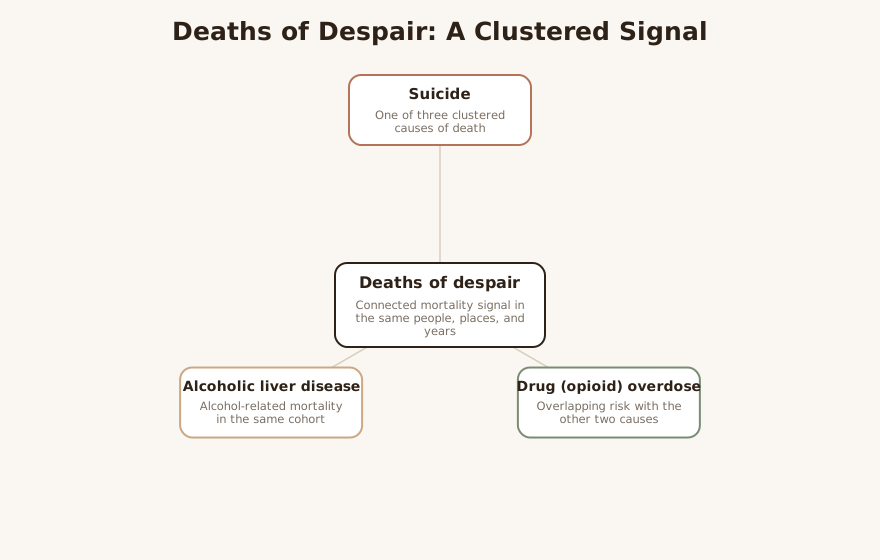
“Deaths of despair” is a construct from social epidemiology and health economics rather than a clinical diagnosis or a therapeutic modality 7. It names a statistical pattern: the simultaneous rise in mortality from three causes — suicide, drug (especially opioid) overdose, and alcohol-related liver disease — clustered in the same populations and time period 7. Economists Anne Case and Angus Deaton introduced and popularized the term, beginning with their 2015 analysis of midlife mortality and culminating in their 2020 book 13. The framework sits at the intersection of public health, sociology, and economics, and it borrows explicitly from Emile Durkheim’s classical sociology of suicide and his concept of anomie — the breakdown of the social framework within which people can live meaningful lives 7.
For practicing therapists, the construct matters not because you will “treat deaths of despair” but because it reframes how three of the most common and most lethal presentations in clinical work — suicidality, substance use, and alcohol misuse — may share upstream social and economic roots LLM. It invites the clinician to hold individual psychopathology and structural disadvantage in the same field of view LLM.
Creators & Lineage
The term and its empirical foundation come from Anne Case and Angus Deaton, the latter a Nobel laureate in economics 3. Their 2015 PNAS paper documented that all-cause mortality among middle-aged white non-Hispanic Americans had risen since 1999, reversing a long historical decline, and that this reversal was driven specifically by suicide, drug and alcohol poisonings, and chronic liver disease 1. In subsequent work they named this cluster “deaths of despair” and extended the analysis into a broader thesis about the labor market, the family, and American capitalism 23.
The intellectual lineage runs through several disciplines. Durkheim’s sociology of suicide supplies the core idea that suicide and self-destruction rise when society fails to provide members with a framework for dignified, meaningful lives 7. Social epidemiology and the social-determinants-of-health tradition supply the method of linking population mortality to economic conditions, education, geography, and social ties 5. Health economics supplies the focus on labor markets, wages, and the economic position of workers without college degrees 3. The construct has also drawn vigorous critics — notably economist Christopher Ruhm, who argued the opioid epidemic is driven more by drug supply than by despair, a debate Case and Deaton engaged directly 4.
Core Principles
The first principle is the clustering claim: suicide, drug overdose, and alcoholic liver disease are not unrelated tragedies but a connected epidemiological signal concentrated in the same people, places, and years 7. A scoping review of social determinants found substantial overlap in risk across all three causes, supporting the idea of a cohesive phenomenon rather than three coincidental epidemics 5.
The second principle is the education divide, what Case and Deaton call the “two Americas” 3. Adults with a four-year college degree have continued to grow healthier and wealthier, while adults without a degree increasingly face stagnant wages, broken families, and rising mortality 3. Lower educational attainment emerged as one of the most relevant social determinants across the three causes 5.
The third principle is that despair is relational and structural, not merely a mood state 2. Case and Deaton emphasize the slow erosion of stable employment, marriage, community institutions, and religious participation — a loss of the social capital that once absorbed economic shocks 2. Their explanation is one of cumulative disadvantage over a lifetime rather than a single triggering event 2.
The fourth principle is that income alone does not explain the pattern 2. The authors note that comparable economic hardship affected Black and Hispanic Americans without producing, initially, the same mortality rise, leading them to emphasize relative deprivation, dashed expectations, and lost social meaning rather than absolute poverty 2. One study cited in the scoping review even found higher absolute income associated with more despair-related deaths in some contexts, underscoring that relative position can matter more than raw income 5.
Interventions & Techniques
Because “deaths of despair” is a population-level construct, it does not prescribe a therapy protocol; its clinical value is as an assessment and case-formulation lens LLM. Several practical techniques follow from taking the framework seriously in the consulting room LLM.
First, integrated screening across the triad: when a client presents with one element — say, hazardous drinking — the construct prompts active screening for the other two, suicidal ideation and other substance use, because the scoping review found these risks travel together 5. Second, social-determinants history-taking: structured inquiry into job loss, underemployment, income trajectory, education, rural isolation, and the status of marriage, family, and community ties, since these were identified as the most relevant determinants 5. Third, meaning- and connection-oriented intervention: because the construct frames despair as anomie — a loss of the framework for a meaningful life — therapeutic attention to belonging, role, and purpose is directly indicated 7.
LLM-generated illustrative example (not a guideline): A 52-year-old man enters treatment after a fall related to drinking. Rather than addressing alcohol in isolation, the clinician screens for suicidal ideation and opioid use, maps his ten-year slide from a unionized job to intermittent contract work, and explores the loss of the social roles that work and a now-ended marriage once provided. The formulation links his drinking to hopelessness about a future that feels foreclosed. LLM
Fourth, harm-reduction and supply-side awareness: the Ruhm debate is a reminder that the lethal mechanism — for instance, the presence of fentanyl in the local drug supply — is itself a modifiable risk, so naloxone access and overdose education belong alongside any despair-focused work 4. Case and Deaton’s own position is that despair and drug supply are not competing explanations but interacting ones: despair creates vulnerability to addiction, while the availability and lethality of the drug determine whether that addiction kills 4.
Evidence Base
The descriptive core of the construct is well established 1. The 2015 finding that midlife mortality among white non-Hispanic Americans rose while it fell in other rich countries and other US groups is robust and widely replicated 1. National trend data are consistent: a Joint Economic Committee report found that the combined deaths-of-despair rate roughly doubled from 22.7 per 100,000 in 2000 to 45.8 in 2017, exceeding any level seen since the early twentieth century, with drug-related deaths rising most steeply 6. A scoping review confirmed that low socioeconomic position, low education, unemployment, and rural residence are the most consistently identified social determinants across the three causes 5.
The causal and interpretive layer is more contested, which is why the honest label for the framework is “established as description, debated as explanation” LLM. Christopher Ruhm and others argue that drug supply and environment — the arrival of OxyContin and later fentanyl — drive overdose deaths more than economic despair does 47. The Joint Economic Committee report similarly noted difficulty finding economic or self-reported-unhappiness trends that neatly match the mortality curves, and leaned toward supply-side framing 6. Critics have also challenged the original racial framing: more recent analyses indicate that Native American and Black Americans experience high or higher rates, so the “white working class” emphasis was incomplete 7. Case and Deaton have engaged these critiques directly, arguing for an interactive model rather than conceding the point 4. For the clinician, the takeaway is to use the construct as a hypothesis-generating lens, not as a proven mono-causal theory of any individual’s suffering LLM.
Populations & Indications
The construct was built on data from working-age adults, with the sharpest early signal among middle-aged white non-Hispanic Americans aged roughly 45 to 54 without a college degree 16. Subsequent research broadened the picture to working-age Americans more generally (ages 25 to 64), with significant mortality increases also documented among Black and Hispanic populations 57. Rural residents and people in deindustrialized regions are over-represented, and male overdose mortality exceeds female by roughly twofold 6.
Clinically, the lens is most indicated for working-class and economically displaced adults, unemployed or underemployed clients, people with substance use disorders, men in regions that have lost stable industry, and rural clients with limited services 56. It is also a useful frame whenever a client’s despair seems anchored less in intrapsychic conflict than in a genuine, ongoing loss of economic footing and social role LLM. The framework does not imply that affluent or college-educated clients are immune; rather, it flags a specific constellation of structural drivers most concentrated in non-college populations 3.
Problems-for-Work
The construct maps onto several concrete clinical problems-for-work. Suicidality and suicide risk: the lens prompts the clinician to weigh structural hopelessness — foreclosed futures, lost status — alongside standard risk factors, and to pair safety planning with attention to social reconnection 17. Alcohol use disorder and opioid and substance use disorders: these are screened together and understood as potentially self-medicating responses to pain and despair, while still requiring evidence-based addiction treatment and overdose prevention 45.
Hopelessness and despair: the Durkheimian frame treats this not only as a depressive symptom but as a rational-feeling response to anomie, which can guide interventions toward meaning, role, and belonging 7. Major depressive disorder frequently co-travels and may mediate the path from economic insecurity to the lethal outcomes 5. Chronic pain is a documented correlate, both as a driver of opioid exposure and as a marker of the bodily toll of declining working-class life 13. Social isolation and disconnection and economic stress and unemployment distress are addressed directly as determinants rather than as background noise, for example by validating the reality of job loss and supporting concrete reconnection and re-employment efforts 25.
LLM-generated illustrative example (not a guideline): A clinician treating a client for opioid use disorder reframes recurrent relapse not as moral failure but partly as a response to chronic back pain plus the collapse of the client’s identity after a plant closure. Treatment therefore couples medication-assisted treatment and naloxone training with work on rebuilding social roles and a sense of future. LLM
Contraindications, Cautions & Cultural Humility
The principal caution is interpretive overreach: “deaths of despair” is a population statistic, and importing it whole into an individual formulation risks deterministic, fatalistic framing of a client’s life LLM. No client should be told their suffering is an inevitable product of macroeconomics; doing so can deepen the very hopelessness the construct describes LLM. The framework is also empirically incomplete on race: the early “white working class” emphasis obscured high and rising rates among Native American and Black Americans, so applying the lens through a white-only template is both inaccurate and culturally insensitive 7.
A second caution concerns medicalization: critics note that labeling fundamentally social and economic problems as a “disease” of despair can pathologize structural injustice and obscure the absence of biological markers for suicide 7. Clinicians should resist collapsing economic and political conditions into individual diagnosis 7. A third caution is the supply-side reality: focusing only on despair while ignoring the lethality of the local drug environment can leave a client unprotected, which is why overdose prevention is non-negotiable regardless of one’s view of the despair debate 46. Cultural humility also means recognizing that the construct emerged in a specific US context and may not transfer cleanly to other societies, since comparable European economic pressures did not produce identical mortality patterns 37.
Treatment-Plan Suggestions & SMART Objectives
| Goal | SMART objective (example) | Mechanism |
|---|---|---|
| Reduce acute suicide risk anchored in structural hopelessness | Client will complete and use a collaborative safety plan and report any ideation at each session for the next 8 weeks | Risk mitigation; externalizing hopelessness that the despair frame links to anomie 7 |
| Integrated screening across the despair triad | Clinician and client will screen for suicidality, opioid use, and alcohol use at intake and monthly, documenting results | Co-occurring risks travel together per scoping-review evidence 5 |
| Reduce hazardous alcohol use | Client will reduce drinking days from 6 to 2 per week within 12 weeks, tracked with a daily log | Lowers alcohol-related liver and mortality risk; addresses one despair-triad cause 15 |
| Overdose prevention | Client will obtain naloxone and complete overdose-recognition education within 2 weeks | Targets the lethal supply-side mechanism in the despair–drug interaction 46 |
| Rebuild social connection and role | Client will re-establish two structured weekly social or community contacts over 6 weeks | Counters social-capital loss identified as a core driver 2 |
| Address economic-stress distress | Client will meet with a vocational or benefits resource and report outcomes within 4 weeks | Targets unemployment/underemployment as a named determinant 5 |
| Restore sense of meaning and future | Client will identify and act on one valued role or goal weekly for 8 weeks | Directly addresses Durkheimian anomie / loss of meaningful framework 7 |
| Treat co-occurring depression | Client will engage in weekly evidence-based depression treatment and complete biweekly symptom measures for 12 weeks | Depression mediates the path from insecurity to lethal outcomes 5 |
Common Misconceptions
A first misconception is that “deaths of despair” is a clinical diagnosis; it is a population-level epidemiological construct with no diagnostic criteria or biomarkers 7. A second is that it is a proven, single-cause theory; in fact the descriptive pattern is well established while the causal explanation remains actively debated between despair-centered and supply-centered accounts 46. A third is that it affects only middle-aged white men; the early data emphasized that group, but later analyses show high rates among Native American and Black Americans and across a wider age range 57.
A fourth misconception is that despair and drug supply are competing explanations one must choose between; Case and Deaton argue they interact, with despair creating vulnerability and supply determining lethality 4. A fifth is that the construct reduces to poverty or low income; the authors stress relative deprivation, lost expectations, and eroded social ties over absolute income, and at least one study found higher income associated with more despair-related deaths 25. A sixth is that it implies clinical fatalism; the construct describes risk at the level of populations, not destiny at the level of individuals LLM.
Training & Certification
There is no certification in “deaths of despair,” because it is a research construct rather than a treatment modality 7. Clinical fluency comes instead from reading the primary economics and epidemiology literature — the original 2015 PNAS paper, the commentary on causes and remedies, and the 2020 book — and from training in the modalities that actually deliver care for the underlying problems 123. For practitioners, the relevant credentials are in evidence-based treatment of substance use disorders, suicide-risk assessment and intervention, and the screening and social-determinants frameworks reflected in the scoping-review literature 5. Familiarity with the critical debate, including Ruhm’s supply-side argument and Case and Deaton’s reply, is part of using the construct responsibly 4.
Key Terms
Deaths of despair: the clustered rise in mortality from suicide, drug overdose, and alcohol-related liver disease, concentrated among non-college-educated adults 7. Anomie: Durkheim’s term for the breakdown of the social framework that gives life meaning, invoked to explain rising self-destruction 7. Two Americas: Case and Deaton’s framing of diverging health and economic trajectories between college-educated and non-college-educated adults 3. Cumulative disadvantage: the lifetime accumulation of economic and social setbacks proposed as the slow engine of despair rather than a single shock 2. Social capital: the community, family, and institutional ties whose erosion is implicated as a driver 2. Relative deprivation: disadvantage measured against expectations or others rather than by absolute income, emphasized over poverty alone 25. Social determinants of health: the economic, educational, occupational, and geographic conditions identified as the most relevant correlates of the despair triad 5.
Resources & Further Reading
▶ Watch — a video introduction to this concept:
- Case & Deaton (2015), Rising morbidity and mortality in midlife among white non-Hispanic Americans (PNAS)
- Deaths of Despair: Why? What to Do? (PMC / NIH)
- Deaths of Despair and the Future of Capitalism (Case & Deaton, Princeton University Press)
- Deaths of despair redux: a response to Christopher Ruhm (Case & Deaton, 2018, PDF)
- A Scoping Review on the Social Determinants of Drug Overdose, Alcohol-Related Liver Disease and Suicide (PMC)
- Long-Term Trends in Deaths of Despair (U.S. Congress Joint Economic Committee)
- Disease of despair (Wikipedia)
Reflective / Supervision Questions
- When a client’s despair is anchored in real, ongoing economic and social loss, how do I validate that reality without sliding into fatalism or implying their suffering is predetermined? LLM
- For a client presenting with one element of the despair triad, what is my routine for screening the other two, and where might I be missing co-occurring risk? LLM
- How do I hold both sides of the despair-versus-supply debate in practice — attending to meaning and connection while ensuring overdose prevention is in place? 4
- The construct’s early framing centered white working-class men; how might that template lead me to under-recognize despair-related risk in Native American, Black, or female clients? 7
- In my formulations, am I distinguishing population-level explanation from individual-level meaning, and am I checking whether the client experiences the “two Americas” framing as clarifying or as diminishing? 3
- Which structural supports — vocational, financial, community — can I reliably connect clients to, and how does the absence of those resources shape what therapy alone can achieve? 5