
Type & Discipline
Grit is a personality construct rather than a treatment modality, situated within personality psychology and the positive psychology tradition.1 It is defined as perseverance and passion for long-term goals — the tendency to sustain effort and interest toward a distant aim despite setbacks, plateaus, and the absence of immediate reward.1 As a construct, grit names a measurable individual difference; it is not in itself a therapy, a protocol, or an evidence-based intervention.LLM
For clinicians, the practical relevance of grit is twofold. First, it offers a vocabulary for discussing a client’s relationship to long-horizon goals — vocation, recovery, training, education — in a way that is intuitive and non-pathologizing.LLM Second, the construct’s two component facets, perseverance of effort and consistency of interest, map onto distinct clinical targets that respond to different interventions.1 Grit belongs to the family of self-regulatory and achievement-related traits and overlaps substantially with the Big Five trait of conscientiousness.7
Creators & Lineage
The construct was introduced by Angela Duckworth and colleagues Christopher Peterson, Michael Matthews, and Dennis Kelly in a 2007 paper in the Journal of Personality and Social Psychology, which proposed grit as a trait distinct from talent and IQ that predicts achievement across demanding settings.1 Duckworth subsequently developed the Grit Scale (and the shorter Grit-S), popularized the idea in a 2013 TED talk and a 2016 trade book, and built a substantial research program around it.34
The lineage of grit runs through several established traditions. It is an outgrowth of positive psychology, the strengths-and-flourishing movement co-founded by Christopher Peterson and Martin Seligman.5 It is conceptually adjacent to the literatures on self-control and conscientiousness, with which it shares strong empirical overlap.7 It is frequently discussed alongside Carol Dweck’s growth mindset, since beliefs about the malleability of ability plausibly support sustained effort, and it sits within the broader frame of achievement motivation theory.LLM Recognizing this lineage helps clinicians place grit accurately: it is a repackaging and popularization of long-standing self-regulation research rather than a wholly novel discovery.7
Core Principles
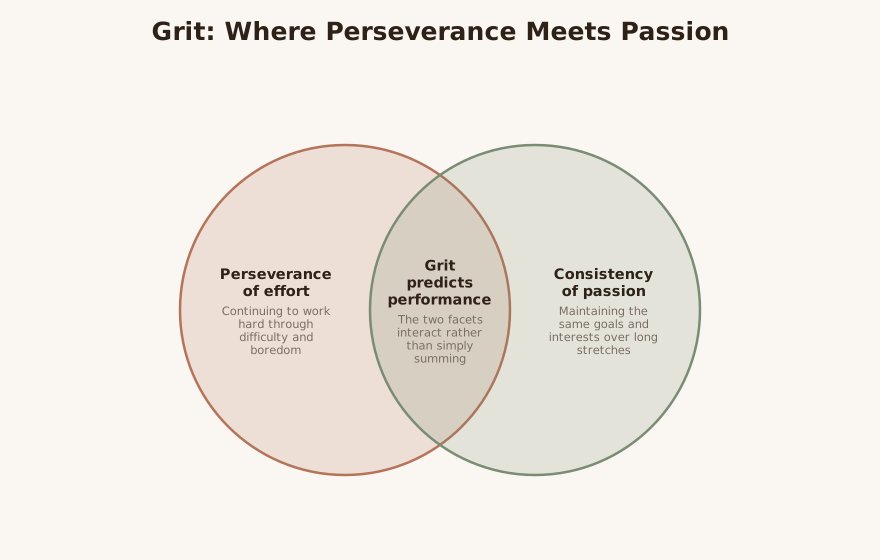
Grit rests on a small set of claims. The first is that sustained achievement in any demanding domain depends not only on talent but on the persistent, effortful application of that talent over years.1 The second is that grit has two facets: perseverance of effort (continuing to work hard through difficulty and boredom) and consistency of interest (maintaining the same goals and passions over long stretches of time).1 The third is that these facets, especially in combination, predict outcomes such as educational attainment, retention in arduous programs, and competitive performance.1
A central refinement came in 2018, when Duckworth and colleagues argued that grit positively predicts performance specifically when perseverance and passion operate together — that the two components interact rather than simply summing.2 In this view, perseverance without a stable object of passion can dissipate into scattered effort, while passion without perseverance produces enthusiasm that never matures into accomplishment.2 For the clinician, the take-home principle is that the productive variable is the conjunction of durable interest with durable effort, not either alone.LLM
Interventions & Techniques
Grit is not itself an intervention, so “grit-building” in practice means borrowing techniques from established modalities and orienting them toward the two facets.LLM To strengthen perseverance of effort, clinicians draw on behavioral activation, graded task assignment, implementation intentions (“if X, then I will do Y”), and deliberate-practice routines that make effortful work specific, scheduled, and feedback-rich.LLM To support consistency of interest, the work is more values-oriented: clarifying what the client cares about over a long horizon, connecting daily tasks to those values, and protecting a chosen goal from impulsive abandonment.LLM
Common technique clusters include goal hierarchies (organizing low-level tasks under a stable superordinate goal), values clarification drawn from Acceptance and Commitment Therapy, growth-mindset framing of setbacks as information rather than verdicts, and self-monitoring of effort and progress.LLM Motivational interviewing is useful when ambivalence about the goal itself is the obstacle, since grit interventions presuppose a goal the client genuinely wants.LLM None of these techniques is proprietary to grit; the construct functions as an organizing lens that tells the clinician which existing tools to reach for.LLM
LLM-generated illustrative example (not a guideline): A graduate student repeatedly starts and abandons thesis chapters. The clinician helps her build a goal hierarchy linking each writing session to the superordinate goal of becoming a researcher (consistency of interest), then installs a daily implementation intention and a visible progress tracker (perseverance of effort). The intervention targets goal abandonment, not the student’s character. LLM
Evidence Base
The honest summary is that grit is an established and heavily studied construct whose practical value has been overstated.7 The original 2007 work showed grit correlated with educational attainment and predicted retention among West Point cadets and performance in a spelling bee, results that were striking and widely cited.1 The construct’s measurement is well developed, and the research base is large.7
However, the most rigorous appraisal — a meta-analysis by Credé, Tynan, and Harms synthesizing 584 effect sizes from 88 samples and nearly 67,000 individuals — is sobering.7 It found that grit is only moderately correlated with performance and retention, that grit is very strongly correlated with conscientiousness (raising the question of whether it is a distinct trait at all), and that the proposed higher-order two-facet structure was not confirmed.7 Critically, the perseverance-of-effort facet carried significantly stronger criterion validity than consistency of interest, and the authors cautioned that interventions designed to raise grit may have only weak effects on success.7 The 2018 PNAS analysis offered a partial reply, arguing that grit predicts performance best when passion and perseverance are modeled as interacting rather than as independent additive terms.2
For practice, the defensible position is this: grit is a useful descriptive vocabulary and a reasonable clinical focus, but it is not a powerful or distinct lever, and most of its predictive work is done by the perseverance facet, which substantially overlaps with ordinary conscientiousness.7 Clinicians should resist framing grit as a fix-all or as a fixed trait that explains why some clients “have what it takes” and others do not.7
Populations & Indications
Grit research has concentrated on achievement-oriented populations: students across educational levels, athletes, military trainees, performers, and professionals in demanding fields.1 In clinical and coaching settings, it is most often invoked with emerging adults and young adults navigating education and early career, with adolescents facing academic demands, and with coaching clients pursuing performance or life goals.LLM
The construct is best indicated when a client has a goal they value but struggles to sustain effort or commitment toward it.LLM It is a poor fit when the presenting problem is the absence of any valued goal, when goal-pursuit is being driven by perfectionism or external pressure rather than genuine interest, or when apparent “low grit” is better explained by depression, attention-deficit difficulties, trauma, or material barriers.LLM In those cases the grit frame can obscure the actual clinical target.LLM
Problems-for-Work
Grit-oriented work is most natural when the problem-for-work involves the gap between intention and sustained action.LLM Procrastination and low self-discipline map onto the perseverance-of-effort facet and respond to behavioral structuring, implementation intentions, and self-monitoring.LLM Goal abandonment and avoidance of challenge map onto consistency of interest and respond to values clarification and goal-hierarchy work that keeps a long-term aim salient when novelty fades.LLM
Academic underachievement and low achievement motivation can be reframed, when appropriate, as effort and engagement problems rather than ability deficits, which often reduces shame and opens room for behavioral change.LLM Low frustration tolerance is addressed by normalizing setbacks and rehearsing effortful persistence through difficulty rather than escape.LLM Burnout, by contrast, requires caution: framing exhaustion as a deficit of grit can be harmful, and the clinical move is usually toward recovery, boundary-setting, and goal re-evaluation rather than more perseverance.LLM
LLM-generated illustrative example (not a guideline): A collegiate athlete with low frustration tolerance treats every missed performance as evidence he “isn’t cut out for it.” The clinician reframes plateaus as expected features of deliberate practice and builds a routine for persisting through them, targeting avoidance of challenge while monitoring for signs of burnout rather than pushing effort indefinitely. LLM
Contraindications, Cautions & Cultural Humility
The most important caution is that grit can be weaponized as a victim-blaming narrative.7 Attributing a client’s struggles to insufficient perseverance ignores structural barriers — poverty, discrimination, disability, unsafe environments — that constrain effort regardless of character, and the meta-analytic evidence does not support treating grit as a strong independent cause of success.7 Clinicians should never present low grit as a moral failing.LLM
A second caution concerns differential diagnosis: what looks like low grit is frequently a symptom of depression, ADHD, anxiety, trauma, or burnout, each of which calls for a different treatment plan than effort-coaching.LLM A third concerns the fixed-trait trap; framing grit as immutable contradicts the intervention rationale and risks demoralizing clients.LLM Culturally, the grit narrative is rooted in an individualistic, achievement-centric value system, and clinicians should hold it humbly when working with clients whose cultures prioritize interdependence, balance, or collective rather than personal goals.LLM Persistence in a harmful or misaligned goal is not a virtue, and helping a client disengage from a costly pursuit can be the clinically correct move.LLM
Treatment-Plan Suggestions & SMART Objectives
| Goal | SMART objective (example) | Mechanism |
|---|---|---|
| Reduce procrastination on a valued task | Client will complete three 25-minute focused work sessions per week for four weeks, logged in a tracker | Behavioral structuring and self-monitoring strengthen perseverance of effort 1 |
| Sustain commitment to a long-term goal | Client will articulate a written goal hierarchy linking daily tasks to one superordinate goal within two sessions | Goal-hierarchy work supports consistency of interest 2 |
| Increase frustration tolerance | Client will identify and reframe two “setback = failure” thoughts per week as practice information | Cognitive reframing reduces escape behavior under difficulty LLM |
| Reduce goal abandonment | Client will use a 48-hour rule before quitting any chosen goal, recording the decision process, for six weeks | Pre-commitment buffers impulsive disengagement LLM |
| Clarify durable interests | Client will complete a values-clarification exercise and rank three long-term aims within three sessions | Values clarity anchors passion to sustain effort 2 |
| Build deliberate-practice routine | Client will set one specific, feedback-rich practice target per week for one month | Deliberate practice converts effort into measurable progress LLM |
| Distinguish persistence from burnout | Client will rate weekly energy and meaning, flagging weeks below threshold for review | Self-monitoring guards against maladaptive over-persistence LLM |
Common Misconceptions
A frequent misconception is that grit is the strongest predictor of success, outweighing talent and circumstance; the meta-analytic record instead shows modest predictive validity and heavy overlap with conscientiousness.7 A related error is treating grit as a unitary trait, when the evidence indicates its two facets behave differently and that perseverance does most of the predictive work.7
Another misconception is that more grit is always better.LLM Persistence in a misaligned, harmful, or unattainable goal can deepen distress, and consistency of interest is only adaptive when the interest itself is worth keeping.2 Finally, many assume grit is fixed or innate; the intervention literature treats it as at least partially malleable, even as the same literature warns that grit interventions may produce only weak effects on outcomes.7 Clinicians who carry these misconceptions risk both overselling the construct and inadvertently shaming clients.LLM
Training & Certification
There is no certification in grit and no credentialed “grit therapy,” because grit is a construct rather than a treatment.LLM Familiarity is best gained by reading the primary literature — the 2007 founding paper, the 2018 interaction paper, and the Credé and colleagues meta-analysis — alongside Duckworth’s general-audience book for the popular framing.1273
Clinically, competence comes from training in the modalities that actually deliver grit-relevant work: cognitive-behavioral and behavioral-activation methods, Acceptance and Commitment Therapy for values work, and motivational interviewing for goal ambivalence.LLM The Grit Scale and Grit-S are freely available self-report measures that can be used to open conversation, but clinicians should treat scores as descriptive starting points rather than diagnostic results.5
Key Terms
Grit — perseverance and passion for long-term goals.1
Perseverance of effort — the facet describing sustained hard work through difficulty and boredom; the more predictive of the two facets.7
Consistency of interest — the facet describing maintenance of the same goals and passions over long periods.1
Conscientiousness — the Big Five trait of being organized, dependable, and self-disciplined, with which grit overlaps strongly.7
Growth mindset — Dweck’s construct that ability is malleable through effort, often paired conceptually with grit.LLM
Goal hierarchy — an organization of low-level tasks under a stable superordinate goal, used to align effort with passion.2
Resources & Further Reading
▶ Watch — a video introduction to this concept:
- Duckworth, Peterson, Matthews & Kelly (2007), “Grit: Perseverance and Passion for Long-Term Goals” (JPSP)
- Why grit requires perseverance and passion to positively predict performance (PNAS, 2018)
- Credé, Tynan & Harms (2017), “Much ado about grit: A meta-analytic synthesis of the grit literature”
- Grit: The Power of Passion and Perseverance (Duckworth, 2016) — author’s book page
- Angela Lee Duckworth: Grit (TED Talk)
- Grit (personality trait) — Wikipedia
- How Grit Shapes Success: Duckworth’s Research Explained
Reflective / Supervision Questions
- When I invoke grit with a client, am I describing a behavior pattern or implicitly assigning a moral characteristic?LLM
- Have I ruled out depression, ADHD, trauma, anxiety, or burnout before framing a client’s struggle as low perseverance?LLM
- Am I distinguishing the two facets — does this client need help sustaining effort, sustaining interest, or choosing a goal worth sustaining?LLM
- Could a grit framing here obscure structural or material barriers that are outside the client’s control?7
- Is continued persistence in this particular goal genuinely in the client’s interest, or would disengagement be the healthier move?2
- How does the achievement-centric, individualistic premise of grit fit — or clash with — this client’s cultural and personal values?LLM
1: Duckworth, Peterson, Matthews & Kelly (2007), JPSP — https://gwern.net/doc/psychology/personality/conscientiousness/2007-duckworth.pdf 2: Duckworth et al. (2018), PNAS — https://www.pnas.org/doi/10.1073/pnas.1803561115 3: Duckworth (2016), Grit (book) — https://angeladuckworth.com/grit-book/ 4: Duckworth (2013), TED Talk — https://www.ted.com/talks/angela_lee_duckworth_grit_the_power_of_passion_and_perseverance
6: Understanding Grit, Cannelevate — https://www.cannelevate.com.au/article/understanding-grit-duckworth-perseverance-success-2026/ 7: Credé, Tynan & Harms (2017), JPSP — https://pubmed.ncbi.nlm.nih.gov/27845531/