
Type & Discipline
The Community Reinforcement Approach (CRA) is a comprehensive behavioral treatment program for substance use disorders. 4 It sits within addiction treatment and belongs to the behavioral / contingency-based family of therapies, grounded in operant conditioning theory — the principle that behavior is shaped by its consequences, both positive and negative. 1 Rather than treating substance use as a discrete pathology to be confronted, CRA approaches it as an operant behavior maintained by reinforcement, and works to shift the balance of reinforcement in the person’s daily life. 3
The defining premise is deceptively simple: rearrange a person’s life so that abstinence is more rewarding than drinking or using. 3 CRA does this not through punishment or negative consequences but by building and amplifying competing sources of reward — social, recreational, familial, and vocational — so that healthy, drug-free living becomes genuinely satisfying and thereby competes with substance use. 2 In this sense CRA is best understood as a menu of integrated behavioral procedures rather than a single technique, individually assembled around what is reinforcing for a particular client. LLM
Creators & Lineage
CRA was introduced by George Hunt and Nathan Azrin in 1973 as a treatment for alcohol dependence. 3 Azrin, a behavior analyst, anchored the method firmly in operant principles drawn from the experimental analysis of behavior. 1 The original Hunt and Azrin trial compared CRA against standard hospital treatment and found CRA clients drank substantially less, spent fewer days institutionalized, worked more days, and showed greater social stability. 3
The approach was made clinically accessible to a wider audience when Robert J. Meyers and Jane Ellen Smith published the first treatment manual for clinicians, the Clinical Guide to Alcohol Treatment: The Community Reinforcement Approach, in 1995. 15 Meyers, who trained under Azrin, went on to develop the principal family-directed offshoot. LLM
Two major extensions share the same operant mechanism. 2 CRAFT (Community Reinforcement and Family Training), developed by Meyers and Smith, is a unilateral family intervention used when the person who uses substances refuses treatment; it coaches concerned significant others to modify the home environment so as to engage the loved one into care. 3 A-CRA (Adolescent Community Reinforcement Approach) adapts the model for youth, generally ages 12 to 24, with structured caregiver involvement. 41 The broader lineage connects CRA to contingency management — with which it is often combined, for example token rewards for clean drug tests in cocaine treatment — and to the empathic, non-confrontational stance it shares with motivational interviewing. 43
Core Principles
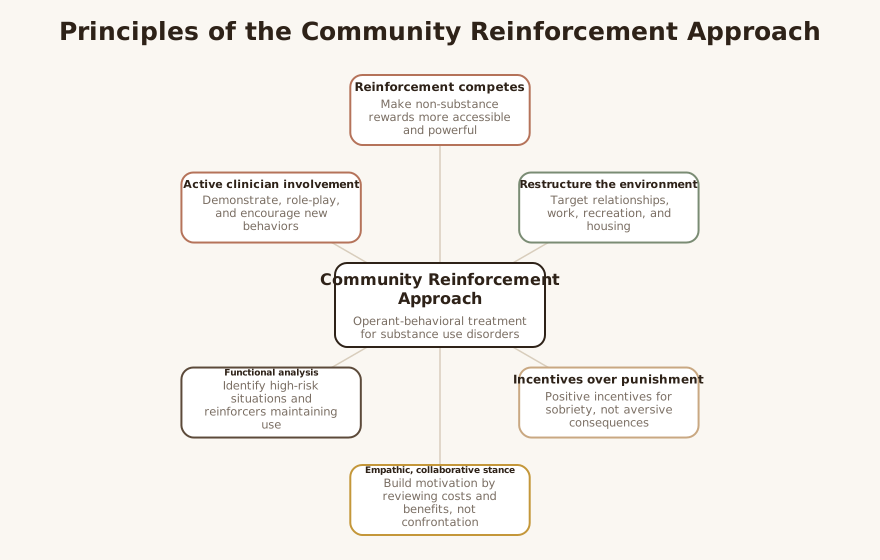
- Reinforcement competes. Substance use persists because it is reinforcing; recovery succeeds when alternative, non-substance-related sources of reward become more accessible and more powerful. 2
- Restructure the environment, not just the person. Environmental contingencies — relationships, work, recreation, housing — powerfully encourage or discourage use, and are therefore primary targets of intervention. 4
- Incentives over punishment. CRA provides positive incentives for sobriety rather than relying on aversive consequences or confrontation. 3
- Empathic, collaborative stance. Motivation is built through empathic review of the costs and benefits of use rather than confrontation. 3
- Individualization through functional analysis. A thorough functional analysis of use patterns identifies high-risk situations and the specific reinforcing consequences that maintain use, allowing treatment to be tailored. 3
- Active clinician involvement. The therapist demonstrates, role-plays, and actively encourages the client to try new behaviors and activities. 1
Interventions & Techniques
CRA is delivered as a set of modules selected to fit the client’s functional analysis. 3 Core components include:
- Functional analysis. A structured examination of antecedents, the substance-use behavior, and its positive and negative consequences, used both to map triggers and to identify candidate reinforcers for a sober lifestyle. 13
- Sobriety sampling. Rather than demanding lifelong abstinence at the outset, the clinician negotiates an intermediate, time-limited trial period of abstinence; offering explicit choice about the trial increases compliance. 3
- CRA treatment plan / happiness scale. Collaborative goal-setting, often organized around a satisfaction or “happiness” review across life domains, drives the selection of modules. 1
- Behavioral skills training. The therapist models and rehearses communication, problem-solving, and drink/drug-refusal skills through demonstration and guided practice. 14
- Social and recreational counseling. Clients are reconnected with non-using activities and people, including activity sampling and access counseling to remove practical barriers to participation. 3
- Vocational counseling / job club. Structured job-finding procedures address unemployment as both a stressor and a source of stabilizing reinforcement. 3
- Relationship / significant-other counseling. Brief relationship work improves positive communication, reduces conflict, and stops partners from inadvertently reinforcing use. 3
- Medication monitoring. Where indicated, supervised pharmacotherapy such as monitored disulfiram can be initiated and observed to support adherence. 3
- Relapse prevention. Functional analysis is reused to anticipate high-risk situations and rehearse responses. 6
LLM-generated illustrative example (not a guideline): A clinician and a client with alcohol use disorder complete a functional analysis showing that drinking reliably follows Friday isolation after a stressful work week. Together they negotiate a two-week sobriety sample, enroll the client in a Saturday recreational league (social/recreational counseling), rehearse a refusal script for a coworker who pressures him to drink (skills training), and set a check-in to review what felt rewarding (happiness review). LLM
Evidence Base
CRA is an established treatment, introduced over 35 years ago, and is described as having among the strongest scientific evidence of efficacy of any approach to substance use disorders — even though many clinicians remain unfamiliar with it, reflecting a persistent research-to-practice gap. 23 It demonstrates strong scientific evidence for short-term effectiveness relative to standard treatment. 1
Specific findings include:
- In studies combining monitored disulfiram with spousal involvement, drinking fell to about 2 percent of all days over a 6-month follow-up, versus roughly 55 percent in standard treatment. 3
- Among homeless alcohol-dependent individuals, CRA almost completely suppressed alcohol consumption over a 1-year follow-up, compared with about 40 percent drinking days in standard care. 3
- Outpatient CRA has shown effectiveness in as few as five to eight sessions, making it compatible with managed-care constraints. 3
- A-CRA ranked among the most cost-effective interventions in a multisite trial for adolescents with cannabis use disorder. 1
- A randomized controlled trial of 60 post-detox inpatients (predominantly heroin users) found that integrating 12 CRA sessions with standard treatment significantly improved overall quality of life (M=299.06 vs. 258.38, p<0.01, d=0.78) and happiness (M=79.43 vs. 68.47, p<0.001, d=0.95) versus standard treatment alone. 6
Honest caveats: much of the most robust evidence is for alcohol use disorder, and research on other drug disorders remains comparatively limited. 1 The quality-of-life RCT was small (n=60), had participant dropout, and was conducted in a single cultural setting, so its findings should be read as supportive rather than definitive. 6
Populations & Indications
CRA and its variants have been used with adults with alcohol use disorder; people with other substance use disorders including opioid, cocaine, and cannabis use; homeless populations with addiction; and adolescents and young adults via A-CRA. 234 The model has been adapted across diverse cultural contexts, including Native American communities that combined traditional ceremonies with CRA’s behavioral strategies. 3
CRA is particularly indicated where reinforcement deficits are prominent — social isolation, unemployment, conflictual relationships, or a lifestyle barren of competing rewards. LLM For treatment-resistant or unmotivated individuals who will not enter care, CRAFT offers a route in through a family member rather than the user. 2
Problems-for-Work
- Substance and alcohol use disorder — functional analysis plus sobriety sampling to initiate and consolidate abstinence. 3
- Treatment engagement / motivation deficits — CRAFT trains family members to reshape contingencies and invite the loved one into treatment. 3
- Relationship conflict — significant-other counseling improves positive communication and removes inadvertent reinforcement of use. 3
- Unemployment / vocational problems — job-club procedures restore work as a stabilizing reinforcer. 3
- Social skills deficits — modeling and behavioral rehearsal of communication and refusal skills. 1
- Relapse and treatment non-adherence — relapse-prevention rehearsal and, where appropriate, monitored medication. 36
LLM-generated illustrative example (not a guideline): A mother enters CRAFT because her adult son with opioid use disorder refuses treatment. The clinician helps her practice positive communication, stop covering his consequences, and time a warm, well-rehearsed treatment invitation — shifting the home environment toward reinforcing engagement. LLM
Contraindications, Cautions & Cultural Humility
CRA itself carries few absolute contraindications, but several cautions apply. LLM Medication components such as disulfiram require medical oversight and clear contraindication screening, and should never be initiated by a non-prescribing clinician acting alone. 3 CRAFT, while it shifts reinforcement at home, must never be applied where doing so could provoke or escalate domestic violence; clinician judgment and safety screening are essential before coaching a family member to change contingencies. LLM
Because CRA explicitly restructures a client’s social, vocational, and recreational world, what counts as a “reward” or a “healthy activity” is culturally and individually defined; the menu must be co-constructed with the client rather than imposed. 4 The successful adaptation of CRA within Native American communities by integrating traditional ceremonies illustrates that cultural responsiveness strengthens, rather than dilutes, the model. 3 The strongest evidence base remains in alcohol use disorder and in particular study populations, so clinicians should hold appropriate humility when extending CRA to under-studied groups. 1
Treatment-Plan Suggestions & SMART Objectives
| Goal | SMART objective (example) | Mechanism |
|---|---|---|
| Initiate abstinence | Client completes a negotiated 2-week sobriety sample with daily self-monitoring logs reviewed at each session for 2 weeks | Sobriety sampling with explicit choice raises compliance 3 |
| Map and reduce triggers | Within 3 sessions, client and clinician complete a functional analysis identifying top 3 high-risk situations and a coping plan for each | Functional analysis individualizes treatment 3 |
| Build competing reinforcers | Client samples and attends at least 2 non-using recreational/social activities per week for 4 weeks | Social/recreational counseling restores competing reward 3 |
| Strengthen refusal skills | Client demonstrates an effective drink/drug-refusal response in role-play with no prompting by end of session 5 | Behavioral skills training via modeling and rehearsal 1 |
| Stabilize vocation | Client completes job-club steps (resume, 5 applications) within 4 weeks | Employment as stabilizing reinforcer 3 |
| Reduce relational reinforcement of use | Partner and client practice 2 positive-communication exchanges weekly for 4 weeks | Significant-other counseling reduces inadvertent reinforcement 3 |
| Support medication adherence | Client takes monitored medication as prescribed, observed at scheduled check-ins, for 6 weeks | Supervised medication monitoring supports adherence 3 |
| Engage a treatment-refusing loved one (CRAFT) | Concerned significant other delivers a rehearsed treatment invitation within 6 weeks of starting CRAFT | Family training reshapes contingencies to promote entry 2 |
Common Misconceptions
- “CRA is just contingency management.” CRA frequently incorporates contingency management (e.g., token rewards for clean tests in cocaine treatment) but is a broader lifestyle-restructuring program spanning vocational, social, recreational, and relationship domains. 43
- “CRA confronts denial.” CRA is explicitly empathic and non-confrontational; motivation is built by reviewing the client’s own costs and benefits of use, not by breaking down denial. 3
- “It demands immediate lifelong abstinence.” Sobriety sampling deliberately uses intermediate, time-limited abstinence trials to lower the barrier to commitment. 3
- “It only works for alcohol.” CRA has been extended to cocaine, heroin, and cannabis and to homeless and adolescent populations, though the alcohol evidence base remains the deepest. 41
- “CRAFT is the same as CRA.” CRAFT is a distinct, unilateral intervention working through family members to engage a treatment-refusing person, not the direct treatment of the user. 4
Training & Certification
The foundational clinical text is Meyers and Smith’s 1995 Clinical Guide to Alcohol Treatment: The Community Reinforcement Approach (Guilford Press), which operationalizes the procedures for clinicians. 15 Robert J. Meyers maintains an official site describing CRA, CRAFT, and A-CRA and the training resources associated with them. 4 A-CRA in particular has structured certification processes used in multisite implementation; clinicians seeking to deliver A-CRA or CRAFT with fidelity should pursue model-specific training rather than relying on the manual alone. 1LLM
Key Terms
- Functional analysis — structured mapping of the antecedents, behavior, and consequences of substance use. 3
- Sobriety sampling — negotiated, time-limited trial of abstinence used as an intermediate goal. 3
- Reinforcer — any consequence (social, recreational, vocational, familial) that increases the likelihood of a behavior; CRA cultivates non-substance reinforcers. 2
- CRAFT — Community Reinforcement and Family Training; unilateral family intervention to engage treatment-refusing users. 3
- A-CRA — Adolescent Community Reinforcement Approach, adapted for youth ages roughly 12–24 with caregiver involvement. 4
- Job club — structured job-finding procedure addressing unemployment as a target of treatment. 3
Resources & Further Reading
▶ Watch — a video introduction to this concept:
- Community Reinforcement Approach (CRA) — Recovery Research Institute
- The community reinforcement approach: an update of the evidence (PubMed)
- The Community-Reinforcement Approach (PMC / NIAAA)
- Robert J. Meyers, PhD — CRA / CRAFT official site
- Clinical Guide to Alcohol Treatment: The Community Reinforcement Approach (Meyers & Smith, 1995)
- The effectiveness of CRA on quality of life and happiness among people using drugs (PMC)
Reflective / Supervision Questions
- For a given client, have I conducted a functional analysis that identifies not only triggers but the specific competing reinforcers a sober life could offer? 3
- Where am I being subtly confrontational rather than empathically reviewing the client’s own cost-benefit balance? 3
- Which life domain — social, recreational, vocational, relational — is most reinforcement-impoverished for this client, and is my plan targeting it? 2
- If a family member is seeking help for a treatment-refusing loved one, have I screened for safety before coaching contingency changes via CRAFT? LLM
- How am I co-constructing what counts as a “reward” with the client’s own cultural and personal values rather than imposing my own? 4
- Am I documenting measurable behavioral targets clearly enough to support medical necessity and supervision review? LLM