
Type & Discipline
Constructivist / Sociodynamic career counseling is a meaning-centered, philosophically grounded approach to career and life guidance that sits within counseling psychology and the broader constructivist tradition 1. Its defining move is epistemological rather than technical: it rejects the assumption of a single, objective reality to be discovered and instead treats reality as plural, subjective, and socially constructed, so that the counselor’s task is to help a person clarify and re-author the meanings by which they live 1. Within the family of career counseling, it represents a deliberate break from the older “test-and-tell” matching paradigm and from purely developmental stage models, repositioning career work as a form of life design and meaning-making 2.
A second hallmark is the collapse of the historical split between “career counseling” and “personal counseling.” LLM The contemporary consensus framing is that career interventions function as mental health interventions, because the same person is doing both the working and the suffering, and the meanings they make of work, identity, relationships, and transition are inseparable 7. This is why the approach is comfortably used by therapists rather than only by vocational specialists, and why it maps cleanly onto clinical concerns such as identity confusion, demoralization, and adjustment to loss LLM.
Creators & Lineage
The Sociodynamic strand was developed by Canadian counseling psychologist R. Vance Peavy, whose 2000 paper articulated a “sociodynamic perspective” and whose later book, SocioDynamic Counselling: A Practical Approach to Meaning Making (2004), laid out the applied method 13. Peavy drew explicitly on social constructionism — the view that knowledge, self, and reality are co-produced in language and culture — and on constructivist psychology’s image of the person as an active, self-organizing meaning-maker rather than a fixed set of traits to be measured 1.
A closely allied and partly overlapping lineage is Mark Savickas’s Career Construction Theory (CCT) and the Life Design paradigm he co-authored with an international group of vocational scholars 24. CCT integrates a narrative perspective onto older differential and developmental traditions, drawing on Adlerian psychology and using clients’ role models, formative stories, and “life themes” as the raw material of construction 5. Peavy’s Sociodynamic counseling and Savickas’s Life Design are typically grouped together as the constructivist wing of contemporary career theory, sharing the premise that people construct rather than simply discover careers 27. Distal influences include social constructionism and narrative therapy, both of which supply the central idea that identity is storied and revisable 15.
Core Principles
-
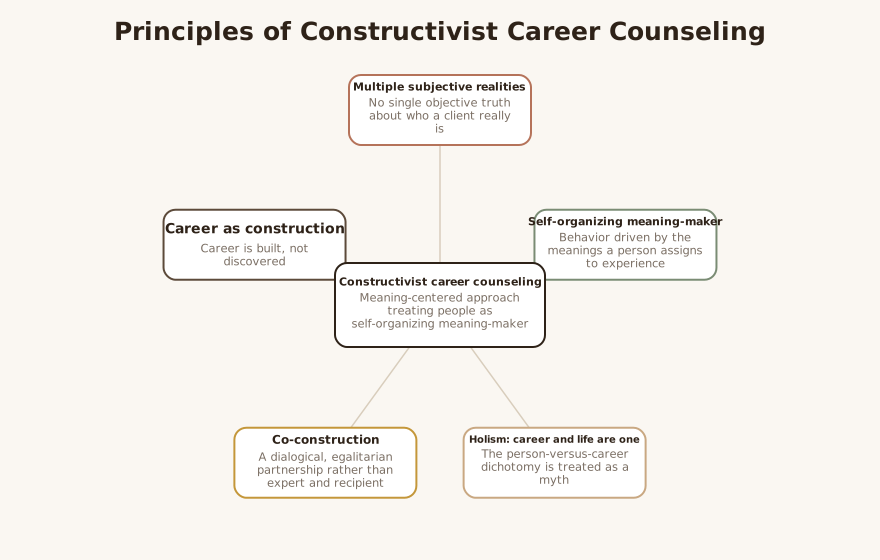
Multiple subjective realities. There is no single objective truth about who a client “really” is or what they are “meant” to do; there are multiple, equally legitimate constructions, and the counselor works within the client’s own frame rather than imposing an external one 1.
-
The person as self-organizing meaning-maker. Behavior is driven by the meanings a person assigns to experience, not by stimuli or traits alone, and counseling proceeds by surfacing and revising those meanings 7.
-
Holism — career and life are one fabric. People seek balance across work, health, relationships, and leisure, so career questions cannot be cleanly separated from personal-emotional ones; the person-versus-career dichotomy is treated as a myth 7.
-
Co-construction in a collaborative relationship. The helping relationship is dialogical and egalitarian: counselor and client are partners building understanding together, not expert-and-recipient 1. LLM Peavy framed the counselor less as a diagnostician and more as a companion who helps the client map and navigate their life space.
-
Career as construction, not discovery. The Life Design paradigm holds that careers are built through ongoing, self-authored projects across a fragmented, uncertain labor market, replacing the assumption of stable jobs and linear ladders 2.
-
Culture and context are constitutive. Meanings are made within social, cultural, and economic conditions, so the counselor attends to the client’s situated context rather than treating the individual as a self-contained unit 1.
Interventions & Techniques
The method is conversational and exploratory rather than test-driven. LLM In Peavy’s Sociodynamic practice the signature technique is life-space mapping — collaboratively drawing or describing the people, commitments, possibilities, and constraints that make up the client’s current “life space,” then using that map to identify movement and choice 36. The map is a working artifact, revisited and redrawn as the client’s construction shifts LLM.
Other core moves include:
- Dialogical inquiry / meaning-making conversation. Open, curious questioning that elicits how the client interprets events, rather than gathering facts to feed a matching algorithm 17.
- Future-oriented and possibility questions. Helping the client articulate hoped-for selves and concrete next steps, treating the future as constructible 2.
- Narrative work. In the Career Construction strand, the counselor uses a structured story interview — eliciting role models, favorite media, mottos, and early recollections — to surface recurring “life themes” the client can then deliberately extend 5. CCT’s posture is summarized as moving the client from actor to agent to author of their own career story 5.
- Attention to adaptability. Savickas’s framework foregrounds career adaptability — the psychosocial resources for coping with transitions — often summarized as the “4 C’s“: concern, control, curiosity, and confidence LLM. The counselor strengthens these capacities rather than only solving the presenting decision LLM.
LLM-generated illustrative example (not a guideline): A 34-year-old in a stalled administrative role says “I should want this job; everyone says it’s stable.” The counselor does not administer an interest inventory. Instead they map her life space (aging parent nearby, partner studying abroad, a long-dormant interest in teaching) and ask what story she would tell about herself in five years. A theme of “wanting to be the steady person others learn from” emerges, reframing the choice from “stay vs. quit” to “where does the teaching theme have room to live.” LLM
Evidence Base
Maturity here is best labeled established: the theory is mature, internationally influential, and widely taught, and the Life Design paradigm was articulated by a large, credentialed international consortium and published in a leading vocational-psychology journal 2. The conceptual lineage — social constructionism, narrative therapy, constructivist psychology — is well developed and coherent 15. LLM However, “established theory” should not be confused with a large randomized controlled-trial base. The constructivist career literature is dominated by theory, qualitative case material, and process studies rather than by manualized RCTs against active comparators, and effect-size meta-analyses specific to Sociodynamic counseling are sparse LLM. Counselors should therefore present it honestly as a well-reasoned, broadly accepted framework with strong face and ecological validity, while acknowledging that its outcome evidence is less quantitatively robust than, say, that for CBT for depression LLM. The CERIC/practitioner literature supports its clinical logic — that career interventions are also mental health interventions — more than it supplies controlled efficacy data 7.
Populations & Indications
The approach is well suited to adults in career transition, who face the construction problem most acutely as old certainties dissolve 2. It fits adolescents and emerging adults and students negotiating first identity-and-occupation questions, where narrative and life-theme work can give shape to inchoate possibility 5. It is indicated for people with identity concerns, since the method works directly on self-construction 1. It is appropriate for unemployed individuals and people navigating life transitions, for whom the holistic, balance-across-life-domains frame is especially apt 7. LLM More broadly, any client whose presenting “career” issue is entangled with mood, relationships, or a search for meaning is a candidate, because the model refuses to triage those apart 7.
Problems-for-Work
- Career indecision — reframed not as a deficit of information but as an unfinished construction; mapping and theme-work give the client a vantage point from which a decision can emerge 1.
- Identity confusion — addressed directly through narrative re-authoring, moving the client from “what am I?” to “what story am I living and want to live?” 5.
- Life transition distress — the life-space map externalizes a chaotic transition, making constraints and openings visible and workable 3.
- Adjustment difficulties — career adaptability resources (concern, control, curiosity, confidence) are explicitly cultivated as coping capacities LLM.
- Demoralization — possibility-oriented dialogue restores a sense of authorship and agency where the client feels stuck and acted-upon 2.
- Low self-efficacy — building “confidence” as an adaptability resource and rehearsing concrete next steps in the life space LLM.
- Meaning and purpose concerns — the central organizing target of the whole approach: helping the person make and revise meaning 7.
- Occupational stress — examined through the balance frame across work, health, relationships, and leisure rather than as an isolated job problem 7.
LLM-generated illustrative example (not a guideline): A recently laid-off engineer presents with low mood and “no idea who I am without my title.” Rather than rushing to resumes, the clinician treats the demoralization and identity rupture as primary, uses early-recollection and role-model questions to recover durable life themes, and only then translates an emerging theme (“solving problems for people who can’t”) into concrete options. LLM
Contraindications, Cautions & Cultural Humility
There are few absolute contraindications, but several cautions. LLM The approach is verbal, abstract, and time-intensive; the narrative method in particular requires extended engagement and is hard to deliver in tightly time-limited or single-session settings 5. Clients in acute crisis, active psychosis, or severe cognitive impairment may not be able to do the reflective meaning-making the model demands, and stabilization or more directive support should precede it LLM. The approach is not a substitute for concrete material help when unemployment is driven by structural or financial emergency LLM.
Cultural humility is built into the theory but must be enacted, not assumed. Because meaning is made within culture, the counselor must resist importing their own constructions of “good work” or “successful identity” and instead stay within the client’s frame, including collectivist, family-centered, or spiritually grounded constructions of vocation 1. LLM The egalitarian, co-constructive stance can itself clash with clients who expect or want expert guidance, and the counselor should negotiate that expectation openly rather than insisting on a non-directive posture. The Life Design paradigm’s premise of self-authored, fluid careers also assumes a degree of labor-market choice that not every client has, so the model should be applied without minimizing real structural constraints 2.
Treatment-Plan Suggestions & SMART Objectives
| Goal | SMART objective (example) | Mechanism |
|---|---|---|
| Clarify a stalled career decision | Within 6 sessions, client will complete a collaborative life-space map and name 2-3 viable options aligned with at least one identified life theme | Externalizing the construction; meaning-making over information 13 |
| Re-author occupational identity | Over 8 sessions, client will articulate a coherent personal “career story” linking past role models to a future self, rated as more authentic on a self-report scale | Narrative re-authoring; actor-to-agent-to-author shift 5 |
| Reduce transition-related distress | Within 4 weeks, client will report a measurable drop in transition distress and identify 3 controllable next actions | Restoring agency and authorship; possibility-oriented dialogue 2 |
| Build career adaptability | Over treatment, client will demonstrate gains in concern, control, curiosity, and confidence via a brief adaptability measure | Strengthening psychosocial coping resources (the 4 C’s) LLM |
| Address meaning/purpose concerns | By session 10, client will describe a personally meaningful organizing theme connecting work to broader life values | Meaning-making as the core therapeutic target 7 |
| Improve work-life balance under occupational stress | Within 6 weeks, client will map current allocation across work, health, relationships, and leisure and set 2 rebalancing actions | Holistic balance frame; person-career integration 7 |
| Increase self-efficacy for next steps | Over 5 sessions, client will complete 2 small real-world “experiments” testing a possible direction and review outcomes | Behavioral rehearsal building the “confidence” resource LLM |
Common Misconceptions
- “It’s just career advice / job matching.” The opposite: it explicitly rejects the matching paradigm in favor of self-construction and life design 2. LLM No test tells the client who they are.
- “Career and personal therapy are separate domains.” The approach is built on dismantling this dichotomy; the career issue and the mental-health issue are usually the same issue 7.
- “Constructivist means anything goes / there are no facts.” Multiple subjective realities is an epistemological stance about meaning, not a denial that labor markets, finances, and constraints are real; good practice holds both 12.
- “It’s only for the well-resourced.” While it assumes some reflective capacity, its holistic frame is especially relevant for the unemployed and those in disruptive transition 7. LLM The caution is about acute crisis and time pressure, not socioeconomic status per se.
- “Narrative work is unstructured chatting.” CCT’s story interview is a defined, repeatable protocol (role models, media, mottos, early recollections) with a clear analytic aim — surfacing life themes 5.
Training & Certification
There is no single licensure that confers “Sociodynamic counselor” status; competence is built through reading the primary texts and supervised practice LLM. Peavy’s SocioDynamic Counselling (2004) is the foundational practitioner text, and his 2000 article is the concise theoretical statement 13. For the Career Construction / Life Design strand, Savickas’s official materials and the Life Designing consortium paper are primary resources, and Savickas’s site curates training videos and articles 24. LLM Practitioners typically integrate this approach into existing counseling or psychotherapy credentials rather than pursuing a separate certificate; clinicians should ensure that when they use it to treat diagnosable conditions, they remain within the scope of their licensed practice. The Career Construction Interview specifically benefits from observed, supervised practice because its value lies in skilled thematic interpretation, not in mechanically asking the questions 5.
Key Terms
- Sociodynamic counseling — Peavy’s constructivist, meaning-centered approach treating the person as a self-organizing meaning-maker in a social field 13.
- Multiple subjective realities — the epistemological premise that there is no single objective reality, only socially constructed ones 1.
- Life-space mapping — collaboratively externalizing the people, commitments, and possibilities composing a client’s current life world 36.
- Life Design — Savickas et al.’s 21st-century paradigm framing careers as self-authored constructions amid uncertainty 2.
- Career Construction Theory (CCT) — Savickas’s narrative-plus-developmental theory of vocational behavior 45.
- Life themes — recurring organizing meanings recovered from a client’s story that guide career authorship 5.
- Career adaptability / the 4 C’s — concern, control, curiosity, and confidence: psychosocial resources for managing transitions LLM.
- Actor–agent–author — CCT’s developmental arc from playing a role, to managing it, to authoring one’s own story 5.
- Person-versus-career dichotomy — the rejected assumption that personal-emotional and vocational work are separate domains 7.
Resources & Further Reading
▶ Watch — a video introduction to this concept:
- Peavy, R. V. (2000). A sociodynamic perspective for counselling.
- Savickas, M. L. et al. (2009). Life designing: A paradigm for career construction in the 21st century.
- Peavy, R. V. (2004). SocioDynamic Counselling: A Constructivist Perspective (book).
- Career Construction Theory (CCT) — Mark Savickas official site.
- Career Construction Theory & Life Design — Marcr (Careers Theory).
- Sociodynamic Counselling: A Constructivist Perspective (memorial site to Vance Peavy).
- Breaking down the myth of the person-versus-career dichotomy — CareerWise (CERIC).
Reflective / Supervision Questions
- When a client presents a “career problem,” how reliably do I notice the mood, identity, or relational issue braided through it — and do I treat them as one or split them apart? 7
- Whose construction of “good work” or “success” is operating in the room — the client’s, or mine? Where might I be importing my own meanings? 1
- Am I genuinely co-constructing, or am I performing collaboration while steering toward a conclusion I have already reached? 1
- For this particular client in acute distress or under real structural constraint, is reflective meaning-making the right next move, or does stabilization / concrete help come first? LLM
- When I use narrative or life-theme work, can I articulate the theme I think I’m hearing, and check it against the client’s own words rather than my interpretation? 5
- How am I documenting this work so that, where a diagnosable condition is being treated, the clinical necessity and functional goals are clear and defensible? LLM