
Type & Discipline
Cognitive Behavioral Therapy for Adult ADHD is a disorder-specific, manualized application of cognitive behavioral therapy developed within clinical psychology to address the organizational, planning, attentional, and self-defeating-thinking difficulties that persist in adults with attention-deficit/hyperactivity disorder 2. It is best understood as a standalone modality in its own right — a structured, skills-based, time-limited protocol — rather than a loose collection of coping tips, and it is delivered in both individual and group formats across roughly six to fourteen sessions depending on the model 4. The most widely disseminated version, the Mastering Your Adult ADHD program, is organized into discrete modules with a therapist guide and a companion client workbook, which places it firmly in the family of disorder-specific CBT protocols 25.
A defining and clinically important feature is what the modality does not claim to do LLM. It is framed by its developers and proponents as an intervention that targets the secondary and functional consequences of ADHD — procrastination, time management, disorganization, demoralization, and low self-esteem — rather than the core neurobiological symptoms of inattention, hyperactivity, and impulsivity themselves 6. Steven Safren’s frequently cited formulation is that “CBT picks up where medication leaves off,” capturing the model’s positioning as a complement to, not a replacement for, pharmacological treatment of the underlying disorder 6.
Because adults with ADHD typically arrive with a long history of underachievement relative to ability, the modality is simultaneously skills-focused and emotionally restorative LLM. It teaches concrete external systems for compensating for executive dysfunction while also addressing the corrosive, often distorted self-talk — “I always fail at this,” “It has to be perfect or it’s worthless” — that lifelong setbacks tend to produce 6.
Creators & Lineage
The most established protocol was developed by Steven Safren together with Susan Sprich, Carol Perlman, and Michael Otto, and is published as Mastering Your Adult ADHD: A Cognitive-Behavioral Treatment Program, with a therapist guide and client workbook issued in a second edition in 2017 25. This protocol was deliberately designed for adults with ADHD who were already taking medication but continued to have residual symptoms, and its evidence base — including a trial published in the Journal of the American Medical Association — documents improved outcomes when the program is delivered alongside medication 51.
A second major lineage runs through Mary Solanto, who developed a group-based CBT model focused specifically on executive dysfunction, sometimes described as metacognitive therapy because it trains the planning, organizing, and self-monitoring functions that ADHD impairs 6. J. Russell Ramsay represents a third influential strand, emphasizing the tight coupling of cognition and action in ADHD — that “changing thoughts and changing behavior work hand in hand” — and the role of implementation-level, in-the-moment strategies for translating intention into completed tasks 6.
The broader lineage is conventional cognitive behavioral therapy LLM. The cognitive component descends directly from Beckian cognitive restructuring: the assumption that distorted automatic thoughts drive emotional difficulty and avoidance, and that identifying and disputing them changes behavior 6. The behavioral component draws on standard skills-training and behavioral-activation traditions, adapted into ADHD-specific external scaffolds such as calendars, task lists, and timers 2. What makes the modality distinct from generic CBT is the disorder-specific content — modules built around the predictable failure points of the ADHD adult — layered onto that familiar cognitive-behavioral architecture 24.
Core Principles
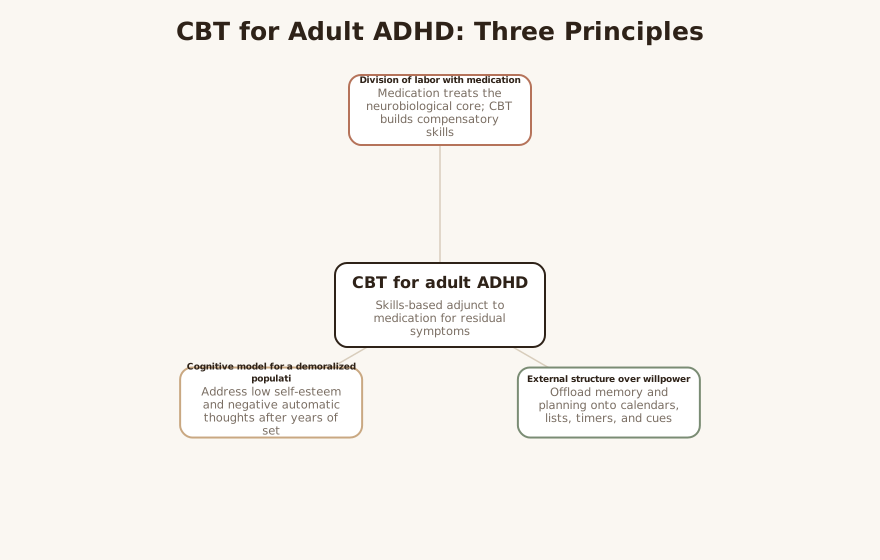
The first organizing principle is division of labor between medication and therapy LLM. The model assumes that medication addresses the neurobiological core of ADHD while CBT builds the compensatory skills and adaptive thinking that medication alone does not supply; CBT “picks up where medication leaves off” 6. This is why the foundational protocol was designed for, and tested in, adults already on medication who had persistent symptoms 1.
A second principle is external structure over willpower LLM. Rather than exhorting the client to try harder, the modality installs concrete, low-friction external systems — a single calendar, a maintained task list, a filing system, timers and environmental cues — on the premise that executive dysfunction is best compensated for by offloading memory and planning onto reliable external tools 26. The mantra taught in some versions, “If it’s not in the planner, it doesn’t exist,” captures this stance 6.
A third principle is the cognitive model applied to a demoralized population LLM. After years of setbacks, adults with ADHD frequently develop dangerously low self-esteem and pervasively negative automatic thoughts, and the modality treats these distortions — all-or-nothing thinking, overgeneralization, “should” statements, magnification — as direct targets, because they fuel avoidance and procrastination 6. A fourth principle is task decomposition and activation: breaking lengthy or aversive tasks into smaller segments and using cues to initiate and sustain action, which addresses the procrastination and task-initiation failures at the heart of ADHD-related impairment 26. Underlying all of these is a fifth, easily missed principle — that the target of treatment is functioning and quality of life, not the elimination of inattention or hyperactivity as such 6.
Interventions & Techniques
The interventions cluster into the three core modules of the established protocol 1. The first module pairs psychoeducation about ADHD as a neurobiological condition with organization and planning training — establishing a calendar and task-list system, a filing system, and a problem-solving method for prioritizing competing demands 12. The second module teaches techniques to manage distractibility and a short attention span, including breaking long tasks into shorter segments matched to the client’s actual attention span and using timers and cues to sustain focus 12. The third module is cognitive restructuring — learning to think more adaptively in situations that provoke distress, by catching, examining, and disputing the automatic negative thoughts that drive avoidance 16.
Beyond the core, the protocol includes optional modules addressing procrastination directly and involving a family member or partner in an informational session, so that the people around the client understand the disorder and support the new systems 12. Solanto’s group model adds the dimension of peer-based metacognitive practice, in which executive-function skills are rehearsed and reinforced in a group of similarly affected adults 6.
Across models, two cross-cutting techniques recur LLM. Behavioral strategies are concrete and externalized — wearing a watch, linking a planner-check to an existing daily routine, environmental engineering to reduce distraction 6. Cognitive strategies are restructuring-based — positive self-coaching, rational disputation of perfectionistic or catastrophic thoughts, and replacing self-defeating predictions with workable ones 6. Homework and coaching elements are common, with the therapist functioning partly as a coach who supports the between-session implementation that is so often where ADHD intentions break down 4.
LLM-generated illustrative example (not a guideline): An adult on a stable stimulant dose still misses work deadlines and avoids opening bills. In the organization module the clinician helps the client consolidate everything into one calendar and a single running task list, with a planner-check anchored to morning coffee. In the distractibility module they break “do taxes” into six fifteen-minute sub-tasks with a timer. In the restructuring module they catch the thought “If I can’t do it perfectly I shouldn’t start,” test it against evidence, and replace it with “A rough draft started is better than a perfect one imagined.” The client begins clearing the backlog LLM.
Evidence Base
The honest maturity label is established — but “established” here means recognized, manualized, and widely implemented, with a real randomized-trial literature, not that the evidence is uniformly high quality LLM. The modality has published therapist and client manuals, multiple randomized controlled trials, and at least one Cochrane-style systematic review, which is more than enough to place it among the better-developed disorder-specific CBT protocols 247.
The strongest single trial is Safren and colleagues’ randomized controlled trial comparing CBT against relaxation with educational support in 86 medication-treated adults with persistent ADHD symptoms 1. CBT was significantly superior on both the ADHD Rating Scale (effect size d = 0.60) and the Clinical Global Impression scale (d = 0.53), with 67% of CBT participants classified as responders versus 33% of controls, and — importantly for durability — gains were maintained at 12-month follow-up 1. This is the study that grounds the modality’s signature claim: that CBT is a useful next-step strategy for medicated adults with residual symptoms 1.
The systematic review tempers this picture and should be read carefully LLM. Pooling 14 randomized trials and 700 participants, it found large effects for CBT versus waiting list (clinician-rated SMD around −1.22) and as an adjunct to medication versus medication alone (SMD around −0.80), but only small and unclear advantages over active control conditions such as supportive therapy, where the evidence was low quality 7. Critically, all trials were at high risk of performance bias because psychotherapy cannot be blinded, allocation concealment was often unclear, and some studies had high attrition 7. The review’s overall verdict was deliberately modest: there is low-quality evidence that cognitive-behavioral treatments may be beneficial for adults with ADHD in the short term, with thin long-term follow-up data limiting generalizability 7.
One further trial complicates the dominant “adjunct for the medicated” narrative and deserves honest reporting LLM. Weiss and colleagues randomized adults to nine sessions of problem-focused CBT plus either dextroamphetamine or placebo and found robust improvement in both arms — a large effect on symptoms (d ≈ 1.1) — with medication adding no significant benefit over CBT and placebo 3. This supports the use of CBT for unmedicated adults or those who cannot tolerate stimulants, but the sample was small (roughly 23 and 25 per arm), and the result runs against the larger body of work framing CBT primarily as a next-step for residual symptoms in medicated patients; it should not be over-read into a claim that CBT replaces medication 31. The fair summary: CBT for adult ADHD reliably outperforms doing nothing and adds value to medication, its advantage over a credible active therapy is uncertain, and the supporting trials carry the unavoidable methodological limits of unblindable psychotherapy research 74.
Populations & Indications
The signature population is medication-treated adults with persistent, residual ADHD symptoms — the group for whom the foundational protocol was designed and in whom it was tested 15. For these clients, medication has reduced the neurobiological core but functional impairment in organization, planning, and follow-through remains, and CBT targets exactly that gap 16.
A second indication is unmedicated adults with ADHD, including those who cannot tolerate stimulants, decline them, or are awaiting access; the Weiss trial provides direct, if small-sample, support for CBT delivering meaningful improvement without medication 3. A third group is adults with ADHD and comorbid anxiety or depression, since the systematic review found consistent reductions in anxiety and moderate improvements in depression alongside the ADHD-specific gains 7. A fourth, cutting across the others, is adults carrying ADHD-related demoralization and low self-esteem — the population whose negative automatic thoughts the cognitive-restructuring component is built to address 6.
The general indication is an adult with ADHD whose primary distress lies in the functional and emotional consequences of the disorder — chronic procrastination, disorganization, missed obligations, and the demoralization these produce — who has sufficient stability and motivation to practice external systems and homework between sessions LLM. CBT is delivered in both individual and group formats, with group models particularly associated with the executive-function-focused approach 46.
Problems-for-Work
In chronic procrastination and missed deadlines, the modality is almost custom-built: the organization module installs a calendar-and-task-list system, the distractibility module supplies task decomposition and timed work blocks, and the optional procrastination module addresses the avoidance directly 12. In disorganization and poor planning, the same externalizing systems — a single calendar, a filing system, a problem-solving method — substitute reliable structure for unreliable working memory 2.
LLM-generated illustrative example (not a guideline): A client whose desk, inbox, and finances are in chronic disarray works through the organization module to consolidate every commitment into one place and to build a weekly review ritual. Rather than aiming for a transformed personality, the goal is a maintainable system the client can actually keep — which is what reduces the cascade of missed bills and forgotten appointments LLM.
In distractibility on extended tasks, breaking work into attention-span-sized segments with timers and cues makes long tasks tractable 1. In negative automatic thoughts and cognitive distortions — all-or-nothing thinking, “should” statements, magnification — cognitive restructuring catches and disputes the thoughts that fuel avoidance 6. In demoralization and low self-esteem secondary to lifelong setbacks, the restructuring and self-coaching work directly targets the corrosive self-narrative, and the trial evidence of accompanying reductions in depression and anxiety speaks to its reach into this domain 67.
LLM-generated illustrative example (not a guideline): A client says, “I’ve always been lazy and I always will be.” The clinician reframes the history through psychoeducation about ADHD as a neurobiological condition, then uses restructuring to test “lazy” against evidence of effort that simply lacked external structure. As the new systems produce visible wins, the self-defeating prediction loses its grip and task initiation improves LLM.
Contraindications, Cautions & Cultural Humility
The first caution is scope LLM. This modality does not treat the core symptoms of ADHD; it addresses their functional and emotional sequelae, so presenting it as a substitute for an adequate assessment of, and where appropriate medication for, the underlying disorder would misrepresent it 6. For most clients the foundational protocol assumes medication is in place, and CBT is the next step for what medication leaves behind 1.
A second caution concerns the evidence itself LLM. Because the clearest advantages are over waiting lists and as a medication adjunct — while the edge over active therapies is small and low-quality, and all trials are unblindable — clinicians should hold the modality’s effectiveness claims with appropriate humility and avoid overselling it as uniquely superior to other credible psychotherapies 7. A third caution is fit and capacity: the model is demanding of between-session practice, and clients with severe untreated comorbidity, acute crisis, or executive impairment so profound that homework is not yet feasible may need stabilization or different sequencing first LLM.
Cultural humility matters because several premises are not culturally neutral LLM. The model’s individualistic, productivity-oriented frame — calendars, task lists, deadlines, self-coaching — reflects a particular set of cultural expectations about work and time, and the very labels it disputes (“lazy,” “underachieving”) carry meaning shaped by a client’s family, community, and educational history LLM. Adapting the external systems to the client’s actual life and values, and being alert to how stigma around both ADHD and help-seeking varies across communities, is part of competent delivery LLM.
Treatment-Plan Suggestions & SMART Objectives
| Goal | SMART objective (example) | Mechanism |
|---|---|---|
| Build a reliable organization system | Within 3 sessions, client maintains a single calendar and task list and performs a daily planner-check anchored to an existing routine | Organization-and-planning module externalizes executive demands onto reliable tools 2 |
| Reduce procrastination on aversive tasks | Within 6 weeks, client completes one previously avoided task per week by breaking it into ≤15-minute segments | Task decomposition and timed work blocks address distractibility and avoidance 1 |
| Sustain attention on extended work | Client completes timed focus blocks matched to attention span on 4 of 5 workdays, before session 6 | Distractibility-management techniques use cues and timers to sustain focus 1 |
| Restructure self-defeating thinking | Client identifies and disputes at least two ADHD-related negative automatic thoughts per week using a thought record | Cognitive restructuring targets distortions that drive avoidance 6 |
| Improve task initiation | Client initiates the day’s top-priority task before noon on 4 of 5 days by session 8 | Behavioral activation plus external cues counters task-initiation failure 6 |
| Address demoralization and self-esteem | Client reports increased positive self-coaching and a measured drop in depressive symptoms by treatment end | Restructuring of the lifelong “underachiever” narrative reduces secondary mood symptoms 67 |
| Maintain gains as a next step after medication | Client demonstrates continued use of systems and skills at a follow-up review | CBT consolidates functional gains that medication alone does not produce, with durability shown to 12 months 1 |
Common Misconceptions
The first misconception is that CBT treats the core symptoms of ADHD; in fact its developers and proponents are explicit that it intervenes on the secondary consequences — procrastination, time management, organization, demoralization — and not on inattention, hyperactivity, and impulsivity as such 6. A second is that CBT can replace medication for most adults; the foundational protocol was designed as a next step for medicated patients with residual symptoms, and while one small trial supports CBT for unmedicated adults, that finding should not be inflated into a general substitution claim 13.
A third misconception is that the evidence is uniformly strong; the most rigorous synthesis rates it as low-quality evidence of short-term benefit, with the clearest effects against waiting lists and as a medication adjunct, and only an uncertain edge over active therapies 7. A fourth is that ADHD CBT is mainly “talk therapy”; it is heavily behavioral and skills-based, installing concrete external systems, with cognitive restructuring as one component rather than the whole 26. A fifth is that it is a brief tune-up; while time-limited, it is an active, homework-intensive protocol whose results depend on between-session practice 4.
Training & Certification
There is no single certifying board that owns this modality; it is delivered by already-qualified mental health professionals — psychologists, social workers, counselors, and others trained in cognitive behavioral therapy — who add the ADHD-specific protocol to their existing scope LLM. The principal route to competence is the published Mastering Your Adult ADHD therapist guide and companion client workbook, which lay out the session-by-session structure and the module content in a form a trained CBT clinician can implement 25.
Because the modality is an application of standard cognitive behavioral therapy to a specific disorder, the practical training path is to bring solid generic CBT skills — case formulation, cognitive restructuring, behavioral activation, homework design — and then learn the ADHD-specific adaptations: the organization-and-planning systems, the distractibility-management techniques, and the disorder-specific cognitive content 26. Familiarity with the group-based and metacognitive variants broadens the clinician’s options across individual and group delivery and across session counts from roughly six to fourteen 46. Supervised practice and attention to the homework-and-coaching elements — the implementation layer where ADHD clients most often falter — are the difference between knowing the manual and delivering it well LLM.
Key Terms
Mastering Your Adult ADHD — the most widely disseminated manualized protocol (Safren, Sprich, Perlman, Otto), with a therapist guide and client workbook, organized into core and optional modules 25. Organization-and-planning module — the foundational component pairing psychoeducation with calendar, task-list, and filing systems 1. Distractibility-management — techniques for sustaining attention by decomposing tasks and using timers and cues 1. Cognitive restructuring — identifying and disputing the negative automatic thoughts and distortions common in adults with ADHD 6. Adaptive thinking — the goal-state of the restructuring work: thinking more usefully in situations that provoke distress 1. Metacognitive / executive-function group CBT — Solanto’s group-based variant focused on training planning, organization, and self-monitoring 6. Next-step strategy — the framing of CBT as the intervention for residual symptoms in adults already treated with medication 1.
Resources & Further Reading
▶ Watch — a video introduction to this concept:
- Cognitive Behavioral Therapy vs Relaxation With Educational Support for Medication-Treated Adults With ADHD and Persistent Symptoms (Safren et al., JAMA, 2010) — PMC
- Mastering Your Adult ADHD: A Cognitive-Behavioral Treatment Program, Therapist Guide (Safren, Sprich, Perlman, Otto) — Oxford University Press
- A randomized controlled trial of CBT therapy for adults with ADHD with and without medication (Weiss et al., 2012) — PMC
- Cognitive behavior therapy for adults with ADHD: a review of recent randomized controlled trials (Mongia & Hechtman, 2012) — PubMed
- Mastering Your Adult ADHD — CHADD
- How CBT Dismantles ADHD Negativity: Cognitive Behavioral Therapy Overview — ADDitude
- Cognitive-behavioural interventions for ADHD in adults (Cochrane systematic review) — PMC
Reflective / Supervision Questions
- When you frame this work for a client, how do you make clear that CBT addresses the consequences of ADHD rather than its core symptoms — and how do you hold that line when a client hopes therapy will “fix the attention problem” itself? LLM
- For a client who is unmedicated by choice or necessity, how do you weigh the small-sample Weiss finding against the larger literature positioning CBT as a next step for residual symptoms, and what does honest informed consent sound like there? LLM
- Knowing the strongest effects are against waiting lists and the advantage over active therapies is uncertain, how would you describe the evidence to a supervisee without either overselling or dismissing the modality? LLM
- How do you tell the difference between a homework failure that signals the wrong system and one that signals the client is not yet stable enough for an implementation-heavy protocol? LLM
- With a client whose relationship to time, productivity, and the label “underachiever” is shaped by a different cultural frame than the manual assumes, how do you adapt the external systems without abandoning the structure that makes the modality work? LLM
- And when restructuring a lifelong “I’m just lazy” narrative, how do you keep the work from sliding into mere reassurance, so the new thoughts are earned by visible behavioral wins rather than asserted? LLM