
Type & Discipline
Implementation intentions are a self-regulation technique, not a therapy or a school of thought 3. The technique takes a person’s existing goal intention — what they want to achieve — and links it to a specific anticipated situation through a simple “if–then” plan of the form “If situation X arises, then I will perform goal-directed response Y” 2. The construct belongs to the psychology of goal pursuit and self-regulation, and is distinguished sharply from a mere goal intention, which only specifies a desired end state (“I intend to exercise more”) without specifying when, where, or how the action will occur 2. Implementation intentions supply exactly that missing operational detail, converting an abstract aim into a concrete situational cue paired with a prepared response 3. For the practicing clinician its value is operational: it is a brief, transferable method for closing the gap between what a client sincerely intends and what they actually do, and it maps cleanly onto behavioral and cognitive-behavioral work already in the clinical toolkit LLM. It is best deployed inside an established framework such as cognitive behavioral therapy or behavioral activation rather than as a stand-alone treatment LLM.
Creators & Lineage
The technique was formulated and named by the psychologist Peter Gollwitzer, who introduced implementation intentions in his 1999 American Psychologist paper “Implementation Intentions: Strong Effects of Simple Plans” 2. Gollwitzer’s central move was to separate two kinds of intention that everyday language blurs together: the goal intention, which commits a person to an outcome, and the implementation intention, which commits them to a specific situated action in service of that outcome 2. The second was proposed precisely because forming a goal intention, however sincere, frequently fails to produce the behavior — the well-documented “intention–behavior gap” 4.
The intellectual lineage runs through self-regulation theory and goal-setting theory, the broader study of how people set, pursue, and attain goals 3. Implementation intentions were developed as the implementational complement to goal setting: goal-setting research established that specific, committed goals improve performance, and implementation intentions extended that logic down to the level of the individual action LLM. The most influential synthesis is the 2006 meta-analysis by Gollwitzer and Paschal Sheeran, “Implementation Intentions and Goal Achievement: A Meta-Analysis of Effects and Processes,” which pooled a large body of studies and became the standard reference for the technique’s efficacy and mechanisms 1. Within applied health psychology, the technique is now catalogued as a recognized behavior-change construct by bodies such as the National Cancer Institute’s Division of Cancer Control and Population Sciences, and it sits comfortably alongside the planning and homework components of cognitive behavioral therapy and the activity-scheduling logic of behavioral activation 3.
Core Principles
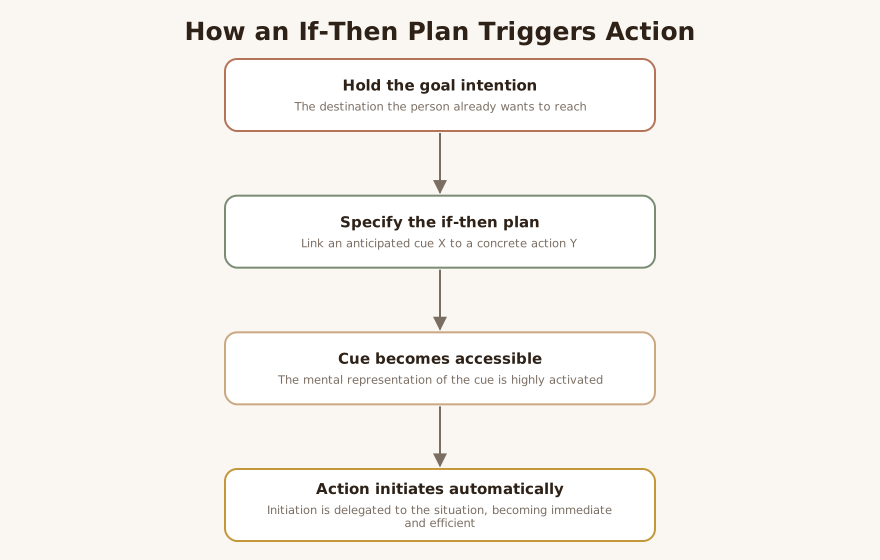
The first principle is the distinction between the goal and the plan 2. A goal intention sets the destination; an implementation intention specifies the route at the level of a concrete action linked to a concrete cue 2. The technique presupposes that the person already holds the goal intention and is intended to operate on the implementation problem — translating “I want to” into “when this happens, I will do that” 3.
The second principle is delegation of control to the environment: by specifying a precise situational cue, the person hands over initiation of the behavior to the anticipated situation rather than relying on conscious deliberation in the moment 1. Gollwitzer and Sheeran characterize the resulting action initiation as becoming relatively automatic, immediate, and efficient once the critical situation is encountered, so the planned response is triggered without the person having to consciously intend it again 1.
The third principle concerns the two cognitive processes the meta-analysis identifies as the mechanism 1. First, the mental representation of the specified cue becomes highly activated and accessible, so the person more readily notices the critical situation when it arises 1. Second, a strong associative link is forged between that cue and the goal-directed response, so that encountering the cue elicits the response with the qualities of an automatic process 1. Together these explain why a plan formed once, in advance, can govern behavior later without renewed effort of will 1.
The fourth principle is specificity and format: the plan must name an identifiable situational trigger and a concrete response, encoded in the characteristic “if–then” syntax that binds the two, and vague plans do not confer the benefit 2. The technique is therefore cheap, brief, and self-administered — its power comes from the structure of the plan rather than from its length 4.
Interventions & Techniques
In practice the intervention is the act of helping a client form one or more “if–then” plans that specify the cue and the response for a behavior they already intend to perform 2. The clinician’s first task is to identify a genuine goal intention, since implementation intentions act on goals the person is already committed to rather than creating motivation where none exists 3. The second is to locate a reliable, concrete critical cue — a time, place, event, internal state, or the completion of a prior action — that will recur and can serve as the trigger 2. The third is to attach a specific, feasible response to that cue, phrased so that encountering the situation makes the response the obvious next step 2.
Beyond plans that initiate a desired action, implementation intentions can be designed to shield an ongoing goal from disruption — for example by specifying in advance how one will respond to a temptation, a distraction, or an unwanted impulse when it appears 1. This shielding function is part of why the technique is studied for self-control problems and not only for simple action initiation 1. The same “if–then” structure can be turned toward suppressing an unwanted response (“if I notice the urge to X, then I will do Y instead”) as readily as toward starting a wanted one 4.
The clinical contribution is to help the client write plans that are concrete enough to fire reliably and matched to situations that genuinely recur in their life, and to fold the planning into a broader treatment that also addresses the motivation, skills, and obstacles behind the goal LLM. The plan is a trigger, not the treatment of the underlying difficulty LLM.
LLM-generated illustrative example (not a guideline): A clinician working with a client whose goal is to take a new medication consistently helps the client form the plan, “If I sit down for breakfast, then I will take my pill with my first glass of water.” The pair deliberately anchor the response to an existing, reliable daily cue rather than to a vague intention to “remember,” and they rehearse the plan aloud so the cue–response link is well encoded. LLM
Evidence Base
The maturity of implementation intentions is best described as established 1. Unlike many behavioral techniques whose support is indirect, this one rests on a large, dedicated meta-analytic literature: the Gollwitzer and Sheeran 2006 meta-analysis pooled a substantial body of studies and reported that implementation intentions had a positive effect of medium-to-large magnitude on goal attainment, over and above the effect of forming a goal intention alone 1. The meta-analysis is notable not only for documenting that the technique works but for testing why it works, supporting the account of heightened cue accessibility and an automatized cue–response link as the operative processes 1. This combination of a replicated effect and an articulated mechanism is what justifies the “established” label LLM.
Honesty requires several caveats for clinical use LLM. First, “established” describes the standing of the behavior-change phenomenon — that adding an “if–then” plan reliably improves goal attainment across many domains — rather than certifying any specific implementation-intention protocol as an evidence-based therapy for a particular disorder LLM. Second, much of the pooled evidence comes from health, academic, and everyday goal-pursuit studies rather than from clinical trials in diagnosed populations, so the transfer to depression, attention-deficit/hyperactivity disorder, or addiction is plausible and theoretically coherent but is itself an extrapolation LLM. Third, the effect depends on the person actually holding the goal and on the plan being concrete and well-matched to a recurring cue; a strong goal commitment and a genuinely reliable trigger are conditions under which the technique performs, not guarantees that any “if–then” sentence will 3. The clinical inferences drawn here — about fit with particular disorders, integration with skills and motivational work, and the limits of planning alone — are reasoned extensions of behavioral practice rather than direct findings of the meta-analysis LLM.
Populations & Indications
Implementation intentions are most useful wherever a presentation turns on a gap between a sincere intention and the behavior that follows — that is, an implementation problem rather than a motivation problem 4. People enrolled in behavior-change programs are the paradigm application, since the technique was developed and most heavily tested as a way to improve follow-through on goals people have already adopted 1. People pursuing health-behavior goals — exercise, diet, screening, medication-taking — are a core indication, and the technique is catalogued as a health-behavior-change construct for exactly this reason 3.
The technique extends naturally to clinical populations whose difficulty is substantially one of initiation and follow-through rather than of wanting LLM. People with attention-deficit/hyperactivity disorder, whose executive-function and initiation deficits widen the intention–action gap, are a logical fit for plans that delegate initiation to an environmental cue and reduce reliance on in-the-moment self-regulation LLM. People with depression, particularly where anhedonia and inertia stall activity, may benefit from “if–then” plans that pair recurring cues with small activating behaviors, complementing behavioral activation LLM. Students facing procrastination, and people managing chronic illness or addiction who must enact coping responses at predictable high-risk moments, are further populations in which prespecified plans can support adherence and relapse prevention LLM. Across all of these, the technique is an adjunct that operationalizes a goal the person already holds, not a diagnosis-specific cure LLM.
Problems-for-Work
Procrastination. The technique converts a vague “I’ll get to it” into a cued action — “If it is 9 a.m. and I have sat at my desk, then I will open the document and write for twenty minutes” — so that initiation is triggered by the situation rather than waiting on willpower 2.
Avoidance and behavioral activation deficits. “If–then” plans pair a reliable daily cue with a small approach behavior, supplying the prespecified trigger that activity scheduling in behavioral activation aims to install, which is especially useful where avoidance and inertia dominate LLM.
Treatment nonadherence. Anchoring a target behavior (taking medication, completing homework, attending an appointment) to an existing routine cue is a direct, evidence-consistent way to raise follow-through on commitments the client has already made 1.
Habit-formation difficulties and executive dysfunction. By forging a cue–response link that initiates the behavior relatively automatically, the technique offloads the work of remembering and deciding, which is precisely the load that executive-function deficits make costly 1.
Relapse prevention and unwanted impulses. Shielding plans specify in advance how the person will respond to a temptation or high-risk cue (“If I am offered a drink, then I will order a soda and step outside”), turning the technique toward suppressing an unwanted response as well as starting a wanted one 4.
LLM-generated illustrative example (not a guideline): A client with depression and the clinician identify that mornings collapse into staying in bed. Together they write, “If my alarm goes off, then I will sit up and put both feet on the floor,” and a second plan, “If I am standing in the kitchen, then I will make one cup of coffee and step onto the balcony for two minutes.” The clinician frames these as small, cue-triggered first actions that do not depend on feeling motivated first. LLM
Contraindications, Cautions & Cultural Humility
Because an implementation intention is a tool rather than a treatment, its limits come from misfit and over-reliance rather than from any inherent danger LLM. The first caution is that the technique presupposes a goal the person actually holds; applied to a behavior the client is ambivalent about or has not chosen, an “if–then” plan addresses the wrong problem and is likely to fail, which can leave the client feeling that they have failed rather than that the plan was mismatched 3. Where ambivalence is the real obstacle, motivational work should precede planning LLM.
The second caution is that planning can substitute for, rather than support, the underlying clinical work — the skills, the mood, or the avoidance that drive the behavior — so the technique should accompany and not replace that work LLM. The third is that a plan is only as good as its cue: a trigger that is vague, rare, or unreliable will not fire, and a clinician should help the client test that the critical situation genuinely recurs in their actual daily life 2.
Cultural humility matters in how the plan is built LLM. What counts as a reliable daily cue, an acceptable target behavior, or a realistic routine varies widely with a person’s work, family structure, living situation, and resources, and the clinician should co-design the plan to the client’s real circumstances rather than assume a textbook example fits LLM. For clients whose routines are organized around family or community obligations rather than individual schedules, the most reliable cues — and the most meaningful responses — may be relational, and the plan should be written accordingly LLM. The clinician should offer the technique collaboratively, fit it to the person in the room, and revise or abandon a plan that does not match their life LLM.
Treatment-Plan Suggestions & SMART Objectives
| Goal | SMART objective (example) | Mechanism |
|---|---|---|
| Reduce procrastination on a stalled task | Client writes one “if–then” plan linking a daily desk-time cue to 20 minutes of work and follows it 4 of 5 weekdays for 3 weeks | A prespecified cue triggers action initiation without renewed deliberation 2 |
| Increase activity in depression | Client forms 2 plans pairing reliable morning cues with small activating behaviors and enacts them 5 of 7 days for 2 weeks | Cue–response links initiate behavior despite low motivation 1 |
| Improve medication adherence | Client anchors pill-taking to an existing daily routine cue and records adherence 6 of 7 days for 4 weeks | Linking the behavior to a recurring situation raises follow-through 1 |
| Strengthen a new habit | Client specifies one “if–then” plan for the target behavior and reviews cue reliability at each session for 4 weeks | A strong cue–response association makes initiation relatively automatic 1 |
| Support executive-function-related initiation | Client offloads one routinely forgotten task onto a fixed environmental cue within 2 weeks | Delegating initiation to the environment reduces the deliberation load 1 |
| Shield a goal from temptation | Client writes one shielding plan (“if tempted by X, then I will do Y”) and reviews its use weekly for 4 weeks | “If–then” plans prespecify responses to disruptive cues 1 |
| Reduce avoidance of a feared step | Client pairs a concrete cue with one approach behavior and completes it 3 of 5 days for 3 weeks | Prespecified action initiation counters in-the-moment avoidance 4 |
| Close the intention–behavior gap on a chosen goal | Client converts one goal intention into a concrete “if–then” plan by session 2 and reports outcomes for 4 weeks | Adding an implementation intention improves attainment over goal intention alone 1 |
Common Misconceptions
A frequent misreading is that implementation intentions are just goal-setting or positive thinking by another name 2. In fact the technique is defined precisely against the goal intention: forming the goal is the part that often fails to produce behavior, and the implementation intention is the separate, action-level plan that closes that gap 2. A second misconception is that more motivation is what the plan supplies; it does not create wanting, but rather operationalizes a goal the person already holds, which is why it is unsuited to genuine ambivalence 3. A third is that any vaguely worded plan will do — but the benefit depends on a concrete cue and a concrete response bound in the “if–then” form, and unspecified plans do not confer it 2. A fourth is that the effect requires ongoing effort or repeated willpower in the moment; the mechanism is the opposite, an automatized cue–response link that initiates the behavior relatively immediately and efficiently once formed 1. A fifth is that implementation intentions are a stand-alone treatment for procrastination or adherence problems; the evidence supports them as a technique that operationalizes goals, best used inside a fuller behavioral and motivational plan LLM.
Training & Certification
There is no certification, credential, or formal training pathway specific to implementation intentions, because they are a behavioral technique rather than a practice modality LLM. Clinicians typically encounter the idea within behavior-change coursework, health psychology, or the self-regulation literature, and through the primary sources — Gollwitzer’s 1999 paper introducing the technique and the Gollwitzer and Sheeran 2006 meta-analysis establishing its efficacy and mechanisms 21. Accessible explainer summaries and applied construct catalogues such as the National Cancer Institute’s behavior-change pages lay out the everyday logic of “if–then” planning and situate the technique within health-behavior practice 43.
For competent clinical application, the relevant training is in the established behavioral methods the technique fits inside — the planning and homework structure of cognitive behavioral therapy, the activity scheduling of behavioral activation, and motivational interviewing for the ambivalence that planning cannot resolve LLM. The most useful preparation is therefore to learn the technique well enough to co-write sound “if–then” plans with clients while building credentialed skill in the treatments it complements LLM.
Key Terms
Implementation intention: a plan in the form “If situation X arises, then I will perform response Y,” which links an anticipated cue to a goal-directed action specified in advance 2.
Goal intention: a commitment to a desired end state (“I intend to do X”), which specifies the outcome but not the situated action and frequently fails to produce behavior on its own 2.
Intention–behavior gap: the well-documented discrepancy between what a person sincerely intends and what they actually do, which implementation intentions are designed to close 4.
Critical cue: the specific situational trigger named in the “if” component — a time, place, event, internal state, or prior action — that is meant to recur and elicit the planned response 2.
Cue accessibility: the heightened mental activation of the specified situation, so the person more readily notices and attends to it when it occurs 1.
Cue–response link: the strong association forged between the critical cue and the goal-directed response, such that encountering the cue initiates the response with the qualities of an automatic process 1.
Action shielding: the use of “if–then” plans to protect an ongoing goal by prespecifying responses to temptations, distractions, or unwanted impulses 1.
Automatic action initiation: the relatively immediate and efficient triggering of the planned behavior once the critical situation is met, without renewed conscious intending 1.
Resources & Further Reading
▶ Watch — a video introduction to this concept:
- Implementation Intentions and Goal Achievement: A Meta-Analysis of Effects and Processes (Gollwitzer & Sheeran, 2006)
- Implementation Intentions: Strong Effects of Simple Plans (Gollwitzer, 1999, American Psychologist) — PDF
- Implementation Intentions — NCI Division of Cancer Control & Population Sciences (DCCPS) construct page
- Implementation Intentions Facilitate Action Control — Psychology Today
- Implementation intention — Wikipedia
Reflective / Supervision Questions
- For this client, is the obstacle truly one of implementation — a gap between intention and action — or is it ambivalence about the goal itself, which an “if–then” plan cannot resolve? 3
- When you help a client choose a critical cue, how do you test that the situation genuinely recurs in their real daily life rather than only in the plan as written? 2
- How do you tell whether a client needs an implementation intention or whether the planning would let them avoid the underlying mood, skill gap, or avoidance that is really driving the behavior? LLM
- For a client whose routines are organized around family or community obligations, how might a relational cue and response fit better than an individual-schedule one? LLM
- How do you introduce the goal-versus-plan distinction so it normalizes the client’s experience of “intending one thing and doing another” rather than implying a failure of character? 2
- When an “if–then” plan works for a client, how do you help them generalize the skill of planning to new goals rather than depending on you to write each plan? 1