
Type & Discipline
Metacognitive Therapy (MCT) is a structured, time-limited psychotherapy within clinical psychology, usually delivered over roughly 8 to 12 sessions 4. It belongs to the broader cognitive-behavioral tradition but is most accurately situated among third-wave, process-based behavioral therapies because it targets how a person relates to and regulates thinking rather than the content of any particular thought 6. The defining move of MCT is to treat the thinking style that maintains disorders as the clinical problem, rather than the negative cognitions themselves 4. Its central organizing claim — captured in the practitioner shorthand “thoughts don’t matter, but your response to them does” — distinguishes it sharply from standard content-focused cognitive therapy 4. MCT is transdiagnostic by design, applying the same model of mechanism across anxiety, depression, and related presentations 1.
Creators & Lineage
MCT was developed by Adrian Wells, a clinical psychologist, who is identified as the originator of the approach 3. The theoretical engine of the therapy is the Self-Regulatory Executive Function (S-REF) model, an information-processing framework Wells developed with Gerald Matthews 6. The S-REF model integrates metacognitive beliefs, the cognitive-attentional syndrome, mental “modes,” and executive control into a unified account of how psychological disorder is produced and sustained 6. MCT emerged from, and remains in dialogue with, Cognitive Behavioral Therapy, sharing CBT’s structured and collaborative style while diverging on its primary target of change 4. The approach is consolidated in Wells’s clinical text Metacognitive Therapy for Anxiety and Depression 5. Institutionally, the MCT Institute (MCTI) was founded and is run by Professor Adrian Wells together with Professor Hans M. Nordahl, both clinical psychologists and university professors, and Wells leads the associated PATHWAY research program 3.
Core Principles
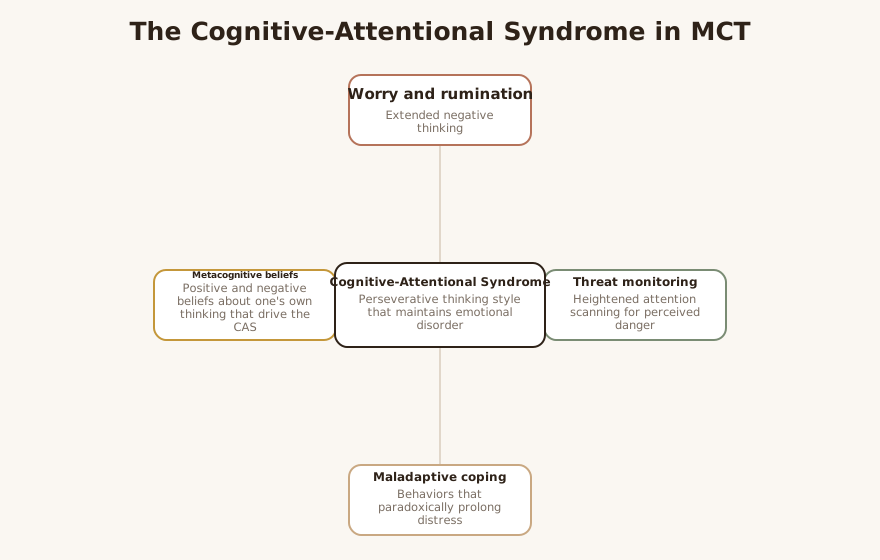
MCT rests on the premise that intrusive negative thoughts are universal, but that sustained disorder develops only when a person engages those thoughts with a maladaptive, perseverative thinking style 4. That style is named the cognitive-attentional syndrome (CAS) 6. The CAS comprises three interlocking processes: extended negative thinking in the form of worry and rumination; threat monitoring, meaning heightened attention scanning for perceived danger; and maladaptive coping behaviors that paradoxically prolong distress 6. An evocative description from the patient-facing literature likens these attempted solutions to “trying to extinguish an open fire with gasoline” 4.
The CAS is driven by metacognitive beliefs — a person’s beliefs about their own thinking 6. MCT distinguishes positive metacognitive beliefs (for example, “worrying helps me solve problems” or “rumination will give me the answer”) from negative metacognitive beliefs, especially beliefs about the uncontrollability and dangerousness of thoughts 6. Positive beliefs recruit the person into worry and rumination, while negative beliefs make the resulting mental activity feel both unstoppable and threatening, locking the cycle in place 6. The model also describes two stances a person can take toward thought: “object mode,” in which one is fused with and immersed in thoughts, and “metacognitive mode,” in which one observes thoughts from a distance 6. A core therapeutic aim is to help the client shift flexibly into metacognitive mode and reduce the CAS, rather than to dispute whether any specific thought is true 4. The hypothesized mechanism of change is improvement in dysfunctional metacognitions, a claim with some empirical support 2.
Interventions & Techniques
MCT operationalizes its model through a recognizable set of process-focused techniques 6. The Attention Training Technique (ATT) uses structured auditory attention exercises to strengthen flexible, externally directed attentional control and to counter self-focused threat monitoring 6. Situational Attentional Refocusing extends this work into real-world contexts, directing attention outward in feared situations rather than inward onto symptoms 6. Detached mindfulness teaches the client to register thoughts as passing mental events without engaging, suppressing, or analyzing them; the developers stress that it is distinct from general mindfulness practices 6. Worry and rumination postponement experiments ask clients to defer perseverative thinking to a set period, which directly tests negative metacognitive beliefs about uncontrollability by demonstrating that worry can in fact be postponed 6.
Across these methods, the unifying intervention logic is to challenge metacognitive beliefs at the level of process, helping clients discover experientially that they can disengage the CAS and that their thoughts are neither uncontrollable nor dangerous 4. The therapist works to interrupt the worry–rumination–threat-monitoring–coping cycle rather than to evaluate the realism of feared outcomes 6.
LLM-generated illustrative example (not a guideline): A client with chronic worry reports she “can’t stop” anxious thoughts about her health. Rather than examining the probability of illness, the clinician introduces worry postponement: she notes each worry trigger and agrees to defer engaging it until a 15-minute window at 6 p.m. By the third week she observes that most worries no longer feel pressing by 6 p.m., providing experiential evidence against the belief that her worry is uncontrollable. LLM
Evidence Base
The evidence base for MCT is best characterized as established but still maturing 1. A 2018 systematic review and meta-analysis by Normann and Morina synthesized 25 trials (15 of them randomized controlled trials) covering 780 adult patients, primarily with anxiety and depression but also including PTSD, OCD, body dysmorphic disorder, and other presentations 1. Within-group effects from pre- to post-treatment were large, with a Hedges g of 1.72 (95% CI 1.44–2.00) on primary outcomes and a g of 1.57 (95% CI 1.26–1.87) at follow-up 1. Between-group effects were substantial: MCT outperformed waitlist with g = 2.06 (95% CI 1.52–2.60) and active treatments with g = 0.68 (95% CI 0.41–0.95) post-treatment 1. In direct comparison with CBT specifically, MCT showed g = 0.69 post-treatment and g = 0.37 at follow-up, suggesting MCT may outperform CBT 1. The authors concluded MCT is highly effective across multiple complaints, with the strongest evidence for anxiety and depression 1.
For depression specifically, a randomized controlled trial with a 1-year follow-up reported durable gains 2. In the intent-to-treat sample, 67% of patients were classified as recovered at 1-year follow-up, 13% improved, and 20% unchanged, with only 5 of 31 remitted patients (13%) relapsing 2. Effect sizes were large, including d = 2.09 for depression symptoms and d = 2.22 for rumination 2. Critically, improvement in metacognitive beliefs showed a unique positive association with improvement in depression symptoms over the year — independent of changes in rumination or worry alone — supporting the therapy’s proposed mechanism 2.
Clinicians should weigh these results against real limitations 1. The meta-analysis reported high heterogeneity (I² of 59–75%), small comparison-group samples, unclear or high risk of bias in roughly 30% of studies, limited follow-up data, and potential allegiance bias, given that 13 of 25 studies were co-authored by the developer, Adrian Wells 1. The depression RCT, while encouraging, was small and compared MCT against a waitlist rather than an active treatment 2.
Populations & Indications
MCT was developed primarily for and tested most heavily in adults with anxiety and depressive disorders 1. The patient-facing and reference literature identify generalized anxiety disorder, depression, OCD, PTSD, and health anxiety as conditions responsive to MCT, typically within 8 to 12 sessions 4. The reference literature also lists social anxiety among the anxiety disorders addressed through the transdiagnostic framework 6. The bulk of the trial evidence is in adults; the 2018 meta-analysis was overwhelmingly adult, with only one study involving children or adolescents 1. Because the model targets a common maintaining process rather than disorder-specific content, MCT is positioned as transdiagnostic, which makes it a candidate where worry, rumination, and threat monitoring are prominent across presentations 1.
Problems-for-Work
MCT maps cleanly onto several problems-for-work where perseverative thinking dominates the clinical picture 6. Generalized anxiety disorder is a flagship indication, with worry treated not as a content problem but as a behavior maintained by positive and negative metacognitive beliefs 6. Major depressive disorder is addressed through rumination, with the depression RCT showing large reductions in both depressive symptoms and rumination 2. Worry and rumination themselves function as discrete problems-for-work, directly targeted by postponement experiments and detached mindfulness 6. Threat monitoring is reduced through the Attention Training Technique and Situational Attentional Refocusing 6. The cognitive-attentional syndrome can be framed as the overarching maintaining process, the meta-target that the others serve 6. OCD, PTSD, and health anxiety are additional problem areas where the model has been applied 4.
LLM-generated illustrative example (not a guideline): A client recovering from a workplace assault scans every room for exits and replays the event nightly. Reframing this as threat monitoring and rumination rather than as a damaged memory needing correction, the clinician introduces detached mindfulness and external attentional refocusing, helping the client notice intrusions as passing events while keeping attention on the present environment. LLM
Contraindications, Cautions & Cultural Humility
The provided sources do not specify formal contraindications for MCT, so the following cautions reflect clinical reasoning rather than guideline statements LLM. Because MCT deliberately withholds content-level reassurance and discourages engagement with thoughts, clinicians should ensure clients with acute risk, psychosis, or severe cognitive impairment are appropriately assessed before relying on a purely metacognitive frame LLM. The evidence base is concentrated in adults, so extension to children, adolescents, and older adults should be cautious given thin trial representation 1. Allegiance bias in the existing literature means effect sizes may be optimistic, and clinicians should hold the comparative-to-CBT claims tentatively pending larger independent trials 1. Cultural humility is warranted because metacognitive beliefs about worry and rumination are shaped by language, family norms, and cultural meanings of distress, and the technique-heavy structure should be adapted collaboratively rather than imposed LLM. The therapy’s premise that “thoughts don’t matter” should be introduced sensitively, framed as being about responses to thoughts rather than as dismissing a client’s lived concerns 4.
Treatment-Plan Suggestions & SMART Objectives
| Goal | SMART objective (example) | Mechanism |
|---|---|---|
| Reduce uncontrollable worry | Client will use worry postponement on 5 of 7 days for 4 weeks, deferring worry to a single 15-minute window | Disconfirms negative metacognitive belief that worry is uncontrollable 6 |
| Decrease depressive rumination | Client will apply detached mindfulness to ruminative triggers and log episodes, reducing average daily rumination time by 50% over 6 weeks | Targets rumination as a CAS process linked to depression outcomes 2 |
| Strengthen flexible attention | Client will complete Attention Training Technique exercises 3x weekly for 6 weeks | Builds externally directed attentional control, countering threat monitoring 6 |
| Reduce threat monitoring in feared situations | Client will use Situational Attentional Refocusing in 3 identified situations weekly for 4 weeks | Redirects attention outward, interrupting self-focused scanning 6 |
| Modify positive metacognitive beliefs | Client will run 2 behavioral experiments testing “worry helps me cope” within 3 weeks | Weakens beliefs that recruit the person into the CAS 6 |
| Shift from object to metacognitive mode | Client will identify and label 3 thoughts daily as “passing mental events” for 4 weeks | Cultivates observational distance from thoughts 6 |
| Sustain gains and prevent relapse | Client will complete a metacognitive relapse-prevention plan before discharge | Consolidates reductions in dysfunctional metacognitions associated with durable recovery 2 |
Common Misconceptions
A frequent misconception is that MCT is simply CBT under a new name; in fact, MCT changes what a person believes about their thoughts and targets the thinking process, rather than altering or disputing thought content as content-focused cognitive therapy does 4. A second misconception is that detached mindfulness is interchangeable with general mindfulness practice, when the developers explicitly position it as a distinct technique with a different aim 6. A third is that the slogan “thoughts don’t matter” means feelings or problems are dismissed; the actual claim is that the response to thoughts, not their occurrence, drives disorder 4. Finally, the strong meta-analytic numbers are sometimes read as settled superiority over CBT, but the authors themselves note that larger randomized trials are needed and that allegiance and heterogeneity temper the comparison 1.
Training & Certification
The MCT Institute (MCTI) provides standardized professional training and describes MCT as an “effective and regulated evidence based psychotherapy” that “requires standardised professional training to become an MCT Institute registered therapist” 3. The institute was founded and is run by Professor Adrian Wells and Professor Hans M. Nordahl, both clinical psychologists and university professors 3. Wells’s clinical text Metacognitive Therapy for Anxiety and Depression serves as a foundational practitioner reference for learning the model and its techniques 5. The provided sources do not enumerate specific training tiers, durations, or eligibility prerequisites beyond the statement that standardized training leads to registered-therapist status 3.
Key Terms
- Cognitive-attentional syndrome (CAS): the maladaptive thinking style — worry/rumination, threat monitoring, and maladaptive coping — that maintains disorders 6.
- Metacognitive beliefs: beliefs about one’s own thinking, divided into positive beliefs (worry/rumination is useful) and negative beliefs (thoughts are uncontrollable and dangerous) 6.
- S-REF model: the Self-Regulatory Executive Function model, the information-processing framework underlying MCT, developed by Wells and Matthews 6.
- Attention Training Technique (ATT): structured exercises that build flexible, externally directed attentional control 6.
- Detached mindfulness: observing thoughts as passing events without engaging them, distinct from general mindfulness 6.
- Object mode vs. metacognitive mode: immersion in thoughts versus observing them from a distance 6.
- Worry/rumination postponement: deferring perseverative thinking to a set window to test beliefs about uncontrollability 6.
Resources & Further Reading
▶ Watch — a video introduction to this concept:
- The Efficacy of Metacognitive Therapy: A Systematic Review and Meta-Analysis (Normann & Morina, 2018)
- A Randomized Controlled Trial of Metacognitive Therapy for Depression: 1-Year Follow-Up
- MCT Institute (MCTI) — official site
- What is Metacognitive Therapy (MCT)? — explainer
- Metacognitive Therapy for Anxiety and Depression (Wells, 2009, Guilford Press)
- Metacognitive therapy — Wikipedia
Reflective / Supervision Questions
- When a client presents with worry or rumination, do I instinctively reach for content-level disputation, and how might shifting to a process focus change my case formulation? LLM
- How will I introduce the idea that “thoughts don’t matter, but responses to them do” in a way that validates rather than dismisses the client’s distress? 4
- Given the allegiance and sample-size limitations in the evidence base, how confident should I be when framing MCT as superior to CBT for a particular client? 1
- Can I clearly distinguish detached mindfulness from the general mindfulness practices my client may already know, and explain why the difference matters? 6
- Am I tracking change in the client’s metacognitive beliefs as a mechanism, not just symptom reduction, consistent with the proposed pathway of change? 2
- How do my client’s cultural and linguistic frames shape their beliefs about worry and rumination, and how should that inform my use of MCT techniques? LLM