
Type & Discipline
Communities of practice (CoP) is a theory of learning, not a psychotherapy. It originates in the social sciences — specifically organizational learning and educational theory — and belongs to the broader family of situated learning 14. Its central claim is that learning is fundamentally social: knowing emerges through participation in shared activity rather than through the isolated transfer of decontextualized facts from one head to another 1. Wenger frames it as “a theory of learning that starts with the assumption that engagement in social practice is the fundamental process by which we get to know what we know and by which we become who we are” 2.
For practicing therapists, this matters because much of what makes a clinician competent — clinical judgment, case formulation, the “feel” for a difficult moment — is not learned solely from manuals or coursework. It is learned through ongoing participation with other clinicians: consultation groups, supervision, case conferences, and informal hallway exchanges LLM. CoP gives a precise vocabulary for that process and a rationale for designing it intentionally rather than leaving it to chance LLM. It is best understood as a framework for professional development, peer consultation, and implementation — not as a clinical intervention you deliver to a patient LLM.
Creators & Lineage
The concept was introduced by Jean Lave and Etienne Wenger in their 1991 work Situated Learning: Legitimate Peripheral Participation, which drew on studies of apprenticeship — including West African tailors and other craft and trade communities — to argue that learning is inseparable from the social context in which it occurs 14. Their early observation was that newcomers learn a trade not by being taught abstractly but by participating, first at the edges and then more centrally, in the real work of a community 4.
Etienne Wenger extended the theory substantially in his 1998 book Communities of Practice: Learning, Meaning, and Identity, which shifted the emphasis toward how communities form around “shared enterprises over time” and how participation shapes identity 2. Over the following years the idea was taken up heavily in knowledge management and organizational settings, and by 2002 Wenger and colleagues published Cultivating Communities of Practice to guide organizations in deliberately fostering them 4.
The lineage runs through situated learning theory, social learning theory, organizational learning, and classical apprenticeship and mentorship models 14. Across three decades the construct has been widely adopted but also re-examined and refined, with scholars noting both its broad influence on contemporary learning theory and the conceptual looseness that came with its popularity 5.
Core Principles
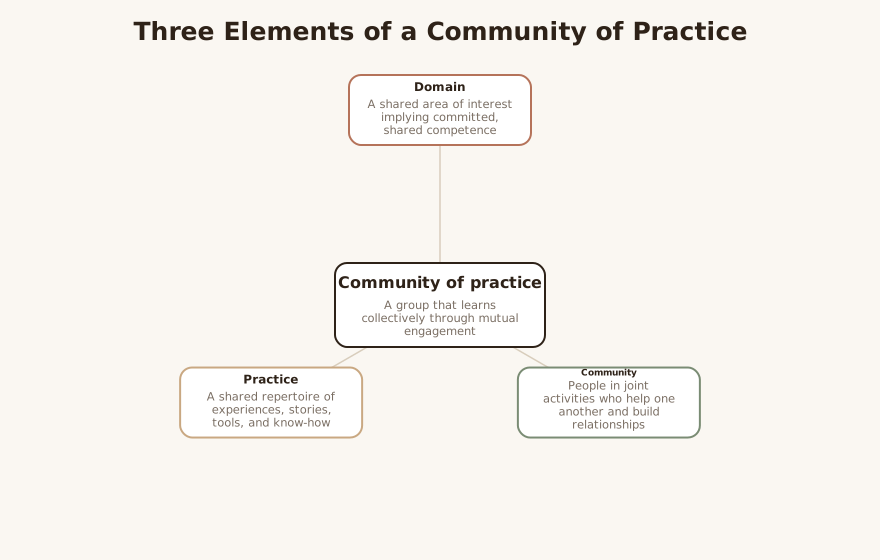
Wenger describes a community of practice as having three structural elements that, together, distinguish it from an ordinary team, network, or club 14.
- Domain — a shared area of interest or activity. Membership implies a commitment to the domain and therefore a shared competence that distinguishes members from others 1. For clinicians, the domain might be “trauma-focused care for adolescents” or “DBT in an outpatient setting” LLM.
- Community — the people who engage in joint activities and discussions, help one another, and share information, building relationships that allow learning 1. A community is not just a shared interest; it requires actual mutual engagement 1.
- Practice — a shared repertoire of resources: experiences, stories, tools, and established ways of addressing recurring problems 1. This is the accumulated, often tacit, know-how of the group 1.
A defining mechanism is legitimate peripheral participation: newcomers begin at the periphery in less central tasks and gradually move toward fuller participation, eventually becoming experienced enough to mentor the next newcomers 14. Learning, in this view, is “becoming a full participant” in the community rather than passively acquiring information 1. Crucially, learning involves the whole person acting in the world — it shapes identity, not just skill 12.
Interventions & Techniques
Because CoP is a learning framework rather than a treatment protocol, its “techniques” are organizational and pedagogical design choices LLM. Common applications in clinical settings include:
- Cultivating, not mandating, the community. Organizations can deliberately foster CoPs to share knowledge efficiently across hierarchies, but the community itself depends on genuine mutual engagement that cannot be fully top-down imposed 4.
- Structuring peripheral entry for newcomers. Trainees and new hires are given real but bounded participation — observing, co-leading, presenting one case — and increasing responsibility as competence grows 14.
- Maintaining a shared repertoire. Groups develop and curate tools, case templates, decision aids, shared language, and “war stories” that encode recurring solutions 1.
- Virtual communities of practice. When members are geographically dispersed, peer-to-peer professional development can be sustained across distance through virtual CoPs 4.
LLM-generated illustrative example (not a guideline): A group practice runs a biweekly hour-long case consultation for its trauma clinicians. New clinicians first attend and observe (periphery), then present a single case with structured prompts, then begin offering formulation feedback to others. Over a year the group builds a shared intake template and a small library of “what we tried when stuck” notes — a living shared repertoire LLM.
Evidence Base
The maturity of CoP as a theory is established: it is one of the most influential and widely cited frameworks in organizational and adult learning, adopted across corporations, educational institutions, and international agencies 45. The concept has demonstrably shaped contemporary learning theory over three decades 5.
However, clinicians should hold two distinctions clearly LLM. First, “established as an influential theory” is not the same as “supported by randomized controlled trials as a clinical intervention.” CoP is a descriptive and design framework for how professionals learn, not an efficacy-tested therapy 4LLM. Second, the construct has known limitations that the scholarship itself flags. Critics note a tendency to romanticize communities of practice and an insufficient treatment of power dynamics, access barriers, and public accountability 1. Earlier formulations also underappreciated the educational value of formal structures 1, and three decades of broad use have introduced conceptual ambiguity about what does and does not count as a CoP 5. In short: a strong, durable framework with real explanatory value, but one whose benefits in any specific clinical setting should be evaluated locally rather than assumed LLM.
Populations & Indications
CoP applies to professionals and learners, not to patient diagnoses LLM. The most natural fits include clinicians and trainees, professional learners, peer support specialists, organizations and teams, healthcare workers, and adult learners generally 14. It is well suited wherever expertise is partly tacit, accumulated through experience, and best transmitted through participation — which describes most clinical work LLM.
Indications for deliberately building a CoP include onboarding new clinicians, sustaining fidelity to a model after initial training, supporting clinicians who work in isolation (solo or fully remote practice), and disseminating an evidence-based practice across a team where manuals alone have not produced consistent uptake 4LLM.
Problems-for-Work
CoP is particularly relevant to several workforce and professional problems clinicians and supervisors encounter LLM.
- Professional isolation. Solo and telehealth clinicians lose the informal learning that happens around colleagues; a structured or virtual CoP restores mutual engagement and peer-to-peer development across distance 4LLM.
- Burnout and workplace disengagement. Participation builds relationships and a sense of shared enterprise and identity, which can buffer against the disconnection that accompanies burnout 1LLM.
- Skill/competence deficits and low self-efficacy. Legitimate peripheral participation lets less-experienced clinicians build competence gradually through real participation rather than being thrown in or held out entirely 14LLM.
- Knowledge-transfer barriers and implementation/training gaps. CoPs move knowledge efficiently across hierarchies and keep new practices alive after the workshop ends by embedding them in a shared repertoire 4LLM.
LLM-generated illustrative example (not a guideline): After a two-day DBT skills training, adherence drifts within months. The clinic forms a small CoP that meets monthly to review recordings, troubleshoot specific skills, and maintain a shared “common pitfalls” document. The recurring engagement — not the original workshop — is what sustains the practice LLM.
Contraindications, Cautions & Cultural Humility
CoP has no clinical contraindications because it is not applied to patients, but it carries genuine cautions for organizations LLM. The literature explicitly warns against romanticizing communities and against ignoring power, access, and accountability 1. A community can become insular, reinforce poor practice, exclude newcomers or those who differ from the dominant group, and resist outside scrutiny 1LLM. A CoP that lacks accountability can entrench bad habits as effectively as good ones LLM.
Cultural humility is essential when the “shared repertoire” of a clinical community encodes implicit norms about who belongs and what counts as competent LLM. Access is not neutral: who is invited to the periphery, and who is allowed to move toward the center, can reproduce existing inequities if left unexamined 1LLM. Supervisors should actively check that the community’s identity and practices do not marginalize clinicians from underrepresented backgrounds or pathologize the populations being served LLM. Because the framework deliberately leans on informal structure, it should be paired with — not used to replace — formal accountability, ethics oversight, and evidence standards 1LLM.
Treatment-Plan Suggestions & SMART Objectives
CoP is a professional development and supervision framework, so the objectives below are framed for clinician/team learning rather than patient treatment plans LLM.
| Goal | SMART objective (example) | Mechanism |
|---|---|---|
| Reduce professional isolation | Solo clinician attends a virtual CoP at least twice monthly for 3 months, presenting one case per cycle | Mutual engagement and peer-to-peer development across distance 4 |
| Onboard a new clinician | New hire moves from observer to case-presenter within 8 weeks, co-leading one group by week 12 | Legitimate peripheral participation toward fuller participation 1 |
| Sustain a trained EBP | Team maintains and updates a shared “pitfalls and solutions” repertoire monthly for 6 months | Shared repertoire encodes recurring solutions 1 |
| Improve knowledge transfer | 90% of team cases discussed in consultation use the shared formulation template within one quarter | Efficient knowledge sharing across hierarchy 4 |
| Build self-efficacy in a skill | Clinician rates confidence in target skill before/after 8 CoP sessions, with a measurable increase | Graduated participation and identity development 1 |
| Strengthen community identity | Group co-authors a one-page statement of its domain and shared standards within 2 months | Domain commitment defines shared competence 1 |
| Increase inclusivity of the community | Audit periphery-to-center pathways quarterly; document and address any access barriers | Counters romanticizing and access/power blind spots 1 |
Common Misconceptions
- “A community of practice is just any team or group.” Not so: it requires all three of domain, community, and practice — a shared competence, genuine mutual engagement, and an accumulated shared repertoire 14.
- “You can mandate a CoP into existence.” Organizations can cultivate and support one, but it depends on real participation and relationships that cannot be fully imposed by org chart 4LLM.
- “Learning means transferring information into individuals.” The theory’s core claim is the opposite — learning is social participation and becoming a full participant, shaping identity, not just downloading facts 12.
- “CoP is an evidence-based clinical intervention.” It is an established learning theory, not an efficacy-tested treatment, and its benefits in a given setting should be evaluated rather than assumed 45LLM.
- “Communities of practice are inherently benign.” The literature warns against romanticizing them and against neglecting power and access dynamics 1.
Training & Certification
There is no licensure or certification required to participate in or facilitate a community of practice, and it is not a regulated clinical credential LLM. The foundational understanding comes from the primary texts — Lave and Wenger’s 1991 Situated Learning and Wenger’s 1998 Communities of Practice: Learning, Meaning, and Identity — and the practitioner-oriented guidance in Cultivating Communities of Practice (2002) 246. Wenger and colleagues (later Wenger-Trayner) have continued to publish framing materials for those designing social learning systems 3. For clinicians, the practical “training” is reading the source material and then deliberately designing and facilitating consultation or supervision groups using the three-element framework LLM.
Key Terms
- Domain — the shared area of interest that defines a community’s identity and shared competence 1.
- Community — the people and relationships through which members engage jointly, help one another, and share information 1.
- Practice — the shared repertoire of experiences, stories, tools, and ways of addressing recurring problems 1.
- Legitimate peripheral participation — the process by which newcomers move from edge tasks toward full participation and eventually mentoring others 14.
- Situated learning — the view that learning is inseparable from the social context in which it occurs, not decontextualized or abstract 1.
- Shared repertoire — the accumulated, often tacit, knowledge and tools a community develops over time 1.
- Identity — the dimension of learning concerned with becoming someone within a community, not just knowing something 12.
- Social learning system — Wenger’s later framing of how communities, boundaries, and identities form learning systems 3.
Resources & Further Reading
▶ Watch — a video introduction to this concept:
- Jean Lave, Etienne Wenger and communities of practice — infed.org — accessible overview of the theory, history, and critiques.
- Communities of Practice: Learning, Meaning, and Identity (Wenger, 1998) — Cambridge University Press — the foundational extended theory.
- Communities of practice: learning as a social system (Wenger) — The Systems Thinker — concise article framing CoPs as social learning systems.
- Community of practice (CoP) — EBSCO Research Starters — encyclopedia entry covering structure, history, and organizational applications.
- Three Decades of Communities of Practice Conceptualization — ResearchGate — review of how the construct evolved and was critiqued.
- Communities of practice: learning, meaning, and identity (full text) — Internet Archive — full text of Wenger’s 1998 book.
Reflective / Supervision Questions
- Which of the three elements — domain, community, or practice — is weakest in my current consultation or supervision group, and what would strengthen it 1LLM?
- How does a newcomer actually move from the periphery toward the center in my setting, and is that pathway equitable 1LLM?
- What lives in our shared repertoire, and how much of our real clinical know-how is tacit and at risk of being lost when someone leaves 1LLM?
- Where might our community be romanticized — reinforcing comfortable habits or excluding dissent — and how do we build in accountability 1LLM?
- For my isolated or remote colleagues, what concrete mutual engagement exists, and would a virtual community of practice meaningfully reduce their isolation 4LLM?
- How is participation in this community shaping my professional identity, not just my skills 12LLM?