
Type & Discipline
Brainspotting (BSP) is a body-based, trauma-focused psychotherapeutic modality situated within clinical psychology and the broader somatic/experiential treatment family. LLM It is best understood as an adaptation and offshoot of Eye Movement Desensitization and Reprocessing (EMDR), sharing EMDR’s premise that traumatic material can be accessed and reprocessed through directed attention to the visual field while the body is held in awareness. 1 Its organizing claim — captured in the practitioner motto “where you look affects how you feel” — is that the position of the eyes is not incidental to emotional processing but can be used deliberately to locate and discharge distress that is stored bodily. 3
Practically, BSP sits at the intersection of three lineages: EMDR, somatic experiencing, and relational/psychoanalytic attunement. 3 Grand has described it as part of the emerging “brain-based” wing of psychotherapy, contrasted with talk therapy, on the rationale that it engages subcortical and somatic systems rather than primarily verbal-cognitive ones. 4 For practicing clinicians, the most accurate framing is this: BSP is a structured attentional technique layered onto an attuned therapeutic relationship, most often delivered as a component within an established trauma treatment rather than as a freestanding, independently validated therapy. LLM
Creators & Lineage
Brainspotting was developed by David Grand, a clinical social worker and psychotherapist, in 2003. 3 Grand was trained in EMDR in 1993 and worked extensively with trauma survivors, including 9/11 survivors, Hurricane Katrina survivors, the Newtown community, and combat veterans returning from Iraq and Afghanistan. 34 In his work he had been developing a variant he called “Natural Flow EMDR,” and Brainspotting emerged directly out of that practice when he observed that a client’s eyes locked or wobbled at a particular gaze position that seemed tied to a charged internal state. 3 He synthesized observations from psychoanalysis, EMDR, and Peter Levine’s somatic experiencing into the new method. 3
Grand has positioned BSP not only for trauma but for performance enhancement and creativity, working with professional athletes, entertainers, and business leaders alongside trauma populations. 4 The lineage matters clinically: because BSP descends from EMDR and somatic experiencing, clinicians already fluent in either will recognize much of its structure — the dual focus on a target memory and on body sensation, the use of bilateral stimulation, and the emphasis on letting processing unfold with minimal verbal direction. 13
Core Principles
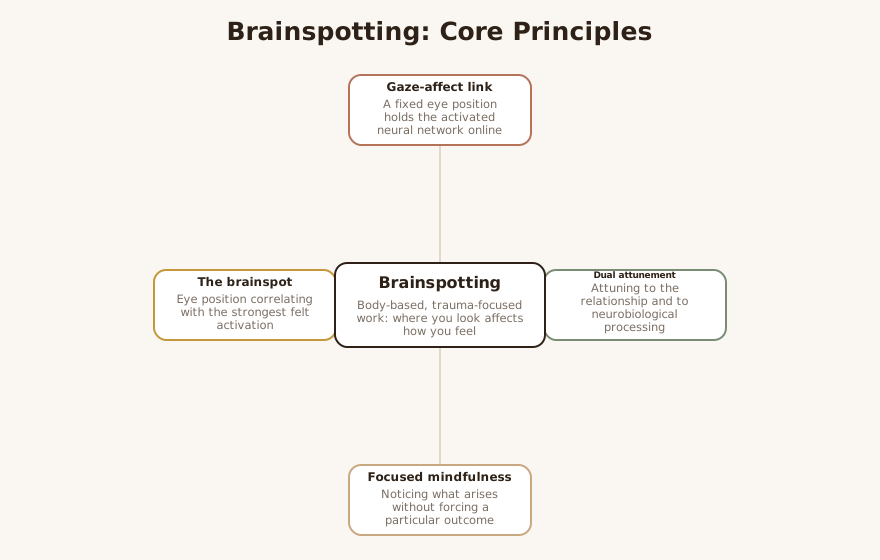
The foundational principle is the gaze–affect link: Grand hypothesizes that fixing the gaze on a specific external point keeps the brain focused on the internal location where a traumatic memory and its somatic charge reside, thereby holding the relevant neural network “online” for processing. 3 A “brainspot” is the eye position that correlates with the strongest felt activation of the target issue. 3
A second core principle is dual attunement — the simultaneous attunement of the therapist to the relationship (the interpersonal field) and to the client’s neurobiological processing. LLM This relational frame is treated as as important as the eye position itself; the brainspot is held within a context of safety and following the client’s lead. 1
A third principle is focused mindfulness with uncertainty: the client is asked to notice whatever arises — sensations, images, emotions, memories — without forcing a particular outcome, and the therapist tracks rather than steers. 1 The proposed neurobiological rationale invokes the role of fixed eye position in memory retrieval and points to subcortical pathways — superior colliculus, mediodorsal thalamus, and amygdala — as candidate substrates, with the further hypothesis that processing interferes with memory reconsolidation after a traumatic memory is recalled. 1 These mechanisms remain hypotheses, not established findings. 13
Interventions & Techniques
The clinician first helps the client activate the target issue and rate its distress (commonly a 0–10 subjective units of distress scale), while identifying where the activation registers in the body. LLM The therapist then locates a brainspot, using one of several methods.
- Outside-window Brainspotting: the clinician uses a pointer and slowly moves it across the client’s visual field, watching for reflexive cues (eye twitches, blinks, swallowing, breath changes) that signal the spot of maximal activation. 13
- Inside-window Brainspotting: the client themselves identifies the gaze position that feels most connected to the distress. 3
- Gazespotting: the spot the client’s eyes naturally drift to while discussing the issue is used as the brainspot. LLM
- One-eye Brainspotting: goggles or a card block one eye to engage hemispheric differences in processing. 3
Once a spot is fixed, the client maintains the gaze and stays with whatever arises, while the therapist provides quiet, attuned presence and minimal prompting. 1 Bilateral auditory stimulation — Grand’s “BioLateral” sound, music or tones panned slowly between the ears — is frequently used to deepen processing. 3 Sessions typically continue until the felt activation reduces, and resourcing or grounding techniques are layered in for clients who need stabilization. LLM
LLM-generated illustrative example (not a guideline): A clinician working with a client recalling a car accident notices the client’s eyes settle and a slight breath-hold when a pointer reaches the left-lower visual field. Holding that spot with BioLateral sound, the client reports a tightening in the chest, then spontaneous tears, then — over several minutes of silence — a settling, with the chest sensation easing and the distress rating dropping. The therapist mostly tracks and offers brief attuned reflections rather than directing the content. LLM
Evidence Base
The evidence base for Brainspotting is emerging and immature, and clinicians should represent it honestly to clients. 3 Small pilot and comparative studies suggest possible benefit, but the theoretical foundations have not been empirically validated. 3 A comparative study by Hildebrand, Grand, and Stemmler (2017) found Brainspotting and EMDR appeared comparable in efficacy for PTSD symptoms. 2 Converging preliminary data summarized in the literature include a small trial (N=53) in which three BSP sessions were as effective as EMDR for PTSD symptoms — notable given EMDR typically averages eight to twelve sessions — a pilot study (N=9) showing significant reductions in PTSD symptoms, functional impairment, and depression after six sessions, and a therapist survey (N=112) in which 82% reported clients responded “better” or “much better” to BSP than EMDR. 1 A clinical white paper has likewise examined BSP’s efficacy in a treatment setting. 5
These signals are encouraging but carry serious caveats. The authors of the supportive literature themselves acknowledge the biases of self-report data and its limited generalizability, and explicitly state that findings are preliminary and require verification by randomized controlled trials. 1 Critically, much of the existing research is authored solely by Brainspotting’s originators and collaborators, introducing potential bias. 3 There is, by independent assessment, very little high-quality evidence of efficacy or effectiveness, the American Psychological Association does not list Brainspotting as a recommended intervention for PTSD, and several psychologists have characterized it as fringe or pseudoscientific. 3 Grand’s broader claims (e.g., for ADHD, fibromyalgia, chronic fatigue) are not supported by cited evidence. 3 The honest summary: promising preliminary results, comparable to EMDR in small studies, but not yet established by rigorous independent trials. 13
Populations & Indications
BSP has been applied across a broad range of populations. Its primary indication is trauma — survivors of single-incident and complex trauma, including the disaster and combat populations Grand has worked with directly. 34 It is used with adults and has been adapted for children and adolescents. LLM Beyond classical trauma, BSP is marketed and used for performance enhancement with athletes and performers, and with first responders and veterans for whom verbal trauma processing may feel inaccessible. 4 It is also applied to people with phobias and anxiety presentations. LLM
The clinically reasonable indications, given current evidence, are trauma-spectrum and anxiety presentations where a client is over- or under-coupled to verbal processing and may benefit from a somatic, attention-based approach — particularly clients who have found EMDR or talk therapy partially helpful but incomplete. LLM Claims of efficacy for conditions outside the trauma/anxiety spectrum should be treated with caution given the absence of supporting evidence. 3
Problems-for-Work
- PTSD and acute stress disorder: the most-studied application; used to reduce intrusive memories, hyperarousal, and avoidance by processing a specific traumatic target. 12
- Complex trauma and dissociation: approached with extra stabilization and resourcing; the attuned, client-led pacing is intended to keep processing within the window of tolerance. LLM
- Anxiety disorders, panic, and phobias: the target is the activating cue (e.g., the feared object or situation) and its somatic signature. LLM
- Performance anxiety: used to clear “stuck” activation around performance memories or anticipatory dread in athletes and performers. 4
- Grief: used to process the somatic and emotional charge attached to a loss memory. LLM
- Chronic pain: applied to the affective/somatic component of pain, on the rationale of mind–body coupling, though evidence here is especially thin. 3
LLM-generated illustrative example (not a guideline): A collegiate gymnast with performance anxiety identifies a brainspot while recalling a fall during competition; over two sessions the anticipatory chest-tightness before routines reportedly decreases, and the clinician integrates this with cognitive rehearsal and exposure within an established treatment plan. LLM
Contraindications, Cautions & Cultural Humility
Because activation-based trauma processing can flood under-resourced clients, BSP is not appropriate without adequate stabilization, and clinicians should screen for dissociative capacity, suicidality, and current safety before deep processing. LLM Clients in acute crisis, or those without sufficient affect-regulation resources, generally need stabilization first. LLM
The largest caution is epistemic and ethical: because the mechanism is unvalidated and BSP is not an APA-recommended PTSD intervention, informed consent should be honest about the emerging evidence and about the availability of better-established trauma treatments such as trauma-focused CBT, prolonged exposure, CPT, and EMDR. 3 BSP is not formally regulated as an independent therapy, and the field relies heavily on practitioner-authored evidence. 3
Cultural humility is essential: the meaning of eye contact, gaze direction, body sensation, and “letting go” varies across cultures, and a method built on sustained gaze and somatic surrender may land very differently depending on a client’s background and trauma history (e.g., gaze aversion as a learned safety behavior). LLM Attunement — already central to BSP — should extend to cultural and identity factors, and clinicians should avoid presenting BSP as a uniquely powerful “brain cure” that supersedes a client’s own framework of healing. 4LLM
Treatment-Plan Suggestions & SMART Objectives
| Goal | SMART objective (example) | Mechanism |
|---|---|---|
| Reduce PTSD intrusion symptoms | Within 8 sessions, client will reduce PCL-5 score by ≥10 points | Target-memory processing via fixed brainspot reduces reactivation 1 |
| Increase window of tolerance | Within 6 weeks, client will use a grounding/resourcing skill to return to baseline within 5 minutes of activation, 4 of 5 attempts | Resourcing + attuned pacing before/around processing LLM |
| Decrease somatic distress | Within 4 sessions, client will report a ≥3-point drop in body-distress rating tied to the target memory | Sustained gaze holds the somatic network online for discharge 3 |
| Reduce phobic avoidance | Within 8 weeks, client will complete 3 previously avoided activities | Processing the activating cue + its somatic signature LLM |
| Lower performance anxiety | Within 5 sessions, client will report ≥40% reduction in pre-performance SUDS | Clearing charge on performance memories/anticipation 4 |
| Improve affect regulation | Within 10 sessions, client will identify and verbalize body cues of activation in 80% of sessions | Focused-mindfulness tracking builds interoceptive awareness 1 |
| Process grief-related activation | Within 6 sessions, client will recall the loss with a SUDS ≤3 | Desensitization of the loss-linked somatic/affective charge LLM |
Common Misconceptions
- “Brainspotting is a proven, evidence-based trauma therapy on par with EMDR or CBT.” The evidence is preliminary; independent high-quality trials are lacking, and the APA does not list it for PTSD. 3
- “The neuroscience is established.” The superior colliculus / thalamus / amygdala and memory-reconsolidation accounts are hypotheses, not validated mechanisms. 13
- “It’s just EMDR with a fixed eye position.” While it descends from EMDR, BSP emphasizes a held gaze, dual attunement, and client-led processing rather than EMDR’s standardized bilateral eye movements and protocol phases. 13
- “It works fast for everything.” Marketing claims for conditions outside trauma/anxiety are not supported by cited evidence. 3
- “The eye position does the work alone.” Practitioners stress the relational, attuned context as integral to the method. 1
Training & Certification
Training is delivered through Grand’s Brainspotting organization in a phased structure — foundational phases followed by advanced phases (e.g., Phases 3–5) and a Master Class. 4 By independent count, more than 6,000 clinicians have been trained. 3 There is no governmental licensure specific to BSP; it is taught as a post-licensure technique to already-credentialed mental health professionals, and “certification” is conferred by the training body rather than by an independent accrediting authority. LLM Clinicians considering training should weigh the cost against the modality’s current evidence status and ensure they maintain competence in established trauma treatments. 3LLM
Key Terms
- Brainspot: the eye position correlated with maximal felt activation of a target issue. 3
- Inside-window / outside-window: client-identified vs. therapist-located brainspots. 3
- Gazespotting: using the eyes’ natural resting position during discussion as the spot. LLM
- Dual attunement: simultaneous therapist attunement to the relationship and to neurobiological processing. LLM
- BioLateral sound: bilateral auditory stimulation (music/tones panned between ears) used to deepen processing. 3
- Focused mindfulness: staying with whatever arises at the brainspot without forcing an outcome. 1
- Memory reconsolidation: the proposed window in which a recalled traumatic memory becomes labile and can be updated. 1
Resources & Further Reading
▶ Watch — a video introduction to this concept:
- A Paradigm Shift in Trauma Treatment: Converging Evidence for a Novel Adaptation of EMDR (PMC10037741) — convergent-evidence review with proposed mechanism and preliminary studies.
- Hildebrand, Grand & Stemmler (2017), Brainspotting vs EMDR (Mediterranean Journal of Clinical Psychology) — comparative efficacy study for PTSD.
- Brainspotting (Wikipedia) — origin, technique variations, and critical evidence assessment.
- David Grand, PhD — official institute biography — developer background and training structure.
- An Examination of the Efficacy of Brainspotting (Hanley Center white paper, 2023) — clinical-setting efficacy white paper.
- What is Brainspotting — interview with David Grand (video) — developer’s own description of the method.
Reflective / Supervision Questions
- How would you describe Brainspotting’s evidence base to a client during informed consent, and how would you present better-established trauma treatments alongside it? 3LLM
- When a technique’s proposed mechanism is unvalidated but clients report benefit, how do you weigh experiential response against scientific maturity in your treatment planning? LLM
- How do you ensure adequate stabilization and within-window-of-tolerance pacing before using activation-based processing with complex-trauma or dissociative clients? LLM
- In what ways might sustained gaze and somatic “surrender” carry different meanings across your clients’ cultural and trauma backgrounds, and how would you adapt? LLM
- How do you document BSP within a recognized billable modality without overstating its standalone status? 3LLM
- What would change your confidence in BSP — what kind of independent evidence would you want to see? 13