
Type & Discipline
Gaslighting is a construct — a named pattern of harmful interpersonal conduct — not a treatment modality, school of therapy, or technique a clinician deploys LLM. It sits at the intersection of moral philosophy, epistemology, sociology, and clinical psychology, and no single one of these disciplines fully owns it 1. Philosophers analyze what is wrong with gaslighting and how it works as a structured form of manipulation 1. Sociologists and clinicians describe it as a tactic of control embedded in relationships and institutions 6. For practicing therapists, the relevant skill is not recognizing a “gaslighting intervention” but recognizing the aftermath of gaslighting in a client and knowing how to help repair it LLM.
The term entered therapeutic usage as a term of art in the 1980s and later passed into everyday language 1. It was named Merriam-Webster’s Word of the Year in 2022, a marker of how thoroughly it has saturated public discourse 6. That ubiquity is both a clinical asset and a hazard, because the colloquial sense is much looser than the phenomenon the construct was coined to capture 6.
Creators & Lineage
The name derives from Patrick Hamilton’s 1938 play Gas Light and its 1944 film adaptation, in which a husband manipulates his wife — moving objects, dimming the gas lights and denying it — to convince her she is losing her mind, so that he can have her institutionalized and seize her jewels 16. The character’s aim was instrumental and conscious, but the everyday phenomenon usually differs in two ways: real-world gaslighters are often not consciously trying to drive their target “crazy,” and they frequently have no clear external goal like jewels 1.
The most influential philosophical account is Kate Abramson’s “Turning Up the Lights on Gaslighting” (2014), expanded into her 2024 Princeton University Press book On Gaslighting 13. Robin Stern, of the Yale Center for Emotional Intelligence, popularized the construct clinically through The Gaslight Effect and a three-type typology (the glamour, good-guy, and intimidator gaslighter) 46. Sociologist Paige Sweet reframed gaslighting as a structured social phenomenon rooted in inequality and power, not merely an individual psychological quirk 6. Andrew Spear contributed the leading epistemological analysis, linking gaslighting to peer disagreement and to Miranda Fricker’s concept of epistemic injustice 2. Theo Dorpat earlier warned that clinicians themselves can gaslight patients by mislabeling their reactions, and urged non-directive, egalitarian stances 6.
Core Principles
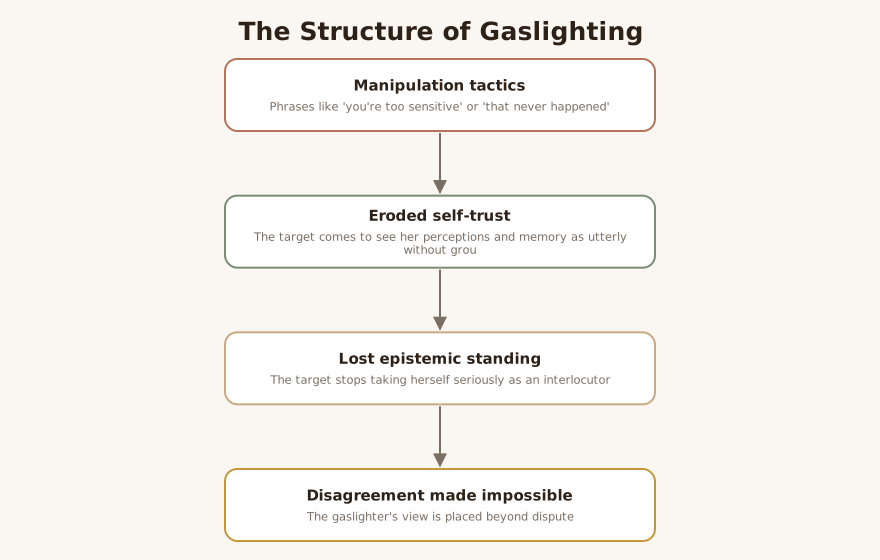
The central feature of gaslighting, on Abramson’s account, is its target: the gaslighter tries to induce in someone the sense that her reactions, perceptions, memories, or beliefs are not merely mistaken but utterly without grounds — so unfounded as to qualify as crazy 1. This distinguishes gaslighting sharply from ordinary dismissal: dismissal fails to take another seriously as an interlocutor, whereas gaslighting aims at getting the target herself to stop taking herself seriously as an interlocutor 1.
Abramson argues the gaslighter’s deepest aim is to destroy even the possibility of disagreement — to have his sense of the world not merely confirmed but placed beyond dispute, which requires the target to lose her standing to issue challenges at all 1. The canonical phrases — “you’re too sensitive,” “you’re imagining things,” “that never happened,” “don’t be paranoid,” “I was just joking” — are not primarily claims of epistemic authority but demands that the target see things the gaslighter’s way 1.
Spear adds the epistemic structure: gaslighting creates a peer disagreement in which what the two parties dispute is the victim’s own epistemic standing — whether she can be trusted as a knower and reasoner at all 2. This is what makes the harm self-amplifying: once a person doubts her own competence, any attempt to trust her own judgment is itself suspect, so the doubt validates itself in a vicious cycle 2. The damage is to epistemic self-trust — trust in oneself as a knower 2.
Three features recur: gaslighting almost always unfolds across many incidents over long stretches of time; it frequently involves multiple parties cooperating; and it frequently isolates the target 1. It is also frequently — though not necessarily — sexist, often arising in response to a woman’s protest against discriminatory conduct and leaning on her internalized sexist norms 1.
Interventions & Techniques
There is no “gaslighting technique” for a clinician to apply; the construct names a harm, so the clinical work targets the harm’s effects LLM. The throughline of intervention is helping the client rebuild epistemic and emotional self-trust that the gaslighting was designed to dismantle 2.
Practical clinical moves drawn from the construct and from recovery guidance include: validation and reality-anchoring, in which the clinician helps the client re-establish confidence in her own perceptions and instincts 5; psychoeducation that names the dynamic, since putting a precise concept to the experience counters the hermeneutical gap in which a person cannot articulate what is happening to her 25; focusing on actions over words, encouraging the client to weigh observable behavior against contradictory verbal reassurance 5; and rebuilding the support network, because isolation is a core mechanism and outside corroboration restores the missing source of disagreement that gaslighting works to eliminate 15. Newport’s recovery guidance also advises clients to avoid trying to win logical arguments with a gaslighter, since the interaction is structured to be unwinnable 5.
LLM-generated illustrative example (not a guideline): A clinician working with a client who keeps prefacing every account with “maybe I’m overreacting” might gently track that phrase across sessions, then name it: “I notice you check whether you’re allowed to trust your own read before you tell me what happened.” Surfacing the pattern is itself reparative LLM.
Because gaslighting frequently co-occurs with intimate partner violence and coercive control, safety assessment is not optional 56. The clinician’s stance matters: Dorpat’s caution is that directive, authority-heavy clinical postures can inadvertently replicate the dynamic, so an egalitarian, collaborative stance is protective 6.
Evidence Base
Honesty about maturity requires a distinction the colloquial usage blurs. The construct is established — it has sustained, rigorous treatment in philosophy and sociology (Abramson, Spear, Sweet, Stern) and broad cultural recognition 126. The epistemic dimensions specifically — peer disagreement, self-trust, and epistemic injustice — have received serious scholarly development 2. What is not established is a treatment-outcome literature: there are no validated, gaslighting-specific therapy protocols with trial evidence, and clinicians necessarily borrow from trauma, abuse-recovery, and self-esteem work LLM.
The empirical psychological base is thin and young. The strongest recent data point is a single small cross-sectional study of 177 Italian emerging adults (ages 19–26) who had experienced gaslighting in romantic relationships 4. Notably, that study examined personality correlates of gaslighting perpetration, mapping dysfunctional traits — separation insecurity, irresponsibility, distractibility, manipulativeness, and intimacy avoidance — onto Stern’s three gaslighting types, rather than testing any treatment 4. It should be read as preliminary and not generalized beyond its sample LLM. Clinicians should treat the construct as conceptually robust but the clinical-science scaffolding as still forming LLM.
Populations & Indications
Gaslighting is most studied in emerging adults navigating romantic relationships, the population sampled in the leading empirical work 4. It is disproportionately experienced by women, who are more frequently targets, and is frequently entangled with intimate partner violence — one figure cited in clinical explainer material reports that 74% of female domestic-violence victims also experienced gaslighting 15. Abramson’s analysis stresses that members of marginalized or lower-status groups are common targets, particularly when they protest discriminatory treatment, and gaslighting can be racialized as well as gendered 16.
Indications for attending to gaslighting in clinical work include presentations of pervasive self-doubt, a client who repeatedly questions whether her own memory or perception can be trusted, chronic anxiety or depression tied to a specific relationship or workplace, and a sense of having lost the ability to think clearly or “even know what one thinks” 15. Workplace and institutional contexts — minimized harassment complaints met with “don’t be so sensitive, you’re overreacting” — are recognized arenas, not only intimate relationships 6.
Problems-for-Work
The construct points to a cluster of concrete problems-for-work LLM:
- Eroded epistemic self-trust — the client cannot rely on her own judgment, memory, or perceptions, the signature injury of gaslighting 2. Application: track and gently challenge automatic self-invalidation; build a log of corroborated perceptions to rebuild evidence of her own reliability LLM.
- Chronic self-doubt and indecision — difficulty making decisions and a reflex to defer to others’ accounts of her experience 5. Application: graded autonomy practice, starting with low-stakes choices the client commits to without external validation LLM.
- Anxiety and depression tied to the relationship or setting 5. Application: standard symptom-focused work, with the relational context kept in view LLM.
- Low self-esteem and lost sense of self 15. Application: values clarification and identity work to recover a deliberative standpoint the gaslighting eroded 1.
- Social isolation 15. Application: deliberate reconnection with corroborating others, since outside perspective is structurally protective 1.
Contraindications, Cautions & Cultural Humility
The largest caution is over-application. Mental-health experts and journalists have flagged that “gaslighting” has become a buzzword often misapplied to ordinary disagreement or conflict, which dilutes its usefulness and can make the genuine abuse pattern harder to name 6. Robin Stern explicitly warns that someone being merely insistent or wrong is not thereby gaslighting 6. Gaslighting is a pattern over time, typically involving the deliberate destabilization of another’s reality, not a single instance of someone disagreeing with or misremembering an event 16.
Clinically, this matters in two directions LLM. First, validating a client’s experience does not require the clinician to adjudicate and label a third party a “gaslighter,” which the clinician cannot verify and which can entrench an adversarial frame LLM. Second, the clinician must guard against the reverse error: dismissing a client’s report of gaslighting can itself replicate the testimonial injustice — the credibility deficit — at the heart of the harm 2. Cultural humility is essential because gaslighting frequently exploits sexist, racist, or otherwise prejudicial norms, and what reads as “overreacting” to one observer may be an accurate read of real discrimination 16. Where the gaslighter holds structural power over the client, individual therapy alone may be insufficient and safety, advocacy, or systemic intervention may be needed 6.
Treatment-Plan Suggestions & SMART Objectives
| Goal | SMART objective (example) | Mechanism |
|---|---|---|
| Restore epistemic self-trust | Within 8 weeks, client identifies and logs 3 perceptions per week she later corroborates, reducing self-invalidating statements in session by half | Rebuilds trust in oneself as a knower 2 |
| Reduce chronic self-doubt | Within 6 weeks, client makes 2 low-stakes decisions weekly without seeking external validation | Counters self-undermining doubt cycle 2 |
| Name and understand the dynamic | By session 4, client can describe the pattern she experienced using accurate concepts in her own words | Closes the hermeneutical gap 25 |
| Lower relationship-linked anxiety | Within 10 weeks, client reports a measurable drop on a standardized anxiety measure | Symptom relief and stabilization 5 |
| Rebuild support network | Within 8 weeks, client re-establishes contact with 2 trusted supports and shares her experience with one | Restores corroboration and counters isolation 15 |
| Strengthen sense of self | Within 12 weeks, client articulates 3 core values and one decision aligned to them | Recovers a deliberative standpoint 1 |
| Establish safety (where indicated) | At intake and monthly, client completes a collaborative safety review with an updated plan | Addresses co-occurring coercive control 56 |
Common Misconceptions
“Any time someone disagrees with me, it’s gaslighting.” Disagreement, insistence, or being wrong are not gaslighting; the construct requires a pattern aimed at destabilizing another’s grip on reality 16. “Gaslighting is always conscious and calculated.” Unlike the film villain, real-world gaslighters often are not consciously trying to drive the target crazy and often lack a clear end-goal 1. “Gaslighting is just lying.” It is not reducible to a lie; its aim is to remove the target’s standing to disagree, not merely to deceive about a fact 1. “It’s a one-time event.” It is characteristically a long-running pattern, often involving multiple people and isolation 1. “If you’re smart, you’re immune.” Abramson’s examples include accomplished academics and executives; success and intelligence do not confer protection 1.
Training & Certification
There is no certification in “gaslighting treatment,” and clinicians should be wary of any program claiming otherwise LLM. Because the relevant clinical competencies live in adjacent domains, the appropriate training is in trauma-informed care, intimate partner violence and coercive control, and the broader literature on emotional and psychological abuse 56. Familiarity with the primary conceptual sources — Abramson’s philosophical account and Spear’s epistemic analysis — equips clinicians to recognize the harm precisely and avoid both over- and under-labeling 12. Stern’s clinical writing offers an accessible practitioner-facing typology 6.
Key Terms
- Gaslighting — a pattern of emotional and epistemic manipulation that induces in a target the sense that her perceptions, memories, or beliefs are utterly without grounds 1.
- Epistemic self-trust — a person’s trust in herself as a knower and reasoner, the faculty gaslighting is designed to erode 2.
- Epistemic injustice — wrong done to someone specifically in her capacity as a knower; gaslighting connects to it via testimonial injustice (a credibility deficit) and hermeneutical injustice (lacking the concepts to interpret one’s own experience) 2.
- Peer disagreement — in gaslighting, a dispute in which the very thing contested is the victim’s own epistemic standing 2.
- Coercive control — a pattern of domination in intimate relationships with which gaslighting frequently co-occurs 6.
Resources & Further Reading
▶ Watch — a video introduction to this concept:
- Abramson, K. (2014). Turning Up the Lights on Gaslighting — Philosophical Perspectives
- Spear, A. D. (2019). Epistemic dimensions of gaslighting — Inquiry
- Abramson, K. (2024). On Gaslighting — Princeton University Press (reviewed in Ethics)
- Gaslighting Exposure During Emerging Adulthood: Personality Traits and Vulnerability Paths — PMC
- What Is Gaslighting? 10 Signs & How to Get Help — Newport Institute
- Gaslighting — Wikipedia
Reflective / Supervision Questions
- When a client describes being told she is “too sensitive” or “imagining things,” how do I validate her experience without prematurely labeling an absent third party? LLM
- Am I attending to the pattern and its effect on the client’s self-trust, rather than litigating individual incidents I cannot verify? LLM
- Where might my own clinical posture — being directive or authority-heavy — risk replicating the very dynamic the client is recovering from? LLM
- How am I distinguishing genuine gaslighting from ordinary relational conflict, and am I at risk of either over- or under-naming it? LLM
- For this client, have I adequately assessed co-occurring coercive control or intimate partner violence and the need for safety planning? LLM
- How do the client’s social location and any prejudicial norms in her environment shape what is happening, and am I holding that with cultural humility? LLM